Displaying items by tag: Michael Ripper
Reptile, The
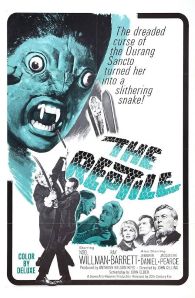
THE REPTILE
UK, 1966, 90 minutes, Colour.
Noel Willman, Jennifer Daniel, Ray Barrett, Jacqueline Pearce, Michael Ripper, John Laurie, Marne Maitland, Charles Lloyd Pack, George Woodbridge.
Directed by John Gilling.
A film from Hammer studios in the middle of the 1960s, after establishing a reputation with the horror films of Dracula and Frankenstein. They became more elaborate in the 1960s, more violence, sexuality – and an increase both ingredients in the late 1960s into the 1970s.
In comparison, this film is very mild, some violence, but an atmosphere of menace and mystery, some attacks, a sinister, vast reptile, victims, a mysterious doctor of theology who has been exploring mythologies in Borneo, his sinister Malay servant. By contrast, there is a former Grenadier Guard retiring with his wife to the country home of his brother who has been killed by the mysterious reptile.
Australian Ray Barrett plays the central character, moving back to Australia and films in the 1980s. Noel Willman creates an atmosphere as the mysterious doctor. Martin Maitland is suitably sinister as the Malay servant. And Michael Ripper, who has a record of appearing in more horror and hammer films than any other actor, has a more sympathetic role as the innkeeper.
Memories of Hammer films.
- Hammer film of the mid-1960s? Horror? Menace?
- The setting, the British countryside, ordinary homes, the mansions, laboratories and basements, the local pub, the cemetery? Atmosphere? The musical score?
- The title, the mythologies, from Malaya and Borneo, serpents, individuals, murderous power, control?
- The opening, Charles Spalding, pursued, killed? Dr Franklin and his presence? The Malay present? The puncture in the neck, the skin?
- The village, the men in the pub, Tom and is running the pub, his navy background, wary, friendly to Harry and to Valerie? His suspicions, coming to the assistance of the couple?
- In the cemetery, of the burial, the Vicar and his business like praying and departing? The later visit to the cemetery, digging up mad Peter’s body, digging up Charles Spalding? Harry and Tom working together?
- Harry and Valerie, war service, inheriting, the solicitor, the train to the village, no one to make them, Harry going to the pub, the men all walking out? Tom offering the drink? Going to the house, settling in?
- The encounter with Dr Franklin, Dr of theology, his background, travels, his daughter, his problems with her, refusing to help Mad Peter, the invitation to the meal, punishment of his daughter, the Malaise serving, the discussions?
- The daughter, suddenly arriving, her charming presence, the flowers, her sudden departure, the menace of The Malay? Her father in control? The revelation of what happened, her being possessed, becoming the reptile? The need for her to be released?
- Harry, the puncture, his escape? Tom helping? Recuperation? Valerie going to the house, looking for the daughter? The encounter with Dr Franklin, locked in the room, the basement of the Serpent, the revelations?
- Harry and Tom to the rescue, the confrontation between Dr Franks in the Malay, the Malay and his death? Tom and Harry, breaking into the house, Dr Franklin’s death?
- The resolution of the mystery, hope for the future?
Revenge of Frankenstein, The
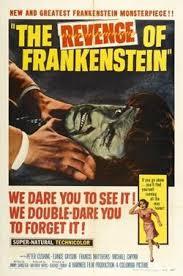
THE REVENGE OF FRANKENSTEIN
UK, 1958, 90 minutes, Colour.
Peter Cushing, Francis Matthews, Eunice Gayson, Michael Gwynn, Lionel Jeffries, Charles Lloyd Pack, George Woodbridge, Michael Ripper.
Directed by Terrence Fisher.
Mary Shelley must be amazed at the vast number of Frankenstein films. And they continue.
However, in the mid-1950s, Hammer Studios began a series of horror films based on classics, especially Frankenstein and Bram Stoker’s Dracula. The first was The Curse of Frankenstein, featuring Peter Cushing as the Baron. While there were some of the horror tropes, especially the end, the film was really made as drama, well cast, well acted, dramatising the elements of Mary Shelley’s perspective but, going beyond it, Frankenstein and the consequences of his actions.
Then, almost immediately, this sequel. And the same comment about drama and the horror tropes. Now, Frankenstein is about to be executed for his experiments, a scene at the gallows, struggle – and, his friends helping him, substituting the assistant priest in the coffin.
The bulk of the film has Frankenstein in the city, calling himself Dr Stein, treating all the fashionable inhabitants who flock to him, but also working in the poor ward. The local Council of doctors are not impressed – except for the young one, played by Francis Matthews, who knows who Dr Stein is and wants to learn from him, collaborating in a reworking of constructing the body of a new creature, wanting to transfer the brain of the crippled Karl who works in the laboratory.
So, the emphasis on drama, Peter Cushing full of dignity, clearly articulate, arrogant in his self-confidence, and the eager young assistant, details of the poor ward, the experiment, and, as expected, some dire consequences.
Six years later, there was a third Peter Cushing/Frankenstein film, Evil of Frankenstein.
- The second in the Hammer Studios trilogy of Frankenstein? The original curse of Frankenstein, the next film, Evil of Frankenstein? The continuation of the story beyond Mary Shelley?
- Hammer Studios, the 1950s, taking up the classic horror stories, emphasising the drama and the characters rather than the horror aspects? Keeping the horror aspects until the end?
- The situation, Frankenstein and his experiments, the arrest, condemnation to death, the opening and the gallows, Frankenstein being led to the gallows, the priest, Karl in attendance, the executioners? The focus on the gallows, the sounds of the commotion, Frankenstein’s escape?
- The cemetery, the two men, the salary, digging up graves, drinking, the lazy digger eating, opening the coffin, finding the priest? Frankenstein, the digger and his heart attack?
- Three years later, Dr Victor Stein in Carlsbruck, his practice, the waiting room full, the women, his work in the poor ward, the many men, his work, charity work?
- The town council of doctors, the meeting, denunciations of Dr Stein? The decision about the delegation, their arrival, being made to wait with the poor patients?
- Peter Cushing as Dr Frankenstein, presence, dignified manner, speaking clearly, dignity? Yet the ruthlessness of his experiments? Commitment to science? His treatment of the committee?
- Dr Kleve, age, earnest, his practice, education, devotion to science, his request of Frankenstein, and the interrogation, Frankenstain showing him the laboratories, the extent of his experiments, fire, the eyes moving, the hand reaching out, the brain? The revelation of the perfect body made up of parts? (And the parts coming from the men in the ward?)
- Karl, hunches, his brain, working with the doctor, the promise of a new body with his own brain?
- Margaret, her position in the town, wanting to work? Dr Stein’s reaction, ousting her? Her later visits? The worker, his confiding the truth in her? Her meeting Karl? Later encounter with Karl, trying to help, his reliance on her? At the musical recital, Karl coming, the crisis?
- The worker in the ward, his relationship with Dr Stein, helping, yet shrewd, having the key, informing Margaret?
- The experiment, taking Karl’s brain, into the new body? Karl’s body – and his discovering it, burning it? Karl, the new awareness, appearance, being bound, the treatment by the doctors? His dissatisfaction, the background of the chimpanzee and Otto and the exchange of brain?
- Dr Kleve and his helping Karl, Margaret, loosening the bonds, his getting away? The clear brain, the monstrous brain, his attack on the young girl? The police stopping the doctors, the interrogation?
- The doctors, going to the recital, the search for Karl, his going berserk?
- The reaction of the doctors, the condemnation of Dr Stein, exposing him and his response? His going into the ward, the condemnation, despising him, the attack, his death, Dr Kleve and the rescue?
- Dr Stein and his recovery, London, Dr Frank and a new life?
Story of Gilbert and Sullivan, The
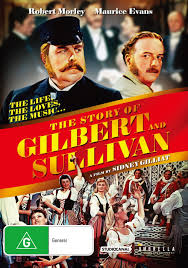
THE STORY OF GILBERT AND SULLIVAN
UK, 1953, 109 minutes, Colour.
Robert Morley, Maurice Evans, Eileen Herlieh, Peter Finch, Martyn Green, Dina Sheridan, Isabel Dean, Wilfred Hyde-White, Muriel Aked, Michael Ripper.
Directed by Sidney Gilliat.
From a 21st-century perspective, it is surprising to discover that this film was not successful at the box office on its release in the early 1950s. Yet, the operettas of Gilbert and Sullivan continued to be very, very popular.
This is quite a lavish production, sets and costumes, theatrical design, English society in the latter part of the 19th century.
For audiences interested in Gilbert and Sullivan, Robert Morley gives a variation on his enjoyably pompous performances as the self-confident Gilbert, master of words and witty lines, yet dreading opening nights, avoiding them, returning to hear applause and go happily on stage. Maurice Evans is Sullivan, classical composer of oratorios, eventually an Opera, teaming up with Gilbert, challenged by friends and a potential fiancee played by Dinah Sheridan, to honour his talent for high art. However, he is carried away and has composed many wonderful melodies, songs to accompany Gilbert’s words, but the music having a stand alone and entertainment value.
The screenplay follows the various productions, reproducing scenes from some of the most famous and well known. The film starts with an extensive excerpt from Trial By Jury, then moves into such favourites as HMS Pinafore, the Pirates of Penzance, The Mikado, The Gondoliers and Yeomen of the Guard, Iolanthe. And references to other creations like The Sorcerer.
Peter Finch appears as D’Oyley Carte, the manager of the company, the builder of the Savoy Theatre, involved in the building of the Opera house. There are quite a number of British character actors in support, Eileen Herlie as Helen D’Oyley Carte, a successful business partner with her husband, Isabel Dean as Gilbert’s wife and an entertaining cameo from Wilfred Hyde-who is to who enjoys the performances unlike his snobbish daughter.
There is some pathos at the end after Gilbert and Sullivan’s falling out, not speaking for some years, a possible reconciliation, the turn-of-the-century performance of the Yeomen of the Guard and the news of Sullivan’s death. Gilbert continued and was knighted by Queen Victoria, the culmination of the film.
In 1999, writer-director, Mike Leigh, did more than justice to Gilbert and Sullivan and their creations in his lavish and engaging film, Topsy Turvey.
