Displaying items by tag: Tony Britton
Suspect/ The Risk
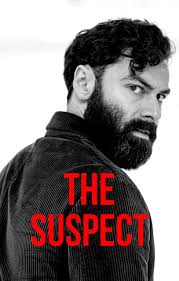
SUSPECT/THE RISK
UK, 1960, 81 minutes, Black-and-white.
Tony Britton, Virginia Maskell, Peter Cushing, Ian Bannen, Raymond Huntley, Thorley Walters, Donald Pleasence, Spike Milligan, Kenneth Griffith, Robert Bruce, Anthony Booth, Basil Dignam, Sam Kydd, Murray Melvin.
Directed by John Boulting, Roy Boulting.
British Nigel Balchin wrote thrillers and wrote the screenplay for this brief film. The Boulting brothers had a strong presence in British cinema from the 1940s. Their intention with this film was to enhance the quality of British supporting features, small budget, filmed in 17 days, brief running time. Critics at the time were harsh on the film, American critics more sympathetic.
With the writing, the Boulting Brothers’ direction, and the considerable quality of the supporting cast, serious issues of scientific experimentation, wartime security, espionage and stealing secrets, there is quite a lot of material in 81 minutes. The locations are confined, home, laboratory, restaurants, espionage. With the supporting cast so articulate, the dialogue makes a strong impression.
In fact, Tony Britton and Virginia Maskell as the stars are not as strong as the character actors, some veterans like Raymond Huntley as the politician, Peter Cushing as the professor, Kenneth Griffith as his assistant, Donald Pleasence, always sinister, Thorley Walters as an eccentric investigator, Ian Bannen as the cynical war invalid, all bring quality to the performances. And there are quite a number of interesting cameos from actors like Spike Milligan, serious and comic at the end, Sam Kydd, Murray Melvin, Anthony Booth.
A curiosity item of the period but an interesting and entertaining 80 minutes.
- Small-budget supporting feature, a television filming style?
- Nigel Balchin thriller, his writing the screenplay, nation, science, politics, espionage, romance? Popular ingredients?
- The cast, the range of British character actors, the focus on dialogue, interactions, intensity, themes articulated in the British style?
- The focus on scientific experimentation, the professor, years of experience, Peter Cushing’s style, the staff, summoned by the government, closure on his experiments, his reactions, the staff, the situation with the dedication of the statue? His discovery of Marriott with the documents, his reaction, the police, covering for Marriott?
- Bob Marriott and Lucy Byrne, colleagues, skills, the date to the pictures, Lucy and her reticence, the situation with Alan, losing his arms in war, her caring for him, past fiancee, his manner, cynical? His meeting with Marriott, charming exterior, undermining him, the connection with Brown, the situation about the government ban, the documents, saving the experiments, handing them over?
- Lucy, her work, with Marriott, the attraction, her helping with Alan, the meeting with Brown, her ignorance, her being interrogated?
- Marriott, his character, dedicated to his work, the experiment with his arm, his reaction to the ban, led on by Alan, the meeting with Brown, taking the documents, the meeting with the spies?
- Dr Shole, collaboration, personality, Mr Prince making the contact, with his assistant, the suspicions, summoning him, the information? The scenes with the professor?
- Mr Prince, his role in the investigations, sometimes doddery, absent-minded, his office a mess, the meetings with Dr Shole, relying on his assistant, the interviews, his hypotheses?
- Brown, his background, sinister, Donald Pleasence’s style, his eyes, the arrangements, the meeting, being the documents, the person in charge, the police, gunshots?
- The politics, the Minister, calling in the professor, good mannered but intense, forbidding the experiments, danger for enemies getting hold of them, the dedication of the statue, his assistant, his visit to the laboratory in meeting the staff?
- The assistant at the office, Spike Milligan, more serious – the final comedy with the monkey?
- British politics in world politics in the late 1950s? This film seen in retrospect?
Loser Takes All
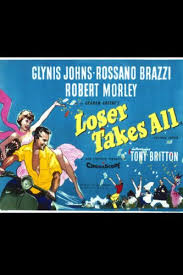
LOSER TAKES ALL
UK, 1956, 88 minutes, Colour.
Glynis Johns, Rossano Brazzi, Robert Morley, Tony Britton, Felix Aylmer, Joyce Carey, Geoffrey Keane, Albert Lieven, A.E.Matthews.
Directed by Ken Annakin.
In retrospect, the biggest surprise about this film is that it is based on a Graham Greene short story and the screenplay has, in fact, been written by Graham Greene. (He is said not to have been so happy about the finished product – he would not have given it a good review in the days when he was a film reviewer!).
It has lavish treatment, a strong cast and Monte Carlo locations and fashions. But, it has a brief running time, a type of British screwball comedy. Characters are not meant to be consistent and, here, they definitely are not. And they are slightly sketched overall.
Rossano Brazzi is a meticulous accountant, wins the favour of businessmen, Robert Morley, who invites him to Monte Carlo for a holiday where he is to marry his fiancee, Glynis Johns. The wealthy man does not turn up and the couple have very limited resources. However, they do get married. A stranger offers a gambling system to the husband and he becomes absorbed, winning a great deal of money and enabling the couple to live something of a high life. But, the husband gets so involved that he neglects his wife and she has caught the eye of a British gambler, played by Tony Britton in his first film.
The plotline is somewhat predictable but the credibility of the characters following the predictable plotline is very doubtful. Perhaps the actors are doing their best, but Rossano Brazzi becomes too serious and avaricious and Glynis Johns more flighty.
There are several character actors in support, a surprising turn by Joyce Carey who has her own schemes in the casinos, Geoffrey Keane as a manager being very superior to the customers.
The film is an early film directed by Ken Annakin who was to have a successful career in the UK and the US, dramas as well is blockbusters.
