Displaying items by tag: Peter Malone's Movie Reviews
Apex/ 2026
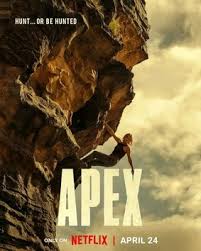
APEX
US/Iceland/Australia, 2026, 95 minutes, Colour.
Charlize Theron, Taron Egerton, Eric Bana, Matt Whelan, Aaron Pedersen, Rob Carlton.
Directed by Baltasar Kormakur.
Extreme sports, survival movies…
The prologue to this film, highly exciting to watch, is also misleading. The setting is Norway, mountains with sheer faces, climbers and their daring, achievements as well as disasters. With a title like apex, and the mountain climbing opening, we might settle in for high peaks and dangers.
But, no. There is a tragedy for the central character, Sasha, tough and played by Charlize Theron, travels to Australia, where her partner in Norway mountaineering came from.
And, as noted that the beginning of this review, extreme sports and survival. Sasha goes out into the Australian bush, actually filmed near enough to Sydney in the Megalong Valley, ready for any challenging activity. But, anyone who has seen films like Wolf Creek, knows that there are always threats, madness and dangerous characters out there in the bush.
And the screenplay cleverly misleads us (now something of a spoiler alert). Sasha encounters an ugly macho lot in the local pub and we expect them to be menacing to the lone female when she travels out alone. Fortunately, perhaps, she is helped out by a nice young man, Ben, played by Taryn Egerton (who, after all, had played Elton John but was also in The King’s Men). He suggests a more interesting location where Sasha can camp and experience Australia.
Bad move. Actually, the men are there, but what follows is a cat and mouse pursuit and escape. Probably best to say immediately that Ben, despite the naivete and sometimes charm, is bonkers. Mad religious ideas, pathological, weird sense of some kind of destiny. And he is persistent in pursuit, knows the bush, can anticipate Sasha’s moves, continually threatening, umpteen crises.
But, with memories of Deliverance and films like The River Wild, Sasha has the opportunity to use her ingenuity as well as her survival skills, hiding in the bush, climbing, in the water, canoeing, rapids and waterfall…
Of course, it is no spoiler, to know that Sasha will win out at the end. The point of the entertainment is to watch the pursuit, the tactics, Ben and his eerie presence and menace, Sasha and her survival abilities. (And, for international good measure, the director is Balthasar Kormakur from Iceland.)
- The title, a survival thriller?
- The opening, the Norwegian mountains, dangers, darkness, the climbers, the accident, death, survival? Setting the tone?
- Sasha, in herself, age, physical abilities, climbing, daring, the dangers, relationship with Tommy, the discussions, the accident, his death, the repercussions? His being Australian?
- Her travel to Australia, memories of Tommy? Adventure? The travel, the encounters with Australians along the way, the pub, the group of men, drinking, taunts, her response?
- Her meeting Ben, his quiet manner, his suggestions, where to travel?
- The Australian scenery, the Megalong Valley, the bush, rivers, mountains? The musical score?
- Sasha, confident, driving, going to the rendezvous, the encounter with the men, apprehensive, their behaviour, her manner?
- The encounter with Ben, his recommendations? Her exploring, the invasion of the tent, the thing is disappearing, her blaming the men?
- The change in the theme, Ben, emerging as sinister, former charm, his ideas, mania, religious, pathologies?
- The film as the pursuit, Sasha and her energy, fleeing, hiding, injuries, the river, can do, the waterfall, climbing?
- Then, his persistence, mania, ingenuity, resources, deceiving Sasha, the pursuit, entrapment?
- The buildup to the final confrontation, Sasha and her resources and wits, men, presumption, injury, death?
- Audiences and their response to the characters, the action – and, maybe, wariness of the Australian bush!
Tuesday
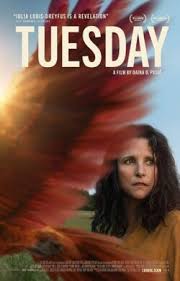
TUESDAY
US, 2023, 110 minutes, Colour.
Julia Louis-Dreyfus, Lola Petticrew, Leah Harvey, voice of: Arinze Kene.
Directed by Daina Oniunas-Pusic.
Tuesday is a strange blend of fantasy and realism. The title is the name of a teenager, ill, confined to her room. She is played by Lola Petticrew. Her mother, Julia Louis Dreyfus, is an American, living in London, devoted to her daughter, but also feeling the burden of the constant care.
The opening sequences suggest cosmic aspects, fantasy, the universe, earth… And, this is further confirmed with the appearance of mysterious bird, a Macaw, who communicates with Tuesday. Much of the drama is the meeting between the bird and the girl, the bird transforming from ugliness to beauty, often increasing in size, conversation and challenge. And, the question as to whether all this is happening in Tuesday’s imagination.
Eventually, the mother is drawn into the scenario, the encounter with the bird, hostility, violence, and a sequence on the beach, the bird taking possession of the mother.
The audience has to have a willing suspension of disbelief to appreciate what is going on in reality or in the imagination, themes of illness, mortality, survival, mother-daughter relationships, and the final challenge to the mother and taking some control of her future.
- The title, Tuesday and her illness, her death day?
- The London setting, the home, the interiors, upstairs and downstairs, the streets, the parks, the shops? Atmosphere? Musical score?
- The scenario, realistic, Tuesday and her illness, terminal, her age, care, at home, her relationship with her mother, tensions?
- The fantasy, the opening, the universe, Earth, cosmic themes? Peoples’ eyes? Deaths? The macaw, eye, plumage, black, later washing, colourful plumage? Increases and decreases in size? Intelligence, voice, memory?
- The symbol of death? Universal and cosmic? Issues of life after death? Beliefs? Tuesday and her beliefs? Her mother, tested, beliefs or not? The religious symbols, the Gospel symbols? The mythologies?
- Tuesday, her personality, looked after by nurse Billie, Billie and her concern, in and out? Involved in the finale?
- Tuesday and the bird, enlarging, diminishing, playful, serious, conversations, something of an alter ego for Tuesday? The themes of death?
- The mother, selling the furniture, selling the rats, the bargaining, at home, in the park, sketching, phone calls, sleeping, the appearance of the deathly characters, chasing her, in the tree…?
- The mother, the confrontation with the bird, aggressive, beating it, burning it, devouring it? Its increasing in her? Her birdlike behaviour? Changes in size?
- The absence of the bird, the range and deaths? Tuesday, diminishing health, wanting to go upstairs, the sale of the furniture? Memories of the past? Tensions with her mother, her mother behaving in the birdlike way?
- At the beach, her mother and the bird, setting the bird free?
- Mother and daughter, quiet, at home, Tuesday dying?
- Her mother’s despair, wanting to die, sitting, the bird appearing, tempting her, taunting her, not letting her die, leaving her free to live?
Headless Ghost, The
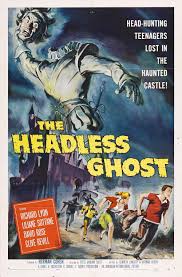
THE HEADLESS GHOST
UK, 1959, 65 minutes, Black-and-white.
Richard Lyon, Lilian Sottane, David Rose, Clive Revill, Jack Allen, Alexander Archdale.
Directed by Peter Graham Scott.
Versatility in the title! This is a small, almost negligible film. American money was put into the British production, Horrors of the Black Museum and the supporting feature was required. This film, quickly written, filmed over two weeks, then became the second half of this British/American program in cinemas.
The basic plot is rather silly, three American tourists in England, visiting a castle as tourists (one referring to castles as old stones surrounded by a ditch!). The three actors in the lead are not persuasive as performers, stilted, sometimes awkward. They do the tour, hear the stories, especially narrated by the current ancestor, looking at the portraits, deciding to hide out overnight to get information for an article.
The film comes more alive with the appearance of Clive Revill, coming down from the painting, Revill giving a class in acting, enjoying his character and the revelations. Especially about the headless ghost and the need for him to recover his head and everybody live in peace.
There is a scene of a banquet, all ghosts enjoying themselves, the headless ghost present.
Complications, the owner and his assistant hearing noises, calling the police, the three Americans discovered, the arrival of the headless ghost, recovering his head, going back into the painting…
It could be a useful exercise for aspiring directors and actors to watch the film sequence by sequence and have discussions as to how they might have filmed each sequence differently and more effectively.
Mister Ten Per Cent
MR TEN PER CENT
UK, 1967, 84 minutes, Colour.
Charlie Drake, Derek Nimmo, Wanda Ventham, John Le Mesurier, Anthony Nichols, Noel Dyson, John Laurie, George Baker, Una Stubbs.
Directed by Peter Graham Scott.
Dear oh dear!
The diminutive comedian, Charlie Drake, was very popular on British television in the 1960s. He also made four films, slight comedies, not particularly well received by critics or the public, The Cracksman being the most successful.
This, his final starring role, is for diehards only, his complete fans. Yet he continued to have a successful career on television and was appearing in supporting roles in various films for the next 30 years.
In retrospect, many audiences will find his performance highly contrived, often very silly, trying too hard.
The film opens with his explaining Swan Lake while working on a building site, pairing with a policeman. Later, with an eye on the portrait of Oscar Wilde, he fancies himself as a dramatist, posh accent though mixing vocabulary, and later will fancy himself advising on how he his play should be produced. But, the play is highly dramatic, comes across as farcical. The unscrupulous entrepreneur, played by John Le Mesurier, decides to profit by investing in a commercial failure. His chosen director is played by Derek Nimmo, himself a very eccentric performer (most successful in television’s Oh Brother).
The would-be playwright interferes with the rehearsals, is taken in by a financier, does not realise how he is being used – but, eventually, ousted from the play, tries to sabotage the London performance, audiences flocking to see and laugh at the farcical play.
Only Charlie Drake’s fans will be persuaded by the last sequence, where the audience realises that he is sincere, hopeful, and applauds him.
The same theme was far more successfully handled by expert Mel Brooks the following year with his comedy classic, The Producers, with Zero Mostel and Gene Wilder (as well as the musical version in the 2000s with Nathan Lane and Matthew Broderick) – and we all remember the extraordinary song and dance routine, Springtime with Hitler!
We Joined the Navy

WE JOINED THE NAVY
UK, 1962, 104 minutes, Colour.
Kenneth More, Lloyd Nolan, Joan O’Brien, Jeremy Lloyd, Dinsdale Landon, Derek Fowlds, Mischa Auer, John Le Mesurier, Lally Bowers, Laurence Naismith, Andrew Cruickshank, Walter Fitzgerald, Ronald Leigh-Hunt, Esma Cannon, Kenneth Griffith, Warren Mitchell, Graham Crowden, Cameos: Michael Bentine, Rodney Bewes, Dirk Bogarde, Sid James.
Directed by Wendy Toye.
British comedy at the beginning of the 1960s, broadening of humour, the period of the beginning of the Carry on series… And, glancing at the cast list, quite a number of names of popular British actors of the time and those who were emerging (and a couple of celebrity cameos, particularly Dirk Bogarde as Dr Simon Sparrow, his character in the Doctor series, where he played with Kenneth More). Sid James does a chuckling variation on his Carry on characters. Notable supporting performances from Kenneth Griffith and, especially, Warren Mitchell. And for fans of veteran actress, Esma Cannon, this is one that definitely should be seen, decked out in official royalty costume and with an accent!
There are several Americans in the cast because of the screenplay, notably Lloyd Nolan, first appearing in American films in the mid-1930s, a 50 years career, his last film Woody Allen’s Hannah and her Sisters.
Much of the screenplay now seems very corny. And there is a great deal of farce. There are interview sequences for inept candidates for the Navy. There are plenty of training sequences. But, with Kenneth More as the central character, always speaking out and being transferred to other jobs, put in command of three potential officers, Jeremy Lloyd (actor but later writer of such television series as Are You Being Served and ‘Ullo ‘Ullo), Dinsdale Landon and Derek Fowlds who came to prominence as the meek public servant in Yes, Minister and Yes, Prime Minister.
There are sequences in the Riviera, clashes between the Brits and the Yanks, more farce about romance for Kenneth More.
Finally, an intervention in an African revolution, Kenneth Griffiths, often so meek on screen, as a yelling and ranting revolutionary, veteran Mischa Auer as two characters leading the country, extremely eccentric.
This comedy has, some humour, but a great deal of silliness as well.
Femme plus riche du Monde, La/ The Richest Woman in the World
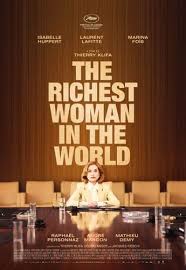
LA FEMME LA PLUS RICHE DU MONDE/ THE RICHEST WOMAN IN THE WORLD
France, 2025, 125 minutes, Colour.
Isabelle Huppert, Laurent Lafitte, Marina Fois, Raphael Personnaz, André Marcon, Mathieu Demy. Paul Beaurepaire.
Directed by Thierry Klifa.
While this is a fictional story, raising of all kinds of emotions as the audience watches some erratic behaviour among the wealthy, is actually based on actual characters in a court case in the early 2000’s. The original was the French Oreol perfume family.
And, perhaps, who better to portray the richest woman in the world in the French film than Isabelle Huppert, by now one of the grandes dames of French cinema? She has a compelling presence even when she is silent or scarcely moving in a scene. Her character, Marianne, has inherited the company from her father and is absolutely devoted to his memory, wary of any threat to his reputation or to his company. She sits on the board, observes, intervenes, has her definite likes and dislikes.
And, into her life comes a rather sweeping character, a photographer, Pierre-Alain, played with zest and gusto by Laurent Lafitte, employed to photograph Marianne for a popular magazine and for company promotion, her being entranced by his lively personality, charm, playing up to her. At first, the audience may be charmed, but then we see his rather narcissistic personality, his ability to exploit situations, his lack of inhibitions in most situations, at times taking over the household, bringing in his partner, the dismay of the rest of the family, a very serious-minded group.
And the enchanted and infatuated Marianne, so much money to disperse and whims, finances him, Gallery and exhibitions, his flattering her, helping her to enjoy life, and making his own ever more comfortable.
There are some background themes of French politics, the film set in the era of President Mitterrand and, the world of business, political ambition and advancement, but also themes harking back to World War II, the Vichy government, the treatment of the Jews, the Resistance.
Eventually, Marianne’s husband dying, her stepdaughter and family deciding to take action, life becomes very unpleasant, lawyers, courts, deals, Pierre-Alain wary, struggling to protect his benefits and to avoid prison. As always Marianne, lost from the world that had been charming and extravagant now experiences her inability to cope with the real world.
There has always been a fascination with lives of the rich and famous, the glitter of wealth, responsibility and irresponsibility, but there is always a price to pay in emotions, relationships, and the question of what is really a worthwhile life.
- Derived from the actual Bettencourt court case, the Oreal family heritage? The basic characters, enhanced with fiction?
- The French settings, the 1980s and 1990s, the political background, President Mitterand, issues, influence, ministers? The world of finance, creativity, board meetings? Wealthy living? The background musical score, atmosphere of the period?
- The title, the focus on Marianne, Isabelle Huppert and her screen presence, her career, the marriage, her older husband, his career, her stepdaughter and attitudes, her husband and son? The family situation with wealth, Marianne and her admiration for her father, his inventiveness, setting up the business, her inheriting the wealth, lavish, bar mitzvah gifts, her behaviour, regal manner?
- The family, her husband, age, political influence, the company, wealth, the revelation of his background, siding with the Vichy government, young, changing his attitude, becoming a partisan? The media raising the issues, the effect on him? His death, the funeral and Marianne’s behaviour?
- The Jewish background, ceremonies, memories of the wall, anti-Semitism. Frederique and her family, ritual celebrations? The role of the board, Marianne and lack of confidence in Jean-Marc?
- Frederique, encouraging Marianne for the photographs, the publicity, the magazines? Hiring Pierre-Alain, his reputation and talents?
- Pierre-Alain, personality, overwhelming, talent as a photographer, his style, control, Marianne and her response, Frederique wary? The sessions, the clothes, his advice, joking, boisterous, taking control?
- Marianne, her response, enlivened, fascinated, amused, attracted, the money granted, his studio? Continually involved, relying on him, his coming to the house, jokes, entertaining her, the reaction of the rest of the family?
- Pierre-Alain, gay, the presence of Raphael, the relationship, Raphael and his observations? The freedom of the house, Marianne accepting them?
- The effect on Marianne, continually extravagant, Pierre-Alain’s exhibitions, the media, criticism? His shrewdness, manipulating Marianne, the freedom of the house, jokes, the pool, meals…?
- Marianne’s husband, his reaction, tolerance? His death? Frederique and her reaction, the finance, the relationship between the two women?
- The consultation of the lawyers, the meetings with lawyers, the advice, finance and advisers? Marianne, bewilderment, personal events, Frederique, the confrontations? With Jean-Marc, the board, Charles and his being on the board, intervening?
- Pierre-Alain, the reactions, his fighting against the impositions, Raphael and his support?
- The court cases, the hearings, the situation, the money, extravagance, arrangements and deals, signing documents, Marianne and Pierre-Alain, issues of jail?
- The aftermath, Marianne by herself, alienation from Frederique and her family, left alone, to die?
Dracula: A Love Story
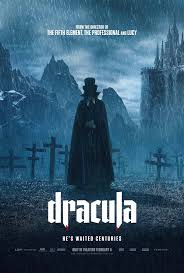
DRACULA: A LOVE TALE
France, 2025, 129 minutes, Colour.
Caleb Landry Jones, Christoph Waltz, Zoe Bleu, Guillaume de Tonquedec, Matilda De Angelis, Ewens Abid.
Directed by Luc Besson.
One wonders about the fascination with the Dracula story, vampires, in the first part of the 2020s, comedy in Redfield, the sombre Voyage of the Demeter, the elaborate Nosferatu. And now, long time action director, Luc Besson, has scripted and directed another variation on Bram Stoker’s novel.
Many of us have a great admiration for Francis Ford Coppola’s 1992, Bram Stoker’s Dracula, with Gary Oldman. It had an extraordinary eight minute opening, Vlad, summoned to war, farewelling his wife, stylised battle sequences, false reporting of his death, his wife killing herself and Vlad defying the priest who refuses her a Christian burial. And Besson has decided to open his film with a rather longer prologue in this vein, fierce battles, death of Vlad’s wife, his defiance of a Cardinal, loss of faith and condemned never to die.
That setting is 1480 then the screenplay moves forward 400 years, Dracula, with Caleb Landry Jones, who had appeared in the Australian film, the trim, is an ageing recluse in his castle, visited by Jonathan Harker, from Paris, to consult him about one of his properties. This gives the opportunity for Dracula to tell Jonathan his story and for it to be visualised, quite lavishly, as a younger Dracula searches incessantly over the world for his wife, infecting a whole range of women (and some pageantry with groups of women and stylised courtly dancing) to help him in his search.
1889, introducing the vampire hunter, not Van Helsing this time, but a priest, devoted to science, determined to find Dracula and put an end to him. And, who better to portray this kind of priest than Christopher Waltz (Oscars for Best Supporting Actor into Tarantino films, Inglourious Basterds and Django Unchained ?
Dracula then travels to Paris, and, with the help of one of his infected women, encounters Mina, sees her as the reincarnation of his wife, determined to take possession of her and return to Romania. Which means then that the priest has to pursue him back to his castle, buildup to a confrontation – and, surprisingly, a rather large scale military assault on the Castle, cannon firing, soldiers invading (and repelled by a team of gargoyles come alive!).
But, the horror emphasis, in the Christopher Lee vein, is not the style of this film. The screenplay has some sympathy for Dracula and his loss, his continued defiance, which means that the ultimate confrontation between him and the priest is not just that the vampire be destroyed but that he make a selfless gesture, enabling Mina to live her life and for him then to be willing to die for her sake, a true love for her. Not exactly what we might have been expecting from a Dracula film.
There are the elements of Bram Stoker’s novel, a strong influence from Francis Ford Coppola’s film, perhaps rather low-key in comparison, but interesting in its sympathetic portrait of the vampire and the priestly variation on Van Helsing.
- The long tradition of Dracula films? Different perspectives? The basis in Bram Stoker’s novel? The influence of Francis Ford Coppola? The several Dracula films in the first half of the 2020s?
- The film as a Luc Besson, fantasy, action?
- The settings, 1480, warfare? The castle? The 1890s, Romania, isolation, the castle and interiors? Paris, society, the hospital? The musical score?
- The prologue, Vlad, Prince, the marriage to Elisabeta, going to war, leading his troops, his guard, the battlers? The pursuit by the enemy? Elisabeta, the carriage, escaping, court, her death?
- Vlad, with the Cardinal, the interactions, his anger, the death of his wife, defying God, defying the church, killing the Cardinal, the image of Christ and the blood? His punishment, not to die? And his perpetual search for his wife?
- The 1890s, Paris, Jonathan Harker, his travels, the property in Paris, the appearance of Dracula, 400 years of age, the welcome, the meal, the cross given by the coach, Dracula drawing it into the fire? Warning Johnthan to stay in his room, Jonathan wandering, the discovery of the coffin? The appearance of the live gargoyles? Johnathan hanging, the blood, Dracula and drinking the blood of the rat? Jonathan his pleading, for Dracula to tell his story?
- The story, his quest for his wife, the decision to infect the women, to have assistants to search for his wife, the stylised dancing, through the centuries, costumes and style, the range of women, attracted, his infecting them? Failure to find this a better way?
- Living in his castle, his personality, the decision to go to Paris, Maria and her fiance, the wedding, her collapse, infected, in the hospital? The doctor, treating her? Her friendship with Nina?
- The central role of the priest, the van Helsing substitute? His talk about the church, science, superstitions? Talking about his order? Independent? His appearance, cassock, hat, his bag? Coming to the hospital, the discussions with the doctor, analysing Maria? Defying her? His researches, the visit to Maria’s room, with her fiance? The book, the image of Dracula? His wife?
- Maria, friendship with Nina, her escape from the hospital, dressed, going out, the celebration, the fair, the rides and excitement, the encounter with Dracula, his charm, the dancing, the effect on Mina?
- Dracula, charming, the love story rather than the threats and horror? His hold on Mina, taking her home, the coffin?
- Jonathan’s escape, with Maria’s fiance, with the doctor, with the priest? The travel into the castle?
- The Castle, the gargoyles of the attack, the priest, the confrontation with Dracula, the discussion, love, immortality, the role of God, God and evil?
- The the Army, the cannon, the soldiers, the invasion, the gargoyles and the destruction?
- The final confrontation between the priest Dracula, the role of Mina, as a little better, her memories, reliving the past and happiness? Pleading with Dracula? His decision, the decision to free her, to die?
- The priest, executing Dracula, the ash, the cloud flying in the sky?
- The basic Bram Stoker story but the emphasis on love story and redemption rather than horror?
Primavera
PRIMAVERA
Italy, 2025, 110 minutes, Colour.
Tecla Insolia, Michele Riondino, Fabrizio Sacchi, Andrea Pennacchi, Valentina Belle, Stefano Accorsi, Hildegard De Stefano.
Directed by Damiano Michieletto.
Over the years there have been a number of films which could be recommended especially for “music lovers”. They are stories of significant composers and musicians and one remembers the films about Mozart, Beethoven, Brahms and Schumann, Paganini… This time the musician and composer is Antonio Vivaldi. Hence the title of the film, Primavera, from his famous Four Seasons (and, a touch of the spoiler, Primavera is played only during the final credits while audiences may have been waiting to hear it throughout the film!).
The setting is Venice, quite lavishly reproduced, the city, the churches, the canals, all that we might expect from Venice. And, rather lavish period sets and decor, an era of wigs and elaborate costumes for both men and women. This is a film which is often striking to the eye.
While Vivaldi, Michele Riondino, ordained a priest but with some delicate health issues and dispensed from public ministry, he is recognised as a composer, he spends a great deal of his time at the Venetian orphanage, a haven for baby girls whose mothers were unmarried, growing up rather cloistered, but well educated, especially in music, instruments, singing. And at the centre of these young women is Cecilia (a traditional name associated with music because of the story of St Cecilia), and, in many ways, she is the centre of the film, a vivid performance by Tecla Insolia. Vivaldi is in charge of music, rehearses the young women, the orphanage providing recitals in their church, but the singers and musicians high up above the altar, hidden from the audience. The conductor-composer is a centre of attention.
Which means that there is double drama. Vivaldi, having opportunity for his composing, his work with the students, not having a great salary, but the audience having the opportunity to hear a great number of his works, performances for the gentry, for the visiting King of Denmark, a lot of pomp and circumstance, but always the music.
The main drama is that of Lucia, expected to marry, her intended coming back from the war, a medalled hero, but viciously violent towards her when she contrives to escape from the arranged marriage. She is a talented violin player, promoted and encouraged by Vivaldi, but certainly a victim of the secondary place of women in Venetian society, forced to take stances, make decisions, but no prospect of success in the public eye.
So, for audiences not familiar with Vivaldi, an opportunity to make his acquaintance, listen to some of his music, enjoy Primavera during the final credits – but, also, a dramatic reminder of the status in society, the dominant male, the subservient female trapped, assertive but victimised.
- Audience knowledge of Vivaldi, his life, his music, his compositions?
- Early 18th century Venice, the views, the buildings, churches, the canals, costumes and decor? Re-creation of the period?
- The role of the music, the accompanying score and its style, early 18th century baroque, Vivaldi’s compositions, choir, operatic, sonatas? And, during the final credits, Primavera?
- The Orphanage, the young women, leading to the orphanage as babies, unmarried mothers, the information in the books, the torn cards, mother is possibly returning to claim their daughters? Social status of unmarried mothers?
- The opening, the cat giving birth, the prioress coming, taking the kittens, drowning them? Symbolic for the young women?
- The young women, the focus on Cecilia, age, longing for her mother, preoccupied, the secret writing of letters to her, her talent for sitting? Relationship with the other young women? With the prioress? With the governor?
- The other women, Laura, their dress, their not being seen, in the church above and the group, prospects for their lives, suitors coming, dowries, leaving and giving up their music?
- The education of the young women, music, reading, culture, in 18th-century Italy? The instruments, performance, the orchestra, the city, the performances, the rivalries amongst the churches for visitors? Issues of finance for the orphanages? Benefactors?
- Don Giulio, with the choir, his attitude, his being dismissed? The discussions for a successor, Vivaldi in the past, his growing reputation, hiring him again?
- Vivaldi, age, priest, his health, not celebrating Mass in public, his music, performances, growing reputation? Payment? His interaction with the young women, sitting, listening, his own work, impressed by Cecilia, her playing the violin, her talent, wanting her as first violinist?
- The routines of life in the orphanage, the young women together, the meals, the domination of the prioress, the governor, said at meals?
- The episode of the young woman, the dowry, the suitor, the wedding down, the celebration?
- The mother coming with the card, Cecilia assuming it was her mother, coming, embracing her? And the dismay with the young woman who was the daughter?
- Cecilia, the research in the library, the information about her? And longing for her mother?
- The greengrocer, the girls looking at him, his dying Cecilia? The later revelation of her pregnancy, his being the father?
- The success of Cecilia, her performance, practice, the instruments?
- The war, coming to an end, the return of Sabfermo and claiming Cecilia as his bride? His manner, the achievement, metal, the music, the Gov?
- Vivaldi, wanting Cecilia to stay, his former requests for new instruments, being ignored, now using them against him? The discovery that Cecilia was pregnant, suggesting that people would think about it responsible?
- So family, his arrival, claiming Cecilia, the discovery that she was pregnant, his response, breaking her wrist and fingers, cruelty?
- The effect on Cecilia, the buildup to the concert, Laura retaining her role, Cecilia asking to watch, her leaving, the prioress helping her escape, her leaving the orphanage, crossing the bridge, to freedom?
- The further information about Vivaldi, his compositions, performances, success, the later discovery of his manuscripts?
Sasquatch Sunset
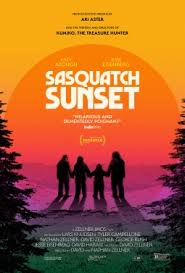
SASQUATCH SUNSET
US, 2024, 88 minutes, Colour.
Jesse Eisenberg, Riley Keough, Christophe Zajac-Denek.
Directed by David Zellner.
The strong suggestion for those intending to watch Sasquatch Sunset, some research into the history of this Bigfoot people, from Northern California, the discovery of the footprint, speculation about the people and their way of life.
Even if an audience is interested in Bigfoot, this speculative film, showing the life of a family over the four seasons of the year, mother, father, child, Alpha Male – and the birth of a baby, may not hold the interest for 88 minutes. On the other hand, audiences wondering about the Bigfoot, the film offers an opportunity to look, ponder, think about human evolution, primitive humans and their look, communication, behaviour, survival. Because of the lack of dialogue, primitive sounds and grunts, the body language of the actors within the Bigfoot costume is, is the main way of communication.
It is a surprise to find Jesse Eisenberg Riley Keough as the mother and father Bigfoot.
The location photography, mountains, landscapes, seasonal changes and the musical score have some quality.
Then, half way through, the Bigfoot family discovers a red cross marking on a tree, then a huge marked log in the river, and some tragedy as the father experimenting with it in the water is drawn under it and drowns.
There are other discoveries for the Bigfoot, a camping ground including a tape recorder playing music, then continuing further, walking and the mother giving birth to a child (there is quite some emphasis on all major bodily functions and behaviour throughout), they come to a set of buildings with the sign that this is the Bigfoot Museum, the giant statue outside, and the family finally presented in tableau in front of the buildings.
Primitive humans, evolution, and a tableau in the present.
God Help the Girl
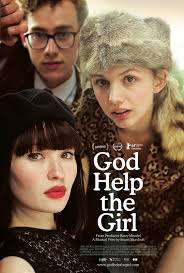
GOD HELP THE GIRL
UK, 2014, 111 minutes, Colour.
Emily Browning, Ollie Alexander, Hannah Murray, Pierre Boulanger.
Directed by Stuart Murdoch.
This is a film for a younger target audience, teens and young adults – not that older adults can’t enjoy it. However, the focus is on teenagers, on music, creating music, performing music, but with a background of personal problems.
The film is a musical, many many songs, some singing performance in clubs, rehearsals, but others were into the action, especially by the central character, Australian Emily Browning, travelling, at home…
She is Eve, in an institution because of anorexia, leaves, becomes involved with an earnest young musician, Ollie Alexander, who introduces her to a guitar student, Hannah Murray, and together, they work on creating songs, tape, hoping for some kind of recognition.
Complications, especially with another singer with commercial contacts, Pierre Boulanger, who has a relationship with Eve, but does not promote her music.
The a range of emotional complications, drugs, musical aspirations and hope, enthusiasms, disappointments, perseverance.
There was already an album in 2009, God Help the Girl, from the director, Stuart Murdoch, who created the band Belle and Sebastian.
