Displaying items by tag: Primavera movie
Primavera
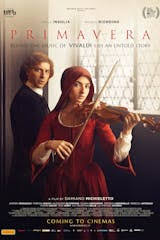
PRIMAVERA
Italy, 2025, 110 minutes, Colour.
Tecla Insolia, Michele Riondino, Fabrizio Sacchi, Andrea Pennacchi, Valentina Belle, Stefano Accorsi, Hildegard De Stefano.
Directed by Damiano Michieletto.
Over the years there have been a number of films which could be recommended especially for “music lovers”. They are stories of significant composers and musicians and one remembers the films about Mozart, Beethoven, Brahms and Schumann, Paganini… This time the musician and composer is Antonio Vivaldi. Hence the title of the film, Primavera, from his famous Four Seasons (and, a touch of the spoiler, Primavera is played only during the final credits while audiences may have been waiting to hear it throughout the film!).
The setting is Venice, quite lavishly reproduced, the city, the churches, the canals, all that we might expect from Venice. And, rather lavish period sets and decor, an era of wigs and elaborate costumes for both men and women. This is a film which is often striking to the eye.
While Vivaldi, Michele Riondino, ordained a priest but with some delicate health issues and dispensed from public ministry, he is recognised as a composer, he spends a great deal of his time at the Venetian orphanage, a haven for baby girls whose mothers were unmarried, growing up rather cloistered, but well educated, especially in music, instruments, singing. And at the centre of these young women is Cecilia (a traditional name associated with music because of the story of St Cecilia), and, in many ways, she is the centre of the film, a vivid performance by Tecla Insolia. Vivaldi is in charge of music, rehearses the young women, the orphanage providing recitals in their church, but the singers and musicians high up above the altar, hidden from the audience. The conductor-composer is a centre of attention.
Which means that there is double drama. Vivaldi, having opportunity for his composing, his work with the students, not having a great salary, but the audience having the opportunity to hear a great number of his works, performances for the gentry, for the visiting King of Denmark, a lot of pomp and circumstance, but always the music.
The main drama is that of Lucia, expected to marry, her intended coming back from the war, a medalled hero, but viciously violent towards her when she contrives to escape from the arranged marriage. She is a talented violin player, promoted and encouraged by Vivaldi, but certainly a victim of the secondary place of women in Venetian society, forced to take stances, make decisions, but no prospect of success in the public eye.
So, for audiences not familiar with Vivaldi, an opportunity to make his acquaintance, listen to some of his music, enjoy Primavera during the final credits – but, also, a dramatic reminder of the status in society, the dominant male, the subservient female trapped, assertive but victimised.
- Audience knowledge of Vivaldi, his life, his music, his compositions?
- Early 18th century Venice, the views, the buildings, churches, the canals, costumes and decor? Re-creation of the period?
- The role of the music, the accompanying score and its style, early 18th century baroque, Vivaldi’s compositions, choir, operatic, sonatas? And, during the final credits, Primavera?
- The Orphanage, the young women, leading to the orphanage as babies, unmarried mothers, the information in the books, the torn cards, mother is possibly returning to claim their daughters? Social status of unmarried mothers?
- The opening, the cat giving birth, the prioress coming, taking the kittens, drowning them? Symbolic for the young women?
- The young women, the focus on Cecilia, age, longing for her mother, preoccupied, the secret writing of letters to her, her talent for sitting? Relationship with the other young women? With the prioress? With the governor?
- The other women, Laura, their dress, their not being seen, in the church above and the group, prospects for their lives, suitors coming, dowries, leaving and giving up their music?
- The education of the young women, music, reading, culture, in 18th-century Italy? The instruments, performance, the orchestra, the city, the performances, the rivalries amongst the churches for visitors? Issues of finance for the orphanages? Benefactors?
- Don Giulio, with the choir, his attitude, his being dismissed? The discussions for a successor, Vivaldi in the past, his growing reputation, hiring him again?
- Vivaldi, age, priest, his health, not celebrating Mass in public, his music, performances, growing reputation? Payment? His interaction with the young women, sitting, listening, his own work, impressed by Cecilia, her playing the violin, her talent, wanting her as first violinist?
- The routines of life in the orphanage, the young women together, the meals, the domination of the prioress, the governor, said at meals?
- The episode of the young woman, the dowry, the suitor, the wedding down, the celebration?
- The mother coming with the card, Cecilia assuming it was her mother, coming, embracing her? And the dismay with the young woman who was the daughter?
- Cecilia, the research in the library, the information about her? And longing for her mother?
- The greengrocer, the girls looking at him, his dying Cecilia? The later revelation of her pregnancy, his being the father?
- The success of Cecilia, her performance, practice, the instruments?
- The war, coming to an end, the return of Sabfermo and claiming Cecilia as his bride? His manner, the achievement, metal, the music, the Gov?
- Vivaldi, wanting Cecilia to stay, his former requests for new instruments, being ignored, now using them against him? The discovery that Cecilia was pregnant, suggesting that people would think about it responsible?
- So family, his arrival, claiming Cecilia, the discovery that she was pregnant, his response, breaking her wrist and fingers, cruelty?
- The effect on Cecilia, the buildup to the concert, Laura retaining her role, Cecilia asking to watch, her leaving, the prioress helping her escape, her leaving the orphanage, crossing the bridge, to freedom?
- The further information about Vivaldi, his compositions, performances, success, the later discovery of his manuscripts?
