Displaying items by tag: Jesse Eisenberg
Minions & Monsters

MINIONS & MONSTERS
US, 2026, 90 minutes, Colour.
Voices of: Pierre Coffin, Alison Janney, Christophe Waltz, Zoe Deutch, Bobby Moynihan, Jeff Bridges, Jesse Eisenberg, Phil LaMarr, George Lucas, Trey Parker.
Directed by Pierre Coffin, Patrick Delage.
We have been living with the Minions, enjoying their mischievous company, since Despicable Me in 2010. With their size, yellow colour, one or two eyes, their distinctive language and chatter, their willingness to serve diabolical masters like Gru, audiences now have expectations of them, enjoying when they turn up in the movies (and in a range of commercials!).
The children’s audience will enjoy all the shenanigans here, the origin story of this group of minions, setting sail, settling in different lands, the various tyrants that they served, and, of all things, their finally arriving in the American West, pursuing a bandit and a train, discovering that it actually was being filmed. They are in Hollywood in the 1920s.
For the adult audience, especially movie fans, there are all kinds of references to early movies, experiments by Edward Muybridge, the Lumiere Bros, George Belies and the moon, and jokes recreating Charlie Chaplin in the cogs sequence in Modern Times, Harold Lloyd on his ladder in Safety Last, and glimpses of Buster Keaton, references to Citizen Kane, Hooray for Hollywood, We’re in the Money… and, the contemporary Hollywood Museum which has George Lucas himself. an exhibit in a glass case, asking to be released from his contract! In fact, this Minions film is really an homage to the movies and, especially to Hollywood in the 1920s, styles of filmmaking, the studio moguls, the directors, camerawork, introduction of sound, awards.
The main characters are the artistic James and his affable friend, Henry, and the good-natured Ed. In Hollywood, they do get a chance to make a movie – but, with the book of spells and their reading them out loud, strange creatures emerge. The culmination of the film is a kind of big gooey Godzilla equivalent, destroying LA in its path. Which means some kind of heroics, the massing together of the minions (which often happens throughout the film from early rowing in prehistoric boats to crowding on vehicles in Los Angeles and, incidentally, breaking the Hollywoodland sign).
A glance at the cast list shows that there is very strong voice talent.
All’s well that ends well, everybody happy with James’s movie, screening at the Chinese theatre, applause, awards, and, at last during the final credits, some upstaging of Gru. So, where to next! And soon!!
Sasquatch Sunset
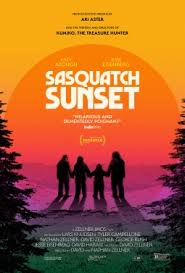
SASQUATCH SUNSET
US, 2024, 88 minutes, Colour.
Jesse Eisenberg, Riley Keough, Christophe Zajac-Denek.
Directed by David Zellner.
The strong suggestion for those intending to watch Sasquatch Sunset, some research into the history of this Bigfoot people, from Northern California, the discovery of the footprint, speculation about the people and their way of life.
Even if an audience is interested in Bigfoot, this speculative film, showing the life of a family over the four seasons of the year, mother, father, child, Alpha Male – and the birth of a baby, may not hold the interest for 88 minutes. On the other hand, audiences wondering about the Bigfoot, the film offers an opportunity to look, ponder, think about human evolution, primitive humans and their look, communication, behaviour, survival. Because of the lack of dialogue, primitive sounds and grunts, the body language of the actors within the Bigfoot costume is, is the main way of communication.
It is a surprise to find Jesse Eisenberg Riley Keough as the mother and father Bigfoot.
The location photography, mountains, landscapes, seasonal changes and the musical score have some quality.
Then, half way through, the Bigfoot family discovers a red cross marking on a tree, then a huge marked log in the river, and some tragedy as the father experimenting with it in the water is drawn under it and drowns.
There are other discoveries for the Bigfoot, a camping ground including a tape recorder playing music, then continuing further, walking and the mother giving birth to a child (there is quite some emphasis on all major bodily functions and behaviour throughout), they come to a set of buildings with the sign that this is the Bigfoot Museum, the giant statue outside, and the family finally presented in tableau in front of the buildings.
Primitive humans, evolution, and a tableau in the present.
Now You See Me, Now You Don't

NOW YOU SEE ME, NOW YOU DON’T
US, 2025, 113 minutes, Colour.
Jesse Eisenberg, Woody Harrelson, Dave Franco, Isla Fisher, Justice Smith, Dominic Sessa, Ariana Greenblatt, Rosamund Pike, Morgan Freeman, Lizzy Caplan.
Directed by Ruben Fleischer.
Surprisingly, given the popularity of the original, this third part of the series comes 12 years after the first Now You See Me. Then there was the sequel two years later. And it has taken most nine years for this episode.
Fans will probably agree that it has been well worth the wait!
The attraction of the film is that it is about magicians and magic, sleight of hand, I deceptions, creation of illusions. And, with 21st-century special effects, there is no lack of magical turns, creative use of special effects, a whole range of deceptions.
The original team is back again, led by Jesse Eisenberg, so often primly determined. Woody Harrelson is also back with his laid-back charm. And, Dave Franco as well as either Fisher. And Lizzy Caplan, who joined the team and the second film, also returns. And, once again, the power behind the team, Morgan Freeman in his mid-80s.
While it is important to highlight the familiar team, the film actually opens with some very clever impersonations by a new young team, Justice Smith, Dominic Sessa, Ariana Greenblatt. They make quite an impression – but they also do impersonations of the original team, taking on the teams mantle of seeking justice, exposing criminals, taking them down. So we are treated to quite a spectacular performance, and we are deceived into thinking that it is the main team in action. But…
Jesse Eisenberg’s Atlas is not impressed and seeks out the young group. But, it emerges that some kind of overseer has sent cards to assemble everyone. They gather, and find that the villain of the piece is relic, daughter of a South African mogul, about to option a diamond. And, surprisingly, she is played by Rosamund Pike, rather relishing the role of a kind of evil femme fatale.
If this sounds intriguing, the two teams combining to confront Veronica, to steal the diamond, to pretend to destroy it, to try to trap her in her guilt, travelling around the world, from the Emirates to France, then audiences will be delighted to be intrigued.
While there are quite a number of spectacular magic episodes, we enjoy meeting the old team again but are trying to make out whether we like the new team, especially Dominic Sessa who is full of himself often able to justify his self-satisfaction with his skills. Justice Smith plays the very nice member of the group and plays a very interesting role in the final solution.
So, we know what to expect, more or less, and there is more rather than less. Already the rumour is around that there will be a fourth episode. And, in light of having two teams now, why not?
- The popularity of the first two films? The nine year gap until this one? The plausible explanations?
- The popularity of the cast, the characters? The appeal of magic? The portrayal of various magic tricks? Special effects and the lighting? Has part of the plot? The musical score?
- The past history, of the Four Horsemen, their performances, their skills, the team work, interactions? The role of Thaddeus and control? The presence of Dylan Roads? The breaking up of the group? Reassembling? The addition of Lula?
- The opening, the reassembling of the Horsemen, their personalities, on stage, the arrogance of the young man and his friends? The introduce introduction to Bosco, Charlie and June? Their jobs, behind-the-scenes, June at the bar, pickpocket? Confrontation with the young men, Merrick and his capacity for putting people to sleep, Bosco on stage, the sleep, the rest of the Horsemen and the confrontations, the money and the denunciation, the angry young man? And the Horsemen disappearing?
- The three friends, personalities, age, their talents? The appearance of Daniel, the confrontation? The magic, their show, using lanterns and projections, their achievement? Daniel’s criticism? Charlie, agreeable, June and friendly, Bosco and his surly attitudes and behaviour?
- Daniel and his proposition, joining with the trio, the master command, The I, planting cards for the others, their all coming together? Building on the old personalities and past stories? Daniel and his touch of arrogance, Merrick and his humour, heavily returning to the group, Jack and his genial presence? Exercising all their magic abilities?
- The situation, Veronica Vandeberg, her story, her father, the diamonds, his wife and her suicide, the housekeeper and his relationship with her, the quizzing his fortune to Veronica? The scenes in South Africa, Veronica and her personality, dominating, her bodyguard, her entourage, the plan to option the diamond, her shady contacts? Her performance to the public?
- The group, working together, the plan? The social, her wanting the photographs? Hiring the photographer with his arrogant manner? The magic tricks of the group, unit and her pickpocketing ability getting all kinds of passes, Charlie and his blending into the work background, Bosco impersonating the photographer? The photo shoot, and wanting to photograph the diamond with Veronica? The revelation of Charlie and the alternating of the cases, in and her manipulation, Bosco and the photographs, the presence of Daniel and his confrontation, the tricks with the opening of the glass case, the diamond, the substitute, smashing it? Confusion?
- The personalities of the group, their working together?
- The mystery of the cards, Charlie and the cards, the map, finding the location, the vast house, the encounter with Thaddeus? Memories of the past, his encouraging, the mystery of who had organised the action? The attack, the siege of the house, Thaddeus and his dying, his encouraging the group? The mystery of the house, revolving rooms, the confusion of the police attack? Finding Veronica’s client list? The arrest of gives one, in the police station?
- The police station, Veronica confronting Merit, his abilities with her, telling her story, the truth about her mother, contriving her death? The father’s relationship with the mistress, her death? The arrival of Muller, her collaboration with Merit, the escape for June? Merit imprisoned, and the possibility of a bargain, the diamond for The Release of Merit?
- The Emirates, the location for the driving exhibition, Veronica and the vehicles, the drivers? The arrival of the group, infiltration, Bosco and impersonations and driving the vehicle, Charlie and June in the background, the tasks?
- The driving and the display? Bosco the crashes? The rounding up of the four Horsemen, trapped underground? Veronica and her superiority, the sand coming into the basement? The discussions, using their wits, the idea of water and the sand, Jack and his using the wrench, the water, heavily using her ring to break the glass, there are escape?
- Veronica, the mysterious caller, challenge her about the diamond?
- The escape, Veronica and the confrontation by her brother, the revelation of Charlie, the revelation of the truth, his being her brother, the role of their father, his mother and her death?
- Veronica on stage, trapped, the revealing of the true story, the diamond?
- Charlie revealed as Peter, his intentions, his masterminding the whole plot, his time in the US, studying magic, befriending Moscow Bosco in June, planting the cards to entice the horsemen to help him with his plan to unmask Veronica?
- Peter, his decision, distributing his wealth to those in need? Fulfilling the aims for the Horsemen and justice?
- The postscript, the intervention of Dylan Rhoades, the achievement – and the future?
Real Pain, A
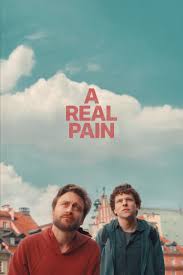
A REAL PAIN
US/Poland, 2024, 90 minutes, Colour.
Jesse Eisenberg, Kieran Culkin, Will Sharpe, Jennifer Grey, Daniel Oreskes, Liza Sadovy, Kurt Egyiawan.
Directed by Jesse Eisenberg.
90 minutes well spent.
An acknowledgement of actor/writer/director, Jesse Eisenberg. for morethan 20 years he has been on screen, his appearance is usually a variation on his vintage performance, more than a touch the edgy. (And he did play Mark Zuckerberg in The Social Contract, 2012.) So, it is surprising to find that he has written and directed A Real Pain, a role for himself which is familiar, but creating a very different character for Kieran Culkin (winning the Golden Globe for his performance).
We are invited to spend the 90 minutes in their company. Ben (Culkin) is already at the airport, lounging around, watching people. His cousin, David (Eisenberg), with a wife and daughter at home , is hurrying to the airport, compulsively phoning his cousin Ben (and later David refers to OCD). And, why are they at the airport? They are cousins, same age, longtime friends, but mostly different in personalities. And their Jewish grandmother, who had experienced the Holocaust, has died but has left them enough money to travel to her native Poland to visit her old home.
They have booked into a tour, led by sympathetic British scholar (Will Sharpe) along with a middle-aged Jewish couple who have prospered in the US, Marcia (Jennifer Grey) a divorcee and, surprisingly, Eloge, a refugee from the Rwandan genocide, welcomed by a Jewish community in Canada and converting.
Throughout the film great deal of Chopin’s music.
On the one hand, there is quite a lot of comedy, sometimes black comedy, always focused on Ben, enormous mood swings, trying to be friendly but ready to turn on people, speak frankly, practically no filters. And, of course, David is always trying to make excuses for him until, finally, in a long close-up on Jesse Eisenberg’s face, as he explains his cousin to the other members of the group.
And, there are some tense moments for the group as well as for the audience, Ben suddenly erupting as they travel first class through Poland and he vigorously reminds them of the train voyages of their ancestors to the camps. And, at an old grave, he turns on the guide, criticising him for his facts and statistics instead of talking in humane terms about the stories. But, at a monument in Warsaw, he rushes off to pose like an attacking soldier, David to take photos, and urging the rest of the group to come and pose with him – which they do.
And, so, on the other hand, there is the very serious issues of memories of the Holocaust, truly moving scene as they visit the city of Lublin and its memories, a visit to the nearby concentration camp of Majdanek, brief indications, silence, for them to remember as well as for us to contemplate. And, finally, quite a visit to their grandmother’s house, an edgy encounter with the neighbours. But, mission accomplished.
The other serious theme of the film is that of the personality of Ben, the fact that he can be a real pain but also the personal, mental struggles.
A significant film for later generations of Jewish people remembering their ancestors in the Holocaust. A significant invitation to empathy for wider audiences.
- The ambiguity of the title? Ben as an annoying real pain? The contrast with the pilgrimage to Poland, memories of the Holocaust in the camps, memories of the real pain, reliving the pain? And pain in the present, Ben as a tormented character?
- Jesse Eisenberg, writing, directing, performing, a variation on his vintage nervy performances, yet his sensitivity to Ben’s character, to the visit to Poland, to the Holocaust memories? His delineation of characters, the situations, torments, serious, humorous?
- The wide range of Chopin’s music as accompaniment?
- The New York opening and closing? David and his world, his mentioning OCD, late, incessant phone calls, reaction at the airport, to Ben, to boarding, the flight? His preoccupation, phone calls, his wife, the young son and his ability to give statistics about buildings? The role of the grandmother, David and Ben’s relationship with her, her leaving the money for them to visit Poland, to see her house? David and his organisation?
- The introduction to Ben, Kieran Culkin’s performance, many hours at the airport, interested in the range of people, his background, the grandmother and his devotion, living in his parent’s basement, the later revelation of the attempted suicide, his mental condition? Erratic, the range of moods, mood swings? The bond with David despite their different worlds, approaches to life?
- The bond between the two, conversations, humour, David’s exasperation, Ben’s outbursts, David’s apologies, sharing the room, the meals, the episode of David sleeping in the train and their having to return, Ben’s confrontational actions, the effect of the trip, the grandmother, memories of the past?
- The tour, the hotel accommodation, the group travelling together, James, British background, not Jewish, five years of leading the groups, his commentary, friendliness? Accosted by Ben about Germany facts and figures, wanting empathy, James saying this was a first-time he had been given feedback, his serious considerations? His sensitivity during the visit to the concentration camp? His consideration of the other members of the group?
- The members of the group, Marcia, age, the divorce, the absent children, ladies who lunch? Friendly, her response to Ben? The middle-aged couple, ordinary Americans, their Jewish heritage, memories, prosperity in America? Eloge and his story, victim of the Rwandan genocide, Canada escape, welcomed by the Jewish community, conversion, valuing the Sabbath and the time for recollection, a gentleman, sincerity? The interactions as a group, attention to James, the various reactions to Ben?
- The various episodes and their impact, comic touches, serious reflections, memories of the past? The monument in Warsaw, larger than life, the resistance, Ben and his posing, persuading all the others to come and pose, David having to take all the photos? The effect on each member of the group from this activity? The issue of travelling in first-class, Ben and his outburst, the memories of the past, the different reactions from the group, not worrying, justified, David and his upset, Ben walking out, David going to find him? The consequence, David going to sleep, passing the station, Ben’s declaration that David was so peaceful and could not wake him up? Getting out of the train, going the opposite direction, eluding the land and the tickets, reuniting with the group?
- The city of Lublin and, the views, the memories, the literary tradition? The gate monument, going to the oldest grave in Poland, James and his commentary, Ben’s outbursts, against statistics, wanting the human element, James taken aback, the reaction of the group, David and embarrassment? The solution of putting the stones and tribute on the headstone? And James’s later comments and reactions?
- The meal, the talk, Ben and his outburst, leaving, David and his monologue, the close-up on his face, his sharing the story of Ben’s attempted suicide, his own emotions, the contrast with their ways of life, yet their bonding and the experience of the trip?
- Preparation for the travel to the concentration camp, the vast Polish countryside, yet the camps are near to the centre of the Lublin? The treatment of the episode, the silencing of the music, the brief commentary an indication of the buildings, the entry, standing, the blue stains on the gas chamber walls, the opens, the vast collection of shoes… And the audience sharing in the silence and the experience of the group?
- The parting from the group, the audience feeling that it has been part of the group on the tour? David and Ben going off on their own, coming to the town, finding their grandmother’s house, putting the stones on the doorstep, the old man on the balcony, not speaking English, the young man, their explaining what they were doing, his sympathy, suggesting the stones were dangerous for the elderly woman living there to fall, David and Ben removing them, the glimpse of the final gesture of the old man, a wave or a sign of dismissal?
- Mission accomplished, going to the airport, the flight back, Ben always able to sleep, David and his phone calls?
- The farewell at the airport, more conversation, the embrace and all that it meant after the trip and the experiences, the Heritage of the grandmother, the Jewish heritage, and David going home and reuniting with his family, and Ben’s saying at the airport, the range of different people there, the enigmatic final close-up of his face?
Wild Indian
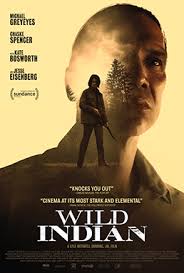
WILD INDIAN
US, 2021, 90 minutes, Colour.
Michael Greyeyes, Chaske Spencer, Jesse Eisenberg, Kate Bosworth, Phoenix Wilson, Julian Gopal, Scott Haze.
Directed by Lyle Mitchell Corbine Jr.
Wild Indian is a brief film focusing on Native Americans, a Native American writer-director, while Mitchell Corbine Jr, the two central men in the narrative, Michael Greyeyes and Chaske Spencer. There is support from white actors, Jesse Eisenberg and Kate Bosworth.
The film is in two parts. It opens with two boys, around the age of 12, at school, their families, friendships, disputes, one boy, Mak’wa, coming from a troubled family, and his friend Teddo, involved in a fatal sequence where Mak’wa shot a young boy.
The narrative then skips a generation, Mak’wa in California, calling himself Michael, wife, business success. By contrast, Teddo has been involved in petty crime, drugs, spent most of his time in jail.
The drama shows Teddo having some kind of remorse, wanting to seek out Mak’wa for some kind of resolution, Michael now resisting the situation, violent towards Teddo with some dire consequences.
While the plot is interesting in itself and the contrast between the two boys and their young lives and their success of lives, it is also interesting in the context of opportunities for Native American boys in the 1980s – and their lives and succeeding decades.
- The title? Traditional white American perspectives on Indians, wild? The condescending attitudes, prejudice?
- This film written and directed by Native American, Native American stars, the supporting white stars?
- The prologue, the old Native American, going out into the countryside, the plague? The recurring this theme at the end? Symbolic of k’wa? Symbolic of Teddh?
- 1984, the reservation, the Native American tribes, families, violence and abuse, schools, teachers, the priest, religious supervision, discussions, moral perspectives?
- The story of Mak’wa, his age, his mother giving birth when young, her neglectful attitude, his father, young, brutal? Mak’wa at school, with the priest, in class, his friendship with Teddo, attraction to the white girl, jealousy of the boy attracted to her? Sullen in his attitudes, the authorities? In the countryside with Teddo? The discussions, Teddo and his family? The gun, the shooting of the boy, Mak’wa’s reaction, Teddo’s reaction, the cover-up?
- The move to the 2010s? Audience surprise at what has happened to the two? Mak’wa, becoming Michael, in California, successful, business contacts, discussions of contracts, meetings? Office, clothes, Finance? His wife, child, the fulfilment of the successful American dream?
- Teddo, in jail, being released, drug dealing environments, the years in jail? Getting out, meeting up with his sister, trying to get a job?
- The buildup to the confrontation between the two men, Teddo, his conscience, confessing to the killing of the boy and the cover-up? Tracking down Mak’wa? Going to California, the confrontation between the two men, discussions, conscience issues? Mak’wa and his fears, violence, the gun, killing Teddo?
- The law, the police, investigations, Michael going back home, the encounter with Teddo’s sister, legal aspects, his business future, wife and child, his decisions for his future, to lose himself in this white world?
- The finale, the old man leaving civilisation? Mak’wa, his conscience, stifling his conscience, his future?
