Displaying items by tag: Philip Barantini
Enola Holmes 3

ENOLA HOLMES 3
UK, 2026, 105 minutes, Colour.
Millie Bobby Brown, Henry Cavill, Helena Bonham Carter, Billy Partridge, Himesh Patel, Sharon Duncan-Brewster, Hattie Morahan, Susan Wikoma, Joe Azzopardi.
Directed by Philip Barantini.
Enola Homes is the sister of Sherlock and Mycroft, the creation of Nancy Springer in a series of popular novels. This is the third of the books to be filmed. It presupposes most of the central characters and the cast return for this version. Millie Bobby Brown is lively and older. Henry Cavill returns as a sombre Sherlock. And, there is the creation of their mother character, a rebel, explosives, demonstrations, somewhat alienated from her family, Helena Bonham Carter enjoying the role.
The marriage is to take place in Malta, most of the action there, Malta and British occupation (and with some sequences railing against British colonialism) and some complications with the military and justice.
Enola (alone spelt backwards) the talks to camera and explains that the good film starts with a wedding – but, she hesitates, his pursued by Dr Watson with the news that Sherlock has been kidnapped. She is committed to finding her brother, using his methods to deduce what has happened to him.
She is in love with the Duke of Tewkesbury, played again by Louis Partridge. Then his mother is also abducted and there is intense deliberation to discover what has happened to Sherlock.
At the beginning, the audience has been introduced to a plot focusing on Tewkesbury, and Moriarty, now a female villain played by Sharon Duncan Brewster, pursues Sherlock and takes him.
Sherlock does leave a clue on the mirror, the name of the Afghan town,Khost. So, questions about Afghanistan, the role of Tewkesbury’s father, Afghan soldiers, payment, doubledealing, cover-ups…
Which all leads to various adventures, and Enola going into action, exposes, confrontation with Moriarty – and happy ending and the possibility for a fourth episode.
- The popularity of the series? Sherlock Holmes sister? Comparisons with Sherlock? Her skill as a detective?
- The British settings, the action taking place in Malta, the vistas of Malta, landscapes, the cities? The musical score?
- Enola, her age, from the previous films, relationship with Sherlock, comparisons, her relationship with her mother, eccentricities? Seeing her at work as a detective, using Sherlock’s methods? Her commentary throughout the film, looking to camera?
- The opening, a wedding, Tewksbury at the altar, the congregation, no bride, her decision-making, getting into the carriage, pursued, Dr Watson, the news of Sherlock’s abduction? Her becoming involved, leaving Tewksbury at the altar?
- The character of Sherlock, his reputation, his letters, logical, not emotional, the interactions with Enola, with Dr Watson, Watson reminiscing about the relationship, the Team, his diaries? Knowing in advance, the past with Moriarty, at the dinner in Malta, seeing the soldiers, pursuing him, disappearance?
- The prologue, England, Moriarty in jail, being freed, the name Tewksbury, her mission, the implication of the British officers in Malta?
- Enola, her pursuit of the soldier, his being killed, the local police, the interrogation, the British officials intervening, her freedom? Her pursuit of the woman, the warning, the woman killed? Her looking for clues after Tewksbury’s mother was kidnapped, finding the medals? Using Sherlock’s methods, reflections?
- The local revolutionary, following Enola, the confrontations and fight, his motivations, against the colonialism of the British, and seeing the colonialism in action?
- Tewksbury, the past stories, relationship with Enola, the scenes of proposal, her acceptance, the bond between them, the swimming sequence? His mother’s abduction? Working with Enola? Dr Watson and his collaboration?
- The arrival of Eudoria, her personality, and dominance, with her daughter, the wedding, her reputation explosions, collaborating with the investigation, going to the headquarters, wanting the documents, the attack on the soldier, the search, finding information about Afghanistan, the gold, the stealing? Sherlock and his clues, writing the name Khost?
- Moriarty, the past with Sherlock, vengeance, her plan, the commission from the British, her setting up all the clues, luring Enola along the way, her vengeance and killing her agents the abduction of Tewksbury’s mother, the scenes in the cell, the water, interrogation, pouring out the water?
- Tewksbury, the explanation of the cave, Enola working out where the gold was, finding it?
- The buildup to the final confrontation, her putting the gun on Moriarty, Moriarty and the explosives, the local soldiers, then Moriarty’s squad, the shootout?
- The release of the mother, the expose of the officials, the gold the betrayal, the hiding, the discovery, the exposure of the British? Tewksbury and his disappointment with his father?
- Enola, whether she should become lady Tewksbury or not, the class issues, the jokes about class, Enola and the discussions with Tewksbury, his giving up his title?
- An enjoyable Holmes adventure, Sherlock, Enola, Moriarty? And the future?
Adolescence
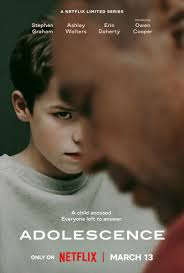
ADOLESCENCE
UK, 2025, 4x55 minutes, Colour.
Owen Cooper, Stephen Graham, Ashley Walters, Faye Marsay, Christine Tremarco, Amelie Pease, Erin Doherty, Joe Hartley.
Directed by Philip Barantini.
A television series that received immediate worldwide acclaim. It is particularly well cast in the major roles and in so many of the supporting roles, including the children at school. The screenplay has been written by veteran writer, Jack Thorne (Wonder, Radioactive, the Enola Holmes films) who was working on a new version of Golding’s Lord of the Flies at this time. He worked with Stephen Graham who brought the idea to him. The direction is by former actor, Philip Barantini, who worked with Stephen Graham in the striking film, Boiling Point, as well as the television series based on the film.
A striking aspect of the series is that each of the episodes, four, was filmed in a single take. Which gives each episode in extraordinary sense of continuity.
The idea for the series came from actor Stephen Graham, concerned about crimes committed by the young, a serious attempt to probe families, children, school and pressures, situations that lead to anger and violent crime. Each chapter provides a different perspective.
The film opens with the police, strong performance from Ashley Walters as the investigator, the police arriving, bashing their way into a house, alarming the family, arresting a 13-year-old, Jamie Miller. There has been universal acclaim for the performance, first time on screen, by Owen Cooper (who then went on to be young Heathcliff in Emerald Fennell’s version of Wuthering Heights). There is general alarm, the boy protesting that he has done nothing wrong, the upset of the family, Stephen Graham is the father, tensions, Jamie being taken to the police station, the details of classifying him, the cell, the arrival of the sympathetic legal adviser, the decision that his father would be the responsible adult to be present in all interrogations and situations. There is the fingerprinting, the taking of blood, the offer of a meal. Then there is the interrogation by the two police officers, Jamie and some questions but, on the advice of the solicitor, offering “No Comment” about the episode. The hour-long narrative is filmed in real time, the gradual revelation of the case, the death of a fellow student by stabbing in a car park at night, the protest of Jamie, the support of his father, the audience ready to take a step further.
The second episode takes place three days later, the opportunity for the police to go to the school to question various students. There are various rumours at the school, students upset. In fact, the episode shows the difficulties in contemporary schools, some students wanting to learn, other students providing all kinds of upsets and answering back to the teachers, some of the teachers effective, others exasperated by their experiences in the classroom. And, in the middle of the interrogations, the fire alarm goes off, the scene of everybody going out to the open area, the murdered girl’s best friend having a tantrum and attacking one of Jamie’s friends, her having to be counselled by one of the teachers but her angry reaction. The police interrogate Ryan, one of Jamie’s friends, the boy was attacked by the girl in the yard. Later, when he is interrogated again, he makes for a run for it, the police pursuing him and catching him, and admitting that the knife in the killing was his. The officers son is also at the school, tension between them but his explaining to his father various aspects of Instagram and online bullying, especially for teenagers and issues of celibacy, herself bullying Jamie. These discussions and the effect of photos and texting may be unfamiliar to many of the parent audiences watching the series.
The third episode takes place in real time, a psychologist coming for a second visit or talked with Jamie. It is seven months later. Erin Dougherty gives a very effective performance as the visiting psychologist and Owen Cooper shows even better his abilities as an actor, the verbal interaction between the two, the issues raised, especially about masculinity, sexuality, teenage understandings and lack of understanding, and an opportunity to see Jamie and an eruption of anger. This is a valuable hour in the understanding of a contemporary 13-year-old boy.
There is explicit reference to Andrew Tate and his large social media following, the “manosphere” and the implications of “toxic masculinity”, its being taken up by so many boys and young men, feeling oppressed, finding ways of asserting themselves, even brutally.
The last episode takes place 13 months after the crime. Surprisingly for the audience, the focus is once again on the Miller family whom the audience saw in the first episode. It is the father’s birthday, his wife preparing breakfast, the daughter alarming them with the news that the father’s van, he is a plumber, has been spray-painted with an insult. This changes the dynamic of the day which had meant to be happy, breakfast, going to the pictures, a Chinese meal. The point of this episode is to show the father’s anger, Jamie having mentioned to the counsellor an example of his father erupting. So much of the early part of the episode has the three in the van going to buy paint to respray over the insult, there is a huge revelation of the family dynamic. Some of those who work at the store recognise the father and gossip. He also sees the two young men who spray-painted and angrily attacks them, throwing paint over the side of his van, in a rage. On the return home, there is a wonderfully intimate scene between husband and wife, especially when Jamie rings and announces that he is changing his plea to guilty. Audiences will appreciate the father’s awareness of the cruelty of his own father towards him, his decision to be the opposite, but his own rage influencing his son who has put his father on a pedestal. The guilt of the father in trying to make his son into the stereotype, sports, tough, while his abilities were in art and drawing.
The series does not go back to the police or to the prison. It stays with the father and mother, acknowledging the past, having to live with it, and to build on it.
The crime might be one of an adolescent. But, the adolescent has grown up in a family.
