Displaying items by tag: Cillian Murphy
Peaky Blinders: The Immortal Man
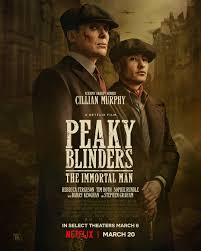
PEAKY BLINDERS: THE IMMORTAL MAN
UK, 2026, 112 minutes, Colour.
Cillian Murphy, Rebecca Ferguson, Barry Keoghan, Stephen Graham, Sophie Rundle, Tim Roth, Ned Dennehy, Pakxy Lee, Jay Lycurgo, Ian.Peck,
Directed by Tom Harper.
The connection with the long-running television series:
AI generated summary from user reviews on the Internet movie database: Reviewers say 'Peaky Blinders' is celebrated for its compelling narrative, intricate characters, and standout performances, especially Cillian Murphy as Tommy Shelby. The series is lauded for its historical accuracy, striking visuals, and unique soundtrack. Central themes include power, loyalty, and betrayal, with a focus on war and class conflict. The Shelby family's interactions and complex storylines captivate audiences, though some critics observe a dip in quality in later seasons. Its aesthetic and immersive atmosphere make it a genre standout.
The television series had a long run and there is often a call for a feature film to gather the themes and characters together. Peaky Blinders ran for over 10 years with 36 episodes, and highlighting the talent of Cillian Murphy (winning a Best Actor Oscar for playing Robert Oppenheimer).
The film takes place some years after the events in the series which moved from World War I into the 1920s and 30s. Now, it is World War II, highlighting an episode where the Third Reich forged an enormous amount of British notes to smuggle into Britain, disrupt the economy, different strategy for obtaining victory. This is visualised for us – and the traitorous go-between is played by Tim Roth.
In the meantime, Tommy Shelby has retired, living quietly, writing his book, The Immortal Man. But, his son, Duke (Barry Keoghan, featured in many films at this period, talented with quite different roles) has a difficult relationship with his father. There are also complications about Shelby and his relationships, his wife, her sister, memories, and the Gypsy community.
And, this community is tough, violence, in the streets, in the pubs…
Eventually, the arrival of the forged money at Liverpool, the British contacts, setting up some contract with the Peaky Blinders and Duke, Stephen Graham appearing in a supporting role, Shelby himself finally having to intervene.
For those familiar with the series, obviously interesting. And, with a sequel series in planning, obviously an introduction.
For those not familiar with the series, a glimpse of gangs, gangsters, violence on the streets, British style.
- The popularity of the series, over 10 years, 36 episodes, Birmingham, Gypsies, crime…?
- A feature film, the impact for those unfamiliar with the series, those who know the series? A satisfactory ending, the death of Tom Shelby?
- World War II, the opening in Germany, the concentration camp, the elaborate forging of the currency, packing, shipping it, the plan to infiltrate the currency, economic collapse, the winning of the war?
- Beckett, sympathetic to the Nazis, in Germany, arranging the transport, the interview with Duke, the sympathiser and his loose lips, Becket shooting him? Duke agreeing?
- The presence of Tom Shelby, his past reputation, World War I and action, the trenches and his memories, his relationship with his brother, the visit to the cemetery, seeing his daughter’s red scarf, his grief about his brother, the revelation of his killing him and his motivations? In the rural house, wandering around, letting go of control, writing his book, Johnny as his helper?
- Duke, son of Tom, the bonding and lack of bonding? His character, brutal, leadership, the issue of the arms and his gang appearing, rounding them up, taking them? Confrontations between the authorities and the Peaky Blinders? Duke and his personal life, leadership, at the pub?
- Tom, his wife, his children? Mysterious presence of Kaulo, sister of Zelda, Tom and his memories, appearances? The presence at the dinner, her role in the city, patriotism, leadership, her son – and her murder? The ceremonies of her burial?
- The old members of the gang, their presence, loyalty to Tom, ageing?
- The pub, the women, the drinking, the gangs? The pub ring the war, the soldiers, Tom and his arrival, control, the confrontation with the soldier, defiance, the hand grenade? Tom and his reassertion of authority?
- Seeing Tom, the relationship with Duke, their meetings, discussions, the count money, Duke and his loyalties?
- Tom, reasserting himself, the various attacks, riding the horse? The Gypsy background? His dreams and imaginings? The discussions with Duke?
- The meetings with their cake, confrontations, shooting fights? Escapes?
- The final plan, and his hold over Duke, to do the shootings, the phone, going Duke and his change of heart?
- The setting up for the arrival of the money, the taking it, the squad, the role of Stagg, his personality, loyalties? On the harbour, the boats, the crash, Tom coming through the tunnel, his dilapidated state, the accident and crash, his getting free, arriving late, the setting of the time of midnight, Becket with Duke, the clock, Tom eventually arriving?
- The final confrontation, the shootout, the death of Becket, his shooting Tom, Duke present?
- The ending of the Peaky Blinders’ tale, the death of Tom, the role of Duke? The finding of the manuscript, giving it to Duke? The final caravan, the fire?
Steve
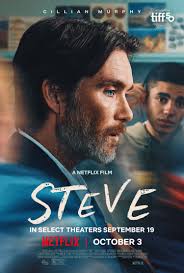
STEVE
UK/Ireland, 2025, 93 minutes, Colour.
Cillian Murphy, Tracy Ullman, Jay Lycurgo, Luke Ayers, Joshua Barry, Joshua J.Parker, Ruby Ashbourne Serkis.
Directed by Tim Mielants.
Irish actor, Cillian Murphy, has had a significant career, Irish films, the Dark Knight trilogy, to his Oscar-winning in Oppenheimer. Since then he has made two small films, very serious, well worth seeing, collaborating with Belgian director, Tim Mielants (who also directed several episodes of Peaky Blinders).
Small Things Like These was set in Ireland, the mid-1980s, focusing on local and church issues, especially the Magdalene centres for unmarried mothers. Steve, on the other hand, is set in England, 1996. The screenplay is by the novelist, Max Porter. His novel was titled Shy, a student in a special school, whereas this film is called Steve, the name of the teacher who manages the school.
The film is tough going, not only for the students who have special needs, various forms of mental illness, some heritage of drugtaking, prone to anger and brawls. And, watching it, the audience will find it tough going, a real challenge as to how to deal with broken teenagers, to have some faith that there is a future for them. We get to know them, the difficulties, tensions amongst themselves – and a special focus on one of them, Shy.
The action takes place over 24 hours on a very difficult day at the special school, set in the English countryside, a small group of 17 year olds, a hard-working and committed staff, led by Steve, another fine Cillian Murphy performance. His assistant, surprisingly, is played effectively by Tracy Ullman. There are some veterans in the school, especially the cook, but also a young teacher who is committed but is finding the pressures and the tension hard to cope with.
The time as the day passes is indicated on screen throughout the film, people arriving, the introduction to the students, their cantankerous behaviour, trying to coax them, deal with them, impose some kind of order and discipline. Their activities, classes (and some of them are quite intelligent given the opportunity), football matches…
But the complexity of the day includes a television crew coming in to make a special about the school, the staff, the values, interviews with both staff and students, asking them on camera to find three words to describe themselves, the boys to look back on what has happened in their lives over the previous five years. But, of course, the crew often get in the way, and we see the host of the program speaking to camera and explaining what is happening at the school.
There is a visit from the local MP (Roger Allam) which doesn’t go well. And there are also the financial issues, government grants, visits from those responsible, the threats to close the school.
In so many countries these days there are concerns about youth crime. What are the solutions, risen, penalties, bail, rehabilitation…? This film offers 93 challenging minutes on these themes.
- The title, the focus on Steve (but the novels title, Shy, one of the boys at the school)?
- 1996, UK, politics, and of Conservative rule, political issues, financial issues, educational issues?
- The action taking place over one day, time indications on screen, the pressure on all the characters, time passing, expectations, the routine of the school, classes, meals, football? And the television crew, filming and interviews? The arrival of the politician? The arrival of the board and the discussions?
- The location, the school, interiors, the grounds? Palatial look?
- The nature of the school, all the boys, aged 17, family backgrounds, violent tendencies, experience, angers, mental conditions? The role of the school, education, therapy, improvement?
- The impact of the boys, public opinion, condemning them? The contrast with the staff, knowing them, bearing with them, hoping for them?
- The device of having the television crew, the time limits, availability, the personalities of the crew, talking to camera, producer, technicians? The comments and observing the situations? Capturing sequences? And the importance of the interviews, in a limited number of minutes the staff explaining themselves, the boys, going back five years to reflect on what has happened to them? The putting together of the program? Will the viewing public?
- The introduction to the boys, their personalities, British, ethnic differences? The focus on Shy, personality, the rocks and his explorations, his angers, his mother, the message of breaking up contact, no longer able to deal with him? The consequences? Tyrone, the young teacher, approaches? The range of the others, their violence, interactions, taunting each other?
- Yet the football match, the rain, camaraderie and bravado?
- Steve, in charge, his personality, responsibility, seeing him during the day, managing the time, the visitors, the rest of the staff, supported by Amanda, encouraging the young teacher, with the cook, the other staff members? Interactions with the boys, breaking up fights? The television crew, his three minutes? With the parliamentarian, showing him round, ER, the boys and the reaction, the swearing insult? The arrival of the board, the prospects for school, the realities of closing down, funding? His anger? Addiction, drinking, Amanda and her support? The ending of the day, going home, the difference with family at home?
- Amanda, Deputy, businesslike, with the boys, with the TV crew, her interview, with the visitors, the closing of the school? Her trying to sports Steve, knowing the truth about him?
- The young teacher, one-month, her earnestness, with the boys, the difficulties, the approaches, the warm support from Steve?
- The meals, the cook, benign, interactions? The food?
- The drama of the fights, in the dormitory area, the rooms? Provoking, angers, taunts? And the spectacular fight in the dining room, into the kitchen, confusion and mess?
- The politician, grim, accent, being shown round, the speech, the insult, his being humiliated? (And the film parodying this kind of politician?)
- The members of the board, young, representatives, financial issues, political issues, the handling of the discussion? The closing of the school, the reasons? And Steve’s anger?
- 93 minutes, getting to know the range of characters very well, appreciating a difficult situation in terms of education and mental health?
Small Things Like These
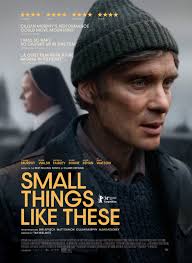
SMALL THINGS LIKE THESE
Ireland, 2024, 95 minutes, Colour.
Cillian Murphy, Eileen Walsh, Zara Devlin, Emily Watson, Michelle Fairlry.
Directed by Tim Mielants.
This film is based on the Booker-prize nominee by Irish novelist, Claire Keegan. Another of her stories, Foster, was filmed as The Quiet Girl, the dialogue in Gaelic. She is a multi-award-winning novelist.
The setting for this film is a town in Ireland, 1985. At the centre is a very serious man, Will, who is a coal deliverer in the town. He is married, a sympathetic wife, played by Eileen Walsh, and household of daughters. He is played by Cillian Murphy, Oscar-winner at this time for Oppenheimer but a veteran of more than 30 years of Irish and international films. Here is a powerful performance but the performance is greatly enhanced by the way that he is photographed throughout the film, so often close-ups, extreme close-ups of his face, the silent body language communicating his experiences, many sad memories, difficulties in the present, dark and brooding.
For an intense film about Ireland, it has been directed by Belgian director, Tim Mielants, who worked with Cillian Murphy directing six episodes of the series, Peaky Blinders, as well as making the intense war film about the German occupation of Antwerp, Wil. Actor and director worked together in their next film, Steve.
There are quite a number of flashbacks to Will and his boyhood, his unmarried mother and their being taken on by a wealthy and kindly widow. Nevertheless, some harsh treatment by the children at school, emphasising his isolation, his self-doubt.
His work is delivering coal, his oldest daughter working with the accounts. His wife is sympathetic, but not always appreciating the depths of his inner thoughts and feelings.
What brings this to a head is the experience of his finding one of the young women who are unmarried and pregnant and committed to the care of nuns in what were called the Magdalenes. She is Sarah and has been locked in the coal room and he discovers her. He brings her out, some confrontations with the nuns, an encounter with the superior, played by Emily Watson. Emily Watson’s Sister Mary embodies those characteristics, many good, many far too severe, of superiors in past times. She is in control, demanding, wanting discipline, actually encouraging a harsh regime, structures, hard work, discipline, the sisters in the convent to exercise this kind of control.
In 2002, Peter Mullan directed The Magdalene Sisters, a strong expose of those times. Small Things like These is a significant companion film.
In his interview with Sister Mary, who knows the family well, she is able to threaten, cajole, control, Will begins to brood even more on the the nuns, the church, unmarried mothers, the fate of the children, his sense of duty, a sense of responsibility.
As the film moves in this direction, Will rescuing Sarah a second time, taking her home, their walking down the corridor of his house to…, the film abruptly stops, surprising the audience in their reflections, emotional responses, which they now have to take out from their film experience to ponder.
- The reputation of the novel by Claire Keegan? The adaptation, short running time, the focus on characters, 1985 and the situations, the flashbacks?
- Ireland, 1985, families, home life, father, mother, the daughters, the small home, the family life? The father and the delivery of the coal?
- Life in the town, the Catholic Church, Christmastime, in the church? The nuns?
- The gradual revelation about the institutions for the Magdalenes, young girls, unmarried mothers, sent by their parents and family, the hardships, the hard work, domestic, laundries, cooking, the pregnancies, the babies? The role of the nuns, the severity, discipline, harsh treatment, Sarah locked in the coal room? The role of the superior, seeing her with the priest, the interview with Will, the awkward situation, her knowledge of him and the family, his daughters and the school, the fees? The money gift for his wife? Her warning him away? Her treatment of Sarah, seemingly benign, the wash, food? Sarah again in the cold room? The film’s judgement on the sisters, the Catholic Church and severity, judgmental on the young women, treatment of them?
- Will as a person, the flashbacks to his past, his mother, the bond with her, the reaction of the other children, their treatment of him, the spit on his coat? His mother cleaning it off? Taken in by Mrs Wilson, Mrs Wilson and her wealth, the household, the kindness to Will and his mother? The effect on Will as he grew up?
- The adult Will as a personality, quiet, brooding, relationship with his wife, the domestic scenes, with his children, the oldest and her accountancy, the interaction with the others, music, the meals, happy times? And the memories of his past? His devotion to his work? Other friends in the town, communication, the visit to the pub?
- The impact of finding Sophie with the coal, having glimpsed her with her parents and her reluctance? Rescuing her, the interview with Sister Mary, Sister Mary and her manipulation of the conversation, affirmation, yet threats, the gift of the money?
- Sarah and her difficulties again, Will and his rescue, bring her to the home, preparing to walk down the corridor, to…?
- The suddenness, abruptness of the ending, the audience processing all that has gone before, anticipation of what is to come, taking this away for reflection after viewing the film?
