Displaying items by tag: Mario Zampi
Bottoms Up
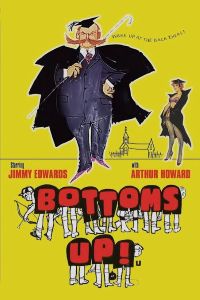
BOTTOMS UP
UK, 1960, 90 minutes, Black-and-white.
Jimmy Edwards, Arthur Howard, Martita Hunt, Sidney Tafler, Raymond Huntley, Reginald Beckwith, Melvyn Hayes, John Mitchell, Richard Briers.
Directed by Mario Zampi.
Bottoms up, especially for receiving a caning in old-style British schools!
Jimmy Edwards was a popular comedian on radio and television in the 1950s. He brings his schoolmaster character from those media to the big screen. Whether it appeals to later generations is a moot point.
And, looking back over the decades and attitudes towards discipline in schools, physical punishment, delivered by staff and other students, this comedy seems particularly old-fashioned. A past that is receding into long distance.
And, a critical look back at plot developments show a subplot concerning a Prince from a colonial country, blackface disguise, not accepted in later generations. And, the most mischievous of the boys is played by the son of a bishop.
The film could be seen as a male version of the popular St Trinians’ girls schools comedies, lots of misbehaving children, lots of frustrated staff, all kinds of slapstick comedy, all kinds of misadventures and plots, turning into a school battlefield and military strategies, humorous dialogue, lots play on words (those masters of English language in radio programs, Frank Muir and Dennis Norden, receive credits for the screenplay). And, some touches of innuendo – after all, this was the era when the Carry on series began.
Jimmy Edwards is huge, bluff, imposing, but also the victim of all kinds of pranks. The fall guy, so to speak, is his hapless assistant, so often the victim of pranks as well as their masters’ bullying, is played by Arthur Howard (brother of Leslie Howard). There is comedy with snobbery, especially with Martita Hunt (so memorable as Miss Havisham in Great Expectations) and the perennially rather snooty government official played by Raymond Huntley. Richard Briers, early in his career, is in the cast.
The film was directed by Italian born Mario Zampi who made a number of comedies in England, notably Laughter in Paradise with Alistair Sim and Too Many Crooks with Terry Thomas (and Carry on stars, Sid James and Bernard Bresslaw).
A curiosity item, broad British comedy in the 1950s and 1960s.
Now and Forever/ 1956
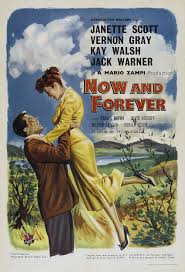
NOW AND FOREVER
UK, 1956, 90 minutes, Colour.
Janette Scott, Vernon Gray, Kay Walsh, Jack Warner, Pamela Brown, Charles Victor, Marjorie Rhodes, Ronald Squire, Wilfred Lawson, Sonia Dresdel, David Kossoff, Moultrie Kelsall, Guy Middleton, Michael Pertwee, Bryan Forbes, Thora Hird.
Directed by Mario Zampi.
Not a well-known British film from the mid-1950s – a young romance, and in colour.
It is a star vehicle for Janette Scott who was to appear in a number of British films in the coming decade, and she appears with her actress mother, Thora Hird, as the family cook. Her co-star is the Canadian Vernon Gray, who made only a few films.
What will be of interest to audiences who like watching the British films of the 1950s, generally small, local issues… Will be very interested in the range of the supporting cast, Kay Walsh is the school headmistress, Jack Warner not a policeman this time but the owner of a garage, father of the character played by Vernon Gray. Pamela Brown is the young girl’s severe mother, Pamela Brown expert at this kind of superior disdainful kind of character. There is Charles Victor a sympathetic, and Marjorie Rhodes his unsympathetic wife, Sonia Dresdel as one of the schoolteachers, David Kossoff in a small role as a pawnbroker, Guy Middleton as the mother’s boyfriend, and Ronald Squire as an eyebrow-raising waiter in a cafe.
The film was directed by Mario Zampi, an Italian who set up the company in London. His best-known films are Laughter in Paradise, with Alistair Sim, and Too Many Crooks.
The story is the familiar one that would be treated in a much more open, even permissive way in the 21st-century. The 18-year-old daughter lives with her mother, a severe socialite, but loves her father who has been divorced from her mother. Then the news that he dies. She encounters the son of the local garage mechanic, her mother hiring him for drives. They are attracted to each other, he driving her to school, her mother disapproving, his father more tolerant, then all kinds of ups and downs, her mother wanting to send her to Canada, her feeling suicidal, the help of the headmistress, the plan to elope with the young man, the police after them, various escapades, and their being caught on the Scottish border, the young man’s father being kindly, trying to persuade her mother to some kind of compassion.
All very familiar – but with a 1950s kind of propriety and reticence.
