Displaying items by tag: Peter Cushing
Revenge of Frankenstein, The
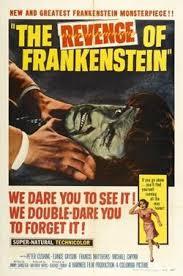
THE REVENGE OF FRANKENSTEIN
UK, 1958, 90 minutes, Colour.
Peter Cushing, Francis Matthews, Eunice Gayson, Michael Gwynn, Lionel Jeffries, Charles Lloyd Pack, George Woodbridge, Michael Ripper.
Directed by Terrence Fisher.
Mary Shelley must be amazed at the vast number of Frankenstein films. And they continue.
However, in the mid-1950s, Hammer Studios began a series of horror films based on classics, especially Frankenstein and Bram Stoker’s Dracula. The first was The Curse of Frankenstein, featuring Peter Cushing as the Baron. While there were some of the horror tropes, especially the end, the film was really made as drama, well cast, well acted, dramatising the elements of Mary Shelley’s perspective but, going beyond it, Frankenstein and the consequences of his actions.
Then, almost immediately, this sequel. And the same comment about drama and the horror tropes. Now, Frankenstein is about to be executed for his experiments, a scene at the gallows, struggle – and, his friends helping him, substituting the assistant priest in the coffin.
The bulk of the film has Frankenstein in the city, calling himself Dr Stein, treating all the fashionable inhabitants who flock to him, but also working in the poor ward. The local Council of doctors are not impressed – except for the young one, played by Francis Matthews, who knows who Dr Stein is and wants to learn from him, collaborating in a reworking of constructing the body of a new creature, wanting to transfer the brain of the crippled Karl who works in the laboratory.
So, the emphasis on drama, Peter Cushing full of dignity, clearly articulate, arrogant in his self-confidence, and the eager young assistant, details of the poor ward, the experiment, and, as expected, some dire consequences.
Six years later, there was a third Peter Cushing/Frankenstein film, Evil of Frankenstein.
- The second in the Hammer Studios trilogy of Frankenstein? The original curse of Frankenstein, the next film, Evil of Frankenstein? The continuation of the story beyond Mary Shelley?
- Hammer Studios, the 1950s, taking up the classic horror stories, emphasising the drama and the characters rather than the horror aspects? Keeping the horror aspects until the end?
- The situation, Frankenstein and his experiments, the arrest, condemnation to death, the opening and the gallows, Frankenstein being led to the gallows, the priest, Karl in attendance, the executioners? The focus on the gallows, the sounds of the commotion, Frankenstein’s escape?
- The cemetery, the two men, the salary, digging up graves, drinking, the lazy digger eating, opening the coffin, finding the priest? Frankenstein, the digger and his heart attack?
- Three years later, Dr Victor Stein in Carlsbruck, his practice, the waiting room full, the women, his work in the poor ward, the many men, his work, charity work?
- The town council of doctors, the meeting, denunciations of Dr Stein? The decision about the delegation, their arrival, being made to wait with the poor patients?
- Peter Cushing as Dr Frankenstein, presence, dignified manner, speaking clearly, dignity? Yet the ruthlessness of his experiments? Commitment to science? His treatment of the committee?
- Dr Kleve, age, earnest, his practice, education, devotion to science, his request of Frankenstein, and the interrogation, Frankenstain showing him the laboratories, the extent of his experiments, fire, the eyes moving, the hand reaching out, the brain? The revelation of the perfect body made up of parts? (And the parts coming from the men in the ward?)
- Karl, hunches, his brain, working with the doctor, the promise of a new body with his own brain?
- Margaret, her position in the town, wanting to work? Dr Stein’s reaction, ousting her? Her later visits? The worker, his confiding the truth in her? Her meeting Karl? Later encounter with Karl, trying to help, his reliance on her? At the musical recital, Karl coming, the crisis?
- The worker in the ward, his relationship with Dr Stein, helping, yet shrewd, having the key, informing Margaret?
- The experiment, taking Karl’s brain, into the new body? Karl’s body – and his discovering it, burning it? Karl, the new awareness, appearance, being bound, the treatment by the doctors? His dissatisfaction, the background of the chimpanzee and Otto and the exchange of brain?
- Dr Kleve and his helping Karl, Margaret, loosening the bonds, his getting away? The clear brain, the monstrous brain, his attack on the young girl? The police stopping the doctors, the interrogation?
- The doctors, going to the recital, the search for Karl, his going berserk?
- The reaction of the doctors, the condemnation of Dr Stein, exposing him and his response? His going into the ward, the condemnation, despising him, the attack, his death, Dr Kleve and the rescue?
- Dr Stein and his recovery, London, Dr Frank and a new life?
Suspect/ The Risk
SUSPECT/THE RISK
UK, 1960, 81 minutes, Black-and-white.
Tony Britton, Virginia Maskell, Peter Cushing, Ian Bannen, Raymond Huntley, Thorley Walters, Donald Pleasence, Spike Milligan, Kenneth Griffith, Robert Bruce, Anthony Booth, Basil Dignam, Sam Kydd, Murray Melvin.
Directed by John Boulting, Roy Boulting.
British Nigel Balchin wrote thrillers and wrote the screenplay for this brief film. The Boulting brothers had a strong presence in British cinema from the 1940s. Their intention with this film was to enhance the quality of British supporting features, small budget, filmed in 17 days, brief running time. Critics at the time were harsh on the film, American critics more sympathetic.
With the writing, the Boulting Brothers’ direction, and the considerable quality of the supporting cast, serious issues of scientific experimentation, wartime security, espionage and stealing secrets, there is quite a lot of material in 81 minutes. The locations are confined, home, laboratory, restaurants, espionage. With the supporting cast so articulate, the dialogue makes a strong impression.
In fact, Tony Britton and Virginia Maskell as the stars are not as strong as the character actors, some veterans like Raymond Huntley as the politician, Peter Cushing as the professor, Kenneth Griffith as his assistant, Donald Pleasence, always sinister, Thorley Walters as an eccentric investigator, Ian Bannen as the cynical war invalid, all bring quality to the performances. And there are quite a number of interesting cameos from actors like Spike Milligan, serious and comic at the end, Sam Kydd, Murray Melvin, Anthony Booth.
A curiosity item of the period but an interesting and entertaining 80 minutes.
- Small-budget supporting feature, a television filming style?
- Nigel Balchin thriller, his writing the screenplay, nation, science, politics, espionage, romance? Popular ingredients?
- The cast, the range of British character actors, the focus on dialogue, interactions, intensity, themes articulated in the British style?
- The focus on scientific experimentation, the professor, years of experience, Peter Cushing’s style, the staff, summoned by the government, closure on his experiments, his reactions, the staff, the situation with the dedication of the statue? His discovery of Marriott with the documents, his reaction, the police, covering for Marriott?
- Bob Marriott and Lucy Byrne, colleagues, skills, the date to the pictures, Lucy and her reticence, the situation with Alan, losing his arms in war, her caring for him, past fiancee, his manner, cynical? His meeting with Marriott, charming exterior, undermining him, the connection with Brown, the situation about the government ban, the documents, saving the experiments, handing them over?
- Lucy, her work, with Marriott, the attraction, her helping with Alan, the meeting with Brown, her ignorance, her being interrogated?
- Marriott, his character, dedicated to his work, the experiment with his arm, his reaction to the ban, led on by Alan, the meeting with Brown, taking the documents, the meeting with the spies?
- Dr Shole, collaboration, personality, Mr Prince making the contact, with his assistant, the suspicions, summoning him, the information? The scenes with the professor?
- Mr Prince, his role in the investigations, sometimes doddery, absent-minded, his office a mess, the meetings with Dr Shole, relying on his assistant, the interviews, his hypotheses?
- Brown, his background, sinister, Donald Pleasence’s style, his eyes, the arrangements, the meeting, being the documents, the person in charge, the police, gunshots?
- The politics, the Minister, calling in the professor, good mannered but intense, forbidding the experiments, danger for enemies getting hold of them, the dedication of the statue, his assistant, his visit to the laboratory in meeting the staff?
- The assistant at the office, Spike Milligan, more serious – the final comedy with the monkey?
- British politics in world politics in the late 1950s? This film seen in retrospect?
