Displaying items by tag: Peter Malone's Movie Reviews
Proclivitas
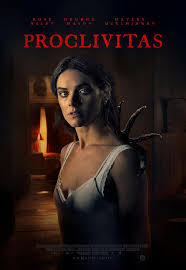
PROCLIVITAS
Australia, 2025, 103 minutes, Colour.
Rose Riley, George Mason, Hayley McElhinney, Chloe Brink, James Rock.
Directed by Miley Tunnecliffe.
The immediate challenge for this film is its title, in Latin. The film opens with a quotation from Cicero, in Latin, then transforming into English, highlighting that inclination/inclination is towards a good while proclivitas/proclivity is a movement towards the bad.
This is a first film by its director after some short films. The film features Rose Riley, many films and television programs as is the case with George Mason.
The film was made in Western Australia, some city settings and a home but then moving to a small town in the countryside, the main action taking place in a rundown house and its being repaired.
This is a story of Claire, played by Rose Riley, a young woman upset at the death of her beloved mother. But, there is something askew with Claire, nervous, edgy, hearing noises, reluctantly going back to her house in the country and to sort out her mother’s effects.
While the film is billed as a horror film, the main horror sequences are right at the end. Rather, this is a drama of menace, Claire experiencing the menace and the details of the plot being gradually revealed, emphasis on the gradual, step-by-step, and the reveal also left until towards the end of the film.
So, something of a psychological case film, Claire training to be a doctor, r her personal problems, on suspension, plea going back to the house, encountering a police school friend as she arrives back of the town, then meeting the young man she loved in the past, Jerry, played by New Zealander George Mason, genial, past love for Claire (and many flashbacks to their past), his own story and problems, now handyman in the town, ready to repair the dilapidated house.
On the one hand, there is the expected renewal of the relationship between the two. On the other, there is the constant tension in Claire’s dreams, in her waking imagination, noises, sensing sinister presences – and, while we might think she has to face her demons, they finally materialise in monstrous form.
Horror fans who like blood and gore will be very impatient with the gradual opening up of the plot and its complications. Audiences who enjoy a psychological drama will find it more interesting – and be more ready to accept the explanations of Claire’s demons and their manifestations.
- The quote from Cicero, inclination to good, proclivity to evil?
- The Western Australian setting, the city, the house, the ambulance? The countryside? The town, the old house, restaurant, police…? The musical score?
- The title and the inclination not to good but to evil? With Claire, with Jerry?
- The film classified as horror but the main horror at the end, the creature, the demon? The film as more ominous, menacing Claire, her memories, her imagination, her fears, her guilt, her demons?
- The gradual unfolding of the narrative, step-by-step, indication memories, imagination, fears? The reveal of the accident, the consequences the end?
- Claire, her age, memories of the past, teenager, the house, with her mother, friendship with Jerry, the bond, memories of the first kisses, the dance, the swimming? Her going away to study medicine, her achievements, her addictions, being haunted, drinking? The death of her mother and its effect, her aunt not going to the house? The travel, the encounter with Tara and the hostility? The breath test? Arriving at the house?
- Jerry, the flashbacks, the friendship, in love, the pool, her going away, the driving, careless, the accident, the death, his being willing to take the responsibility, his life in prison? Coming out, tradesman in the small town, memories of Claire?
- Claire as tentative, talk with Jerry, eating out, the food, the kiss, telling some of her story, his doing the work, their company together, the sexual encounter, the consequences, Tara coming for Jerry and her displeasure? The day off? But all the time Claire hearing noises, sensing the presences?
- Jerry, genial, memories of the past, the game of memories, Claire’s mother and the contact, visiting Jerry in prison, Communications? Claire’s surprise? Her discovering the tablets, his throwing them away, their reappearance? Her imagination?
- Her going back to the house, the demons? The return to the country?
- The buildup to a climax, the visualisation of the demons, Tara’s visit, the gun, Jerry and his sense of despair, Tara shot, Claire and her being jolted, imagination, the creature, her defiance, facing her demon, monstrous, and its disappearance, taking charge, an ambulance for Tara, healing for Jerry?
- The pace is a film, gradual, drama, the visualisation of the demon climax, the future?
Mastermind, The
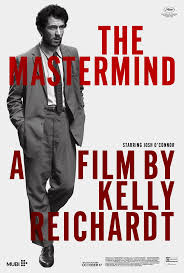
THE MASTERMIND
US, 2025, 110 minutes, Colour.
Josh O'Connor, Sterling Thompson, Alana Haim, Jasper Thompson, Bill Camp, Hope Davis, John Magaro, Gabby Hoffman, Amanda Plummer..
Directed by Kelly Reichardt.
Many films specialists, noting the information, written and directed by Kelly Reichardt, is sufficient for them to want to see this film. (Over 30 years, Kelly Reichardt has directed only 10 feature films and a number of short films but has built up a reputation with a range of American stories, often with a focus on women, but also offering food for reflection on American history and society.
And this continues with this film, a museum robbery, specifically inspired by the 1972 robbery of the Worcester Art Museum in Massachusetts, in which two Gauguins, a Picasso, and a Rembrandt were stolen. Her interest, however, is not so much in the robbery but on the character, the mastermind of the title (though, looking at his career, the title is quite ironic), his behaviour in the aftermath of the robbery and exposure. Some commentators refer to the film as an “anti-heist” film.
The setting is 1970, upheaval in the United States at the end of the 60s, social unrest, but, especially, the background of the war in Vietnam.
The central character is played by Josh O’Connor, busy with releases in 2025, The History of Sound as well as Wake Up Dead Man. He is a family man, a carpenter, unemployed, in need of money, planning the stealing of artwork from the local gallery, hiring three petty criminals, not vetting them in any mastermind kind of way, their exposing him, his trying to rationalise, his wife leaving him with the family, his wanting money from his mother, his father a judge critical about the lack of ambition of the thieves.
The mastermind is abducted by the criminals, gets away, but with public knowledge about his crime, he begins an odyssey, getting lifts, trying to survive, lack of money, going to a friend from the past but moved on by the friend’s wife, his continuing on the road and an uncertain ending as he steals a woman’s purse, tries to escape through the Vietnam war protest and is elected arrested.
Many audiences, Kelly Reichardt fans, welcomed the film. For many others, even some who admire Kelly Reichardt, have found the film difficult to sit through, the pace, the unsympathetic central character… (Which was the experience of this reviewer.)
- The title, for James Mooney, accurate, ironic?
- The 1970s setting, social upheaval in the US, financial difficulties, the background of the Vietnam war? Re-creation of the period? The musical score?
- The initial plot, Mooney, the stealing of the car, the backing out of the driver, his choice of the two colleagues, the plan to steal the art, at the gallery, removing the paintings? His associates, Gibson and his rations, pulling the gun, later robbing the bank? Guy asking for more money?
- Mooney at home, his wife, family, relationship with Tommy? His mother and giving him money? His father, judge? His comments about the lack of initiative by the thieves?
- Mooney, having to cope with situations, sending his wife and family away, keeping his son, taking with him? The confrontation with Guy? The setup, the criminals, the abduction? The consequences?
- Mooney, getting away, on the road, money, surviving, his situation becoming public? The alienation of his wife, the phone calls?
- Going to stay with his friend, Fred and his wife, their life together, memories of the past, Fred and his wariness, the wife, her making the connection with the professor to act as a fence for the paintings, his being sent away?
- His plans, on the road, stealing the woman’s purse, trying to escape through the Vietnam war protesters, his being arrested? And then?
Property, The

THE PROPERTY
Israel, 2024, 110 minutes, Colour.
Rivka Michaeli, Sharon Strimban, Andrzej Seweryn, Piotr Pacek, Uri Hochman.
Directed by Dana Modan.
The property of the title is situated in Warsaw. It was owned before World War II by a Jewish couple – and, now, 64 years later, the daughter of the owners has returned to Poland.
Stories about the Holocaust are inexhaustible. However, while the Holocaust is significant in its repercussions on some of the central characters, this film deals with different memories. And, in comparison with other dramas, it takes the lighter touch, some comic moments, some melodramatic family conflicts, the screenplay gradually unfolding quite a complex scenario, and, perhaps, some tears for the audience at the end.
Regina Segal is an elderly widow, coming back to Poland which she left in 1939 as a pregnant young 15-year-old, now bringing her granddaughter with her, her son recently dying of cancer. Regina can be very cantankerous. Her granddaughter, Mika, is much tougher, having served in the Israeli army, sad at the loss of her father.
Many will be reminded of Jesse Eisenberg’s humorous/sad Oscar-winning film, A Real Pain, where two American cousins visit the Poland of their grandmother.
Each of the central characters, including a cousin, rather large and vociferous, Cantor for sacred ceremonies, is tracking down the property. Regina, of course, has a very personal interest and the film has opened with her and the father of her child rowing on a lake, speculating about what will happen to them. Mika is curious, realising that she would inherit the property. The cousin, on the other hand, has been pressurised to find it by his side of the family. So, each with their own agenda, and getting entangled.
But there is also a nicely sympathetic character, a young man who saves Mika from her over-eager cousin. He is a tour guide as well as a musician and an artist, bonding very quickly with Mika and anxious to help her in her quest (not without quite some emotional tangles).
The strongly emotional aspect of the film comes with the audience going with Regina to the apartment, now a restaurant, encountering the owner and his wife – and, ultimately, the revelation of a sad story of a pregnancy, of a young girl being sent to Israel, the war breaking out, her parents and the apartment, the young man and his involvement – now to be emotionally confronted and, hopefully, resolved, many decades later.
A quieter telling of a sad story whose direction is dramatically and emotionally affected and changed by the Nazi invasion of Poland.
- The title, the focus on the property, originally, the ownership, the Nazi invasion, decisions is 1939, family, dispersed, themes of displacement, home, ownership?
- Effective resetting, Israel, Poland, Warsaw, the sites of Warsaw, the streets, apartments and hotels, the restaurant? The musical score?
- The opening, the lyrical tone Lake, the young couple, together – and the separation? The return to these sequences at the end of the film in the light of what actually happened?
- Regina, her age, 64 years after the opening sequences? Israel, her marriage, the death of her husband, the recent death of her son, relationship with her daughter, the daughter strong-minded, serving in the Israeli army? The decision to go to Poland, defined the property, to settle the ownership? Regina’s ulterior motive to find her long-lasting love?
- The comic touches, the serious touches? The film based on a graphic novel, images and dialogue, and the sister-directors and their family history?
- Regina, in Poland, wanting to be there, not wanting to be there, retiring, with her daughter, with the cousin and his Mac nations, the daughter and the lawyer, the rites? The different family interests?
- Mike, a relationship with her mother, her dead brother, accompanying her mother, discussions with the lawyer, the possibilities, her inheriting the property? The contrast with meeting the guide, college, his personality, music, accompanying Micah, the light romantic touch?
- The cousin, his appearance, Cantor, his motivations, interactions with Regina and her daughter, his hands about the ownership?
- Regina, going to the restaurant, her motivation coming, to see how long lost love, discovering him, the property, becoming a restaurant? His personality, after 64 years, his own marriage, life?
- The emotional impact of the two meeting again, the memories of the said envelope, her pregnancy, a younger age, the interference of her parents, sending her away, marriage, Israel? His remaining?
- The thing is coming to an end, Regina and her mission and it’s a compliment coral the issue of the property, the daughter, returning home?
2: 22
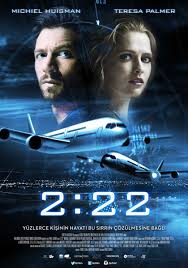
2: 22
Australia/US, 2017, 98 minutes, Colour.
Michiel Huisman, Teresa Palmer, Sam Reid, John Waters, Kerry Armstrong, Maeve Dermody.
Directed by Paul Currie.
While the film is billed as an American science-fiction drama, it is actually an Australian production, filmed in Sydney, most of the cast being Australia. The main exception is the leading man, media house, American.
The film was not successful on its release, billed as the film with the least box office 2017. However, it has had a firmer further life on television and streaming.
Michelle Houston plays an air traffic controller with some kind of psychic powers. However, in cycling through New York City, he has a lot of repetitious, déjà vu sites and experiences, especially at Grant Central Station, and everything, an ageing at the time of 2:22.
He has to give up his traffic controlling work when there is almost an accident – and the encounters a heart dealer, Teresa Palmer, who was on the plane. She also has a boyfriend, an artist, played by Sam Reid, who deals in holograms.
So, while there are the romantic complications in the present as well is the mystery of 222 and the characters and sites that are seen, it then becomes a link to a death 30 years earlier, the day that the two central characters were born, and some kind of dramatic psychic connection between those events and the present.
Which means that the audience does have to pay attention to sort out the various threads of the plot. The film looks quite good, the two central characters sympathetic. A science fiction/fantasy pastime.
- Silence-fiction? Science fantasy?
- The Australian production, filming in the US and Australia? American style, Australian supporting cast? The recreation of New York City, apartments, Grand Central station, Kennedy airport and flight control? The musical score?
- The title, the time, Dylan and his experiences, his interest in stars, constellations? His background, family, training, fear of flying, flight control? His friendships? His hallucinations? Saving the planes from colliding? Being suspended?
- His life, his apartment, his interests, the encounter with Sarah, his ticket to the aerial ballet, talks with Sarah, the audience having seen her on the plane about to crash? Her life and work, the art gallery, Jonas and his work? Dylan going to the exhibition, the holograms, the characters and situations of his 2:22 situation, his mad outburst and destructive?
- Travelling in New York City, the camps, the recurring situations, same people, talk, the businessmen, the children, the pregnant woman, 2.22, the electrical fault?
- The bond with Sarah, the sharing the same birthdate? Dylan and the information about the past, the events it Grand Central, Jake and Evelyn? 30 years earlier, the stars and constellations?
- Dylan, realising that he and Sarah had to relive the 30 years events of the past, Evelyn as the dead woman, his going to see Catherine her sister, the discussions, Catherine sceptical?
- Jonas, wanting to go away with Sarah, Dylan and his finding that Jake, the alleged murderer, lived in the apartment, the search, the discovery of the letters, reading the stories? Confiding in Sarah? Her hesitation?
- The buildup to the climax, the repetition at Grand Central, Jonas, his reliving the murderer, Jake and Evelyn victims, Jonas shooting at Sarah, Dylan intervening and shot, recovering? Jonas shot by the police?
- The aftermath, happiness, stillness pilot, Sarah and the baby?
Turn Me On
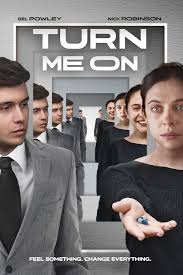
TURN ME ON
US, 2024, 99 minutes, Colour.
Bel Powley, Nick Robinson, Griffin Newman, Justin H. Min, Nesta Cooper, Julia Shiplett, Patti Harrison.
Directed by Michael Tyberski.
Two Academy Is a film for young adult audience, raising contemporary issues in something of her science fiction/fantasy context. But, the screenplay raises quite a number of key questions, especially about human freedom and decisions, that a significant for older audiences.
The screenplay posits a society where medication controls emotions. Life in the community, where people are often asked whether they are content, is something like a cult experience.
But, what if someone decided to disobey the, exercise freedom, defy the authority, and not take the medication, what would the consequences be.
The two central characters are played by Nick Robinson, in popular dramas like catalogue, Simon and Jurassic Park films, with British Bel Powley. The strange experience of having emotions leads her to persuade William and other friends to experiment with her.
The consequences for emotions, sexual experience, are presented in the context of the discovery of freedom and lack of experience as to how to handle this freedom.
So, what will be the consequences for the central couple, when William not take his medication, what about the others? What about the founder of the community and the defiance of authority?
One of the deeper philosophical/theological issues that the film raises is that of human freedom and how important it is, and not being controlled by authority beyond oneself. On the other hand, over the centuries, the experience of tragedies has often raised the issue of why God doesn’t intervene. The theological answer is that God graces us with our freedom – and having to cope with the consequences of the exercise of human freedom as well as the evolution of nature and sometimes disastrous consequences.
The screenplay for this film opts for human freedom, human choice, and not the imposition and intervention of a higher authority.
- The title, the tone, the activated? The contrast with the narrative of the medication turning people down?
- The setting, the community, like a University College, the apartment blocks? The exteriors, park and garden? The visit to the seashore? The interiors, the rooms, workplaces, meeting rooms, corridors? The musical score and atmosphere? And the insertion of popular songs and classical music?
- Science-fiction? Futuristic story?
- The basic premise, a controlling management, Our Friends? Recruiting, appealing to people who were depressed, needed some kind of hope? The Institute, the medication, suppressing emotions, suppressing memories, people becoming automatons, the tone of the greeting, “Are you content?”. The nature of this contentment, impassive?
- Couples put together, companions, no sexual attraction or activity? Cohabiting? The routines of getting up, the taking of the tablets daily? Going to work? The monotony of the work, the irony of Joy and her name?
- The opening, the television presentation, the founder and his encouragement? Later in the film, his television appeal, Joy listening? The other member of the staff seen, the doctor and explaining to Joy that she had cancer? Not to take the tablet? For a day? The later visit from the supervisor, the interrogation, to and fro, the indication that the scenario had been a test for Joy, that she had past, the invitation for her to become part of the management, her skill with people, her discovery of enjoyment, the television programs, comfort and freedom?
- William, with Joy, appointed as partner, cohabiting but no real emotion? The meeting with Frank and Michelle, newly appointed to the core group, Christopher and Samantha, his leadership? The nature of the meetings?
- Joy, not taking the tablet, the effect on her feelings, psychology, looking in the mirror, the prospect of cancer, her beginning to smile, to laugh, going to work, opening the boxes, discovering the rings? The talking with William, persuading him to not to take the tablet? His reluctance, his agreement? The consequences for him, smiling, coming alive?
- The discovery of their freedom, exercise of free will, the friendship, the love, the sexual attraction, the experimentation, “the Sinking”, the consequences for the relationship? Shared enjoyment?
- At the meetings, the other couples, the discussions, the possibility of them all not taking the tablets, the consequences? Emotions, love, lust, sexual reactions, Christopher with Joy, William and his being hurt, reaction? Samantha and Michelle, the mutual attraction, the exclusion of Christopher? Frank, his bewilderment? Christopher accosting Joy, William seeing this, her reaction?
- William, his being hurt, the description of the hurt and the physical and psychological consequences? His taking the tablet again? The reaction of the others, resuming the tablets, giving up their freedom? Security rather than risk?
- The future for Joy, in the management, the reliance plan placed on her, separation from William, yet the truth, her love for him, going to see him, his not taking the tablet, the possibilities for a future, into the unknown, exercising free will, the escape through the building, out into the countryside, at the barrier on the shore?
- The ending of the film, the option for freedom rather than control? For human living?
Death is a Woman
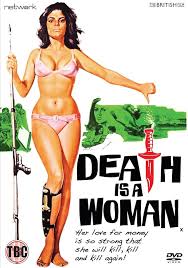
DEATH IS A WOMAN
UK, 1966, 80 minutes, Colour.
Mark Burns, Trisha Ann Noble, Sean Curry, William Dexter, Terence de Marney.
Directed by Frederic Goode.
Mainly for the record. Colourful thriller but not very good at all.
The setting is a Mediterranean island so quite an amount of colourful scenery. And undercover agent is sent to investigate drug deals only to find two main suspects killed, the audience seeing who did it. He is sent an assistant for the investigation. Part of his undercover assistance includes some flirtations and sexy sequences.
The brains behind the exploitation of the drugs and the money is Francesca, played by Australian Patsy Ann Noble, later calling herself Trisha Noble, daughter of notable Australian entertainers.
Mark Burns, leading men here, sometimes leading man but mainly supporting character in a career of over 40 years, is suspected of the murders and therefore becomes involved in the investigation, fighting with the murderer, interactions with Francesca.
More interesting are some of the oddball characters around the island, especially one who sits around, dishevelled, but knows the police, and helps in the investigation, played by Terence de Marney.
In the mid-1960s, there were a lot of British small-budget, brief adventures of this nature, rivalling television episodes but not particularly successfully.
We Bury the Dead
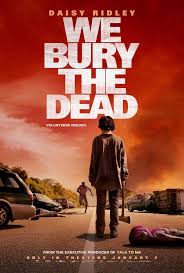
WE BURY THE DEAD
Australia, 2024, 94 minutes, Colour.
Daisy Ridley, Brenton Thwaites, Mark Coles Smith, Matt Whelan.
Directed by Zach Hilditch.
As with so many post-apocalyptic stories, the dead seem to have a life of their own before they are buried after being killed a second time.
The screenplay for this film does not use the word zombie but refers to those who have died and have some kind of continuing thread of life within them. And the situation is dire, a nuclear situation gone wrong, a brief visual indication that the US is to blame, an explosion along the east coast of Tasmania, centering on Hobart and its large population but affecting the surrounding coast and towns, half a million killed.
Many volunteers arrive in Tasmania, military and police control, the allotting of tasks, finding bodies, those with some continuing life in them, destroying and burying them, identifications. One of the volunteers is Ava, Daisy Ridley, whose husband has been attending a retreat weekend in southern Tasmania. A sympathetic guard allows her to become part of the squad for finding the dead, teaming her up with a divorced tradesman, from Melbourne, Clay, Brenton Thwaites.
While there are some grotesque moments, the emphasis is on the drama but not highlighting, as in some of the zombie films, the increasing menace of the threatening living dead. But Ava is eager to continue south, with the help of Clay, his motorbike, but a difference and his disappearing.
The next drama concerns Riley, Mark Coles Smith, military, on training in Queensland at the time of the disaster, returning home to find his pregnant wife. Suspicions, help, and a sense of betrayal and Ava’s determination to go further south, even walking.
The opening of the film did indicate something of the relationship between Ava and her husband, the wedding, the aftermath but intimations that all was not well, confirmed when she does eventually find him dead in the resort.
The film has been written and directed by Western Australia director, Zach Hilditch, whose previous film, Their Final Hours, also explored disasters and consequences. And, interesting to note concerning landscapes and coasts, while the film is set in Tasmania, the filming was done in Western Australia.
An interesting variation on the living dead dramas.
- Post-apocalyptic story – set in the present? In Australia, Tasmania, the destruction of Hobart? An American accident, incident?
- The Tasmanian settings, the countryside, the coast, the city of Hobart, the resort? But filmed in Western Australia? The musical score?
- The title and its tone, the words on never mentioned, the dead, some “coming online again”, the squad to identify, to destroy?
- Expectations of a zombie film, this film is different, comparatively few living dead sequences, threats, drama, but humanity? Need for execution? The difference, the central characters, personal stories, sense of humanity, identifying the dead, their lives, a and her search for her husband, Riley and his dead pregnant wife, the men digging the grave for his family, her helping him? A different tone?
- The background of the explosion, the explanations, the demonstrations in America, the visuals of the explosion, the aftermath, smoke, the number of people dead?
- A over at her story, in herself, her relationship with Mitch, the continued flashbacks, the development of the relationship, together, the dance, the wedding, the aftermath, explanation of morals, his going to the resort, her reading, committed search for him, the discovery of his body, the card for the woman, taking off his wing? Her response?
- Ava, volunteering, the large number of volunteers, their task, the military, seeds of detail of the work, identifying the bodies? And throughout the film the number places where bodies are discovered, single, vast assemblies of corpses? Ava teaming with a Play, his Melbourne background, building, separation from his family, unable to get out of his own way, his language? The work, working with a, the danger, finding corpses, those online, the killings?
- Clay, the motorbike, Ava persuading him to take her South, the ride, the visuals of the highway, the stranded cars, the dead? The authorities, the confrontation with Clay, Riley, Clay and his escape?
- The episode with Riley, sympathetic, intelligible with the military, finding his pregnant wife dead, the hopes, the decision to take a, at his home, his moods, the memories while, a in her clothes, the dance, the music and the earpiece, the effect on him, the effect on her, her reaction, the confrontation, her attack on him?
- The decision to walk, the episode with the man digging the grave, helping with the burial? Her finding the bed-and-breakfast, her husband, the woman, talking to her husband, eventually taking of her ring? The disappointment and disillusionment?
- Finding Clay, together, Clay and his future, Ava and her future?
Jimpa
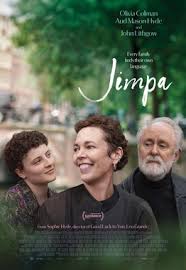
JIMPA
Australia, 2025, 113 minutes, Colour.
Olivia Colman, John Lithgow, Aud Mason-Hyde, Eamon Farren, Daniel Henshalll, Kate Box, Deborah Kennedy.
Directed by Sophie Hyde.
At the beginning of this film, Adelaide filmmaker, Hannah, played by Olivia Colman, is on a zoom interview concerning financing for her next film. She explains that she does not want conflict. The financiers say conflict is essential to drama. Hannah continues with the plan for her film. But, her understanding of conflict is differences talked over, sorted out, aiming for some kind of resolution, reconciliation. She is not talking about conflict in the sense of dominating and conquering.
This is a very personal film for writer-director, Sophie Hyde. So, she makes it film about preparing a film about her father. And, it is a fictional development of actual characters and events, Sophie Hyde’s father, Jim, marrying, having two children, coming out as gay in the late 1970s in Adelaide, continuing to for social issues until his death in 2018.
But, also based on reality, is the next generation of parenting. Hannah is married to quietly genial Daniel Henschel. Their 16-year-old child, Frances, has emerged as non-binary, exploring their self-identity. And, in fact, Frances is played by Aud Mason-Hyde, non-binary. Sophie Hyde and her husband, film editor, Brian Mason, are the parents in real life.
Family life and parenting have become so much more complex in recent times, and this film surfaces the issues, decisions of Jim (now Jimpa), the grandpa, played forcefully by John Lithgow, leaving his family, moving to Amsterdam as a more congenial setting for a gay man, but still in contact with them. Hannah wants to talk to her father about the making of her film, his opinions, his agreement. He is a powerful and dominating character, always talking, argumentative, heavily involved in social academia, often in the company of his ageing gay friends, relying on his assistant, Richard (Eamon Farren).
The film has some moments of direct frankness in its highlighting of Jimpa’s world. And, there is a complex focus on Frances, relationship with Jimpa, parental approval/not, wanting to stay with him in Amsterdam, discovering various personalities and behaviour in the queer community.
But the latter part of the film also focuses on serious illness, Jimpa, communicating or not, family gathering round him, an assessment of his life and influence.
As, with so many of the significant problems of life, issues need continuing probing and resolving
- The personal story of the writer-director, her father, her child, gender identification issues?
- The background of the Adelaide story, Sophie Hyde and her father, marriage, children, divorce, gay, championing gay rights? The background of Sophie Hyde and her partner, Brian Mason, their child, non-binary? And Aud Mason Hyde acting the part that corresponded to her in real life?
- The central character as a filmmaker, her career, preparing her film, the Zoom discussion with the financial backers, her not wanting conflict, their demanding conflict? The interspersing of Zoom interviews with actual actors as potential cast? Her concern, the writing, communicating with her father, getting his opinion, consent?
- The situation at home, Hannah, age and experience, the affable relationship with her husband, his gentleness, quiet, supporting his wife, supporting Frances? Frances, a 16, the issue non-binary, her experience at school, communicating with the students, their reactions against her? Her wanting to get out of the school?
- The family situation, Jim, as played by John Lithgow, the back story, the marriage in the 1970s, two children, the divorce, his coming out, going to Amsterdam, finding life there more congenial, the baths and pickups, his academic work and positions, gay rights, his gay friends, their company, getting older? Richard as his assistant, relying on him, the gay atmosphere?
- The decision for the family to go to Amsterdam, and wanting to discuss with her father, Frances wanting to meet him, the possibility of staying with him?
- Jim, grandfather, Jimpa?, Opinions, talking, taking over people? His response to Frances, to Hannah? The issue of his story, the film? The issue of his job, go to Helsinki, the interview, the rival for the job and meeting her party, his recommendation and the board interview in Finland, and the discussions? His retirement?
- Hannah, her reactions, the discussions, tensions, Hannah and her husband being protective of Francis, the range of discussions with Frances, Frances going out, the group, young, the queer community, the issue of sexual expression, the special friendship, seduction, agreement, the sexual experience, coming back, Jim’s reaction, her parents’ reaction? The possibility of Frances going to London with Hannah on her film work?
- Jim, his collapse, his illness, previous stroke, in the hospital, Hannah and her being with her father, talking, signals of pressing his hand, listening? Frances at the hospital? Hannah and her sister, the relationship, the past, her complaints and demands, with her father?
- The future, Hannah and her film (and Sophie Hyde actually making this film)? Her husband, Brian Mason being the editor of the film? The husband filming within the film? The rest of the family? Frances, decisions, relationships and identity? And the success of the film, Jimpa?
Four Mothers
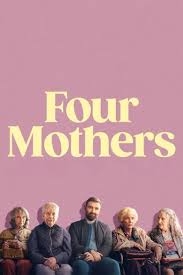
FOUR MOTHERS
Ireland, 2024, 89 minutes, Colour.
James McArdle, Fionnula Flanigan, Gaetan Garcia, Marie Ruane, Dearbhla Molloy, Rory O'Neill, Dane O'Sullivan, Gearoid Farrelly.
Directed by Darren Thornton.
An Irish film, very Irish film. But this is a story about a middle-aged novelist, on the brink of success, interviews, podcast, prospective American tour, getting over the complications of his early years, growing up, relationships. But, as with Irish and other stories, there is his mother.
In fact, this film is based on a brief 2008 Italian film, Mid-August Lunch, Pranzo di Ferragosto, this time middle-aged Italian son and his care for his imposing mamma.
However, this film multiplies sons and mothers fourfold. At the centre is James McArdle’s Edward, creative and diffident, worrying in his mind and imagination, at the beck and call of his mother. Not so much call, since she had a stroke and cannot speal – but very much at her beck, insistent, frequent, demanding, playing for sympathy.
Which would have made a film in itself. However, Edward has three close friends, each with very different personalities, who decide to go on a holiday together. And each of them has a mother. And there is the extra thing to mention is that they are all gay. So, all off to the continent for enjoyable vacation, except would with his mother. And they constantly contact Edward with their liberation and exhilaration, while he is at home with the four mothers.
And, all four mothers go to the house and Edward has to sleep in his car, they will demand different kinds of breakfasts, and different kinds of outings, to the doctor, shopping, to a karaoke club, while mother has a strong impulse for attending funerals. Edward has to adapt, sometimes graciously, sometimes with frustration. And, in their ways, the mothers respond to the attention that he gives them.
While many men in the audience will identify with looking after mothers, everyone, sons and daughters, will be observing the excellently drawn characters that the actresses play, led by veteran Fionnula Flanagan Edward’s mother.
The film seems to have touched a nerve with the public, winning popular awards at festivals and having rather longer than expected commercial seasons.
- Title and expectations? For sons?
- An Irish story, based on an Italian story, the ritual framework, the son helping the mothers, the complexities of the Irish story and interactions?
- The Dublin settings, homes streets and suburbs, aged care homes, the outings, the bus, the funeral, hairdressing, the karaoke bar, the visit to the medium and the Galway scenery…? The musical score?
- The focus on Edward, his age, gay, stories of his past experience, going to Sweden and his mother phoning, his relationship with Ralph, his friends, writing the novel, the acclaim, young adult audience, the gay theme, the publicists, the plans for the American tour? His own inner feelings, hostility towards his father and his father’s memory, his mother’s stroke, unable to speak, using machine, demanding? His visit to his friend, the therapist? The feelings of inadequacy, and the attacks?
- His friends, the decision to go on a holiday, the telephone calls, his friend and his mother at home, it is gay, what a holiday, taking over answer? The pressure on Edward as well is for the interviews, his notes, awkward interviews, the exasperation of the agent?
- The arrival of the mothers, the three sons depositing than others, into the house, Alma and her reactions, hostile first, then demanding on Edward to take care of the women?
- The personality of the mothers, the very Catholic mother, church, sides of the Cross? The town mother? The unmarried mother and her interests, more pleasant personality?
- The arrival, the rooms, the demands, Edward having to sleep in the car, the breadth the situation, his range to the store, preparing breakfast? Reliance on Raff and the bus? The tension between him and Raff the past relationship? Raff’s new relationship?
- The outings, in the bus, Alma and her dominance, to the funeral, the mother and her fussing, serving, washing up, introducing the glory woman to Edward? Alma and getting her hair done? The return home, the women watching television, the opening up, the discussions? And Edward in the car once again, his nightmare about his voice changing in the interview?
- The demands of the women, seeing the medium television, wanting to go to Galway, his exasperation, Raff on the bus, the welcome from woman, the motivations, wanting to know about their husbands? The pigeons and the shooting? The cards, the messages, her descriptions of each of the men and their messages to their wives, reassuring? The messages father to Edward and his reaction?
- The men on holidays, the phone messages, the images?
- The Zoom setup, Edward and his wanting to give up the tour? Reactions?
- Jean, getting the taxi in the night, it pursuing her, the karaoke bar, her singing, bringing her back, the quiet conversation? The drink together?
- The men returning home, the women going home after the experience, the changes? Edward and the men? The party, Raff and his partner and the celebration?
- Edward, the challenge for his mother, giving him the space?
- His going to America, enjoying the travels, the interviews?
- The blend of serious themes, Irish treatment, Irish comedy?
Last Days of Dolwyn, The
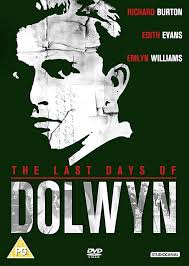
THE LAST DAYS OF DOLWYN
UK, 1949, 95 minutes, Black and white.
Edith Evans, Richard Burton, Anthony James, Emlyn Williams, Hugh Griffith.
Directed by Emlyn Williams.
Interesting film from 1949 for many reasons. It was typical of British filmmaking after World War II, some austerity in production, black-and-white photography, return to social themes from 50 years earlier in the 1890s, consequences of the Industrial Revolution, Welsh villages.
There is also the personal theme of the man ejected from the village, returning to wreak his revenge.
The film was written and directed by playwright-actor, Emlyn Williams, Night Must Fall, The Corn is Green. And he plays a central role in this film.
But, in retrospect, the film is very interesting as the first film from one of Wales’s most famous actors, Richard Burton. Within five years he was in Hollywood appearing in such blockbusters as, the Robe. And, of course, a famous and notorious life and career.
It also was the emergence of Edith Evans as a significant screen actress, famous on stage, moving into film, celebrated for her lady Bracknell in The Importance Being Earnest and an Oscar nomination in the 1960s for The Whisperers.
- Basic British filmmaking of the late 1940s, script, direction, cast, settings and local Welsh photography? Remembering the 1890s? Local issues, Welsh communities in villages? Industrial Revolution and consequences?
- The black-and-white photography, authentic feel, the village, the mountains, the dam? The Chapel, interiors? The Welsh singing, choirs?
- Mr Davis, snob, from England, his back story, a child, accusations of thieving, his being ousted? Wanting revenge? The minister giving him a lift, the initial clash about preaching? Coming to the village, outside the Chapel, listening to the homily? The people coming out, his accommodation, talking with the singer? Wanting to be driven a carriage to Lady Dolwyn’s house?
- The initial atmosphere of Welsh life in the 19th century, community, enclosed, not travelling, the Chapel, the whole community, listening to the sermon, Welsh language, life in the town, Lady Dolwyn and her daughter, going to the Chapel? Mary, the back of the Chapel, tidying, the death of her child 20 years earlier, adopting the boys? Running the shop?
- The emerging of the issue, the need for water in Lancashire, the exploitation of the Welsh water, Davis and his route through the valley, his revenge, his speeches, the offer of money, the discussions amongst the people, whether to sign or not, the money, the moved to Liverpool, work in the mills? Signing?
- Gareth, returning from Liverpool, his explanation of the trams, people unfriendly…? His brother wanting to go to Liverpool? The bonds between the adopted sons and their mother? Gareth, attracted to the aristocratic daughter, in the woods, the glove, failure to speak, the later attractions, at the social, dancing, the bonding? The other brother working at the family mansion?
- The Minister, his warnings, unmasking Davis?
- Mary, unwilling to go, discussions with her sons? Her visit to Lady Dolwyn?
- Davis, Mary and the document for her house, not wanting to sell? Davis going to the dam, to flood the valley? His return, the confrontation with Mary, Gareth and the fight, the fire, on fire, Mary wanting the doctor? His death?
- The community waiting in the hills, apprehensions?
- Mary, the discussions with Gareth, the dead body, her decision, conceal the body, her going to the dam, and her causing the flood?
- Her returning to the people on the hill – and the openness to the future?
