Displaying items by tag: John Waters
2: 22
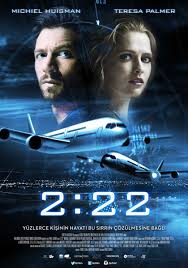
2: 22
Australia/US, 2017, 98 minutes, Colour.
Michiel Huisman, Teresa Palmer, Sam Reid, John Waters, Kerry Armstrong, Maeve Dermody.
Directed by Paul Currie.
While the film is billed as an American science-fiction drama, it is actually an Australian production, filmed in Sydney, most of the cast being Australia. The main exception is the leading man, media house, American.
The film was not successful on its release, billed as the film with the least box office 2017. However, it has had a firmer further life on television and streaming.
Michelle Houston plays an air traffic controller with some kind of psychic powers. However, in cycling through New York City, he has a lot of repetitious, déjà vu sites and experiences, especially at Grant Central Station, and everything, an ageing at the time of 2:22.
He has to give up his traffic controlling work when there is almost an accident – and the encounters a heart dealer, Teresa Palmer, who was on the plane. She also has a boyfriend, an artist, played by Sam Reid, who deals in holograms.
So, while there are the romantic complications in the present as well is the mystery of 222 and the characters and sites that are seen, it then becomes a link to a death 30 years earlier, the day that the two central characters were born, and some kind of dramatic psychic connection between those events and the present.
Which means that the audience does have to pay attention to sort out the various threads of the plot. The film looks quite good, the two central characters sympathetic. A science fiction/fantasy pastime.
- Silence-fiction? Science fantasy?
- The Australian production, filming in the US and Australia? American style, Australian supporting cast? The recreation of New York City, apartments, Grand Central station, Kennedy airport and flight control? The musical score?
- The title, the time, Dylan and his experiences, his interest in stars, constellations? His background, family, training, fear of flying, flight control? His friendships? His hallucinations? Saving the planes from colliding? Being suspended?
- His life, his apartment, his interests, the encounter with Sarah, his ticket to the aerial ballet, talks with Sarah, the audience having seen her on the plane about to crash? Her life and work, the art gallery, Jonas and his work? Dylan going to the exhibition, the holograms, the characters and situations of his 2:22 situation, his mad outburst and destructive?
- Travelling in New York City, the camps, the recurring situations, same people, talk, the businessmen, the children, the pregnant woman, 2.22, the electrical fault?
- The bond with Sarah, the sharing the same birthdate? Dylan and the information about the past, the events it Grand Central, Jake and Evelyn? 30 years earlier, the stars and constellations?
- Dylan, realising that he and Sarah had to relive the 30 years events of the past, Evelyn as the dead woman, his going to see Catherine her sister, the discussions, Catherine sceptical?
- Jonas, wanting to go away with Sarah, Dylan and his finding that Jake, the alleged murderer, lived in the apartment, the search, the discovery of the letters, reading the stories? Confiding in Sarah? Her hesitation?
- The buildup to the climax, the repetition at Grand Central, Jonas, his reliving the murderer, Jake and Evelyn victims, Jonas shooting at Sarah, Dylan intervening and shot, recovering? Jonas shot by the police?
- The aftermath, happiness, stillness pilot, Sarah and the baby?
Better Man
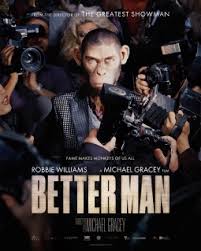
BETTER MAN
Australia/UK, 2024, 134 minutes, Colour.
Robbie Williams, Jonno Davies, Steve Pemberton, Alison Steadman, Kate Mulvaney, Damon Herriman, Fraser Hadfield, Raechelle Banno, Tony Budge, Anthony Hayes, John Waters.
Directed by Michael Gracey.
Whether you know all about British singer, Robbie Williams and his extensive and successful career, or whether you know nothing about him, this film is an extraordinary cinema, cinematic, experience.
It is based on the Robbie Williams memoir. And, while this film might be called a portrait or a biopic, it takes a different path from the usual. It is an overview of William’s career (though checking on his initial years in the boy band, Take That, then his solo career, reuniting with Take That, collaborating with many artists, tours, it reveals that there is far far more to his activities and success than the film indicates). But, it might be also described as a portrait of Robbie Williams psyche, his confidence and lack of confidence, his self-image, self-deprecating yet highly assertive, alcohol and drug addiction for many decades, erratic antics and behaviour, exploration of family connections, and massive success and awards which might have been his hopes but more than his expectations.
And, the way to do this? The device of Robbie Williams appearing as a chimpanzee. On paper, this might have sounded too risky. However, in the introductory sequences, Robert as a little boy, bullied, emulating his singing father, concern from his hard-working mother, support from a doting grandmother, he does appear as a chimpanzee and the audience is willing to accept this. And, a tribute to British actor, Jono Davies, who appears for the most part as Williams, the Robbie Williams himself, behind the mask, as himself in his later years. With the chimpanzee prosthetics and CGI effects, Davies is still able to create a credible and complex character, in performance, in song, in his torments.
Much of the film was made in Australia Australian director, Michael Gracey (with a background of visual effects and commercials), who entertained audiences with The Last Show man. There are some British actors like Jono Davies, Steve Pemberton as Pete Conway, Williams ambitious to entertain father, and a pleasing Alison Steadman as the devoted grandmother. But, a great number of the rest of the cast are Australians, led by Damon Herriman as producer, Nigel Martin Smith, Kate Mulvaney as William’s mother, Anthony Hayes as producer, and even veteran John Waters as Michael Parkinson in an interview.
To describe this portrait as a “warts and all” expose is an enormous understatement!
So, while the device of having Williams appear in monkey form tells us to look at him differently, especially in his depressed moments, seeing hostile chimpanzee variations of himself in the audiences, condemning him, there is a great deal of virtuoso filmmaking, special effects and editing, for instance a huge musical extravaganza sequence in Regent Street in London, the crowds at the Williams concerts and their adulation, contrasting with quiet moments of personal anguish, the sequence of the funeral of his grandmother.
For those who have followed Williams for more than 30 years in his career, the Take That era and his solo career, there is an enormous range of his songs included here. But the whole film is framed by one song that highlights the initial ambitions, the ups and downs of the career, the downs and ups of personal life, the seeking of help, coming through with the lyrics of doing all he could to become a Better Man, the song lyrics for William’s life, especially as he stands on stage singing with his father, enabling his father to take a bow, the Frank Sinatra-gospel affirmation: My Way.
- Title, Robbie Williams and his song, his ambitions to be a Better Man while doing it “My Way”?
- Audience knowledge of Robbie Williams, his career, popularity, awards? The boy band, Take That? His solo career? Preparations? Songs and lyrics? Ups and downs? How much does audience knowledge of him affect the response to the film?
- The film based on Williams’ memoir, his honesty, being candid, warts and all, strengths and failures? His origins, bullied as a boy, love of music, his father and his singing, entertaining, leaving, the separation for long years? His working mother and support? His doting grandmother? Her encouragement, his ability to sing, the enjoyment of the Pirates of Penzance concert, nervousness, showing off, applause?
- The impact of the device of his appearance as monkey, “less evolved than other people”, the psychological effect for the audience, acceptance, interpretation? His own self-image? The aptness of the monkey facade, appearance? And the audience accepting this throughout the film? The versatility of Jono Davies performance’, acting, singing, stagecraft, but also the brooding and quiet episodes? And the effect of the various images of himself, monkeys, in the audience, criticising and condemning him? And, in the final sequences, Robbie Williams himself?
- The film as a psychodrama, Robbie Williams commentary on himself, his ambitions and hopes, yet putting himself down, comparisons with his father, bullied at football, the success in the play at school, the joining with the young men of Take That, the role of Nigel Martin Smith, organiser, shrewd, getting performances, rehearsing, songs and lyrics, Gary Bowler as the lead, yet Robbie Martin lead singing, Smith naming him Robbie, the impact and range of performances of the songs?
- Williams at 16, in his teens, success, the gay clubs, popularity, the concerts for young women and their acclaim? The effect on Williams? Self-image, clashes with the group, spoiling performances, acting like a spoiled brat? Depression sequences, the driving, the oncoming vehicles, swerving into the water, the swarm of fans in the water, his coming to the surface?
- The possibility of going solo, Chambers changing him, listening to the song, arranging it, the continued collaboration over the years?
- Success, his father, his entertaining in the small clubs and groups, changing his name, leaving, pride in his son, turning up after many years, trying to make contact? The support of his mother, her presence at the concerts, with his grandmother? The crucial moment of his performance, his mother phoning, the news of his grandmother’s death, the transition to the cemetery, the burial, and his later taking the TV to her grave? (And the very British touches with their watching the two Ronnies – and the image of the two Ronnies towards the end of the film?)
- Success, reviews, concerts, collaborations, tours? The interview with Michael Parkinson, sitting on his lap, the smart remarks, self-confidence and self-doubt?
- The significance of the group therapy encounter?
- The encounter with Nicole Appleton, on the boat, her gradual revelation herself, the communication, the relationship, the significance of Oasis and the comparisons, Liam Gallagher, the drugs? The break with Nicole, at the house, his secluding himself in the bathroom, her shock, leaving him?
- His ambition to play at Knebville, the discussions, eventually arriving there, the crowds, the performance, the doubts, the surreal image of his fighting the battle with all the images of himself and conquering them?
- The portrait of the members of Take That, in themselves, their talent, the success, the clashes with Robbie, his leaving, Nigel Martin Smith and his contempt for Robbie, watching him leave? But the later reconciliation with Gary and the others? Performances?
- The finale, on stage, his father present, the background of their confrontation, Gary lying on the water, his father going into the water, the interchange, Robbie wanting his father support for Robert? His father’s self-awareness, at the concert, on stage, their singing together, his father finally taking a bow having said he was happy just to entertain one person with all that he had?
- Robbie Williams aged 50 at the time of the release of the film, looking back at his life? And life ahead?
