Displaying items by tag: Hugh Griffith
Last Days of Dolwyn, The
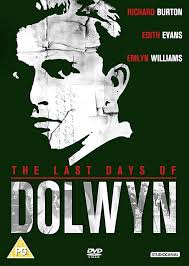
THE LAST DAYS OF DOLWYN
UK, 1949, 95 minutes, Black and white.
Edith Evans, Richard Burton, Anthony James, Emlyn Williams, Hugh Griffith.
Directed by Emlyn Williams.
Interesting film from 1949 for many reasons. It was typical of British filmmaking after World War II, some austerity in production, black-and-white photography, return to social themes from 50 years earlier in the 1890s, consequences of the Industrial Revolution, Welsh villages.
There is also the personal theme of the man ejected from the village, returning to wreak his revenge.
The film was written and directed by playwright-actor, Emlyn Williams, Night Must Fall, The Corn is Green. And he plays a central role in this film.
But, in retrospect, the film is very interesting as the first film from one of Wales’s most famous actors, Richard Burton. Within five years he was in Hollywood appearing in such blockbusters as, the Robe. And, of course, a famous and notorious life and career.
It also was the emergence of Edith Evans as a significant screen actress, famous on stage, moving into film, celebrated for her lady Bracknell in The Importance Being Earnest and an Oscar nomination in the 1960s for The Whisperers.
- Basic British filmmaking of the late 1940s, script, direction, cast, settings and local Welsh photography? Remembering the 1890s? Local issues, Welsh communities in villages? Industrial Revolution and consequences?
- The black-and-white photography, authentic feel, the village, the mountains, the dam? The Chapel, interiors? The Welsh singing, choirs?
- Mr Davis, snob, from England, his back story, a child, accusations of thieving, his being ousted? Wanting revenge? The minister giving him a lift, the initial clash about preaching? Coming to the village, outside the Chapel, listening to the homily? The people coming out, his accommodation, talking with the singer? Wanting to be driven a carriage to Lady Dolwyn’s house?
- The initial atmosphere of Welsh life in the 19th century, community, enclosed, not travelling, the Chapel, the whole community, listening to the sermon, Welsh language, life in the town, Lady Dolwyn and her daughter, going to the Chapel? Mary, the back of the Chapel, tidying, the death of her child 20 years earlier, adopting the boys? Running the shop?
- The emerging of the issue, the need for water in Lancashire, the exploitation of the Welsh water, Davis and his route through the valley, his revenge, his speeches, the offer of money, the discussions amongst the people, whether to sign or not, the money, the moved to Liverpool, work in the mills? Signing?
- Gareth, returning from Liverpool, his explanation of the trams, people unfriendly…? His brother wanting to go to Liverpool? The bonds between the adopted sons and their mother? Gareth, attracted to the aristocratic daughter, in the woods, the glove, failure to speak, the later attractions, at the social, dancing, the bonding? The other brother working at the family mansion?
- The Minister, his warnings, unmasking Davis?
- Mary, unwilling to go, discussions with her sons? Her visit to Lady Dolwyn?
- Davis, Mary and the document for her house, not wanting to sell? Davis going to the dam, to flood the valley? His return, the confrontation with Mary, Gareth and the fight, the fire, on fire, Mary wanting the doctor? His death?
- The community waiting in the hills, apprehensions?
- Mary, the discussions with Gareth, the dead body, her decision, conceal the body, her going to the dam, and her causing the flood?
- Her returning to the people on the hill – and the openness to the future?
Take Me High
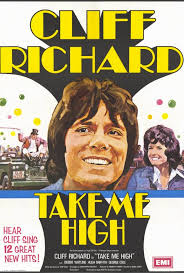
TAKE ME HIGH
UK, 1973, 91 minutes, Colour.
Cliff Richard, Debbie Watling, Hugh Griffith, George Cole, Anthony Andrews, Richard Wattis.
Directed by David Askey.
Not exactly a 21st century entertainment! Rather, of interest for more historical reasons.
This was the last main feature film for popular singer, Cliff Richard, emerging at the age of 19-20 as a singer, and actor in such films as espresso bongo, but then moving to some popular musicals. After Take Me High, his main screen presence was a long list of music videos.
Rather surprisingly in this film, he plays a merchant banker, in Birmingham, working with Anthony Andrews, surprising to see him so early, soon to be in The Scarlet Pimpernel and his key role in Brideshead Revisited. Cliff Richard is not entirely persuasive as this kind of banker, especially when the script asks him to be something of a mastermind in financial deals, one up and ship towards his partner. The deals are between Hugh Griffith, highly overacting at first, then agreeably punctures, remembering his Oscar for Ben Hur as well is his presence in Tom Jones. He is conservative, a Birmingham family traditions, contrast with George Cole as a more left-wing representative.
Debbie Watling plays a manager a restaurant who has financial problems with the company, links up with Cliff Richard, inventing the new hamburger, the Bromberg. Longtime comedian, Richard Wattis, has a role as the head of the banks in one of his final performances.
Filmed on location in Birmingham, the city, the canals, the streets and parades… It has a listed soundtrack of 15 songs. The credits focused close-up of Cliff Richard singing but many of the songs, most of them, directly son as background to the action.
A belated attempt to have Cliff Richard as a film star – but, he continued his long career, is a popular singer.
