Displaying items by tag: Bill Camp
How to Make a Killing
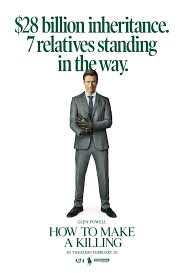
HOW TO MAKE A KILLING
US, 2026, 105 minutes, Colour.
Glen Powell, Margaret Qualey, Jessica Henwick, Bill Camp, Ed Harris, Topher Grace, Zach Wood, Andrew Lukis.
Directed by John Patton Ford.
Quite a slick 21st century American entertainment, the world of wealth, loss of wealth, ambitions, amoral, turning immoral, murder – murders.
And a generally glossy affluent setting, some moderate hardships in New Jersey, the affluent world of New York. And, leading the cast is popular Glen Powell, several starring roles each years since his break out in Maverick, along with Margaret Qualley, an even more frequent screen presence in recent years.
This is a murder drama, a touch of the serious, a touch of the satiric, not intending to be a film for thoughtful reflection on ethical and moral issues – though, there is quite an unexpected twists towards the end which certainly gets the central character thinking.
In the final credits, there is an acknowledgement that this film was inspired by the 1949 British film, Kind Hearts and Coronets, and the novel on which was based. This was a film, certainly, from another era, effective serious/satiric British filmmaking, and the famous tour-de-force performance by Alec Guinness playing all those to be murdered by the ambitious central character.
The origins of How to make a Killing may be of little interest to the 21st-century audience. However, those who remember and appreciated the original have the advantage of knowing what is going to happen. But, they will have the regrets that while there are victims here to be killed, they are played by a varied including Bill Camp, Topher Grace and, ultimately, Ed Harris.
So, the audience is invited to have sympathy for Glen Powell’s ability to bring grinning charm despite his ordinary upbringing even though he discovers he is heir to millions. He is Beckett Redfellow, his pregnant mother disowned by her wealthy father, having to go to work, and Beckett finishing up in a clothing store.
As a boy, he fell for the charms of the rather dominating Julia who grows up to be the dominating Margarette Qualey, false charms, ready to twist any man around her little finger. And she does.
The screenplay, remembering the original, has the whole story told in flashback, Beckett on death row, execution imminent, and the prison chaplain, a serious priest, asking the question and spending the whole film listening to Beckett’s interesting story and his murderous quest for his fortune – including quite the finale and the deathly confrontation with his grandfather.
The unexpected twist towards the end leads the story in a somewhat different direction.
An easy night out kind of entertainment.
- The 21st century American entertainment, ambiguous hero, romantic entanglements, ambition and greed, murders, the law?
- The credit with the note about Kind Hearts and Coronets, 1949, inspiring this film?
- Beckett Redfellow, his story, in death row, execution close, the arrival of the priest, prison chaplain, Beckett telling his story, the priest listening, his interventions, encouraging? The execution time, the prayer?
- The flashbacks to the past, Mary, wealthy family, her dominating father, the attraction, the date, her pregnancy, the birth sequence, the father collapsing and dying? Her father confronting her, denunciation, cutting her off? Bringing up her baby, encouraging him, her hard work, Beckett as an adult, his life, prospects?
- Explaining the issue of money, the family, the family tree, those between him and the fortune?
- His mundane life, accommodation, his job, the clothing store, Julia arriving, the flashbacks to the flirtation in the past, her being dominating, his response? In the store, memories, announcing her engagement? His having to give up his job because of the owner and replacement? Going to the warehouse, working there, the beginning of his plan? The encounter with his uncle, sympathetic, giving him the job, privileges?
- The first victim, playboy, extravagant, wild scenes, on the yacht, Beckett present, the plan, the rope, the anchor, his death?
- The final sequence – and the repetition for each of the victims?
- Noah, music and art, the gallery, the encounter with Beckett, the discussions, friendship, revelations, Noah and his death?
- The FBI, the couple, the interrogations?
- Stephen, money, swindles, religion, his following, his speeches, Beckett pretending to interview him, the boastful interview, the sword, the revelation, Stephen’s many enemies, the contrivance of his death?
- The aunt, the adoptions, her charity, her personality, her teeth, the whitening, her death?
- Julia, her continued appearances, dominating, charm and ruthlessness, her husband, his inefficiency, wealth, losing, her asking for the loan, the various visits to Beckett, seductive and tantalising, the ultimatum? The timing, blackmail, Beckett hurrying to the office, the encounter with Lyle, the confrontation, collapse, the FBI, the accusation, the evidence, the murder?
- Ruth, her relationship with Noah, about to break it, the attraction to Beckett, him to her, her life, working in the garment industry, the outings with Beckett, his falling in love with her, the time together, the proposal, the plan for the engagement, the party, and their fashionable apartment?
- Beckett, prospering, arrogant, wealth, lifestyle, the meetings of the wealthy board, his uncle, his uncle’s collapse and death?
- His grandfather, personality, in the shadows, emerging, inviting Beckett to dinner, his dilemma about his engagement party, his arrival, the vast mansion, the meal, the discussions, the grandfather and his rifle, eating attacking his grandson, Beckett and his defence, firing the arrows, the death of his grandfather? His hurrying back to the party? Ruth and her waiting, her decision to walk out on Beckett?
- The arrest, the irony of his being arrested for a murder he did not commit? Interrogation, the evidence, the trial, being found guilty? Julia, her testimony, talking of Beckett always loving her? Julia with the incriminating photos?
- His finishing his narration for the priest, going to execution, the stay, Julia and her letter assisting him, her visit to the prison, the breakup, his desperation? Her deal, his signing away all his wealth to her?
- The finale, the priest in the bar contemplating what he had heard, Beckett released, Ruth, meeting him, giving him the hair token of his mother which he often looked at, motivation, her driving away? Julia in the parking lot – and future, Beckett subservient to her?
Mastermind, The
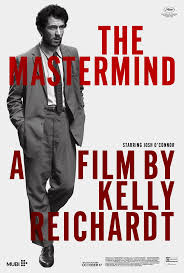
THE MASTERMIND
US, 2025, 110 minutes, Colour.
Josh O'Connor, Sterling Thompson, Alana Haim, Jasper Thompson, Bill Camp, Hope Davis, John Magaro, Gabby Hoffman, Amanda Plummer..
Directed by Kelly Reichardt.
Many films specialists, noting the information, written and directed by Kelly Reichardt, is sufficient for them to want to see this film. (Over 30 years, Kelly Reichardt has directed only 10 feature films and a number of short films but has built up a reputation with a range of American stories, often with a focus on women, but also offering food for reflection on American history and society.
And this continues with this film, a museum robbery, specifically inspired by the 1972 robbery of the Worcester Art Museum in Massachusetts, in which two Gauguins, a Picasso, and a Rembrandt were stolen. Her interest, however, is not so much in the robbery but on the character, the mastermind of the title (though, looking at his career, the title is quite ironic), his behaviour in the aftermath of the robbery and exposure. Some commentators refer to the film as an “anti-heist” film.
The setting is 1970, upheaval in the United States at the end of the 60s, social unrest, but, especially, the background of the war in Vietnam.
The central character is played by Josh O’Connor, busy with releases in 2025, The History of Sound as well as Wake Up Dead Man. He is a family man, a carpenter, unemployed, in need of money, planning the stealing of artwork from the local gallery, hiring three petty criminals, not vetting them in any mastermind kind of way, their exposing him, his trying to rationalise, his wife leaving him with the family, his wanting money from his mother, his father a judge critical about the lack of ambition of the thieves.
The mastermind is abducted by the criminals, gets away, but with public knowledge about his crime, he begins an odyssey, getting lifts, trying to survive, lack of money, going to a friend from the past but moved on by the friend’s wife, his continuing on the road and an uncertain ending as he steals a woman’s purse, tries to escape through the Vietnam war protest and is elected arrested.
Many audiences, Kelly Reichardt fans, welcomed the film. For many others, even some who admire Kelly Reichardt, have found the film difficult to sit through, the pace, the unsympathetic central character… (Which was the experience of this reviewer.)
- The title, for James Mooney, accurate, ironic?
- The 1970s setting, social upheaval in the US, financial difficulties, the background of the Vietnam war? Re-creation of the period? The musical score?
- The initial plot, Mooney, the stealing of the car, the backing out of the driver, his choice of the two colleagues, the plan to steal the art, at the gallery, removing the paintings? His associates, Gibson and his rations, pulling the gun, later robbing the bank? Guy asking for more money?
- Mooney at home, his wife, family, relationship with Tommy? His mother and giving him money? His father, judge? His comments about the lack of initiative by the thieves?
- Mooney, having to cope with situations, sending his wife and family away, keeping his son, taking with him? The confrontation with Guy? The setup, the criminals, the abduction? The consequences?
- Mooney, getting away, on the road, money, surviving, his situation becoming public? The alienation of his wife, the phone calls?
- Going to stay with his friend, Fred and his wife, their life together, memories of the past, Fred and his wariness, the wife, her making the connection with the professor to act as a fence for the paintings, his being sent away?
- His plans, on the road, stealing the woman’s purse, trying to escape through the Vietnam war protesters, his being arrested? And then?
Salem's Lot/ 2024
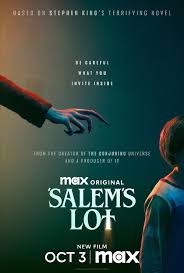
SALEM'S LOT
US, 2024, 170 minutes, Colour.
Lewis Pullman, Mackenzie Leigh, Jordan Preston Carter, Alfre Woodard, Bill Camp, John Benjamin Hickey, Spencer Treat Clark, Plou Asbaek, Alexander Ward, William Sadler.
Directed by Gary Dauberman.
Salem’s Lot is one of Stephen King’s earliest works. It has been filmed several times, most successfully for television.
Here is a 21st-century version – which has not received the hoped-for acclaim.
It is a story of a town in Maine, Stephen King territory. There has been atmosphere, disturbing, in the town, and a writer returns to investigate his past. His played by Lewis Pullman. At the same time, a wealthy man buys a property and imports a large box – revealed to be the container for a vampire.
So, this is a vampire film, strikingly visual as regards the vampires but their behaviour resembling that of many zombie films.
The writer is attracted to a young woman in the estate agency, dominated by her mother who eventually turns out to be the servant of the vampire owner. There are sympathetic characters in the town, especially the school principal. The most sympathetic character is a young boy, Jordan Preston Carter being a strong screen presence. He is bullied, discovers, to his horror, that some of his young close friends who supported him have become vampires.
There are not so many surprises in the vampires taking over except the death of the young woman, so no ultimate romance. But the school principal is taken over – played by Bill Camp. On hand is the local doctor, very tough, played by Alfre Woodard.
One of the most interesting features is that the town streets are deserted, no cars, discovering them all at the drive-in, the zombies in the boot of the car, ready to emerge as soon as darkness falls. One of the best features is the young boy driving a car, knocking down the drive-in screen so that the sun burns up the emerging vampires.
However, there are some ultimate confrontation is very little of a happy ending.
- A Stephen King novel? Previous film and television versions? 21st-century interpretation?
- Atmospheric horror, the mysterious removal at the opening, ominous sense, the box, is one, the dirt…? Setting the tone?
- Salem’s Lot as a Maine town, atmosphere, small, homes, diner, schools…? The musical score?
- The arrival of the visitor, renting the old house, the storing of the coffin? Mysterious?
- The school, the boys, the bully, Mark, Danny and his friends, the second attack, Mark tripping him, the fight, the principal, breaking the fight, supportive of Mark? Mark and his family?
- Ben, driving into town, his past story, growing up, parents killed in the crash? His career as a novelist? Looking for accommodation, Susan and the book, realisation of who he was? Later visiting him, the attraction, discussions, the scene at the drive-in? The sexual relationship? Her back story, her possessive mother?
- Barlow and his background and dominance? Straker and his role in the town? The young boys, families? the range of town characters – and the preparation for them to be vampirised?
- Ben, his presence in the town, interactions with people, memories of the past, Susan’s mother warning him off? His research?
- The time, the dark, the manifestations of the vampires, their appearance, zombielike behaviour?
- The taking of the town, the various confrontations, including Susan? The school principal, the caretaker, his intervention, his becoming a victim?
- The doctor, her role in the town, tough, sceptical, becoming involved? Susan’s mother and antagonism?
- The buildup to the climax, Mark and his interventions, his family? The other boys – and the scenes of their being pursued in the forest, taken over by the vampires? Vampires themselves, their appearances, confrontations?
- The means of warding off the vampires, the crosses and the light, on the vampires’ faces, and the personal interventions, especially Mark and his young friend? The attempts to resuscitate Susan, her turning on them?
- Mark, using his wits, into the house, locked in, escaping, the drive-in? The absence of cars on the streets, all at the drive-in? The huge screen? Looking in the boot of the car, the vampires all hidden? The setting sun, the coming of the darkness, trying to open Barlow’s coffin? The dark and the vampires emerging at the drive-in, Mark and his driving, knocking down the screen, prolonging the light, and the light consuming the vampires? The buildup to the final confrontations, Susan’s mother shooting the doctor? Mark arriving and knocking her down?
- Surviving, Mark and Ben, and driving out of Salem’s lot?
