Displaying items by tag: Frederic Goode
Death is a Woman
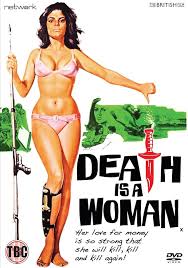
DEATH IS A WOMAN
UK, 1966, 80 minutes, Colour.
Mark Burns, Trisha Ann Noble, Sean Curry, William Dexter, Terence de Marney.
Directed by Frederic Goode.
Mainly for the record. Colourful thriller but not very good at all.
The setting is a Mediterranean island so quite an amount of colourful scenery. And undercover agent is sent to investigate drug deals only to find two main suspects killed, the audience seeing who did it. He is sent an assistant for the investigation. Part of his undercover assistance includes some flirtations and sexy sequences.
The brains behind the exploitation of the drugs and the money is Francesca, played by Australian Patsy Ann Noble, later calling herself Trisha Noble, daughter of notable Australian entertainers.
Mark Burns, leading men here, sometimes leading man but mainly supporting character in a career of over 40 years, is suspected of the murders and therefore becomes involved in the investigation, fighting with the murderer, interactions with Francesca.
More interesting are some of the oddball characters around the island, especially one who sits around, dishevelled, but knows the police, and helps in the investigation, played by Terence de Marney.
In the mid-1960s, there were a lot of British small-budget, brief adventures of this nature, rivalling television episodes but not particularly successfully.
Hand of Night, The/ Beast of Morocco
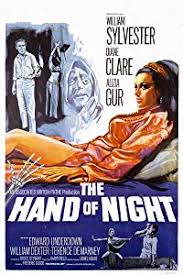
THE HAND OF NIGHT/BEAST OF MOROCCO
UK, 1968, 90 minutes, Colour.
William Sylvester, Diane Claire, Alizia Gur, Edward Underdown, Terence De Marney.
Directed by Frederic Goode.
The Hand of Night is a small budget blend of horror and adventure in Morocco. It was filmed on location in Morocco, directed by Frederic Goode who also made The Syndicate in Kenya the same year – and using the same star, William Sylvester (who, also in that year, starred in Stanley Kubrick’s 2001: a Space Odyssey).
The film opens with sinister nightmarish behaviour – which turns out to be a nightmare for the central character on a flight. The fellow traveller in the next seat, played by Edward Underdown, also appeared in the dream, carrying a cough and in a sinister cave.
The central character was driving when his wife and daughter were killed in an accident and this haunts him, escaping to Morocco, becoming involved with archaeologists, a sinister presence called Omar, and the tomb of the vampire Princess. He becomes involved with the vampire and finds it hard to tell whether this is reality or fantasy.
On the one hand, this is 1968 in Morocco, a modern city, a lot of sequences are driving around the city and through the countryside. On the other hand, with the excavations, the story of the vampire Princess, her threats, and the involvement of the niece of the archaeologist, the film builds up touches of romance, the abduction of the niece, her final rescue – and the decision to finally impale the vampire.
Of historical interest for those who wonder about small budget filmmaking in England in the late 1960s.
Syndicate, The/ 1968
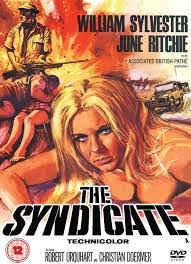
THE SYNDICATE
UK, 1968, 63 minutes, Colour.
William Sylvester, June Ritchie, Robert Urquhart, Christian Doermer, John Bennett.
Directed by Frederic Goode.
A small-budget action adventure film, shot on location in Kenya. The release was delayed and the initial version, over 100 minutes, was edited to 63 minutes for general release.
A team go to Kenya for uranium exploration. The leader is alcoholic, Robert Urquhart overacting, travelling with his wife and very suspicious of her, June Ritchie perhaps under acting. The principal character is a failed American pilot, William Sylvester, in with the British team, falling in love with the wife, having to take final action. There is a young German entrepreneur explorer, Kristian Dermer.
Most of the action takes place in travelling to the uranium site, the locals digging, suspicions and a whole range of suspicious accidents. Perhaps it is the editing that makes this rather confused. Clashes, personality fights, the husband suspicious of his wife, her wanting out of the marriage.
At the end, the young German goes to Nairobi, teams up with various business interests, guns produced, attacks and violence, the threat to the uranium – and the pilot and the wife making their escape by plane.
Not necessary viewing.
