Displaying items by tag: Olivia Coleman
Jimpa
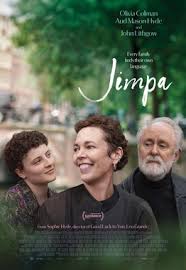
JIMPA
Australia, 2025, 113 minutes, Colour.
Olivia Colman, John Lithgow, Aud Mason-Hyde, Eamon Farren, Daniel Henshalll, Kate Box, Deborah Kennedy.
Directed by Sophie Hyde.
At the beginning of this film, Adelaide filmmaker, Hannah, played by Olivia Colman, is on a zoom interview concerning financing for her next film. She explains that she does not want conflict. The financiers say conflict is essential to drama. Hannah continues with the plan for her film. But, her understanding of conflict is differences talked over, sorted out, aiming for some kind of resolution, reconciliation. She is not talking about conflict in the sense of dominating and conquering.
This is a very personal film for writer-director, Sophie Hyde. So, she makes it film about preparing a film about her father. And, it is a fictional development of actual characters and events, Sophie Hyde’s father, Jim, marrying, having two children, coming out as gay in the late 1970s in Adelaide, continuing to for social issues until his death in 2018.
But, also based on reality, is the next generation of parenting. Hannah is married to quietly genial Daniel Henschel. Their 16-year-old child, Frances, has emerged as non-binary, exploring their self-identity. And, in fact, Frances is played by Aud Mason-Hyde, non-binary. Sophie Hyde and her husband, film editor, Brian Mason, are the parents in real life.
Family life and parenting have become so much more complex in recent times, and this film surfaces the issues, decisions of Jim (now Jimpa), the grandpa, played forcefully by John Lithgow, leaving his family, moving to Amsterdam as a more congenial setting for a gay man, but still in contact with them. Hannah wants to talk to her father about the making of her film, his opinions, his agreement. He is a powerful and dominating character, always talking, argumentative, heavily involved in social academia, often in the company of his ageing gay friends, relying on his assistant, Richard (Eamon Farren).
The film has some moments of direct frankness in its highlighting of Jimpa’s world. And, there is a complex focus on Frances, relationship with Jimpa, parental approval/not, wanting to stay with him in Amsterdam, discovering various personalities and behaviour in the queer community.
But the latter part of the film also focuses on serious illness, Jimpa, communicating or not, family gathering round him, an assessment of his life and influence.
As, with so many of the significant problems of life, issues need continuing probing and resolving
- The personal story of the writer-director, her father, her child, gender identification issues?
- The background of the Adelaide story, Sophie Hyde and her father, marriage, children, divorce, gay, championing gay rights? The background of Sophie Hyde and her partner, Brian Mason, their child, non-binary? And Aud Mason Hyde acting the part that corresponded to her in real life?
- The central character as a filmmaker, her career, preparing her film, the Zoom discussion with the financial backers, her not wanting conflict, their demanding conflict? The interspersing of Zoom interviews with actual actors as potential cast? Her concern, the writing, communicating with her father, getting his opinion, consent?
- The situation at home, Hannah, age and experience, the affable relationship with her husband, his gentleness, quiet, supporting his wife, supporting Frances? Frances, a 16, the issue non-binary, her experience at school, communicating with the students, their reactions against her? Her wanting to get out of the school?
- The family situation, Jim, as played by John Lithgow, the back story, the marriage in the 1970s, two children, the divorce, his coming out, going to Amsterdam, finding life there more congenial, the baths and pickups, his academic work and positions, gay rights, his gay friends, their company, getting older? Richard as his assistant, relying on him, the gay atmosphere?
- The decision for the family to go to Amsterdam, and wanting to discuss with her father, Frances wanting to meet him, the possibility of staying with him?
- Jim, grandfather, Jimpa?, Opinions, talking, taking over people? His response to Frances, to Hannah? The issue of his story, the film? The issue of his job, go to Helsinki, the interview, the rival for the job and meeting her party, his recommendation and the board interview in Finland, and the discussions? His retirement?
- Hannah, her reactions, the discussions, tensions, Hannah and her husband being protective of Francis, the range of discussions with Frances, Frances going out, the group, young, the queer community, the issue of sexual expression, the special friendship, seduction, agreement, the sexual experience, coming back, Jim’s reaction, her parents’ reaction? The possibility of Frances going to London with Hannah on her film work?
- Jim, his collapse, his illness, previous stroke, in the hospital, Hannah and her being with her father, talking, signals of pressing his hand, listening? Frances at the hospital? Hannah and her sister, the relationship, the past, her complaints and demands, with her father?
- The future, Hannah and her film (and Sophie Hyde actually making this film)? Her husband, Brian Mason being the editor of the film? The husband filming within the film? The rest of the family? Frances, decisions, relationships and identity? And the success of the film, Jimpa?
Roses, The
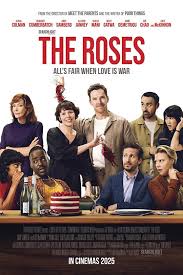
THE ROSES
UK/US, 2025, 105 minutes, Colour.
Olivia Colman, Benedict Cumberbatch, Kate MacKinnon, Andy Samberg, Ncuti Gatwa, Sunita Mani, Zoe Chao, Jamie Demetriou, Halla Finley, Wells Rappaport, Will Smith, Alison Janney.
Directed by Jay Roach.
Once upon a time, well 1989 anyway, the popular stars of such adventures as Romancing the Stone, Jewel of the Nile, Michael Douglas and Kathleen Turner, surprised everyone in the adaptation of Warren Adler is somewhat caustic novel, The War of the Roses. Not the 16th century between York and Lancaster, but a 20th century couple moving from love to enmity. Black comedy with some stinging challenge about marriage and relationships.
And now, 30 something years later, a new version, scripted by Australian Tony McNamara (who began in Australian television but has written screenplays including The Favourite, Poor Things and the series The Great). And it has an American director who has a very interesting career in both comedy and historical drama, ranging from the Austin Powers comedies and the Meeet the Parents comedies to the 2000 US election controversy in Florida, The Recount, and Sarah Palin and the 2008 election, Game Change, biography of black listed screenwriter Trumbo and Fox News scandals, Bombshell.
Added to this, the talent and versatility of stars Olivia Coleman and Benedict Cumberbatch, one-time Doctor Who, Ncuti Gatwa, and popular American comedians ateacKinnon and Andy Samberg.
In fact, while the opening of the film has the meeting between Theo and Ivy in London, he an idealistic architect, she a talent for cooking and a career as a chef, they soon move to California where the rest of the story takes place. In fact, the film was made completely in England, studios and the southern.
10 years pass, happy marriage, twin children, comfortable life – what could go wrong? Answer, practically everything!
Which means that most of the film is black comedy, a great deal of farce, lots and lots of bickering, insults, sometimes no holds barred, even at dinners with guests. A lot will depend on audience sympathies. Theo experiences an absolute architectural disaster which banishes him from his hopeful career, and makes him an at-home father. Ivy experiences great success, critics applause, an expanding empire of restaurants. Which means that underlying all this many themes of male and female roles at home, at work, rivalries, resentments, the effect on children…
And, while the dialogue is often black, bleak, highly ironic, often offensive, our laughter will depend on our sensitivities about these issues and where our sympathies lie.
While there are American comedians in supporting roles, they are something of a distraction, generally unnecessary and not so convincing in their interactions with Theo and Ivy.
But, brilliantly acted, Benedict Cumberbatch always interesting, Olivia Colman indicating that she can take on any role, The Roses is a mixture of amusing, offending, confronting…
- The title and expectations? A reinterpretation of the 1989 The War of the Roses?
- Comedy, satire, farcical situations, sharp dialogue, parody?
- Setting the scene, London, Theo and his architectural ambitions, Ivy and her cooking ambitions, their meeting, marriage?
- 10 years later, in the United States, Theo and his career as an architect, Ivy subduing her cooking talent, the twin children, Ivy at home, spoiling the children? Theo strict?
- The disaster, the storm, the destruction of Theo’s building? The contrast with Ivy’s success, the customers taking refuge, progress, the personalities of her staff, the food critic and his response? The consequences, Theo and his failures, unable to practice? Ivy, progress, increasing number of restaurants?
- The clash between the two, Theo depressed, jealousy of Ivy, Ivy and her success, enjoying it, dominant? The situation with Theo as the stay-at-home parent, his style and strictness with the children? Ivy feeling shut out? And the children, their scholarships, to Miami? Husband and wife at home, clashes? Attempt reconciliation, the visit to New York?
- The friends, Barry and Amy, Barry the lawyer, Amy and her flirtatious manner? The friends, the meals and discussions?
- The marriage counselling and the sardonic response? Ivy, her decision, the finance for the dream home?
- The years, the lavish detail of the home, the success of the home? Entertaining, Barry and Amy, the situation becoming more brittle, the dialogue at the meal table, scoring off each other? The prospects for divorce, Ivy and her sharp divorce lawyer versus Barry?
- The divorce conditions, Theo wanting only the house, Ivy refusing to give it to him? Her restaurants closed for health reasons? The tactics, the spite, the barbs, the farcical interactions? The signing of the papers, the full signature…?
- The exasperation, and finally each admitting that they do love each other, after the fight around the house, the destruction of the Julia Child stove?
- The ending, the reconciliation, the danger, explosive – and the screen turning to white?
- The use of farce and parody for satiric reasons? The film opting for farce and explicit insult and tactics rather than subtlety?
Paddington in Peru

PADDINGTON IN PERU
UK, 2024, 106 minutes, Colour.
Hugh Bonneville, Emily Mortimer, Samuel Joslin, Madaleine Harris, Julie Walters, Olivia Coleman, Jim Broadbent, Hayley Atwell, Voices of: Ben Whishaw, Imelda Staunton. Cameos by Hugh Grant, Joel Fry, Robbie Gee, Sanjeev Baskhar, Ben Miller, Jessica Hynes.
Directed by Dougal Wilson.
Who cannot like Paddington! His stories are always bearable!
We have enjoyed the first two films very much. There was an element of surprise about them, the introduction to Paddington himself, the wonderful voice provided by Ben Whishaw, the members of the Brown family and their ability to welcome Paddington. And, there were various adventures and, who can forget, the villainous Hugh Grant?
It does mean that here we accept Paddington straightaway, the glimpse of his early years in Peru reaching out to pick a beautiful orange, falling into the River – and landing in London. Now, a letter from his Aunt Lucy (voiced by Imelda Staunton) encouraging him to come for a visit (and that humour is awkward episode getting his passport photographs).
But there is a bit of background about Mr Brown, somewhat British stick-in-the Mode, challenged at work about risks. In the brainwave! Why don’t they all go with Paddington to Peru, including the kindly Mrs Bird (Julie Walters). Hugh Bonneville is once again Mr Brown but, this time, Emily Mortimer is Mrs Brown.
Once they will arrive in Peru, now met by Reverend Mother at the local home for retired bears! Suddenly, and exuberantly, we have Sister Act meets The Sound of Music. But, bad news, aunt Lucy has disappeared and Paddington is determined to find her. And, Olivia Coleman, in recent years showing a variety of talent (Wonka, Little Wicked Letters), is here as the exuberant Reverend Mother.
With the action adventure that follows, more than a touch of Indiana Jones here, the action is geared more to the young audience, the touch of caricature with the boat captain (Antonio Banderas), farcical and slapstick situations high dangers and minutes, especially as Paddington and the family get lost in the Andes jungle, double dealings and some sinister flashbacks…
But, there are some secrets to be revealed, and a variation on the search for El Dorado and that fabled gold. This, everybody benefits from the adventure, and Mr Brown becomes extraordinarily daring. And Paddington has to make a decision, finding his tribe there in Peru, and whether he will go back home with the Browns.
Adult audiences, especially, please don’t rush for the exit when the credits begin to appear because there is a very enjoyable special guest interlude during the credits. And, as always, possibilities for more.
- The popularity of Paddington, the films? And in himself, from Peru, landing in London, the Brown family, part of the family, his adventures, memories of Aunt Lucy in Peru, the possibility of his returning to visit Peru and Aunt Lucy? The effectiveness of Ben Wishaw’s voice?
- Expectations from the previous film and their popularity and acclaim? The intentions of the filmmakers here, a film for younger audiences, style, treatment, humour, adventures, the touch of the absurd for enjoyment? The impact for older audiences, the adult characters, the adventure, the mayhem? And the postscript with Hugh Grant?
- The scenes of Paddington’s origins, little bear, the oranges, on the branch, falling, to England, with the family? The memories of Aunt Lucy? The correspondence with her? His receiving the letter from her, inviting him to Peru, his eagerness?
- The Brown family, the children growing older, University entrance, computer games and inventions, not wanting to play Scrabble with the mother, Mr Brown, the firm, Risk-taking, the American executive, her demands, the challenge to him? His very proper reticent British way of style of life?
- The suggestion to go to Peru, the reaction of the family, Mr Brown and the decision to take a risk? Mrs Bird and her presence, decision to go? The farewell in the street with all the British film and television celebrities’ cameos? The flight, landing, Peru?
- The visuals of Peru, the mountains, the river, waterfalls, locations in Peru and Colombia? The settlement? The boat
- the convent, Reverend Mother, her cheery attitude, the staging of the musical, Sister Act meets The Sound of Music? The family settling in? The disappearance of Aunt Lucy, the nuns? The retired bears and their lifestyle, bingo…? Reverend Mother and her explanations, her eagerness for them to go searching, but her remaining at home?
- The expedition, Paddington and his eagerness, the family, hiring the boat, the captain and his daughter, his manner and mannerisms? On the voyage, the comedy, the dangers, the rapids?
- The background of El Dorado, the captain and his ancestors and their appearing behind him, his relationship with his daughter, the search for gold, Paddington and his arm band, the translation and interpretation? The captain disappearing and his search?
- The family on the boat, the dangers, capsizing, stranded? Through the jungle? Mr Brown and his being more daring? Paddington’s memories of the Inca image, his arrival at the tower, the rock? The family arriving?
- The Machu Picchu kind of location, the confrontation with the captain, pursuing more Paddington, the fights, the bolder, the dangers…? The reappearance of the daughter, her helping the family?
- Mrs Bird, back at the convent, curious, suspicious, finding the radio room, the confrontation, the truth about Reverend Mother? The plane, flying, the crash landing, the confrontation, Reverend Mother from the El Dorado-seeking family, the flashbacks to their disasters? The confrontation with the captain? Her being overcome?
- Finding Aunt Lucy, going beyond the barrier, finding El Dorado, the gold being the oranges, the scenes of collecting, squeezing, Paddington and his predilection for marmalade?
- Paddington finding his tribe, his being welcomed, his speech, the family ready for him to stay, his decision to return with them, finding his tribe but going home with his family?
- Happy ending – and the epilogue with Phoenix Buchanan and Hugh Grant’s style? Future prospects?
Wicked Little Letters
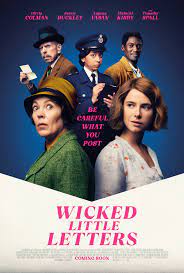
WICKED LITTLE LETTERS
UK, 2023, 100 minutes, Colour.
Dear Coleman, Jessie Buckley, Timothy Spall, Gemma Jones, Anjana Vasan, Eileen Atkins, Joanna Scanlan Lolly Adefope, Hugh Skinner.
Directed by Thea Sharrock.
They certainly are!
England, 1920, still feeling the aftermath of the war and the war dead, a small English village, Hampton. This is all based on an actual story, rediscovered in 2017, comic writer (half of the In-Between as, Jonny Sweet) saw it as an opportunity to write a wry British comedy. So, the basic facts might be based on reality, the way the characters act, their interactions, serious and comic, may not be held this episode actually was.
Wicked letters have unpleasant contents. In this case, they are highly offensive, scabrous, touches of the obscene, course and crass language, swearing. Those who might be feeling fastidious, it might be best to give this one a miss. But, for those prepared to take the language in its context, this is, in fact, an entertaining comedy was a lot of critique of British life. And the makers have decided to introduce a number of black characters, policewoman, judge, whether they would not have been present in 1920. It would be interesting to imagine how Ealing Studios might have made this film within the context of the 1950s.
Wicked little letters can be seen as anticipating the trolling of 21st-century social media.
The cast is excellent. Olivia Coleman has proven herself in a wide range of roles, from the Queen in The Crown to her Oscar-four as Queen one in The Favourite. And Irish actress-singer, Jessie Buckley, has also shown her talent in a variety of different roles. Here they are pitted against each other, Olivia Coleman as the very prim, religious, repressed and righteous, Edith, seen at home with her emotionally monstrous father, quite a different role for Timothy Spall, and her ever-patient, easily-offended mother, Gemma Jones. And she is the recipient of the letters, her mother upset, her father angry, going to report to the local police.
And, the main suspect lives next door, an unmarried Irish mother with the daughter, Rose, Jessie Buckley. Most audiences would realise very quickly that Rose did not write the letters – and not necessarily a surprise when we discover, half way through, who is writing the letters.
But, the police, a lot of satire in their presentation, instantly ready to arrest Rose. The chief is blustering and self-important. It is one assistant, played by Hugh Skinner, is rather dim but fancies himself. And they have Gladys, having to call herself “woman police officer Gladys Moss”, looked down on, dismissed as a suffragette, who eventually enlists the help of an interesting group of ladies in the town, fine cameos from veterans Eileen Atkins, Joanna Scanlon, Lolly Adefope, to defend Rose who has been carted off to jail (paying her bail), and elaborating schemes to unmask the letter writer.
The two leads bring their respective characters to vivid life, Rose with the touch of the raucous but kindly, victimised, Edith the epitome of biblical quotes, repression, subservient to her demanding father, not entirely unhappy with all the publicity in the media as the letters victim.
The film is often very funny – and the final outburst of obscenities, definitely in context and a damning judgement, will probably make most audiences burst out laughing!
- Based on a true story? The right treatment? Serious? Comic? A British treatment, satire on British society?
- The title, stories of poison pen letters? Anticipation of social media patrolling? The effect on those involved, the targets, investigations, unmasking?
- The atmosphere of the town, small, after World War I, memories of the war, the war dead, the Irish moving to England? Small town atmosphere, people knowing each other? The streets, the homes, adjacent? Shared facilities, the bath? Gossip?
- The situation, it is, her age, the past love and her dismissing him (and the real story of her father emerging later), at home with her mother and father, her religiosity, Bible reading? Completely subservient to her father? Her friendship with Rose, next door, talk, walk along the beach?
- Rose, Irish background, with her daughter, the story of her dead husband in the war, the relationship with Bill? Raucous, the lovemaking and the crucifixion banging on the wall? At the pub, drinking, shouting? Her language? Her love for her daughter?
- The letters, the content, the language, obscene, personal attacks? Edith and the letters, her mother and father, the reaction, her father going to the police?
- The police, the satiric presentation, the chief, rushing to conclusions, his busy life, disregarding the writing, wanting results? Castable paperwork, personality, a bit dim, the investigations, sexist towards Gladys? Collaboration with the Chief? The further investigations, the interrogations, the arrest?
- Conclusion that Rose was writing the letters, her comment that she needn’t have written but could have given the insult to verbally? Her arrest? Her daughter, Bill, everybody observing? Going to jail, the experience of jail, seeing Edith at the station giving her testimony? The police treatment? Her life in jail, acceptance?
- Edith, reading the Bible, giving the interviews, the media, her liking the celebrity?
- Edith and her parents, her dominating father, completely unsympathetic, ruling her life? Her mother, the effect of the letters, the death? The funeral? The priest, the prisoners, the memories?
- Edith and her playing twist? Her friends? Going to the club? The games, the talk? The friends and their own ideas, able, strong-minded, the discussions with And and Kate? Suspicions? Deciding to post bail? Welcoming Roses?
- Rose, the return home, awaiting trial? The support of the friends? The revelation about Nancy’s father, Bill being upset? Rose being branded a liar?
- The letters starting again, the various targets, the insults? Even the police? The police and their reaction, still targeting Rose, the issue of the writing?
- Gladys, her father is policeman, her training, 1920, the screenplay making a point about this impossible situation of the time? Her having to identify herself as woman police officer? The interviews with Rose, the documents, her suspicions, but of holding the letter of the law? Her treatment by the chief? By the constable? Are life at home? Her decision to intervene, looked down on by Edith’s father? The writing, particularly lettering? Her teaming up with Mabel and the others? Trying to catch Edith? Stalking her, the stamps and the envelope, the unmasking?
- Rose, the trial, her being outspoken, the prosecutor, the defence, the witnesses? Are being branded a liar?
- The reconciliation with can build, love for her daughter?
- Half way through, the audience, probably already suspecting, seeing Edith writing the letters, delighting in the language, the animosity? Her being trapped, her reaction?
- The reaction of her father, her being taken away, the fell-Marist blast given at the end – and the audience laughing?
- Serious? Funny? The use of language – and in this context?
Wonka
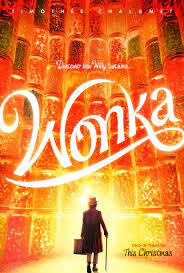
WONKA
US/UK, 2023, 116 minutes, Colour.
Timothee Chalamet, Calaha Lane, Hugh Grant, Olivia Coleman, Keegan-Michael Key, Jim Carter, Patterson Joseph, Matt Lucas, Matthew Baynton, Freya Parker, Rakhee Thakrar, Natasha Rothwell, Rich Fulcher, Colin O'Brien, Sally Hawkins, Rowan Atkinson, Rufus Jones, Tom Davis, Kobna Holdrook-Smith..
Directed by Paul King.
Everyone knows the name, Willy Wonka. He first appeared in Roald Dahl’s story in 1964 and a subsequent story in 1972. Roald Dahl has been one of the most popular storytellers, especially for younger audiences, with such titles as Matilda, The Witches, James and the Giant Peach…
But, Willy Wonka is known far more widely than his readers with the 1971, Willy Wonka and the Chocolate Factory, with the engaging Gene Wilder, and the popular songs, Pure Imagination, and the Oompa Loompa song (both in this present film but not The Candy Man). Tim Burton did a reinvention of Willy Wonka with Johnny Depp in Charlie and the Chocolate Factory.
Now, here is a prequel. Where did Willy Wonka come from, where did he learn how to make chocolate, his relationship with his mother, his ambitions to open a chocolate store, a nicely naive young man setting out on an adventure. The screenplay actually takes a number of issues from the original story, especially the villainous chocolate cartel entrepreneurs and their opposition to Willy Wonka.
So, quite a lot of plot for a prequel. However, this new film is also designed as a musical, rather reminiscent of the film versions of Broadway musicals (and, most probably, Wonka is destined for Broadway and beyond). The new songs are pleasant even if not so memorable as Pure Imagination, sung nicely by the various characters with lyrics that illustrate their characters and the situations – the most memorable, perhaps, involving the repetition and the beat of the word, Scrub.
The film has been co-written and directed by Paul King who became a great favourite with his very pleasing and entertaining Paddington films. He brings the same sensibility to Wonka.
And, to be the new Willy Wonka, here is Timothee Chalamet who has already proven himself as a substantial actor on screen presence in dramas and comedies but, especially as Paul Atreides in Dune – and Dune 2 scheduled for release in 2024. He is quite small, very young-looking, a blend of the innocent and the ambitious, remembering his mother (a cameo by Sally Hawkins), generous, but shocked to discover the greed of a venal world. And the tag, “the greedy always beat the needy” often repeated throughout the film.
There is something rather Dickensian about the early sequences, Wonka encountering an ultra-Dickensian landlady played by Olivia Coleman. And Wonka is sentenced to a long imprisonment below the boarding house, a workhouse laundry, with a different assortment of penalised characters, especially a young girl, Noodle, who tries to save Wonka. Amongst those down below is the former accountant of the cartel, played by Jim Carter, liberated from Downton Abbey.
Willy Wonka has a chest full of ingredients for chocolate, a magician’s capacity for multiplying chocolates with the most exquisite tastes and physical and psychological effects, leading to a lot of comedy turns. He concocts a plan to escape from the laundry with Noodles’ help, then with the help of the others, to find the cooked books of the cartel and expose them. However, they have their allies, the chief of police, the chocoholic Keegan-Michael Key (and his fat suit, fatter suit, fattest suit after his choc indulgence), and the chocoholic priest, Rowan Atkinson this time with no weddings but one funeral.
The cartel is sinister, led by the aggressive Patterson Joseph, aided by Matt Lucas with an orange wig which falls off, and Matthew Baynton who chokes whenever he tries to say the word “poor” and gags when others see it. They are due for a comeuppance.
And, the Oomps Loompas? Well worth awaiting the arrival of a miniature Hugh Grant as Lofty, resentful that Wonka has stolen his special beans and demanding repayment. Hugh Grant has been sending himself up in recent films and obviously is enjoying this escapade, a heroic rescue for Wonka and Noodles – and a kind of MC entertainment during the final credits!
Roald Dahl is often quite dark in his stories. Even though Wonka is very light, there are the three villains, there is the corrupt chief of police and priest, and a dire attempt on the life of Willy Wonka and Noodle.
This is quite a lavishly produced entertainment, incorporating happy memories of Willy Wonka from the past, drawing us into his extraordinary chocolate world yet again.
- The popularity of Willy Wonka, Roald Dahl’s stories, 1971 film, 2007 film? Now a musical? Prequel?
- The production values, fantasy and effects, costumes and decor, locations, the city blend of London/Paris/Berlin?
- The new songs, the characters singing them, the lyrics illustrating the characters and situations, Scrub, the dance routines, the lavish stagings and sets, choreography – and Broadway musicals?
- The incorporation of the original song, Pure Imagination, theme for the film? The Oompa Loompa song?
- Willy Wonka and his origins, with his mother, her care and love for him, the chocolate bar, the message? The dream of opening the chocolate store, the memories of the store in the city? His ambitions? Setting out, his suitcase and its contents, his magic powers? Farewell to his mother? Her reappear at the end and the opening of the store? Being with him?
- Arrival in the city, his personality, young, enthusiastic, naive, the 10 sovereigns, the demands made on him, a fine for daydreaming… No money, sitting on the bench, Bleacher talking with him, taking him to Mrs Scrubbit? Nice, nasty, demanding the money, his staying the night, with the money, her demanding interest, is relegation to the basement, not reading the fine print, the warning from Noodles?
- Downstairs, the laundry, hardship, the song, Scrub, Noodles at her place, the other members, the comedian, Abacus and his being an accountant? The plan, Wonka getting out with the laundry, then everybody getting out, working together, the search for the books of the entrepreneurs (and the flashback to Abacus searching and his arrest)?
- The cartel, the three personalities, the aggressive leader, Matt Lucas and his bad wig and naive utterances, the chocolatier who could not say the word “poor” and choked when he heard it? Their shop, encountering Willy, tasting the chocolate, turning against him? Using the chief of police, his being paid in chocolate to eliminate opposition? The deals, a touch of conscience, taking the chocolate, becoming fatter and fatter? The priest, the Cathedral, the confessional, payment by chocolate, the lift downstairs, the preparation for the funeral, the giraffe, getting the giraffe out, the group getting inside, the chocoholic monks, the funeral?
- Noodles, the nice orphan, age, mystery of her background, drop-down the shoot, the ring, Willy recognising the link with the chocolatier? Helping, the dangers, the final revelation, the story of her birth, inheritance, disappearance?
- The scheme for Mrs Scrubbit and Bleacher, pretense that he was Austrian nobility, his dressing up, the flirting, the final expose?
- The nature of the chocolates, the people in the square, the response? The police? The ingredients of the chocolates, going to the zoo, the episode with the giraffe? In the Cathedral?
- The arrival of Lofty, the background of the Oompa Loompas, Lofty and his size, dress, Hugh Grant’s manner, vocal style, song, walk, accusations about the stealing of the beans, the flashbacks? His keeping guard? His reclining, Willie and his puzzles? His coming to the rescue when the couple were drowning in chocolate? The origins of the Oompa Loompas and their work in the factory, Lofty being shorter and the truth, becoming the taster?
- The threat to Willie and Noodles, the cartel and the confrontation, releasing the chocolate, their almost drowning, the rescue? And the transformation of the chocolate into the town square fountain? The chocolates the entrepreneur, their flying, the arrest, the good policeman and the exposure of the overlarge Chief of Police?
- Noodles, the happy ending, reunited with her mother?
- The happy ending, and the future for Willy Wonka and his chocolate factory?
- And Hugh Grant And puzzled but, the MC during the final credits?
