Displaying items by tag: Michael Tyberski
Turn Me On
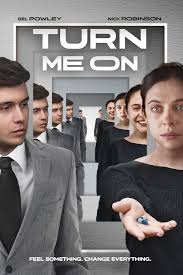
TURN ME ON
US, 2024, 99 minutes, Colour.
Bel Powley, Nick Robinson, Griffin Newman, Justin H. Min, Nesta Cooper, Julia Shiplett, Patti Harrison.
Directed by Michael Tyberski.
Two Academy Is a film for young adult audience, raising contemporary issues in something of her science fiction/fantasy context. But, the screenplay raises quite a number of key questions, especially about human freedom and decisions, that a significant for older audiences.
The screenplay posits a society where medication controls emotions. Life in the community, where people are often asked whether they are content, is something like a cult experience.
But, what if someone decided to disobey the, exercise freedom, defy the authority, and not take the medication, what would the consequences be.
The two central characters are played by Nick Robinson, in popular dramas like catalogue, Simon and Jurassic Park films, with British Bel Powley. The strange experience of having emotions leads her to persuade William and other friends to experiment with her.
The consequences for emotions, sexual experience, are presented in the context of the discovery of freedom and lack of experience as to how to handle this freedom.
So, what will be the consequences for the central couple, when William not take his medication, what about the others? What about the founder of the community and the defiance of authority?
One of the deeper philosophical/theological issues that the film raises is that of human freedom and how important it is, and not being controlled by authority beyond oneself. On the other hand, over the centuries, the experience of tragedies has often raised the issue of why God doesn’t intervene. The theological answer is that God graces us with our freedom – and having to cope with the consequences of the exercise of human freedom as well as the evolution of nature and sometimes disastrous consequences.
The screenplay for this film opts for human freedom, human choice, and not the imposition and intervention of a higher authority.
- The title, the tone, the activated? The contrast with the narrative of the medication turning people down?
- The setting, the community, like a University College, the apartment blocks? The exteriors, park and garden? The visit to the seashore? The interiors, the rooms, workplaces, meeting rooms, corridors? The musical score and atmosphere? And the insertion of popular songs and classical music?
- Science-fiction? Futuristic story?
- The basic premise, a controlling management, Our Friends? Recruiting, appealing to people who were depressed, needed some kind of hope? The Institute, the medication, suppressing emotions, suppressing memories, people becoming automatons, the tone of the greeting, “Are you content?”. The nature of this contentment, impassive?
- Couples put together, companions, no sexual attraction or activity? Cohabiting? The routines of getting up, the taking of the tablets daily? Going to work? The monotony of the work, the irony of Joy and her name?
- The opening, the television presentation, the founder and his encouragement? Later in the film, his television appeal, Joy listening? The other member of the staff seen, the doctor and explaining to Joy that she had cancer? Not to take the tablet? For a day? The later visit from the supervisor, the interrogation, to and fro, the indication that the scenario had been a test for Joy, that she had past, the invitation for her to become part of the management, her skill with people, her discovery of enjoyment, the television programs, comfort and freedom?
- William, with Joy, appointed as partner, cohabiting but no real emotion? The meeting with Frank and Michelle, newly appointed to the core group, Christopher and Samantha, his leadership? The nature of the meetings?
- Joy, not taking the tablet, the effect on her feelings, psychology, looking in the mirror, the prospect of cancer, her beginning to smile, to laugh, going to work, opening the boxes, discovering the rings? The talking with William, persuading him to not to take the tablet? His reluctance, his agreement? The consequences for him, smiling, coming alive?
- The discovery of their freedom, exercise of free will, the friendship, the love, the sexual attraction, the experimentation, “the Sinking”, the consequences for the relationship? Shared enjoyment?
- At the meetings, the other couples, the discussions, the possibility of them all not taking the tablets, the consequences? Emotions, love, lust, sexual reactions, Christopher with Joy, William and his being hurt, reaction? Samantha and Michelle, the mutual attraction, the exclusion of Christopher? Frank, his bewilderment? Christopher accosting Joy, William seeing this, her reaction?
- William, his being hurt, the description of the hurt and the physical and psychological consequences? His taking the tablet again? The reaction of the others, resuming the tablets, giving up their freedom? Security rather than risk?
- The future for Joy, in the management, the reliance plan placed on her, separation from William, yet the truth, her love for him, going to see him, his not taking the tablet, the possibilities for a future, into the unknown, exercising free will, the escape through the building, out into the countryside, at the barrier on the shore?
- The ending of the film, the option for freedom rather than control? For human living?
