Displaying items by tag: Daniel Henshall
Jimpa
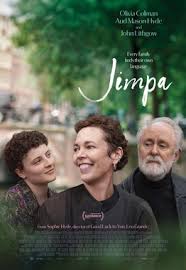
JIMPA
Australia, 2025, 113 minutes, Colour.
Olivia Colman, John Lithgow, Aud Mason-Hyde, Eamon Farren, Daniel Henshalll, Kate Box, Deborah Kennedy.
Directed by Sophie Hyde.
At the beginning of this film, Adelaide filmmaker, Hannah, played by Olivia Colman, is on a zoom interview concerning financing for her next film. She explains that she does not want conflict. The financiers say conflict is essential to drama. Hannah continues with the plan for her film. But, her understanding of conflict is differences talked over, sorted out, aiming for some kind of resolution, reconciliation. She is not talking about conflict in the sense of dominating and conquering.
This is a very personal film for writer-director, Sophie Hyde. So, she makes it film about preparing a film about her father. And, it is a fictional development of actual characters and events, Sophie Hyde’s father, Jim, marrying, having two children, coming out as gay in the late 1970s in Adelaide, continuing to for social issues until his death in 2018.
But, also based on reality, is the next generation of parenting. Hannah is married to quietly genial Daniel Henschel. Their 16-year-old child, Frances, has emerged as non-binary, exploring their self-identity. And, in fact, Frances is played by Aud Mason-Hyde, non-binary. Sophie Hyde and her husband, film editor, Brian Mason, are the parents in real life.
Family life and parenting have become so much more complex in recent times, and this film surfaces the issues, decisions of Jim (now Jimpa), the grandpa, played forcefully by John Lithgow, leaving his family, moving to Amsterdam as a more congenial setting for a gay man, but still in contact with them. Hannah wants to talk to her father about the making of her film, his opinions, his agreement. He is a powerful and dominating character, always talking, argumentative, heavily involved in social academia, often in the company of his ageing gay friends, relying on his assistant, Richard (Eamon Farren).
The film has some moments of direct frankness in its highlighting of Jimpa’s world. And, there is a complex focus on Frances, relationship with Jimpa, parental approval/not, wanting to stay with him in Amsterdam, discovering various personalities and behaviour in the queer community.
But the latter part of the film also focuses on serious illness, Jimpa, communicating or not, family gathering round him, an assessment of his life and influence.
As, with so many of the significant problems of life, issues need continuing probing and resolving
- The personal story of the writer-director, her father, her child, gender identification issues?
- The background of the Adelaide story, Sophie Hyde and her father, marriage, children, divorce, gay, championing gay rights? The background of Sophie Hyde and her partner, Brian Mason, their child, non-binary? And Aud Mason Hyde acting the part that corresponded to her in real life?
- The central character as a filmmaker, her career, preparing her film, the Zoom discussion with the financial backers, her not wanting conflict, their demanding conflict? The interspersing of Zoom interviews with actual actors as potential cast? Her concern, the writing, communicating with her father, getting his opinion, consent?
- The situation at home, Hannah, age and experience, the affable relationship with her husband, his gentleness, quiet, supporting his wife, supporting Frances? Frances, a 16, the issue non-binary, her experience at school, communicating with the students, their reactions against her? Her wanting to get out of the school?
- The family situation, Jim, as played by John Lithgow, the back story, the marriage in the 1970s, two children, the divorce, his coming out, going to Amsterdam, finding life there more congenial, the baths and pickups, his academic work and positions, gay rights, his gay friends, their company, getting older? Richard as his assistant, relying on him, the gay atmosphere?
- The decision for the family to go to Amsterdam, and wanting to discuss with her father, Frances wanting to meet him, the possibility of staying with him?
- Jim, grandfather, Jimpa?, Opinions, talking, taking over people? His response to Frances, to Hannah? The issue of his story, the film? The issue of his job, go to Helsinki, the interview, the rival for the job and meeting her party, his recommendation and the board interview in Finland, and the discussions? His retirement?
- Hannah, her reactions, the discussions, tensions, Hannah and her husband being protective of Francis, the range of discussions with Frances, Frances going out, the group, young, the queer community, the issue of sexual expression, the special friendship, seduction, agreement, the sexual experience, coming back, Jim’s reaction, her parents’ reaction? The possibility of Frances going to London with Hannah on her film work?
- Jim, his collapse, his illness, previous stroke, in the hospital, Hannah and her being with her father, talking, signals of pressing his hand, listening? Frances at the hospital? Hannah and her sister, the relationship, the past, her complaints and demands, with her father?
- The future, Hannah and her film (and Sophie Hyde actually making this film)? Her husband, Brian Mason being the editor of the film? The husband filming within the film? The rest of the family? Frances, decisions, relationships and identity? And the success of the film, Jimpa?
Mickey 17
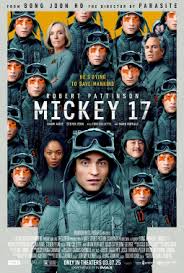
MICKEY 17
US, 2025, 137 minutes, Colour.
Robert Pattinson, Stephen Yeun, Mark Ruffalo, Tony Collette, Naomi Ackie, Patsy Ferran, Holliday Grainger, Daniel Henshell, Thomas Turgoose.
Directed by Bong Joon Ho.
There were high expectations for Mickey 17. Korean director, Bong Joon Ho, has had a prominent career since the 1990s, range of genre films including The Host, Mother, Snowpiercer and his Oscars, including best film, for Parasite. Here he is taken on an American story, and has treated it both seriously and satirically.
It is 2054, much of a muchness like the present in some ways, Mickey and his friend Tivo trying to raise money from a loan shark to start a business, failure, and the violent aggression of the loan shark. But, in this future, there is space exploration and the setting up of planets. There is also a great deal of scientific experimentation – including processes to create multiples of human beings, living, dying, and then being printed out again, identified with successive numbers. The morality of this process is being questioned.
Enter one of those evangelical church leaders, Kenneth Marshall, played with satiric zest and prominent teeth by Mark Ruffalo – aided and abetted by his smiling but domineering wife, played by Toni Collette. Marshall disapproves of the process but agrees that in some ways it could be useful, that the government should set up an expedition on a new planet, four a half years travel there, and set up a process for multiples, but only one at a time. And, with the succession of multiples, they are also described as “expendables”.
But we are also introduced to Mickey 17, Robert Pattinson enjoying his role. On the new planet, out scouting, he falls down a hole, is menaced by some strange creatures, wondering whether they are animals or aliens, not rescued by his colleague, but, saved, in fact by the creatures. Which gives him the opportunity to give a resume of his original life as Mickey Barnes, and the visual succession of all the numbers between one and 17. But, when he is presumed lost killed, Mickey 18 is printed out, Pattinson again, quite a different personality, tough, determined, rebellious…
And there is a range of characters on the planet, the scientists generally kowtowing to Marshall, young Dorothy being an exception and stepping in to help Mickey 17. Marshall has his sycophantic assistant, a yes-man, pandering to all Marshal’s exorcist whims, especially in organised religious television programs for the subservience staff on the planet. His wife is always there, but is experimenting with making sauces! In the meantime, there is an officer, Nasha (Naomie Acker) who is in a relationship with Mickey 17.
We can all this go? The capturing of one of the creatures and killing it, and holding a baby to ransom over a furnace. The two Mickeys confronting each other, Nasha and her coping with each of them, Tivo now involved in drug dealing and threats from the loan shark on earth.
There is a solution but, as with most of the film, not always predictable, always some surprises, some satire, some parody – especially with Kenneth Marshall and his final vanity in confronting the aliens.
The original book, by William Ashton, was published in 2022 and the film began production during the Biden era. But, released in the early days of the Trump era, many audiences will be making links! One reviewer noted that Bong Joon Ho was taking the Mickey out of the United States. Yes!
- Science fiction? Science fantasy? Political fantasy? Space exploration and development? Humanity issues? Moral issues? Philosophical issues?
- The career of the director, films in Korea, range, science fiction, Oscars for Parasite?
- The credibility of the plot, situation on Earth, 2054, ordinary life, Mickey and Vito and their plans, finance, the loan shark, the threats? But the political developments, scientific experimentation, production of multiple persons, moral issues, political? The intervention of Kenneth Marshall, support of his wife? His speech, the panel listening, agreement, setting up the centre on the planet? Moral issues, only one multiple?
- The visuals of the planet, wintry, the spring season, the centre, interiors, rooms, laboratories, meeting room, television programming? The musical score? Songs?
- The prologue, Mickey, the confrontation with the creatures, falling down, Vito and his taunts, no help? Setting up an atmosphere?
- Mickey, Robert Pattinson’s performance, as 17 and 18, his background on Earth, volunteering, is recounting the various stages of his life, further printing after deaths, the range of deaths, the range of personalities, situations, experimentation and testing? His relationship with Nash and her support? Mickey 17, in the snow, the story of his acceptance by the creatures, communication with them, the rescue? And discovering that Mickey 18 had been produced?
- Mickey 18, the different personality, strong minded, confrontational? Encountering 17, their interactions, the episode with Nash, the drugs, sexual encounters? The building up of tension? Especially towards Kenneth Marshall? The agent and her discovery of 17, the attraction, the confrontations with Nasha?
- Kenneth Marshall, the religious background, the church, his moral stances, vanity and position, relationship with his wife, her advice, domineering? His ambitions, the plan, the multiples, overcoming his moral scruples? His ambitions for success? His manner, his teeth, speech, presiding at meetings, his assistant as flattering him all the time, his interactions with the lab managers, their subservience to him? His wife, her manner, the cooking, the sources?
- The confrontation with the aliens, the taking of the baby, the shooting, one creature destroyed? The massing of the aliens, the leader? 17 and his ability to communicate? The work on the translation device? Dorothy, her work, personality, helping the Mickey’s?
- Marshall, his plan, discovering the two, the explosive device to destroy each of them? The flatterers, television, his going out, the speech before destroying them, his continued vanity? His wife waiting at the studio watching?
- The Mickey’s, the previous clashes, the fights, 17 to fall down into the furnace, saved? With Nasha? Her confrontation with Marshall? Strong-minded?
- The contact with the aliens, 17 and his communication, Marshall discovering this, the upset? The aliens and then manoeuvres, massing to conceal the leader, then dispersing, the confusion? The condition of the return of the baby threatened over the furnace? Nasha having to hold the baby’s rope in her mouth?
- The plan is to fire, Marshall unable to give his speech, the explosions, his death? The aliens, the return of the baby? Possibilities for peace?
- Six months later, Spring, the assembly, Mickey 18 sacrificing himself for the explosion, 17 and his presence, Nasha and her speech, the flashback and his memories during her speech, then his pressing of the detonator to destroy the multiples machine?
- The banning of multiples? The machine, Marshall’s wife, her reproducing her husband? She being a multiple?
- The tone of the film, comic and serious, satiric, some parodies, especially Marshall in the Trump era, but issues of science, humanity, ethics, philosophy?
