Displaying items by tag: Richard E Grant
Ladies First
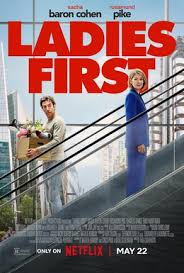
LADIES FIRST
US, 2026, 93 minutes, Colour.
Sacha Baron Cohen, Rosamund Pike, Tom Davis, Emily Mortimer, Werucha Opia, Charles Dance, Fiona Shaw, Richard E.Grant, Kathryn Hunter, Bill Paterson, Ron Cook.
Directed by Thea Sharrock.
There has been a constant popularity in films of role reversals, parents becoming children, children parents, and, sometimes, the role reversals of men and women, being transported into an alternate universe. And that is the case here – but, it is a remake of the 2018 French comedy,. I am not the Easiest of Men which was released at the time of the #Me Too emergence.
Perhaps 2026 is a bit late for Ladies First as some reviewers have suggested. However, as we watch it, the comedy of the men behaving in a female way, was to be subservient, accepting this, exasperated, finding ways to overcome it as well as the comedy of the women behaving in insensitive macho attitudes and manner, it does make its points for a wide audience.
And, this version has many advantages. Who better than Sasha Baron Cohen, memories of Borat and his other films and satires, playing the misogynistic, obnoxiously insensitive male, paying lip service to female executives and ignoring them at meetings, seeing himself as a contemporary Lothario, but remaining male throughout the story, forced to face the macho-women mirror images of his objectifying behaviour. Many tangles, many humorous moments, many satiric barbs – and his finally getting the message.
The other advantage is having Rosamund Pike as the co-star, her two previous films, Now You See Him, Now You Don’t and In the Grey, saw her cast as rather ruthless business women and she draws on this when, after being introduced as a 20 year employee at the firm, receiving a token promotion but ignored at meetings, and then transformed into the hard-hearted executive dramatising and exercising all the ambitious, unscrupulously dominating mirror of male behaviour.
And, there is a strong cast character actors in supporting roles. The usually urbane Charles Dance has become a rather simpering assistant. Kathryn Hunter, rather tiny, a cleaner in the office, always getting in the executive’s way, transforms into a hard-drinking, dominating CEO. Richard E.Grant, is a pigeon-man vagrant who understands the situation, trying to give advice to Sasha Baron Cohen.
Also a plus is the director, Thea Sharrock, who has made the sensitive, The Beautiful Game, as well as the sharp satire of Wicked Little Letters.
So, a whole lot of reversal situations, most of them very funny, but always the consciousness/conscience check that male chauvinism is being sent up as exercised by the women and that the men are experiencing as women, the continued putdowns, targeted male superiority, male exploitation and harassment.
And, for those who enjoy words and play on words, there are all kinds of funny moments and quick quips, Queens Cross instead of King’s Cross, the end of the prayer as a-woman, a variation on frequently used swear word. And, on a broadcast, Pope Beatrice IV.
Sad to say, this kind of comic role reversal, perhaps required somewhat less than in times past, is still very relevant.
Nuremburg
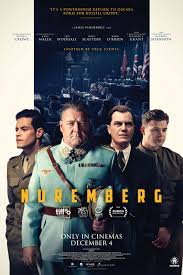
NUREMBERG
US, 2025, 148 minutes, Colour.
Russell Crowe, Rami Malek, Michael Shannon, Leo Woodall, John Slattery, Richard E.Grant, Colin Hanks, Lydia Peckham, Ben Miles, Lotte Verbeek, Mark O'Brien, Andreas Pietschmann.
Directed by James Vanderbilt.
80 years after the end of World War II, the name Nuremberg still evokes memories of the Nazi regime, the rallies in the 1930s, Lottie Riefenstahl is film Triumph of the Will, the location for the proclamation of anti-Semitic laws, and after World War II, the trials.
Cinemagoers and television viewers will have memories of the 1961 classic, Judgement at Nuremberg, and the 2000 television series, Nuremberg, with Brian Cox as Herman Goering. Here is a new take on the trials, focusing particularly on Goering and the American psychiatrists brought in to gauge the mental states of those accused, Douglas Kelly. There is also a focus on Justice Robert Jackson, his role in promoting the trials even though there were no legal precedents, the combining of Britain, France, the Soviet Union and the US to sit in legal judgements on these Nazi war criminals. The screenplay by writer-director, James Vanderbilt, draws on documentation and verbatims of speeches during the trials.
With the focus on Goering, a large man in real life, Russell Crowe fully embodies him (and Crowe, 25 years after Gladiator and his Oscar, can still dominate the screen). Physically, he is quite a contrast to the psychiatrist, Douglas Kelly, played by Oscar-winner Rami Malek. At the centre is a battle of wits, Goering able to combine charm with ruthlessness in his hyper-narcissistic personality, Kelly with psychiatric shrewdness but, in many ways, succumbing to the domination of Goering, an ambiguous friendship, bonding with Goering’s wife and daughter, but a final disillusionment.
Along with this focus on the two central characters, the screenplay provides the background to the raising of such issues as an international court, no legal precedent. And the need for international collaboration with Britain, France and the Soviet Union. At the centre is Justice Robert Jackson, a seriously sombre performance by Michael Shannon, earnest, committed – and with a surprising sequence where he goes to persuade Pius XII to support the trials, using the Pope’s concordat with the Nazi regime in 1933 as a persuasive point of power to gain the Pope’s assent.
Each of the central characters has powerfully dramatic moments. As do two of the supporting characters, standing out is Leo Woodall’s performance as Howie Triest, Kelly’s translator, but revealing at the end his Jewish background and an impassioned narration of his persecuted life and his American commitment. And, Richard E.Grant also has a significantly dramatic scene, a short but cumulatively effective interrogation of Goering on the stand, brutally making Goering admit his continuing Nazi loyalties.
Older audiences will be familiar with so many of the details but, for later audiences, the device is used in the screenplay to have characters explain situations that they were discovering in 1945. And, the film here uses newsreel footage, re-enacted black-and-white footage. And, there is quite extensive footage, screened in Nuremberg at the trials, the horror of the prisoners in the concentration camps, the starvation and torture, the mounds of dead bodies, the bulldozers clearing… 80 years later still profoundly shocking.
With its focus on Goering and Kelly, Nuremberg is not the last war trials story but it does bring the past back to life – and, some of the speeches at the trial and an epilogue with Douglas Kelly in a radio program proclaiming that fascist groups and individuals can still flourish even if the neo-Nazis are not wearing uniforms. Today we know how true this is.
- The title, expectations, memories of Nuremberg, the Nazi rallies, vast rally building, the post-war trials, significance in crimes against humanity? International collaboration?
- Audience knowledge of the war, the Nazi regime, Hitler, Goering as his second-in-command, the concentration camps, the Holocaust, ideology, anti-Semitism, power? The explanations in the dialogue of the film to explain to the characters of the time and their new awareness, for later film audiences?
- The film as drama, relying on documentation from the court case, the book about the psychiatrist and his encounters with the accused, the focus on Goering and the psychiatrist? The use of black and white news footage, re-created footage, especially the concentration camps?
- The extensive scenes of the concentration camps, the dead, the bodies, the survivors, the bulldozers… The impact 80 years later?
- The strong cast, the musical score?
- Goering story, World War I, his wounds, commitment to Hitler, the 1920s into the 1930s, his role of command, his decisions, legislation, anti-Semitic, final solution, complete and total solution? Interactions with the other members of the Nazi regime? His plan for surrender, in the car with his wife and daughter, prison? His plan for control, to be centre-stage, to make his statement? The disappearance of his wife and daughter?
- Douglas Kelly, psychiatrist, reputation, military, invited to deal with the war criminals, his personality, his shrewdness, analysis, knowing that Goering spoke English, the discussions with Howie, the translations, perceptions of Goering, narcissistic, control? Writing his notes, the plan for the book? The range of meetings with Goering, Howie present, alone with Goering, the letters, his decision to visit his wife and daughter, the letters, the return? The attachment, later visits, the daughter and the piano? And the personal discussions with Goering?
- Justice Jackson, his personality, legal background, Supreme Court, his assistant, discussions about bringing the criminals to trial, the assistant and her legal arguments, no precedent, the need for International collaboration, not just America prosecuting in another country? The background of the discussions, Roosevelt and his stances, the Congress, variety of legal opinion, the socials and discussions? The visit to Pius XII, asking for support, quoting 1933, the Vatican and the concordat with the Nazis, the experience of the war, Pius XII and his reputation, the respectful discussion, the political blackmail? The support?
- The preparations in Nuremberg, rebuilding the hall, preparations, the international judges, the media?
- Colonel Andrus, in charge, his personality, the touch abrasive, not approving of Kelly, his attitude towards the prisoners? In Switzerland, the transfer to Nuremberg? The cells, no amenities, the beds, mattress, toilets, to prevent suicides? Goering is, that they were German built?
- Jackson, coming to Nuremberg, the audience contemplating the issues through him, his speeches, the meeting with Maxwell Fyfe? The support of his assistant?
- The other accused, the presentation of who they were, their background, war crimes, anti-Semitism, their personalities? The reaction to imprisonment, assertion? The arrival of Hess, his salute, claiming amnesia, the time in Scotland? Interactions with Goering, pretending not to know him? Kelly using Goering to get information about Hesse? Using the letters as persuasion?
- Kelly, on the train, the magic, the card tricks, the journalist, meeting her, his drinking, the interview with her, the headlines, the colonel dismissing him? At the station, returning home, Howie at the station, the powerful scene with Howie, explanation of his past, German, Jewish, escape, the United States, enlisting, wanting to bring down the criminals? The influence on Kelly, accused of not doing anything, his book, giving it to Jackson to prepare the case? His coming to the court?
- Kelly and his interaction with the various criminals, discussions, the Rorschach tests, the responses and indications of their psychology, especially Kelly’s comments on Goering’s responses?
- The arrival of Dr Gilbert, brash style, clashes with Kelly, suggesting writing a book together, the blonde information to Goering about his wife and daughter being taken, the fight with Dr Gilbert?
- The trial opening, the accused, Goering delaying in standing and sitting, centre of attention? Jackson, his speeches, his interrogation of Goering, verbal fencing, accuracy, precision of dates, quibbling about translations? Jackson and his sense of failing (and not being appointed to the Supreme Court)? Maxwell Fyfe, his asking the question, the powerful sequence of his interrogation, Goering’s responses, going through the history of the Third Reich, Goering accepting it, the final question about still being loyal to Hitler? The defeat of Goering?
- Kelly, the final visit to Goering, and the background of the magic trick, Goering and the cyanide pill, his suicide?
- The hour for the executions, sudden, not letting the accused is one, no drugs, the test case, tantrum, Howie dressing him, escorting him to the gallows, Howie and the personal antagonism towards the accused, the hanging?
- Kelly, the radio interviews, his book, drinking, assertions, the reactions? And the final sequence of him walking along the corridor, drunk, and his depression and suicide, cyanide pill?
- The final information, the consequence of the Nuremberg trials, new standards for Justice and the law for crimes against humanity?
Thursday Murder Club, The
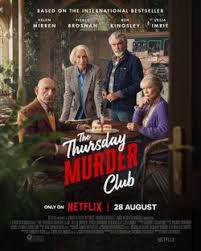
THE THURSDAY MURDER CLUB
UK, 2025, 118 minutes, Colour.
Helen Mirren, Pierce Brosnan, Ben Kingsley, Celia Imre, Naomi Acte, Daniel Mays, Jonathan Pryce, David Tennant, Henry Lloyd-Hughes, Tom Ellis, Geoff Bell, Paul Freeman, Richard E. Grant, Ruth Sheen.
Directed by Chris Columbus.
For several years now, this reviewer included, many readers have been exhilarated by the series of novels about The Thursday Murder Club. They have been written by television personality, Richard Osman, familiar from earlier seasons of the British television quiz program, Pointless, and from his own show, House of Games. In his writings, Osman is a great creator of characters, bringing them alive, especially with eccentricities, is able to develop intricate murder mysteries and their solutions, and has a witty way with words and topical references to politics, media, which can always bring a smile.
And he has created this group of foUr elderly residents of an aged care community in Kent who meet in the common room every Thursday morning to explore and try to solve cold cases. And, for the film version, American director, Chris Columbus (Home Alone, Mrs Doubtfire), brings his genial touch to a screenplay by Katy Brand and Suzanne Heathcote which has done a wonderful job of gathering all the key elements of the novel for a two-hour drama. (Within 24 hours of its appearance on Netflix, the IMDb registered a high number of bloggers, many delighted, some with various quibbles as expected, and then, for this reviewer, unexpectedly, bloggers who seemed unable to wait to share their misery of disappointment and judgements of failure in the adaptation – and one wonders why this judgemental haste. But, on with this review of enthusiasm…).
Helen Mirren has no trouble in being Elizabeth with her espionage background. Ben Kingsley perfectly embodies the gentlemanly psychotherapist. It was hard, while reading, to imagine Pierce Brosnan as old union activist, Ron, but he rises to the occasion, obviously enjoying himself in the role. In the novel, former nurse, now widow, Joyce, is often more than daffy. Celia Imre is wonderful in the role although, perhaps, she has been written a little less daffy than in the novels. But, it all works.
And, there is a wonderful supporting cast of British character actors, Jonathan Pryce standing out as Elizabeth’s husband, a good man with developing dementia. David Tennant enjoys himself as the main villain but Richard E. Grant is unexpected as a sinister florist towards the end of the film.
The film opens with an example of the Thursday Murder Club in action, a cold case in connection with a former member who is now lying in coma, her sad husband in attendance. And, while this might have served as an introduction to the club’s activities and remained as that, it actually becomes quite integral to the development of the plot and the finale.
But, there are two other deaths which have to be investigated, especially in connection with the possible sale of the aged care home by a ruthless developer.
And, then there are the two representatives of the local police, the alert at Donna (Noemi Ackie who played Whitney Houston in the film biography recently) and the rather overweight, sweets-eating, less on the ball Hudson, played engagingly by Daniel Mays. (And the laugh out loud scene in the novel where the club cram him on the couch to pressure him is happily incorporated into the film!).
So far Richard Osman has written five of these novels, and the film then provides faces and mannerisms of the stars for those who continue to read the novels, making them come alive most enjoyably.
- The popularity of Richard Osman’s books, characters and setting, murder mysteries and solutions, witty writing? The popular audience for this kind of storytelling? And the strong cast?
- The setting, the aged care home, rooms, meeting places? The outside sequences, atmosphere? Police stations? The village streets? The cemetery, the demonstrations in the street…? The musical score?
- The title, popularity of murder mysteries, the Agatha Christie tradition? The miss Marple tradition? The club, the members, the meetings, Elizabeth and her espionage background, Ron and his union background, Ebrahim and his psychotherapy, Joyce and her nursing background? Penn, police background, the cold case, her illness and coma, John caring for her? Elizabeth’s visits?
- The initial case, the woman stabbed and thrown out the window, the alleged intruder, the boyfriend, the investigation, the police believing the boyfriend, his disappearance? The photos, the meeting, moves towards solutions? Joyce responding to the photo, the blood, they’re asking her opinion? Her becoming a member of the club? The complication with the discovery of the Bones in the cemetery, the identification, confrontation with John, the murdering of the boyfriend, disposing of his bones? Admission of the truth, John killing Penn, suicide, Abraham and his eulogy at the cemetery?
- The situation with the home, bent, his character, divorce proceedings, his wife’s affair with Jason, ownership of the property, with Tony Curran? His plans for demolition, rebuilding flats, entertainment centre? Tony Curran and his Art board, the clash? Tony Curran, at home, the confrontation, his death, the investigation?
- Vent, his relationship with Bogdan, putting him as the boss, to dig in the cemetery during the protest, the discovery of the Bones, the meeting with Elizabeth, his Polish background, his mother, Elizabeth listening questions, her finding him at home, playing with Stephen, chess? The friendship? Stephen, his shrewdness, that Bogdan had killed Tony Curran? Elizabeth discovering the racquet about passports, hurrying back home, U of Stephen being poisoned, the police, the revelation of the truth, bogged down and is later friendship with Stephen?
- The discovery of the third owner, Elizabeth with the documents, Joyce and her relationship with her daughter, Joanna haughty, but examining the documents, giving the information about the ownership of the property? The mysterious identity, aunt Maud and the bouquet, the initials? The bouquet for Elizabeth, warning her off, her identifying the florist, the identity of the criminal, his savage reputation, disappearing? Elizabeth and the discovery of the passport racket, Tony Curran’s involvement, the truth about bogged down? Her deal with the criminal?
- The police station, Donna, her background in London, race, the meeting with the club, her lecture, the case, serving coffee to the male police, Elizabeth and her visit to the police, the information, the deal? Hudson, his manner, overweight, heating? Discussions with Elizabeth, the deals, wedging him on the couch, plying him with cake…? Donna and her position, driving, the interrogations, the collaboration with the club?
- The protest, vent and his visit to the elderly, the 10 minute consultation, Father Mackie and his protest, the crowds at the cemetery gate, man-to-man his arrogance, his collapse, his death? The post-mortem, poisoned?
- The role of each of the members in the investigation, Abraham and his analysis, his notes, calm presence? Ron, the union background, protests, two wives, relationship with Jason, Jason and his boxing in the past, doing jobs for vent, television, admired, his statue and the photo, the ice-skating? The affair? Ron and his posing as bewildered, then his suit and posing as his son’s lawyer…? Joyce, skill as a nurse, at home, the touch of the Daffy, cakes? And Elizabeth in control?
- Elizabeth, her relationship with Stephen, his going dementia, the tablets, playing chess, yet alert?
- The resolving of the mystery of vent’s death? Penn and John? The funeral?
- The finale, the audience enjoying the investigation, the quiet British style, the elderly, shrewdness, each playing their part?
Death of a Unicorn
DEATH OF A UNICORN
US, 2025, 107 minutes, Colour.
Paul Rudd, Jenny Ortega, Will Poulter, Tea Leoni, Richard E.Grant, Anthony Carrigan, Jessica Hynes.
Directed by Alex Scharfmann.
Certainly an arresting title. Unicorns take us into the world of imagination, fantasy, even of symbolism. But with death in the title, it is all rather foreboding.
What follows is a rather sombre drama but the audience being kept alert by unexpected events, memories of stories about unicorns, the screenplay making them more and more symbolic as the action goes on.
A lawyer and his young daughter, grieving the death of her mother, are seen travelling on a highway out in a forest wilderness. He is intent on getting the wealthy owner of a mansion, with terminal cancer, to sign documents for the administration of this estate. He lives with his wife, son and heir, with two servants. He is pharmaceutical tycoon with his own laboratory and doctors and assistance.
The father and daughter are played by Paul Rudd and Jenny Ortega. The family is Richard E. Grant as the dying tycoon, Tea Leoni as his wife, Will Poulter standing out as his spoilt son.
But, in this context, there is an accident on the highway, the car hitting a unicorn, the question of a mercy killing to put it out of its misery, loading it into the car, the plan to bury the unicorn secretly at night.
With the accident on the highway, the film is quite unpredictable, tantalising with the behaviour of the characters, the power of the unicorns, speculation on the symbolism, healing powers, hostility to humans…
A word of caution. If this review has stimulated interest, a warning that there are quite some horror and brutality sequences in a number of deaths throughout the film… and an Eat the Rich theme.
Unpredictable journey which turns into symbolic nightmare.
- The arresting title? The reality of the accident with the unicorn? The consequences? Symbolic interpretation?
- The situation, the mansion in the woods, the owner and his illness, business and medications, plan for his administration, the unicorns, healing, exploitation, vengeance and destruction?
- The opening, Elliot and Ridley, the tension between the two, her not wanting to be there, memories of her mother and her death, Elliot focusing on the success of the business, relying on Ridley’s presence? The drive, the unicorn, hitting it, Ridley and her sense of its presence, Elliot putting it out of its misery, loading it into the car, intending to bury it secretly?
- The mansion on the family, Odell, dying, demanding? Belinda and her support, her manner, aristocratic? Shepard, his age, the heir, casual, in shorts, his attitude? Shaw, the servant, her severe manner, command? Griff, his appearance, servant, at beck and call, his willingness?
- Each character, the encounters, likes and dislikes? Ridley creating an atmosphere of awkwardness? Discussion about the plan, the almost signing?
- The unicorns, attack, the healing powers, the shining horn, Ridley and the connection? The effect on Odelll? And the beginnings of thoughts of exploitation? Shepard and his reaction – and the later snorting the powder from the unicorns?
- The mythology, the tapestries, the stories, Ridley and her art studies, interpretations?
- The unicorns arriving, to rescue the young, the invasion, the role of the servants, laboratory, the doctor and assistant, the examination of the unicorns, the tests, the science, the attack and the death of the doctor?
- The unicorns and their presence, the siege, the attacks, chases throughout the house, Odell and his going hunting, Shepard and his slack attitudes, Belinda trying to be nice?
- The succession of deaths, the vindictiveness of the unicorns, Odell, attack on Belinda, Shaw?
- The impact on Elliot, relationship with Ridley, Ridley and her fears, interpretations? The possibility for escape? Griff and unlocking the door, to move to the car? Griff and his escape?
- Shepard, the doctor’s assistant, involving her, her death?
- The final attack on Elliot, his going into the cosmic experience as Ridley had, the unicorns and their capacity for revival, Elliot’s revival, reunited with Ridley? The venerating performance by the unicorns?
- Elliott and Ridley, their leaving, change of mind and heart?
- The film as horror, as action, as “Eat the Rich”, business exploitation, the environment, mythologies as symbolic for experience?
Lesson, The
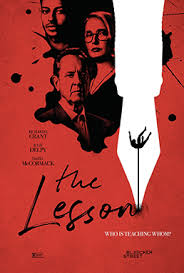
THE LESSON
UK, 2023, 104 minutes, Colour.
Richard E.Grant, Julie Delpy, Daryl McCormack, Stephen McMillan, Crispin Letts.
Directed by Alice Troughton.
There are certainly lessons in this drama but they are not the core. Rather, the characters involved are those who have to learn lessons – and do.
This is a British film, but set in the world of literature, creative writing, the screenplay divided into chapters. There is a prologue where a young man, Liam, Daryl McCormack (Good Luck to You, Leo Grande) is being interviewed about his writing – and, this will be reprised in the epilogue, the tentatively having become the self-confidently.
Liam is talented, gets the opportunity to go to a large country estate owned by the celebrated writer, Sinclair (Richard E.Grant), successful, seen being interviewed, ultrasensitive, walking out, certainly a man of moods. At home is his French wife, Helene (Julie Delpy). She is supportive of her husband, and businesslike. But they have hired Liam as a tutor for their teenage son, Bertie (Stephen McMillan), somewhat erratic in his studies but being pressurised by his father for forthcoming exams and qualifications.
For a while, the audience will be with Liam, intrigued by the family situation, memories of a talented dead son who committed suicide in the mansion pool, Sinclair writing into the early hours of the morning, the seeming detachment of Helene, and a butler who is the essence of formality.
But, we become more and more antagonistic towards Sinclair, his whims, self-importance, ambiguous relationship with his wife, as well as mixed responses to Bertie and his studies, his writing, the ups and downs of his interactions with Liam.
Then, there is a surprise when Sinclair seems to be very friendly with Liam, even inviting him to read his latest manuscript. Liam invited to show his own manuscript to Sinclair. The results are rather disastrous and lead to quite some dramatic complications, Liam expressing positive criticism of the final part of the novel, Sinclair, upset, denouncing Liam as having no talent.
What follows is quite intriguing, the revelation of some truths, a liaison between Liam and Helene, and the raising of the issues about the dead son.
Very British in tone, interesting plot developments, and a lot of ironies in the lessons that the characters have to learn.
- The title? The tutor and his coaching? The novelist and his teaching everyone lessons? And the experience of the tutor and its being a lesson for him?
- A British film, British atmosphere, affluent family, the country mansion, interiors, subsidiary buildings, the grounds, the pool? The world of literature, author interviews, television interviews? The literary atmosphere? The musical score, the classics?
- The prologue and the division into chapters, epilogue? The cumulative effect?
- The interview with Liam, his novel, the interviewer asking the origins, the cut and the flashbacks, the epilogue and the final question and Liam’s response?
- Sinclair, his being interviewed, his manner, humorous, condescending, superior, the influence of events in his work, upset, walking out? Replay of some of the scenes? And the theme that authors steal from great works?
- Liam, his background, accent, qualifications, studies, agency, the tutor? Going to the Sinclair family? The encounter with Helene, contracts, nondisclosure and the later use of the contracts? The encounter with Bertie, his age, studies, talent, parents expectations, preparation for interviews and exams? Liam arriving, Ellis, the reception, the perfect butler, Liam and his accommodation outside the main building? Ellis, no familiarity?
- The sessions with Bertie, outside, initial hostilities, the discussions, literature, the to-ing and fro-ing, Bertie gradually mellowing, the influence of his father, Liam and daring him to go into the pool?
- Sinclair, returning home, working throughout the night, the windows, Liam observing, observing Sinclair and Liam working through the night, asleep? Observing the sexual encounter between Sinclair and Helene? The meals, formalities, the playing of the classics? Liam being excluded from some meals? Ellis and his preparing the coffee?
- Liam the quotations, his memory, word associations, remembering further texts? In this important for the drama with Sinclair’s novel?
- Felix, the dead son, prior to the family, the story of his suicide, drowning? His literary abilities? Silence about him?
- Sinclair, his computer, Liam and his fixing the computer, Sinclair’s reliance on him, the conversations, the new novel, Sinclair giving Liam the manuscript to read, Liam and his own writings, Bertie taking his text, Liam asking Sinclair to read it? Liam’s return, his comments about the novel, the two thirds excellent, the failings of the final third? Sinclair’s angry response? Ridiculing Liam as having no talent?
- Sinclair’s absence, Liam talking with Helene, his approach, the sexual encounter, the consequences?
- Liam, his anger with Sinclair, supporting Bertie, Bertie’s absence in London? His deleting the manuscript from the computer? Taking the text? The discovery that Felix had written the first two parts? His father appropriating them? His anger about his own manuscript, tearing it up, throwing it in the pool?
- Sinclair’s return, the disappearance of the manuscript, Helene’s reaction, Liam and his searching the computer? Sinclair driving away, the search? Return, Liam and the truth, the confrontation between the men, Liam outspoken, the struggle, falling into the lake, Sinclair turning his head and drowning himself?
- Helene and the consequences, protecting everyone, Ellis and his retrieving the body, subservient to Helene, the scenario, the deaths, the police, Liam to leave, his packing, at the gate, the police arriving?
- The epilogue, his having written a novel, the interviewer, looking into the gallery and Bertie present and encouraging him?
Saltburn

SALTBURN
UK, 2023, 127 minutes, Colour.
Barry Keoghan, Jacob Elordie, Archie Madekwe, Rosamund Pike, Richard E.Grant, Carey Mulligan, Alison Oliver, Paul Rhys.
Directed by Emerald Fennell.
While Saltburn is the name of a sumptuous English country estate, its sound echoes something like a chafing irritant. Not entirely irrelevant to the themes.
Writer-director, Emerald Fennell, won a writing Oscar for her initial feature, Promising Young Woman. This was quite disturbing experience – and Emerald Fennell’s audience is now offered even more disturbing experiences.
This is the story of Oliver Cook, played with sometimes deceptive intensity by Barry Keoghan (Irish, having made an impact with Killing of a Sacred Deer, Banshees of Innisfail). He narrates, quietly taking us into his confidence, pondering his emotions and motives. He is from Preston, average family, though he has some stories about his parents and failures, scholarship to Oxford, looked down on by elite students, but in a kindly gesture, befriending the aristocratic Felix Catton (Jacob Elordie who was a very tall Elvis in Priscilla). He is spurned by Felix’s financially dependent cousin, Kylie (Archie Madekwe Gran Turismo).
In fact, Saltburn has a a very strong cast, especially at home with Rosamund Pike at her superior best as the mother and a dithering Richard E.Grant as the father. Alison Oliver is the precocious daughter and Paul Rhys the most supercilious Butler ever on screen! And there is an arresting cameo, Pamela the unwanted but tolerated guest at Saltburn, from the promising Young woman herself, Carey Mulligan.
Felix invites Oliver to Saltburn for the summer – a benign gesture, but very precarious as Oliver makes his tentative way in relating to the family.
So many commentators have made the link between Oliver to Tom Ripley, remembering Anthony Minghella’s classic The Talented Mr Ripley. And, with the country estate, there are references to Brideshead revisited. And, it is probably fair to say that this is Evelyn Waugh 21st-century style, something of Brideshead Re-revisited, where society has made a descent into the vapid without any trace of the transcendent.
However, a useful comparison might be Pier Paolo Pasolini’s highly controversial 1968 drama, Teorema, an initially sweet Terence Stamp invited to live with the family, his manipulation of each of the characters for their destruction. (And, at this time, there were two British variations on this theme, Michael York in Something for Everyone and Peter McHenery in Joe Orton’s Entertaining Mr Sloane.)
A popular saying, sometimes cliche, is that all is fair in love and war. Oliver confides to us his feelings and his love, and his sometimes provocative sexual behaviour, but, as his stay for the summer goes on, it would seem that for him all is fair in the undermining war he has set out on.
So, certainly a provocative film, certainly an uncomfortable film to watch, sometimes funny, always serious, a satiric attack on traditional British aristocracy, more than a touch of the mordant.
Barry Keoghan certainly gives a strong and memorable performance, and, in retrospect, especially with the final unmasking and literal exposure, a very subtle performance. This will probably be talked about for a long time – and it will certainly be very interesting to see the next steps in his career.
- The title, the estate, the echoes of the sound with salt and burning, as relevant to all of this behaviour and the families experience?
- The title, the lettering, the gates, the mansion, sumptuous interiors, the exteriors, the grounds? The musical score?
- Echoes of Brideshead Revisited, Evelyn Waugh for the 2020s? But a complacent aristocracy, self-focused, in decline, nothing transcendent?
- Echoes of Patricia Highsmith, Tom Ripley, the opportunist, insinuating himself, relating to the characters, destroying them? Sociopathic? The films of the 60s like Teorema?
- The focus on Oliver Cook, Barry Keoghan’s performance, confiding to the audience, hopes, loves, emotional puzzles? His commentary on his behaviour? His age, his story of his parents, negative images, and the comic melodrama of Felix discovering the truth, the ordinary parents and their hopes? His scholarship, the importance of being at Oxford? The chatty friend, his belly tolerating this, abandoning him for Felix’s invitation? Revelation of his opportunism?
- The incident with the bike, helping Felix, Felix’s gratitude, invite him into the circle? (And the final revelation that he can had contrived the flat tyre and created the situation for insinuating himself?) The other friends, conversation, drinking, the situation with paying for the drinks (and the later revelation that he did have enough money but capitalised on Felix’s generosity)? However, Farleigh seeing right through him?
- The invitation to the summer, the journey, arriving early, Duncan as the butler, fastidious, snobbish, his observing Oliver throughout the visit? The impression of the home? Felix and the introduction to his parents, his sister, and finally being present, depending on the family for his finances, his back story about his mother, America?
- The summer holidays, relaxing, the swimming, discussions, socials, parties? Oliver and his birthday party on the lavish presentation?
- Oliver insinuating himself, the mother, social snob, but vapid ideas, the treatment of Pamela, her behaviour at the table, her back story, the hence to get rid of her, and the story of her suicide? The father, seemingly dithering, preoccupied with his interests? But their both accepting Oliver?
- Venetia, eating disorders, her age, her self-assertion, smoking, sexuality, the encounter with Oliver and its being observed, Farleigh and his angry reaction, Venetia and her continued flirting, the eating, a dependence on Oliver?
- The visit to his parents, Felix insisting, the revelation of the truth, their being very ordinary, his lies, the consequences for Oliver?
- The ambiguity of the birthday party, in the context of his lies, the birthday cake? Costumes, masks, being unmasked? And the satisfaction of the parents in hosting the party and its success?
- The image of the labyrinth, the meeting with Felix, the challenge – and Felix’s death, the blood, and eventually seen in the final flashbacks? The encounter with Venetia, the bath, the blood, her death?
- The funerals, whether Oliver should stay or not, the initial welcome, the father suggesting that he should go, Oliver refusing? Ousted?
- Sometime later, the seemingly chance encounter with the mother, the cakes, the discussion, her invitation? The story of her husband, his death?
- The mother, her illness, Oliver contriving it, removing the connections, her death?
- His success in ingratiating himself with everyone, the consequences, dependence, his inheritance?
- The dramatic impact of his stripping, after seeing him lying on the grave of Felix, the sexual overtones, and then his dancing, completely unmasked and exposed, throughout the house which was now his?
