Displaying items by tag: Jonathan Pryce
Thursday Murder Club, The
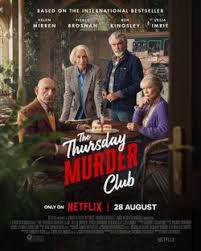
THE THURSDAY MURDER CLUB
UK, 2025, 118 minutes, Colour.
Helen Mirren, Pierce Brosnan, Ben Kingsley, Celia Imre, Naomi Acte, Daniel Mays, Jonathan Pryce, David Tennant, Henry Lloyd-Hughes, Tom Ellis, Geoff Bell, Paul Freeman, Richard E. Grant, Ruth Sheen.
Directed by Chris Columbus.
For several years now, this reviewer included, many readers have been exhilarated by the series of novels about The Thursday Murder Club. They have been written by television personality, Richard Osman, familiar from earlier seasons of the British television quiz program, Pointless, and from his own show, House of Games. In his writings, Osman is a great creator of characters, bringing them alive, especially with eccentricities, is able to develop intricate murder mysteries and their solutions, and has a witty way with words and topical references to politics, media, which can always bring a smile.
And he has created this group of foUr elderly residents of an aged care community in Kent who meet in the common room every Thursday morning to explore and try to solve cold cases. And, for the film version, American director, Chris Columbus (Home Alone, Mrs Doubtfire), brings his genial touch to a screenplay by Katy Brand and Suzanne Heathcote which has done a wonderful job of gathering all the key elements of the novel for a two-hour drama. (Within 24 hours of its appearance on Netflix, the IMDb registered a high number of bloggers, many delighted, some with various quibbles as expected, and then, for this reviewer, unexpectedly, bloggers who seemed unable to wait to share their misery of disappointment and judgements of failure in the adaptation – and one wonders why this judgemental haste. But, on with this review of enthusiasm…).
Helen Mirren has no trouble in being Elizabeth with her espionage background. Ben Kingsley perfectly embodies the gentlemanly psychotherapist. It was hard, while reading, to imagine Pierce Brosnan as old union activist, Ron, but he rises to the occasion, obviously enjoying himself in the role. In the novel, former nurse, now widow, Joyce, is often more than daffy. Celia Imre is wonderful in the role although, perhaps, she has been written a little less daffy than in the novels. But, it all works.
And, there is a wonderful supporting cast of British character actors, Jonathan Pryce standing out as Elizabeth’s husband, a good man with developing dementia. David Tennant enjoys himself as the main villain but Richard E. Grant is unexpected as a sinister florist towards the end of the film.
The film opens with an example of the Thursday Murder Club in action, a cold case in connection with a former member who is now lying in coma, her sad husband in attendance. And, while this might have served as an introduction to the club’s activities and remained as that, it actually becomes quite integral to the development of the plot and the finale.
But, there are two other deaths which have to be investigated, especially in connection with the possible sale of the aged care home by a ruthless developer.
And, then there are the two representatives of the local police, the alert at Donna (Noemi Ackie who played Whitney Houston in the film biography recently) and the rather overweight, sweets-eating, less on the ball Hudson, played engagingly by Daniel Mays. (And the laugh out loud scene in the novel where the club cram him on the couch to pressure him is happily incorporated into the film!).
So far Richard Osman has written five of these novels, and the film then provides faces and mannerisms of the stars for those who continue to read the novels, making them come alive most enjoyably.
- The popularity of Richard Osman’s books, characters and setting, murder mysteries and solutions, witty writing? The popular audience for this kind of storytelling? And the strong cast?
- The setting, the aged care home, rooms, meeting places? The outside sequences, atmosphere? Police stations? The village streets? The cemetery, the demonstrations in the street…? The musical score?
- The title, popularity of murder mysteries, the Agatha Christie tradition? The miss Marple tradition? The club, the members, the meetings, Elizabeth and her espionage background, Ron and his union background, Ebrahim and his psychotherapy, Joyce and her nursing background? Penn, police background, the cold case, her illness and coma, John caring for her? Elizabeth’s visits?
- The initial case, the woman stabbed and thrown out the window, the alleged intruder, the boyfriend, the investigation, the police believing the boyfriend, his disappearance? The photos, the meeting, moves towards solutions? Joyce responding to the photo, the blood, they’re asking her opinion? Her becoming a member of the club? The complication with the discovery of the Bones in the cemetery, the identification, confrontation with John, the murdering of the boyfriend, disposing of his bones? Admission of the truth, John killing Penn, suicide, Abraham and his eulogy at the cemetery?
- The situation with the home, bent, his character, divorce proceedings, his wife’s affair with Jason, ownership of the property, with Tony Curran? His plans for demolition, rebuilding flats, entertainment centre? Tony Curran and his Art board, the clash? Tony Curran, at home, the confrontation, his death, the investigation?
- Vent, his relationship with Bogdan, putting him as the boss, to dig in the cemetery during the protest, the discovery of the Bones, the meeting with Elizabeth, his Polish background, his mother, Elizabeth listening questions, her finding him at home, playing with Stephen, chess? The friendship? Stephen, his shrewdness, that Bogdan had killed Tony Curran? Elizabeth discovering the racquet about passports, hurrying back home, U of Stephen being poisoned, the police, the revelation of the truth, bogged down and is later friendship with Stephen?
- The discovery of the third owner, Elizabeth with the documents, Joyce and her relationship with her daughter, Joanna haughty, but examining the documents, giving the information about the ownership of the property? The mysterious identity, aunt Maud and the bouquet, the initials? The bouquet for Elizabeth, warning her off, her identifying the florist, the identity of the criminal, his savage reputation, disappearing? Elizabeth and the discovery of the passport racket, Tony Curran’s involvement, the truth about bogged down? Her deal with the criminal?
- The police station, Donna, her background in London, race, the meeting with the club, her lecture, the case, serving coffee to the male police, Elizabeth and her visit to the police, the information, the deal? Hudson, his manner, overweight, heating? Discussions with Elizabeth, the deals, wedging him on the couch, plying him with cake…? Donna and her position, driving, the interrogations, the collaboration with the club?
- The protest, vent and his visit to the elderly, the 10 minute consultation, Father Mackie and his protest, the crowds at the cemetery gate, man-to-man his arrogance, his collapse, his death? The post-mortem, poisoned?
- The role of each of the members in the investigation, Abraham and his analysis, his notes, calm presence? Ron, the union background, protests, two wives, relationship with Jason, Jason and his boxing in the past, doing jobs for vent, television, admired, his statue and the photo, the ice-skating? The affair? Ron and his posing as bewildered, then his suit and posing as his son’s lawyer…? Joyce, skill as a nurse, at home, the touch of the Daffy, cakes? And Elizabeth in control?
- Elizabeth, her relationship with Stephen, his going dementia, the tablets, playing chess, yet alert?
- The resolving of the mystery of vent’s death? Penn and John? The funeral?
- The finale, the audience enjoying the investigation, the quiet British style, the elderly, shrewdness, each playing their part?
Penguin Lessons, The
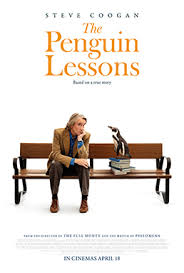
THE PENGUIN LESSONS
UK/Spain, 2024, 111 minutes, Colour.
Steve Coogan, Jonathan Pryce, Julia Fossi, David Herrero, Bjorn Gustafsson, Alfonsina Carroccio.
Directed by Peter Cattaneo.
Films about penguins are always interesting, intriguing, often delightful. 2024 saw the release of My Penguin Friend as well as the Penguin Lessons. Both are set in South America, the former in Brazil, the latter in Argentina. The former is set in the present, the concern for penguins and the environment. The latter is set in 1976.
1976 was a significant year in Argentinian history, civil unrest, the coup by the generals and their continued military dictatorship for the next eight years (including the Falklands War). This is very much the atmosphere of this story. However, the focus is on an Englishman, Tom Michell, the screenplay a fictional adaptation of his memoir (and, as often the case these days, some footage of himself and the penguin during the final credits).
Tom is a teacher, has been drifting for years through the US and Latin America, saddened, isolated, sardonic, not coping with the death of his daughter. He is welcomed by the principal of a privileged high school for the sons of wealthy Argentinians (including generals). The principal is played in a very proper English manner by Jonathan Pryce.
And Tom is played by Steve Coogan, an actor comfortable in both drama and comedy, seen to advantage in the National Theatre Live version of Dr Strangelove where he plays four satiric characters). Here he is rather world-weary, trying to teach his class English language and literature, forced to coach Rugby which he dislikes, intending to coast along in his life and work.
As with any visitor to Buenos Aires, he decides to catch the ferry across the Plata, a visit to Uruguay for some kind of relaxation. Instead, he and a companion from the nightclub, find a penguin covered in oil from a slick. He is happy to abandon it. She wants to clean it, care for it. And, long story short, the penguin becomes his responsibility, getting it through police checks and Customs, concealing it, trying to get rid of it, bringing it back to the school and ensconce it in his apartment.
And, there are many penguin lessons, the penguin becoming in the words of one of the alert students in the class, a metaphor. The penguin, now named, is a hit with the boys, uniting them from their mischief and bullying, paying attention, eager to feed the penguin, its becoming a football mascot.
Interestingly, everybody talks to the penguin, now named Juan Salvador, especially Tom. His rather demanding landlady and her daughter are charmed. His co-teacher from Finland is able to pour out all his personal troubles to the penguin. And, after being initially taken aback, of course, even the principal talks to the penguin. So, happy penguin lessons at the school.
But, this is the year of the coup, the cleaner’s daughter involved in protests, snatched by the police in the street in front of Tom, his not venturing to help, then the disappearance of the shopkeeper who supplied fish to the school, and an episode where Tom with the penguin sees the police chief who headed the abduction, sitting in a cafe, his little daughter patting the penguin, but a severe reprimand for Tom and then his being arrested, interrogated, tortured and released. This atmosphere pervades the latter part of the film.
While there is a happy ending at the school, the boys the better for Tom’s classes and his advocating of social equality and care, and the presence of Juan Salvador, all graduating. And the headmaster decides to use his influence with the parents to obtain the release of the imprisoned cleaner’s daughter.
This is a British film, an adaptation of the memoir, directed by Peter Cataneo (famous for his direction of The Full Monty), some British reserve and reticence as wellais sarcasm and sardonic remarks, which avoids an over-sentimental appeal, but nevertheless has its moments of laughter – and, perhaps to the surprise of some audiences, some tears.
- The title, memoir of the author, based on a true story, fictionalised, the home movie of the penguin during the final credits?
- Argentina, 1976, civil unrest, secret police and arrests, disappearances, the generals, the coup? And its continuing into the mid-1980s? Memories of the Falklands war?
- The city awareness of areas, the school and its interiors, grounds, the city streets, shops, the visit to Uruguay, the countryside, the city? The beaches, the oil slick? The musical score?
- Tom Michel, his story, arriving in Argentina, employed by the school, relationships with the headmaster, various schools in the US and Latin America, age, gradual revelation of the hit run death of his daughter and its effect on him, his wife, loneliness, sarcasm and sardonic, his room in the school, the encounter with the tough housekeeper, meeting Tapio from Finland, his conversations, serious minded, his sad story about his friend and ex-wife?
- The classes, the wealthy students, the fascist backgrounds, taunting the Socialist boy? Disturbances in class? Tom and his classes, sarcasm, Hamlet, literature, John Masefield’s poem, Shelley? Boys and their personalities, presumptions, bullying and targets? The football game, Tom going to lie down, overhearing the conversation between the shopkeeper with the fish and Sofia, reassuring her?
- The decision to go to Uruguay, motives, the trip with Tapio, the bar, the encounter with the women, the dancing, on the beach, finding the penguin, the woman and her compassion, Tom not wanting involvement, back to the hotel, secretly, washing and cleaning it, the kiss, and the woman leaving? The complications with the police and Customs about the penguin, the interrogations, the police threats? Tom bringing the penguin back to the school, in his room, trying to feed it, keeping it on the balcony?
- Audience response to the penguin, the name from Jonathan Livingston Seagull, Tom bringing it to class, the response of the boys, feeding the penguin, behaving better in class, Tom and his getting the boys to lie down, reflect, commentary on the poems, Diego and the focus on metaphor?
- The penguin, in the room, the balcony, with Sofia and her mother, the meal, Tapio and his conversation and revelation to the penguin? And later the headmaster doing the same? Tom and his conversations with the penguin?
- The political situation, lack of freedom, brutality, Sofia’s arrest, the closing down of the fish shop? Tom and Sofia’s arrest, not doing anything, excusing himself to the school, the later confession to Sofia’s mother, with the penguin and seeing the chief of police, his daughter patting the penguin, Tom asking for the release of Sofia, his arrest, torture, release? The reaction of people at the school? The headmaster and his intervention for Sofia? Successful?
- The headmaster, his personality, British, style, colonial? The patronage of the wealthy parents? Closing the school for a week? Suggesting that Tom move on? Talking to the penguin? Change of heart? The boys improving with their studies? The graduation ceremony and the applause for the students?
- Tom, his sad life, the possibility for change, the penguin as reality and metaphor, his staying at the school? And the happiness of Sofia’s release?
- The final information about his staying at the school, return to Wales, finding the old footage?
- The very British sensibility of the characters? Transported from Britain to the uncertainties of the oppression of the generals in Argentina, 1970s-1980s?
