Displaying items by tag: Helen Mirren
Goodbye June
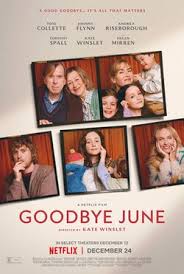
GOODBYE JUNE
UK, 2025, 114 minutes, Colour.
Helen Mirren, Timothy Spall, Kate Winslet, Andrea Riseborough, Johnny Flynn, Toni Collette, Fisayo Akinade, Stephen Merchant.
Directed by Kate Winslet.
A film with an appeal to a wide audience. It is a solid British drama. It has a very strong British cast. And, it is the first film directed by Kate Winslet, based on a screenplay by her son, Joe Anders (his father theatre and film director, Sam Mendes, and in his early 20s writing the film). Family.
Very often people don’t like to use the word death, burying the phrase, passing away, or the euphemism, passed. But here is a film about death and dying and no hesitations.
Over the decades audiences have been in admiration for Helen Mirren and the variety of roles that she has played. Helen Mirren turned 80 in 2025 and here she is playing a terminally ill mother family, collapsing at the opening of the film, rushed to hospital, decisions to stay in hospital for some kind of palliative care before her death. And many moments when we the audience share her physical pain.
The focus is on her three daughters, how they relate to their mother, how they relate to each other, their own families. And, with their mother so close to death, they are very conscious of their disputes but having the opportunity to display them, become more aware of, and, with the quiet intervention of their mother, facing up to the realities of their lives, in the past and the present.
The portrayals of the three sisters are very strong. Kate Winslet herself plays the oldest of the three, the reliable one, talented in her work, supporting others financially, children of her own that she feels she does not seen enough of, her husband away on business. By contrast, the second daughter, played by Andrea Riseborough (and glimpses of Stephen Merchant as a husband) is devoted to her children but, soon seen to be a controller, and heavy resentments towards her older sister.
But there is quite a contrast with the third sister, played by Toni Collette, caught up in New Age meditations and practices, living on the continent, with her classes, strong emotions, but afraid that time is passing her by.
The always reliable Timothy Spall plays June’s husband – an interesting portrait of the loving husband but who finds it hard to express emotions, taking refuge in sitting around and nodding off, after the canteen the pub, challenged by his daughters – and a wonderfully emotional sequence when he does a karaoke song, devoted to June.
And, then there are the grandchildren – it is Christmas time and they are preparing to take part in a Christmas pageant. They perform for their grandmother in hospital, more details of the Gospel story in the play than in many explicitly Christmas films. (And the entertaining line with grandfather playing the innkeeper, replying to Mary and Joseph that there is no room at the inn because “it’s Christmas and were very busy”.)
And back again to June, loving her family, not blind to their failures, finding ways to bring them even closer together (, moving sequences on truth-telling and re-discovering love) – and, a pleasing variation on the title when she leaves her letter to her unborn granddaughter, urging her to live her life to the full. And it is signed, Goodbye June.
- A film about death and dying? Illness? Palliative care and decisions? Family support?
- Using the language of death and dying, not just simply “passing”?
- The work of Kate Winslet, her son writing the screenplay, her direction, her performance and presence?
- The situation, the family, the mother’s illness, treatment, failing, the prospect of dying, soon? The impact on her husband, the past relationship, his coping and not coping? The response of her daughters, the contrasts, the emotion of her son, the grandchildren?
- June, her age, her marriage, for children, her love them? Her understanding them? The nature of her illness, the treatment, her collapse in the kitchen, getting her to the hospital, the surgery, the gathering of the family? Her response? Her knowing her condition?
- The doctors, the surgery, their explanations, Molly and her harsh responses, the doctor clicking his pen at her outburst? The decisions? The couple with the palliative care, June and her plan for her future? Molly’s angry outburst? Julia and her apologies?
- The decision for June to stay in hospital, Molly setting up the roster, not coinciding with Julia? The family and their keeping to the roster, the effect on them all? June, her pain, alleviation, sense of peace, patient with her children, her decision to try to reconcile them?
- Julia, the oldest, her marriage, her children, the Down Syndrome youngest? Her absent husband and his business, connections? The children and the Christmas play, dropping them at school, the arguments in the car? Her work, responsibilities – and later revelation of her paying for mortgages for her parents, for Molly…? Strong in herself, yet often angry? The interchanges with Molly?
- Molly, her appearance, her marriage, the children, the baby, bonding with her children, busy at home, to the hospital, her response to her mother, her harshness in listening to the doctors, to the palliative care team? Her roster? Anger with Julia? Her husband in the background, at home, with the children?
- Connor, living at home, waking, hearing his mother? His age, highly emotional, his response to his mother, to his father, staying at home and caring? Taking his mother to the hospital, his grief, emotions? Relationship with his sisters? His presence?
- Helen, New Age, in Germany, her sessions, her talk, her clientele, the exercises, the phone call, her coming to London, her mother’s comment about her not wearing yellow, the bond with her mother, with the others? The discovery of her pregnancy? Her partner, her later story about his relationships, Gustav and his being available for surrogacy? Helen. her age, emotions, apprehensive?
- Bern, the long marriage, his age, appearance, seemingly distracted, with his wife, at home, leaving the tap running, the flooding of the house? His relationship with his daughters? Seemingly self-preoccupied? Food, the pub, the beer, the football matches and his shouting? Fixing the television?
- Days passing, the roster the visits, the effect on June, health, her pain, the relief?
- The staff, the character of Angeli, his background, his name, his kindness to Helen, their bonding, his discussions with the children? In the interfaith chapel? Connor wandering into the Chapel, returning, with Angeli, the touch of the hand – and at the end of the final party, as a couple?
- June and her wanting to reconcile Julia and Molly, the plan with Angel, summoning them, the hurry, June’s device of getting them tell her right the letter to Helen’s child, straight talking to them? The scene together, the corridor, who first? Molly and her own idolising of Julia in the past, imitating her, Julia leaving when Molly was 13,feeling a sense of loss, betrayal? Envy of Julia and her accomplishments? Getting the Snickers, eating? Julia and a declaration about herself, having to take all the responsibilities? The bonding between the two, decision to cook the Christmas meal together?
- Connor and his exasperation with his father, his father going to the pub, telling his father off, in the pub, Bern choosing Georgia on my mind, substituting Junie, the emotional love for his wife, his son hearing it, their bonding? The house flood, Bern’s denial, different accommodation?
- The decision for the Christmas play, everybody turning up, the focus on Christmas, details of the Christmas play, the Gospel story, the performance, the humour, the joy?
- June, with Bern, her dying?
- The aftermath, the party, everybody together, joy, reconciliation, the toast to June?
- The finale, her letter to Helen’s child, expression of love, touches of immortality, the nice touch with the title, Goodbye June.
Thursday Murder Club, The
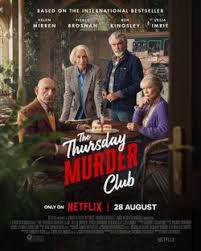
THE THURSDAY MURDER CLUB
UK, 2025, 118 minutes, Colour.
Helen Mirren, Pierce Brosnan, Ben Kingsley, Celia Imre, Naomi Acte, Daniel Mays, Jonathan Pryce, David Tennant, Henry Lloyd-Hughes, Tom Ellis, Geoff Bell, Paul Freeman, Richard E. Grant, Ruth Sheen.
Directed by Chris Columbus.
For several years now, this reviewer included, many readers have been exhilarated by the series of novels about The Thursday Murder Club. They have been written by television personality, Richard Osman, familiar from earlier seasons of the British television quiz program, Pointless, and from his own show, House of Games. In his writings, Osman is a great creator of characters, bringing them alive, especially with eccentricities, is able to develop intricate murder mysteries and their solutions, and has a witty way with words and topical references to politics, media, which can always bring a smile.
And he has created this group of foUr elderly residents of an aged care community in Kent who meet in the common room every Thursday morning to explore and try to solve cold cases. And, for the film version, American director, Chris Columbus (Home Alone, Mrs Doubtfire), brings his genial touch to a screenplay by Katy Brand and Suzanne Heathcote which has done a wonderful job of gathering all the key elements of the novel for a two-hour drama. (Within 24 hours of its appearance on Netflix, the IMDb registered a high number of bloggers, many delighted, some with various quibbles as expected, and then, for this reviewer, unexpectedly, bloggers who seemed unable to wait to share their misery of disappointment and judgements of failure in the adaptation – and one wonders why this judgemental haste. But, on with this review of enthusiasm…).
Helen Mirren has no trouble in being Elizabeth with her espionage background. Ben Kingsley perfectly embodies the gentlemanly psychotherapist. It was hard, while reading, to imagine Pierce Brosnan as old union activist, Ron, but he rises to the occasion, obviously enjoying himself in the role. In the novel, former nurse, now widow, Joyce, is often more than daffy. Celia Imre is wonderful in the role although, perhaps, she has been written a little less daffy than in the novels. But, it all works.
And, there is a wonderful supporting cast of British character actors, Jonathan Pryce standing out as Elizabeth’s husband, a good man with developing dementia. David Tennant enjoys himself as the main villain but Richard E. Grant is unexpected as a sinister florist towards the end of the film.
The film opens with an example of the Thursday Murder Club in action, a cold case in connection with a former member who is now lying in coma, her sad husband in attendance. And, while this might have served as an introduction to the club’s activities and remained as that, it actually becomes quite integral to the development of the plot and the finale.
But, there are two other deaths which have to be investigated, especially in connection with the possible sale of the aged care home by a ruthless developer.
And, then there are the two representatives of the local police, the alert at Donna (Noemi Ackie who played Whitney Houston in the film biography recently) and the rather overweight, sweets-eating, less on the ball Hudson, played engagingly by Daniel Mays. (And the laugh out loud scene in the novel where the club cram him on the couch to pressure him is happily incorporated into the film!).
So far Richard Osman has written five of these novels, and the film then provides faces and mannerisms of the stars for those who continue to read the novels, making them come alive most enjoyably.
- The popularity of Richard Osman’s books, characters and setting, murder mysteries and solutions, witty writing? The popular audience for this kind of storytelling? And the strong cast?
- The setting, the aged care home, rooms, meeting places? The outside sequences, atmosphere? Police stations? The village streets? The cemetery, the demonstrations in the street…? The musical score?
- The title, popularity of murder mysteries, the Agatha Christie tradition? The miss Marple tradition? The club, the members, the meetings, Elizabeth and her espionage background, Ron and his union background, Ebrahim and his psychotherapy, Joyce and her nursing background? Penn, police background, the cold case, her illness and coma, John caring for her? Elizabeth’s visits?
- The initial case, the woman stabbed and thrown out the window, the alleged intruder, the boyfriend, the investigation, the police believing the boyfriend, his disappearance? The photos, the meeting, moves towards solutions? Joyce responding to the photo, the blood, they’re asking her opinion? Her becoming a member of the club? The complication with the discovery of the Bones in the cemetery, the identification, confrontation with John, the murdering of the boyfriend, disposing of his bones? Admission of the truth, John killing Penn, suicide, Abraham and his eulogy at the cemetery?
- The situation with the home, bent, his character, divorce proceedings, his wife’s affair with Jason, ownership of the property, with Tony Curran? His plans for demolition, rebuilding flats, entertainment centre? Tony Curran and his Art board, the clash? Tony Curran, at home, the confrontation, his death, the investigation?
- Vent, his relationship with Bogdan, putting him as the boss, to dig in the cemetery during the protest, the discovery of the Bones, the meeting with Elizabeth, his Polish background, his mother, Elizabeth listening questions, her finding him at home, playing with Stephen, chess? The friendship? Stephen, his shrewdness, that Bogdan had killed Tony Curran? Elizabeth discovering the racquet about passports, hurrying back home, U of Stephen being poisoned, the police, the revelation of the truth, bogged down and is later friendship with Stephen?
- The discovery of the third owner, Elizabeth with the documents, Joyce and her relationship with her daughter, Joanna haughty, but examining the documents, giving the information about the ownership of the property? The mysterious identity, aunt Maud and the bouquet, the initials? The bouquet for Elizabeth, warning her off, her identifying the florist, the identity of the criminal, his savage reputation, disappearing? Elizabeth and the discovery of the passport racket, Tony Curran’s involvement, the truth about bogged down? Her deal with the criminal?
- The police station, Donna, her background in London, race, the meeting with the club, her lecture, the case, serving coffee to the male police, Elizabeth and her visit to the police, the information, the deal? Hudson, his manner, overweight, heating? Discussions with Elizabeth, the deals, wedging him on the couch, plying him with cake…? Donna and her position, driving, the interrogations, the collaboration with the club?
- The protest, vent and his visit to the elderly, the 10 minute consultation, Father Mackie and his protest, the crowds at the cemetery gate, man-to-man his arrogance, his collapse, his death? The post-mortem, poisoned?
- The role of each of the members in the investigation, Abraham and his analysis, his notes, calm presence? Ron, the union background, protests, two wives, relationship with Jason, Jason and his boxing in the past, doing jobs for vent, television, admired, his statue and the photo, the ice-skating? The affair? Ron and his posing as bewildered, then his suit and posing as his son’s lawyer…? Joyce, skill as a nurse, at home, the touch of the Daffy, cakes? And Elizabeth in control?
- Elizabeth, her relationship with Stephen, his going dementia, the tablets, playing chess, yet alert?
- The resolving of the mystery of vent’s death? Penn and John? The funeral?
- The finale, the audience enjoying the investigation, the quiet British style, the elderly, shrewdness, each playing their part?
White Bird
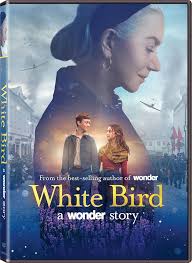
WHITE BIRD
US, 2023, 120 minutes, Colour.
Ariella Glaser, Orland Schwerdt, Helen Mirren, Gillian Anderson, Jem Matthews, Bryce Gheisar.
Directed by Marc Forster.
A film about occupied France.
To appreciate this journey back into the past, Jewish families, in Alsace, the advance of the Germans, anti-Semitism, the trains to the concentration camps, it is helpful to know that the film is based on graphic novel by popular author, R. J. Palacio, noted for her books for children and younger audiences. This is very much a Young Adult treatment of its theme. Which means that the drama and the sometimes dreadful situations are be presented in a way that, for instance, the whole family could watch the film together. There should be no expectations that this will be a graphic treatment for an an older audience.
But, the film opens in the present, in New York City, a young boy, Julian, expelled from school for bullying, is at his new school, and immediate suggestions of bullying situations. But, that is not the story here. Rather, his famous grandmother, a world renowned artist who is having an exhibition, retrospect, in New York, concerned about Julian’s expulsion and what will happen to him in a new school, tells him the story about her parents, in France, her own experience of the war. Which means then that most of the film is in flashbacks, often returning to the grandmother and Julian ensuring that he is listening attentively to her story.
As do we. The grandmother is Sara, mid teens, played by Ariella Glaser. Family is Jewish, the parents not immediately apprehensive but suddenly taken away. Sara attends the local school, run by a sympathetic priest. The staff of the school try to save the Jewish students from the Nazis, running away but everyone caught except for Sara, and the brutal death of the young teacher who helped.
Many audiences will be thinking of the Diary of Anne Frank as we see what happens to Sara, successfully running away, eluding capture, helped by a fellow student whom she had ignored in the past, he the butt of bullying because of his lame leg. He is Julien, played by Australian actor, Orland Schwerdt. With the consent of his parents, Sara is hidden in the barn, a growing friendship over a period of two years.
Julien is very likeable, audience sympathy for him, and the audience appreciating the growing friendship between him and Sara. But, there are the realities of war, some of the local boys from the school aligning themselves with the Nazis, some brutal confrontations. But, of course, Sarah has survived and prospered, having had great opportunity in the barn to continue and develop her drawings, her art. And, as she explains, that is why her young grandson has been called Julian.
Older audiences will be attracted to the film because it is headlined by Helen Mirren and Gillian Anderson, Helen Mirren as the older Sara, Gillian Anderson as Julian’s mother.
And, the imaginative touch, the presence of the White Bird, and its symbolism of peace and joy, protection.
(Audiences familiar with the writings of R.J.Palacio will know her story, Wonder, filmed in 2017, the American boy, Julian, a bullying character there – and this film opening with reference to his being expelled and at the new school.)
- A film about occupied France, the background of the Holocaust, but designed as a film for a Young Adult audience? Not designed for an older mature audience wanting to relive or to understand the Holocaust? Acknowledging these limits?
- The work of R.J.Palacio, her novels, graphic novels? The connection with Wonder, Julian, bullying, this new film and his changing school, his attitude towards bullying, sitting at the dining room table, told that is sitting with losers, the girl with the glasses and her invitation to join the social club? And is later apologising to her and his future?
- The framework with Julian, at school, his grandmother visiting from Paris, her reputation as an artist, the retrospect exhibition? Her talking with Julian, telling her story, hoping to temper his bullying and set him on a straight path?
- Helen Mirren as the grandmother, her presence and style, public celebrity, telling the story, the episodes in flashback, coming back to Julian in the present, the impact of her story on him?
- Sara’s story, in Alsace, Jewish family, the imminent arrival of the Germans, her parents confident, and their being taken? Her presence in the school, Catholic background, the priest in charge, the roundup of the Jewish students, the Germans, the sympathetic boys, especially Vincent and helping them? The young teacher getting the students to run away, their being rounded up, his being shot? Sara and her running away, hiding?
- Sara, the encounter with Julian, her having sat next to him in class for five years but snobbish? His leg and disability? Rescuing Sara, bringing her home, hiding her in the barn, the consent of his parents? The caution about the neighbours, thinking them informers? Sarah and the initial situation in the barn, the parents coming to welcome her, Julien and his visits, the food, pencils and the art book, the conversations, time passing?
- Memories of the Diary of Anne Frank? Sara and her isolation, secrecy, for two years? The growing friendship with Julien, playing cards, talking, the sketches? The birthday celebration, the cake, the parents joining in? The effect on Sarah?
- Julien, the moments of tension with Sara, not visiting? The resuming of the friendship?
- The presence of the Germans in the town, Julien and his decision to walk through the town, the mockery of the fellow students, his being taken with the infirm at the hospital, the drive, at into the countryside, their passing on the advice to run, everybody running, their all being shot?
- The parents, the news, her into the authorities, visit to the neighbours, the discovery that they were sheltering in old Jewish man for the years, the giving the mother the money to pay for Julien’s release, her hurrying to the authorities, going to the site, Julien’s death?
- The dangers for Sara, her being helped by the neighbours, her being saved till the end of the war?
- The dramatic sequence with Vincent, his finding her, her running into the countryside, the rule is, the attack on Vincent, his death?
- The effect of the story on Julien, his grandmother’s exhortation is an encouragement? And happy story of his name, and the parents giving away at her wedding ceremony?
- The gearing of the telling of the story to the young adult audience, glimpses of the violence rather than focusing on it, making it a film to enable younger audiences to go back into the past, to experience the anti-Semitism, the German occupation, the sending of the Jews to Auschwitz?
