Displaying items by tag: Ben Kingsley
Thursday Murder Club, The
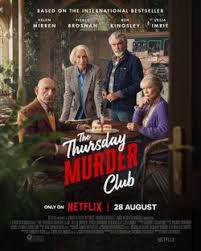
THE THURSDAY MURDER CLUB
UK, 2025, 118 minutes, Colour.
Helen Mirren, Pierce Brosnan, Ben Kingsley, Celia Imre, Naomi Acte, Daniel Mays, Jonathan Pryce, David Tennant, Henry Lloyd-Hughes, Tom Ellis, Geoff Bell, Paul Freeman, Richard E. Grant, Ruth Sheen.
Directed by Chris Columbus.
For several years now, this reviewer included, many readers have been exhilarated by the series of novels about The Thursday Murder Club. They have been written by television personality, Richard Osman, familiar from earlier seasons of the British television quiz program, Pointless, and from his own show, House of Games. In his writings, Osman is a great creator of characters, bringing them alive, especially with eccentricities, is able to develop intricate murder mysteries and their solutions, and has a witty way with words and topical references to politics, media, which can always bring a smile.
And he has created this group of foUr elderly residents of an aged care community in Kent who meet in the common room every Thursday morning to explore and try to solve cold cases. And, for the film version, American director, Chris Columbus (Home Alone, Mrs Doubtfire), brings his genial touch to a screenplay by Katy Brand and Suzanne Heathcote which has done a wonderful job of gathering all the key elements of the novel for a two-hour drama. (Within 24 hours of its appearance on Netflix, the IMDb registered a high number of bloggers, many delighted, some with various quibbles as expected, and then, for this reviewer, unexpectedly, bloggers who seemed unable to wait to share their misery of disappointment and judgements of failure in the adaptation – and one wonders why this judgemental haste. But, on with this review of enthusiasm…).
Helen Mirren has no trouble in being Elizabeth with her espionage background. Ben Kingsley perfectly embodies the gentlemanly psychotherapist. It was hard, while reading, to imagine Pierce Brosnan as old union activist, Ron, but he rises to the occasion, obviously enjoying himself in the role. In the novel, former nurse, now widow, Joyce, is often more than daffy. Celia Imre is wonderful in the role although, perhaps, she has been written a little less daffy than in the novels. But, it all works.
And, there is a wonderful supporting cast of British character actors, Jonathan Pryce standing out as Elizabeth’s husband, a good man with developing dementia. David Tennant enjoys himself as the main villain but Richard E. Grant is unexpected as a sinister florist towards the end of the film.
The film opens with an example of the Thursday Murder Club in action, a cold case in connection with a former member who is now lying in coma, her sad husband in attendance. And, while this might have served as an introduction to the club’s activities and remained as that, it actually becomes quite integral to the development of the plot and the finale.
But, there are two other deaths which have to be investigated, especially in connection with the possible sale of the aged care home by a ruthless developer.
And, then there are the two representatives of the local police, the alert at Donna (Noemi Ackie who played Whitney Houston in the film biography recently) and the rather overweight, sweets-eating, less on the ball Hudson, played engagingly by Daniel Mays. (And the laugh out loud scene in the novel where the club cram him on the couch to pressure him is happily incorporated into the film!).
So far Richard Osman has written five of these novels, and the film then provides faces and mannerisms of the stars for those who continue to read the novels, making them come alive most enjoyably.
- The popularity of Richard Osman’s books, characters and setting, murder mysteries and solutions, witty writing? The popular audience for this kind of storytelling? And the strong cast?
- The setting, the aged care home, rooms, meeting places? The outside sequences, atmosphere? Police stations? The village streets? The cemetery, the demonstrations in the street…? The musical score?
- The title, popularity of murder mysteries, the Agatha Christie tradition? The miss Marple tradition? The club, the members, the meetings, Elizabeth and her espionage background, Ron and his union background, Ebrahim and his psychotherapy, Joyce and her nursing background? Penn, police background, the cold case, her illness and coma, John caring for her? Elizabeth’s visits?
- The initial case, the woman stabbed and thrown out the window, the alleged intruder, the boyfriend, the investigation, the police believing the boyfriend, his disappearance? The photos, the meeting, moves towards solutions? Joyce responding to the photo, the blood, they’re asking her opinion? Her becoming a member of the club? The complication with the discovery of the Bones in the cemetery, the identification, confrontation with John, the murdering of the boyfriend, disposing of his bones? Admission of the truth, John killing Penn, suicide, Abraham and his eulogy at the cemetery?
- The situation with the home, bent, his character, divorce proceedings, his wife’s affair with Jason, ownership of the property, with Tony Curran? His plans for demolition, rebuilding flats, entertainment centre? Tony Curran and his Art board, the clash? Tony Curran, at home, the confrontation, his death, the investigation?
- Vent, his relationship with Bogdan, putting him as the boss, to dig in the cemetery during the protest, the discovery of the Bones, the meeting with Elizabeth, his Polish background, his mother, Elizabeth listening questions, her finding him at home, playing with Stephen, chess? The friendship? Stephen, his shrewdness, that Bogdan had killed Tony Curran? Elizabeth discovering the racquet about passports, hurrying back home, U of Stephen being poisoned, the police, the revelation of the truth, bogged down and is later friendship with Stephen?
- The discovery of the third owner, Elizabeth with the documents, Joyce and her relationship with her daughter, Joanna haughty, but examining the documents, giving the information about the ownership of the property? The mysterious identity, aunt Maud and the bouquet, the initials? The bouquet for Elizabeth, warning her off, her identifying the florist, the identity of the criminal, his savage reputation, disappearing? Elizabeth and the discovery of the passport racket, Tony Curran’s involvement, the truth about bogged down? Her deal with the criminal?
- The police station, Donna, her background in London, race, the meeting with the club, her lecture, the case, serving coffee to the male police, Elizabeth and her visit to the police, the information, the deal? Hudson, his manner, overweight, heating? Discussions with Elizabeth, the deals, wedging him on the couch, plying him with cake…? Donna and her position, driving, the interrogations, the collaboration with the club?
- The protest, vent and his visit to the elderly, the 10 minute consultation, Father Mackie and his protest, the crowds at the cemetery gate, man-to-man his arrogance, his collapse, his death? The post-mortem, poisoned?
- The role of each of the members in the investigation, Abraham and his analysis, his notes, calm presence? Ron, the union background, protests, two wives, relationship with Jason, Jason and his boxing in the past, doing jobs for vent, television, admired, his statue and the photo, the ice-skating? The affair? Ron and his posing as bewildered, then his suit and posing as his son’s lawyer…? Joyce, skill as a nurse, at home, the touch of the Daffy, cakes? And Elizabeth in control?
- Elizabeth, her relationship with Stephen, his going dementia, the tablets, playing chess, yet alert?
- The resolving of the mystery of vent’s death? Penn and John? The funeral?
- The finale, the audience enjoying the investigation, the quiet British style, the elderly, shrewdness, each playing their part?
King of Kings, The/ 2025
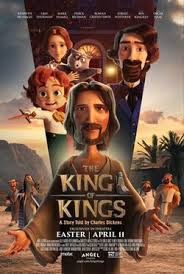
THE KING OF KINGS
South Korea/US, 2025, 100 minutes, Colour.
Voices of: Kenneth Branagh, Oscar Isaac, Uma Thurman, Pierce Brosnan, Mark Hamill, Forest Whitaker, Ben Kingsley, Jim Cummings, Roman Griffin Davis.
Directed by Seong-ho Jang.
Yes, the Gospel story. However, this film is an animation-dramatisation of a story by Charles Dickens, a story he wrote in the 1840s for his family, recited every Christmas by the author and read aloud in succeeding family generations, Dickens forbidding publication. However, in 1934, the family made it available over 60 years after the death of the author.
At the beginning of his story, Dickens wrote: My Dear Children, I am very anxious that you should know something about the History of Jesus Christ. For everybody ought to know about Him. No one ever lived who was so good, so kind, so gentle, and so sorry for all people who did wrong, or were in any way ill or miserable, as He was.
This film was made by a South Korean animator, Seong-go Jang, in Korean studios but uses the voices of some very talented English speakers, British and American.
Dickens told the story to his family and in this film he tells it to his younger son, Walter, quite a spirited boy, absorbed by stories of King Arthur, swords and dragons. And he disrupts his father’s presentation on stage of Scrooge and A Christmas Carol. s Dickens’ sympathetic wife urges him to tell the Gospel story, the young boy becoming more and more interested, initially wanting kings and dragons, but drawn into the story and following the person of Jesus. And, all the while, accompanied by his mischievous cat.
Which means that this is definitely a film for the younger audiences, but could be a pleasure for the whole family.
The animation style is vivid, the characters, the backgrounds, sometimes gently quiet with Jesus healing, with the apostles, at other times very vivid, especially Jesus walking on the water in the overwhelming storm. A great deal of the time is given to the Last Supper, the agony in the garden, Judas betrayal, uses trial and Caiaphas and Pilate, the crucifixion. Audiences who enjoy animation stories like this style and treatment.
But, a key element of the screenplay is having the young boy enter into all the action, observing close-up, being with Jesus, listening, watching, admiring, dismayed… And, at times, Dickens himself comes with his son into the action, close-up, and all the while with Kenneth Branagh’s narration as Dickens. The device of having Walter within the Gospel story is a great means for younger audiences also entering in, identifying, learning about Jesus and his story with a devout theme-highlighting commentary by Dickens.
St Ignatius Loyola founder of the Jesuits, would probably endorse this film. In his Spiritual Exercises, he urges those making retreats, or at any time with gospel contemplations, to enter into the scene, to be there, to experience the Gospels. And, a great challenge to those on retreat is to ask them where they are in the scene, at a distance observing, or very close to Jesus. This film dramatises what this closeness could be like.
The voice cast is very strong, not only Kenneth Branagh, but Uma Thurman as his wife, Mark Hamill is an extraordinarily rambunctious and King Herod pantomime-like , Ben Kingsley is a thundering villainous high priest, Caiaphas, Pierce Brosnan is a disdainful Pontius Pilate – and Oscar Isaac is Jesus.
In 2000, the animated film, The Miracle Maker, with Ralph Fiennes as the voice of Jesus, was very successful in portraying the Gospel stories. Now, The King of Kings is a very welcome addition.
- How successful as a Gospel film? This, the range of the Gospel episodes?
- Charles Dickens’ story, for his family, here for his son, the urging of his wife?
- The style of animation, from South Korea, the quality of the voice cast?
- The opening, A Christmas Carol, the story of Scrooge, Dickens in the theatre, interrupted by his son, Walter, King Arthur, dragons and sword, stubborn in reacting to his father, the cat, all the disruption, the pages scattered and torn? The audience watching, Walter and the cat? Dickens and his response?
- Dickens, his patient wife, urging Dickens to tell the story of the Gospels? Dickens own appreciation of the Gospel story, his admiration for Jesus, the tone of his narrative in telling the story?
- The visuals, journey to Bethlehem, the appearance of the angels, shepherds and magi, Herod and his overreaction, the indications of persecution of the innocent children, the flight into Egypt, Jesus growing up, the return to Galilee, the finding in the temple, Jesus emerging as an adult.
- The device of having Walter go into the action, with his cat, gradually understanding, becoming involved, emotions, observing and then becoming very close to Jesus?
- The familiar gospel sequences of Jesus’ public life, the elaborate temptations in the desert, the choosing of the apostles, Peter and the fishing, the healing of the crippled man, the casting out of the Demon, Jesus’ encounters, Mary and the request about Lazarus, the raising of Lazarus, the anointing of Jesus, the complaints of Judas, the entry into Jerusalem, building up the picture of Jesus? Especially the dramatisation of Jesus walking on the water, Peter and his walking, drowning, appeal to Jesus?
- The Last Supper, Agony in the Garden, Judas and his deal with kindness, the reaction of the scribes and Pharisees, planning to kill Jesus, this, the emphasis on healing the servant’s ear with Peter and the sword, the trial and Caiaphas thundering, rousing the crowd, the choice between Barabbas and Jesus, Pontius Pilate washing his hands, scourging, crowning with thorns, the way to Calvary, the crucifixion, the thieves and the good thief, Jesus’ death? The importance of the resurrection?
- Dickens entering into the scenes with his son? The effect of the story on Walter, sharing it with the other children?
- The telling of the Gospel stories with an appeal to the children’s audience and to families?
Wes Anderson's short films from Roald Dahl: Wonderful World of Henry Sugar; The Swan; Poison; The Rat Catcher
WES ANDERSON’S SHORT FILMS FROM ROALD DAHL STORIES.
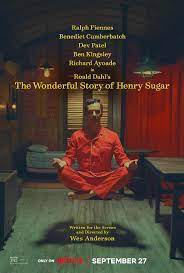
THE WONDERFUL WORLD OF HENRY SUGAR
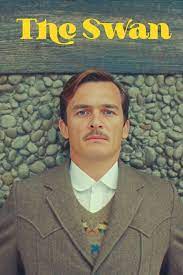
THE SWAN

POISON
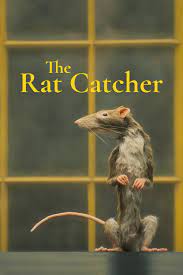
THE RAT CATCHER.
THE SHORT FILMS
Roald Dahl novels and short stories have been very popular on screen since the 1960s, Willy Wonka (and several versions since), stories like The Witches, Matilda, James and the Giant Peach. Here is a selection from his short stories.
Wes Anderson had already made a film of a Roald Dahl story, the animated feature, The Fantastic Mr Fox (with voices of George Clooney, Meryl Streep).
This time he has made what might be called live-action animation, actors performing but with very stylised backgrounds and sets, and action within the scenes of sets being moved, of stagehands coming in with props and removing them, and equivalent of stage performance. Anderson had used this kind of live-action animation in his feature, Asteroid City.
As with all his films, he assembles a distinguished cast – each of them appearing in several of these stories, Ralph Fiennes as Roald Dahl himself, the narrator, but also the rat catcher; Ben Kingsley as the man who can see without eyes, as a doctor; Dev Patel as a doctor and a friend of a patient; Richard Ayeode as a doctor, as a service station assistant, as a guru; Rupert Friend at the service station and narrating the story of The Swan.
The screenplay for each story retains the text written by Dahl – all expertly recited, often very rapidly, and the films could serve as audiobooks. The dialogue includes even the interjections, “he said”, spoken by the actors, turning to camera, then turning back to the action. In fact, there is a lot of direct speaking by the actors to the camera, breaking the fourth wall, talking to the audience.
This has quite a dramatic effect, the audience observing, invited to be involved, making judgements on the characters and their behaviour, opinions on the issues.
And there are issues:
Henry Sugar as a character who is not likeable, arrogant, self-centred, listening to a story about an Indian guru, capitalising on the techniques that the Indian used to be able to see things without his eyes (and the story of the Indian himself and his training and success), Henry Sugar then exploiting the technique, winning and winning vast amounts of money at the casinos, facing the fact that he does not need the money, deciding to give it away, throw it from his balcony, but a policeman coming to tell him that he is disobeying the law. So there is redemption for Henry Sugar.
A theme of The Swan is bullying, the focus on a young boy and his grown-up self narrating the story of the bullies at school, the effect on him, persecution, ridicule, and his developing wings to fly away from the bullying.
There is racial prejudice in Poison, the story of an officer in India, lying in bed, stating that a snake has attacked him and asking his close friend and ally to get a doctor to administer remedies. In his desperation, the officer is condemnatory of the doctor and his Indian background.
There is something sinister about The Rat Catcher, again Roald Dahl telling the story but then Ralph Fiennes hired as a Rat Catcher by a journalist and the owner of a service station, discussions about animals and rats, menace, the methods of dealing with rats, the rat catcher meanwhile becoming all the more rodent -like.
Netflix is showing all these stories – as a continuous program or as separate short films.
Daliland
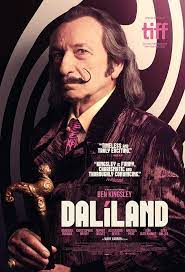
DALILAND
US, 2022, 97 minutes, Colour.
Ben Kingsley, Barbara Sukowa, Ezra Miller, Christopher Briney, Rupert Graves, Andreja Pejic, Alexander Beyer, Mark McKenna, Zachary Nachbar-Seckel, Avital Lvova.
Directed by Mary Harron.
Daliland, the idiosyncratic world of Spanish artist, Salvador Dali. Dali, who died in 1989, and who might well be very pleased with this cinema portrait but not very pleased to realise that, with the passing of time, the 21st-century audience may not know who he is, or was. This is an opportunity to become aware of this most eccentric person, self-centred and arrogant, who achieved a great deal in the world of art, fostering his own publicity.
This film opens tantalisingly with Dali himself on a talk show, immediately recognisable with his upturned moustache, with the contestants blindfold, asking questions – to which Dali says yes to everything. He does look like Dali himself but here is Ben Kingsley, 40 years after his Oscar for playing Gandhi, showing how versatile he can be when embodying unusual characters. It is an excellent Ben Kingsley performance. And he is matched by Barbara Sukowa playing Gala, his wife of many decades, a Russian émigré to France, 10 years older than Dali but with him from 1929 to her death in 1982, demanding on him, protective of him, forcing him to work when he was reluctant, but with an eye to younger men whose careers she promoted.
In checking with sources on Dali and his life and work, a very long entry and detailed in Wikipedia, for instance, for quick research, many aspects of Dali’s character and behaviour described there are incorporated into the film, into Dali’s talk about himself, in the portrait and behaviour of Gala, his hypochondria, food issues, sexuality, voyeurism…
But, this is a dramatised portrait with fictional elements. The principal element is that of the character, Jim, Christopher Briney, an earnest young man from Idaho who begins work in New York for Dali’s agent, attracts Dali’s attention, calling him St Sebastian, but not attracting Gala’s favour. As he goes to work with Dali, meant to keep an eye on him to keep him working for an immediate show, he allows himself to be seduced by this other planet as he calls it, intrigued by the parties, the flamboyant guests, sexual overtones, the New York world of the mid-1970s. We have seen Jim at the beginning of the film, in 1984, watching the Dali show on television, so this is a flashback, his experience of Dali, his genuine love of art but realising he could never be an artist, but then the victim of the whims of Dali, Gala and his agent.
In 1985, he makes a trip to Spain, to visit Dali, caught up in various schemes whereby art paper was bought, Dali signing the pages and then lithographs and prints made of the art and sold as the genuine article (also referenced in Wikipedia). He does his best to help Dali whom he admires but is ousted by Gala.
The screenplay highlights some of the past between Dali and Gala, some flashbacks with Ezra Miller as Dali and Avital Lvova as Gala. But, at the end, Jim visits the artist who is in health decline, to give him a book that he had compiled of the various signatures that Dali used for his work. It emerges that Jim, no longer seduced by this world, runs a small gallery, his love of art.
The screenplay was written by John Walsh and directed by his wife, Mary Harron. In looking at Mary Harron’s filmology, she has brought her audience into some bizarre and exotic worlds, I Shot Andy Warhol, his strange New York world, especially the 1960s; The Notorious Bettie Page, a model who was investigated by the American Senate; and a film version of Bret Easton Ellis’s tale of a predatory young banker, American Psycho. She brings her intrigue with these offbeat worlds, the touches of decadence, to her interpretation of Daliland.
1. Audience knowledge of Dali and his art and career?
2. Salvador Dali as a 20th-century figure, art, celebrity, multicultural?
3. The director, her career, her interests, a New York focus?
4. The focus on Dali in his old age, intimations of the past, the flashbacks of himself and Gala, Spain, Art and career, Luis Bunuel, influence in Hollywood, the visits to the United States?
5. The opening device, the television quiz, the introduction to Dali, his self-confidence?
6. Ben Kingsley’s performance, incarnating Dali? In himself, his character, self-absorption, moods? His relationship with Gala? Issues of sexuality? Art, painting, exhibition, pressures and timetables? His whims? Food, socials, antisocial, his agents, assistants, the media?
7. Or should have Gala, her age, older than Dali, the relationship, over the decades, her temperament, lovers, fostering careers, Jesus and Superstar?
8. Jim, the background in Idaho, seeing Dali on television, moving to New York, his work in assisting Dali, keeping him up to the mark? Interactions with Gala, her dislike of him? His being seduced by this New York lifestyle, the characters, the encounters with Lucy, sexuality, the relationship? Dali calling him St Sebastien?
9. New York society, the parties, lavish, sexuality, the presence of Alice Cooper, the presence of Amanda, Jesus and Jesus Christ Superstar? The presence of Captain Moore, his aide?
10. The impact of the flashbacks, brief, the young Dali, the young Gala, in Spain, the meeting, marrying?
11. Dali later retiring to Spain, his life there, career? Returning to sources?
12. Jim, his visit, tracking down Dali, the reaction of Gala? His book with the variety of signatures? Dali using him on his visit?
13. Jim, the aftermath of his experience of Dali and Daliland, managing his art gallery, his future?
14. Insights into the character of Dali, his career, his style of art?
