Displaying items by tag: John Slattery
Nuremburg
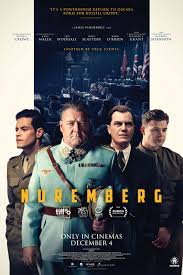
NUREMBERG
US, 2025, 148 minutes, Colour.
Russell Crowe, Rami Malek, Michael Shannon, Leo Woodall, John Slattery, Richard E.Grant, Colin Hanks, Lydia Peckham, Ben Miles, Lotte Verbeek, Mark O'Brien, Andreas Pietschmann.
Directed by James Vanderbilt.
80 years after the end of World War II, the name Nuremberg still evokes memories of the Nazi regime, the rallies in the 1930s, Lottie Riefenstahl is film Triumph of the Will, the location for the proclamation of anti-Semitic laws, and after World War II, the trials.
Cinemagoers and television viewers will have memories of the 1961 classic, Judgement at Nuremberg, and the 2000 television series, Nuremberg, with Brian Cox as Herman Goering. Here is a new take on the trials, focusing particularly on Goering and the American psychiatrists brought in to gauge the mental states of those accused, Douglas Kelly. There is also a focus on Justice Robert Jackson, his role in promoting the trials even though there were no legal precedents, the combining of Britain, France, the Soviet Union and the US to sit in legal judgements on these Nazi war criminals. The screenplay by writer-director, James Vanderbilt, draws on documentation and verbatims of speeches during the trials.
With the focus on Goering, a large man in real life, Russell Crowe fully embodies him (and Crowe, 25 years after Gladiator and his Oscar, can still dominate the screen). Physically, he is quite a contrast to the psychiatrist, Douglas Kelly, played by Oscar-winner Rami Malek. At the centre is a battle of wits, Goering able to combine charm with ruthlessness in his hyper-narcissistic personality, Kelly with psychiatric shrewdness but, in many ways, succumbing to the domination of Goering, an ambiguous friendship, bonding with Goering’s wife and daughter, but a final disillusionment.
Along with this focus on the two central characters, the screenplay provides the background to the raising of such issues as an international court, no legal precedent. And the need for international collaboration with Britain, France and the Soviet Union. At the centre is Justice Robert Jackson, a seriously sombre performance by Michael Shannon, earnest, committed – and with a surprising sequence where he goes to persuade Pius XII to support the trials, using the Pope’s concordat with the Nazi regime in 1933 as a persuasive point of power to gain the Pope’s assent.
Each of the central characters has powerfully dramatic moments. As do two of the supporting characters, standing out is Leo Woodall’s performance as Howie Triest, Kelly’s translator, but revealing at the end his Jewish background and an impassioned narration of his persecuted life and his American commitment. And, Richard E.Grant also has a significantly dramatic scene, a short but cumulatively effective interrogation of Goering on the stand, brutally making Goering admit his continuing Nazi loyalties.
Older audiences will be familiar with so many of the details but, for later audiences, the device is used in the screenplay to have characters explain situations that they were discovering in 1945. And, the film here uses newsreel footage, re-enacted black-and-white footage. And, there is quite extensive footage, screened in Nuremberg at the trials, the horror of the prisoners in the concentration camps, the starvation and torture, the mounds of dead bodies, the bulldozers clearing… 80 years later still profoundly shocking.
With its focus on Goering and Kelly, Nuremberg is not the last war trials story but it does bring the past back to life – and, some of the speeches at the trial and an epilogue with Douglas Kelly in a radio program proclaiming that fascist groups and individuals can still flourish even if the neo-Nazis are not wearing uniforms. Today we know how true this is.
- The title, expectations, memories of Nuremberg, the Nazi rallies, vast rally building, the post-war trials, significance in crimes against humanity? International collaboration?
- Audience knowledge of the war, the Nazi regime, Hitler, Goering as his second-in-command, the concentration camps, the Holocaust, ideology, anti-Semitism, power? The explanations in the dialogue of the film to explain to the characters of the time and their new awareness, for later film audiences?
- The film as drama, relying on documentation from the court case, the book about the psychiatrist and his encounters with the accused, the focus on Goering and the psychiatrist? The use of black and white news footage, re-created footage, especially the concentration camps?
- The extensive scenes of the concentration camps, the dead, the bodies, the survivors, the bulldozers… The impact 80 years later?
- The strong cast, the musical score?
- Goering story, World War I, his wounds, commitment to Hitler, the 1920s into the 1930s, his role of command, his decisions, legislation, anti-Semitic, final solution, complete and total solution? Interactions with the other members of the Nazi regime? His plan for surrender, in the car with his wife and daughter, prison? His plan for control, to be centre-stage, to make his statement? The disappearance of his wife and daughter?
- Douglas Kelly, psychiatrist, reputation, military, invited to deal with the war criminals, his personality, his shrewdness, analysis, knowing that Goering spoke English, the discussions with Howie, the translations, perceptions of Goering, narcissistic, control? Writing his notes, the plan for the book? The range of meetings with Goering, Howie present, alone with Goering, the letters, his decision to visit his wife and daughter, the letters, the return? The attachment, later visits, the daughter and the piano? And the personal discussions with Goering?
- Justice Jackson, his personality, legal background, Supreme Court, his assistant, discussions about bringing the criminals to trial, the assistant and her legal arguments, no precedent, the need for International collaboration, not just America prosecuting in another country? The background of the discussions, Roosevelt and his stances, the Congress, variety of legal opinion, the socials and discussions? The visit to Pius XII, asking for support, quoting 1933, the Vatican and the concordat with the Nazis, the experience of the war, Pius XII and his reputation, the respectful discussion, the political blackmail? The support?
- The preparations in Nuremberg, rebuilding the hall, preparations, the international judges, the media?
- Colonel Andrus, in charge, his personality, the touch abrasive, not approving of Kelly, his attitude towards the prisoners? In Switzerland, the transfer to Nuremberg? The cells, no amenities, the beds, mattress, toilets, to prevent suicides? Goering is, that they were German built?
- Jackson, coming to Nuremberg, the audience contemplating the issues through him, his speeches, the meeting with Maxwell Fyfe? The support of his assistant?
- The other accused, the presentation of who they were, their background, war crimes, anti-Semitism, their personalities? The reaction to imprisonment, assertion? The arrival of Hess, his salute, claiming amnesia, the time in Scotland? Interactions with Goering, pretending not to know him? Kelly using Goering to get information about Hesse? Using the letters as persuasion?
- Kelly, on the train, the magic, the card tricks, the journalist, meeting her, his drinking, the interview with her, the headlines, the colonel dismissing him? At the station, returning home, Howie at the station, the powerful scene with Howie, explanation of his past, German, Jewish, escape, the United States, enlisting, wanting to bring down the criminals? The influence on Kelly, accused of not doing anything, his book, giving it to Jackson to prepare the case? His coming to the court?
- Kelly and his interaction with the various criminals, discussions, the Rorschach tests, the responses and indications of their psychology, especially Kelly’s comments on Goering’s responses?
- The arrival of Dr Gilbert, brash style, clashes with Kelly, suggesting writing a book together, the blonde information to Goering about his wife and daughter being taken, the fight with Dr Gilbert?
- The trial opening, the accused, Goering delaying in standing and sitting, centre of attention? Jackson, his speeches, his interrogation of Goering, verbal fencing, accuracy, precision of dates, quibbling about translations? Jackson and his sense of failing (and not being appointed to the Supreme Court)? Maxwell Fyfe, his asking the question, the powerful sequence of his interrogation, Goering’s responses, going through the history of the Third Reich, Goering accepting it, the final question about still being loyal to Hitler? The defeat of Goering?
- Kelly, the final visit to Goering, and the background of the magic trick, Goering and the cyanide pill, his suicide?
- The hour for the executions, sudden, not letting the accused is one, no drugs, the test case, tantrum, Howie dressing him, escorting him to the gallows, Howie and the personal antagonism towards the accused, the hanging?
- Kelly, the radio interviews, his book, drinking, assertions, the reactions? And the final sequence of him walking along the corridor, drunk, and his depression and suicide, cyanide pill?
- The final information, the consequence of the Nuremberg trials, new standards for Justice and the law for crimes against humanity?
