Displaying items by tag: David Tennant
Thursday Murder Club, The
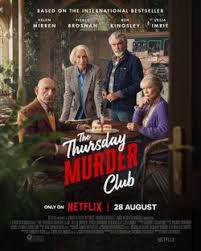
THE THURSDAY MURDER CLUB
UK, 2025, 118 minutes, Colour.
Helen Mirren, Pierce Brosnan, Ben Kingsley, Celia Imre, Naomi Acte, Daniel Mays, Jonathan Pryce, David Tennant, Henry Lloyd-Hughes, Tom Ellis, Geoff Bell, Paul Freeman, Richard E. Grant, Ruth Sheen.
Directed by Chris Columbus.
For several years now, this reviewer included, many readers have been exhilarated by the series of novels about The Thursday Murder Club. They have been written by television personality, Richard Osman, familiar from earlier seasons of the British television quiz program, Pointless, and from his own show, House of Games. In his writings, Osman is a great creator of characters, bringing them alive, especially with eccentricities, is able to develop intricate murder mysteries and their solutions, and has a witty way with words and topical references to politics, media, which can always bring a smile.
And he has created this group of foUr elderly residents of an aged care community in Kent who meet in the common room every Thursday morning to explore and try to solve cold cases. And, for the film version, American director, Chris Columbus (Home Alone, Mrs Doubtfire), brings his genial touch to a screenplay by Katy Brand and Suzanne Heathcote which has done a wonderful job of gathering all the key elements of the novel for a two-hour drama. (Within 24 hours of its appearance on Netflix, the IMDb registered a high number of bloggers, many delighted, some with various quibbles as expected, and then, for this reviewer, unexpectedly, bloggers who seemed unable to wait to share their misery of disappointment and judgements of failure in the adaptation – and one wonders why this judgemental haste. But, on with this review of enthusiasm…).
Helen Mirren has no trouble in being Elizabeth with her espionage background. Ben Kingsley perfectly embodies the gentlemanly psychotherapist. It was hard, while reading, to imagine Pierce Brosnan as old union activist, Ron, but he rises to the occasion, obviously enjoying himself in the role. In the novel, former nurse, now widow, Joyce, is often more than daffy. Celia Imre is wonderful in the role although, perhaps, she has been written a little less daffy than in the novels. But, it all works.
And, there is a wonderful supporting cast of British character actors, Jonathan Pryce standing out as Elizabeth’s husband, a good man with developing dementia. David Tennant enjoys himself as the main villain but Richard E. Grant is unexpected as a sinister florist towards the end of the film.
The film opens with an example of the Thursday Murder Club in action, a cold case in connection with a former member who is now lying in coma, her sad husband in attendance. And, while this might have served as an introduction to the club’s activities and remained as that, it actually becomes quite integral to the development of the plot and the finale.
But, there are two other deaths which have to be investigated, especially in connection with the possible sale of the aged care home by a ruthless developer.
And, then there are the two representatives of the local police, the alert at Donna (Noemi Ackie who played Whitney Houston in the film biography recently) and the rather overweight, sweets-eating, less on the ball Hudson, played engagingly by Daniel Mays. (And the laugh out loud scene in the novel where the club cram him on the couch to pressure him is happily incorporated into the film!).
So far Richard Osman has written five of these novels, and the film then provides faces and mannerisms of the stars for those who continue to read the novels, making them come alive most enjoyably.
- The popularity of Richard Osman’s books, characters and setting, murder mysteries and solutions, witty writing? The popular audience for this kind of storytelling? And the strong cast?
- The setting, the aged care home, rooms, meeting places? The outside sequences, atmosphere? Police stations? The village streets? The cemetery, the demonstrations in the street…? The musical score?
- The title, popularity of murder mysteries, the Agatha Christie tradition? The miss Marple tradition? The club, the members, the meetings, Elizabeth and her espionage background, Ron and his union background, Ebrahim and his psychotherapy, Joyce and her nursing background? Penn, police background, the cold case, her illness and coma, John caring for her? Elizabeth’s visits?
- The initial case, the woman stabbed and thrown out the window, the alleged intruder, the boyfriend, the investigation, the police believing the boyfriend, his disappearance? The photos, the meeting, moves towards solutions? Joyce responding to the photo, the blood, they’re asking her opinion? Her becoming a member of the club? The complication with the discovery of the Bones in the cemetery, the identification, confrontation with John, the murdering of the boyfriend, disposing of his bones? Admission of the truth, John killing Penn, suicide, Abraham and his eulogy at the cemetery?
- The situation with the home, bent, his character, divorce proceedings, his wife’s affair with Jason, ownership of the property, with Tony Curran? His plans for demolition, rebuilding flats, entertainment centre? Tony Curran and his Art board, the clash? Tony Curran, at home, the confrontation, his death, the investigation?
- Vent, his relationship with Bogdan, putting him as the boss, to dig in the cemetery during the protest, the discovery of the Bones, the meeting with Elizabeth, his Polish background, his mother, Elizabeth listening questions, her finding him at home, playing with Stephen, chess? The friendship? Stephen, his shrewdness, that Bogdan had killed Tony Curran? Elizabeth discovering the racquet about passports, hurrying back home, U of Stephen being poisoned, the police, the revelation of the truth, bogged down and is later friendship with Stephen?
- The discovery of the third owner, Elizabeth with the documents, Joyce and her relationship with her daughter, Joanna haughty, but examining the documents, giving the information about the ownership of the property? The mysterious identity, aunt Maud and the bouquet, the initials? The bouquet for Elizabeth, warning her off, her identifying the florist, the identity of the criminal, his savage reputation, disappearing? Elizabeth and the discovery of the passport racket, Tony Curran’s involvement, the truth about bogged down? Her deal with the criminal?
- The police station, Donna, her background in London, race, the meeting with the club, her lecture, the case, serving coffee to the male police, Elizabeth and her visit to the police, the information, the deal? Hudson, his manner, overweight, heating? Discussions with Elizabeth, the deals, wedging him on the couch, plying him with cake…? Donna and her position, driving, the interrogations, the collaboration with the club?
- The protest, vent and his visit to the elderly, the 10 minute consultation, Father Mackie and his protest, the crowds at the cemetery gate, man-to-man his arrogance, his collapse, his death? The post-mortem, poisoned?
- The role of each of the members in the investigation, Abraham and his analysis, his notes, calm presence? Ron, the union background, protests, two wives, relationship with Jason, Jason and his boxing in the past, doing jobs for vent, television, admired, his statue and the photo, the ice-skating? The affair? Ron and his posing as bewildered, then his suit and posing as his son’s lawyer…? Joyce, skill as a nurse, at home, the touch of the Daffy, cakes? And Elizabeth in control?
- Elizabeth, her relationship with Stephen, his going dementia, the tablets, playing chess, yet alert?
- The resolving of the mystery of vent’s death? Penn and John? The funeral?
- The finale, the audience enjoying the investigation, the quiet British style, the elderly, shrewdness, each playing their part?
Macbeth/2025
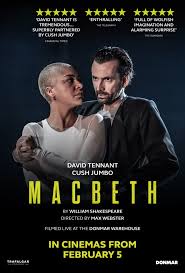
MACBETH
UK, 2025, 114 minutes, Colour.
David Tennant, Cush Jumbo, Cal MacAninch, Noof Ousellam, Moyo Akande, Casper Knopf, Jatinder Singh Randhawa, Rona Morison, Brian James O'Sullivan, Ros Watt, Benny Young
Directed by Max Webster; Capture directed by Tim Van Someren.
For just over 400 years, Shakespeare’s Macbeth, The Scottish Play, has been regularly performed. And, there have been several film versions including those by Orson Welles, Roman Polanski, filmed stage versions with Kenneth Branagh, Ralph Fiennes, and the basic plot being used for several gangster films like Joe Macbeth and Geoffrey Wright’s version updated to Melbourne.
In the last decade there have been Justin Kurzel’s version with Michael Fassbender and Marion Cotillard as well as Joel Coen’s version with Denzel Washington and Frances McDormand.
But, here is Macbeth with a Scottish accent. And a number of the other characters as well. And it is a striking performance, especially with his accent, by popular film and television star, David Tennant. At the outset, he makes Macbeth’s character his own and doesn’t let go. Sometimes, Lady Macbeth seems to dominate in interpretations. However, here she is played by Cush Jumbo, strongly intense but never dominating Macbeth himself.
The rest of the cast is an ensemble, often standing in a row at the back of the stage, then emerging and taking on quite a range of characters. And there is a racial mix in the cast as well as two actresses taking on male characters, especially Ross and Malcolm. And amongst the ensemble are musicians playing on stage.
And, considering the stage, it is a white square, surrounded on three sides by the audience (wearing headphones so that they hear the Shakespearean language well and extraneous sounds are excluded). At times there can be some props carried on stage including the weapons. And, at the end, behind the stage there is a colourful nature panorama. The minimalist staging of the play works particularly well, making demands on the imagination of the audience.
But, one might say the triumph of this version is the decision to use close-ups throughout the film, bringing the audience so close to Macbeth himself, to Lady Macbeth in her scheming as well as in her guilty madness, to all the characters. But, best of all is the decision to have Macbeth, David Tennant, frequently in close-up, looking and speaking straight into camera, intense, confiding in us the audience, trying to make us complicit in his decisions, in his regrets, in his ruthlessness, in his ultimate disillusionment.
This certainly makes this version of Macbeth worth seeing, brief, running under two hours, on the move, intense for performers and for the audience.
This version has another special surprise. Often the Porter sequence is omitted.
It is intended are some comic atmosphere/relief before the full tragedy descends on us. In this version, the director has decided to do some stand-up comedy, touches of broad appeal, the comedian as the Porter, Jatinder Singh Randhawa, engaging with the audience, asking about their headphones, joking but eventually moving into the Shakespeare text. Quite a memorable interlude.
The director of the play is Max Webster, significant in the UK his creative work. However, there has to be a credit for the director for the “Capture” of the play for the screen, Tim Van Someren. His use of the close-ups has been praised, and, often, the camera looking straight down on stage and characters, keeping the camera moving for the action, a sense of stillness for the soliloquies and the reflections.
This version of Macbeth reminds us of the richness of Shakespeare’s language and the quotations we remember, the political complexities of the plot, the psychology of the downfall of an ambitious man and his supportive wife – there can be many more versions.
