Displaying items by tag: Thea Sharrock
Ladies First
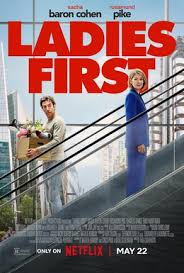
LADIES FIRST
US, 2026, 93 minutes, Colour.
Sacha Baron Cohen, Rosamund Pike, Tom Davis, Emily Mortimer, Werucha Opia, Charles Dance, Fiona Shaw, Richard E.Grant, Kathryn Hunter, Bill Paterson, Ron Cook.
Directed by Thea Sharrock.
There has been a constant popularity in films of role reversals, parents becoming children, children parents, and, sometimes, the role reversals of men and women, being transported into an alternate universe. And that is the case here – but, it is a remake of the 2018 French comedy,. I am not the Easiest of Men which was released at the time of the #Me Too emergence.
Perhaps 2026 is a bit late for Ladies First as some reviewers have suggested. However, as we watch it, the comedy of the men behaving in a female way, was to be subservient, accepting this, exasperated, finding ways to overcome it as well as the comedy of the women behaving in insensitive macho attitudes and manner, it does make its points for a wide audience.
And, this version has many advantages. Who better than Sasha Baron Cohen, memories of Borat and his other films and satires, playing the misogynistic, obnoxiously insensitive male, paying lip service to female executives and ignoring them at meetings, seeing himself as a contemporary Lothario, but remaining male throughout the story, forced to face the macho-women mirror images of his objectifying behaviour. Many tangles, many humorous moments, many satiric barbs – and his finally getting the message.
The other advantage is having Rosamund Pike as the co-star, her two previous films, Now You See Him, Now You Don’t and In the Grey, saw her cast as rather ruthless business women and she draws on this when, after being introduced as a 20 year employee at the firm, receiving a token promotion but ignored at meetings, and then transformed into the hard-hearted executive dramatising and exercising all the ambitious, unscrupulously dominating mirror of male behaviour.
And, there is a strong cast character actors in supporting roles. The usually urbane Charles Dance has become a rather simpering assistant. Kathryn Hunter, rather tiny, a cleaner in the office, always getting in the executive’s way, transforms into a hard-drinking, dominating CEO. Richard E.Grant, is a pigeon-man vagrant who understands the situation, trying to give advice to Sasha Baron Cohen.
Also a plus is the director, Thea Sharrock, who has made the sensitive, The Beautiful Game, as well as the sharp satire of Wicked Little Letters.
So, a whole lot of reversal situations, most of them very funny, but always the consciousness/conscience check that male chauvinism is being sent up as exercised by the women and that the men are experiencing as women, the continued putdowns, targeted male superiority, male exploitation and harassment.
And, for those who enjoy words and play on words, there are all kinds of funny moments and quick quips, Queens Cross instead of King’s Cross, the end of the prayer as a-woman, a variation on frequently used swear word. And, on a broadcast, Pope Beatrice IV.
Sad to say, this kind of comic role reversal, perhaps required somewhat less than in times past, is still very relevant.
Beautiful Game, The
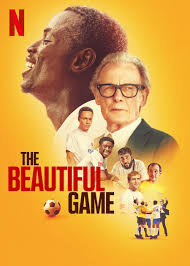
THE BEAUTIFUL GAME
UK, 2024, 125 minutes, Colour.
Bil Nighy, Micheal Ward, Valeria Golino,, Kit Young, Callum Scott Howells, Tom Vaughan Lawler, Leo Hamilton, Susan Warlomo, Christina Rodio.
Directed by Thea Sharrock.
Even though this is a soccer (football, a.k.a. in the UK, The Beautiful Game), it is much more than just a sports film – although fans will enjoy the different matches and the play.
But there is much, much more to the film then the soccer, essential though it is.
Did we know that since 2001 there has been the Homeless World Cup, where teams of homeless men and women representing their country train, have a coach, can apply to participate in the annual competition, a small group going to the host country, small sides, limited playing time, but a competition nonetheless?
Here the competition venue is Rome (always an attractive location). The focus is on a UK group, a group of men, though the American side is a team of women, coached by Mal, a thoughtful Bill Nighy, Nighy at his most likeable.. We learn the homeless stories, addiction, gambling, child neglect… But these men are on the moral mend, especially through the team.
The film has opened with children playing football, a young man watching them, joining in the kicking, but the audience suspecting that he has a chip on his shoulder. He is a bitter former professional, Vinnie (Micheal Ward), with emotional consequences. Mel watches him, invites him to join the group which he reluctantly does. He shows he has great skills, especially with his feet on the ball. However, his relationship with the rest of the men has very strong ups and downs.
Then, the team is ready, and off to Rome. Audiences who enjoy Rome will find plenty to their liking. (The screenplay has been written by Frank Cottrell Boyce (Dog Millionaire), a Catholic, often including Catholic themes in his films, like Millions about being a saint. He introduces some God talk, especially through one of the most exuberant characters in the film, a South African nun, the coach and sponsor of their team, delayed at passport control in South Africa because of visa problems for one of their members from Zimbabwe, but her persuading the official to let them arrive, arriving late, arranging a match with the English team, wearing her habit and veil, and gleefully calling on God for help!
The main teams we see are Japan, US, Italy and, as noted, South Africa. The matches have their excitement, the audience taking sides, especially when we realise that one of the English team is Syrian, a refugee barber, and the Italians have a hostile Syrian on their side. There is drama with the American team, a young woman determined to become a professional, the matches, some defeat, but a final reward for her.
In the meantime, Vinnie goes off by himself at times, refuses to share a room with one of his team who admires him, a former addict who lapses.
This is a very likeable film, and Mal is a very good man. There are some complications for Vinnie, his coping with his past, having to step up to some self-sacrifice – and finally, happily, learning why Mal has supported him so much.
A film of compassion blended with sports enthusiasm, an invitation to feel with others, hope for opportunities and second chances.
- The title, football, soccer, UK name, beautiful?
- The football audience, soccer audience, the other football codes? A sports Mfilm? More?
- The Homeless World Cup? Since 2001? Its scope? The teams, limits, the times for the matches? International? The players coming only one time in their lives? International perspective?
- The film and its outreach to the homeless, the reasons, addiction, neglecting children, gambling, thief? And the refugee barber from Syria?
- The International preparations, the focus on the UK, the team from Japan and the girl in charge, her age? The men, vagrants, the look? South Africa, the nun, boisterous leadership, the team? The US, Rosita and her ambitions?
- Gabriella, coordinator, knowing everyone, observations, comments, encouragement?
- Vinny, the introduction, with the children, playing, intervening, the criticisms? Mal Bradley observing him, intervening, praising him? Vinny, the loner, in his car, the courier jobs, not available, visit, child, wife, clashes? Is History of playing professionally? His bitterness? The challenge?
- Mal Bradley, his character, his years as a scout, his years with the Homeless team, bonding with each of them, encouraging, training them? The personal interactions with each?
- Vinny bitter, scoring goals, special technique, Cal and his skills, reactions, training together?
- The team, Nathan, simple and kind, revelation of his addiction, not able to be at home, the concern of his mother, the phone calls? Friendly with Vinny? Vinny not wanting to share the room with him, condemnation of Nathan as an addict, a loser? The effect on Nathan, the methadone treatment, neglecting it, having to go home, his apology to Vinny?
- Kevin, the background of his gambling? Jason, naivete, the attraction towards Rosita and their encounters? Cal, skills, the story of neglecting his son in the car? Aldar, the war in Syria, Kurds, refugee, barber? And his giving the haircuts to the team?
- The troubles, the spirit, the variety of teams? The South African team, held up with passport control, the introduction of sister, personality, the habit, boisterous, leading the team, prayer, God language? Insisting at the passport desk? The achievement, arriving in Rome, late for the match? Approaching Vinny, the agreement to the game? South Africa winning? The previous points for the UK because of their absence? The American team and their play?
- The visualising of the matches, the techniques, tactics, the scores?
- The spirit of the games, teamwork, opportunities, Rosita, her scholarship? The Italian team, the Syrian refugee, the final kicks, handshaking with Aldar? The Japanese loss, but the tour of Rome and their seeing beautiful things? Wanting one goal, getting more? The UK team and the visit to the Trevi fountain and tossing the coin, Mal and the memories of his wife and honeymoon?
- Vinny and the clashes, not sharing the room, by himself, the request to play for South Africa, his achievement, the medals? Alienation from the team?
- The ending, his arriving late, the reconciliation?
- Mal telling them to the truth about scouting him, and his reaction, happy to have been scouted by Mal?
- And the range of happy endings – touching the heart?
Wicked Little Letters
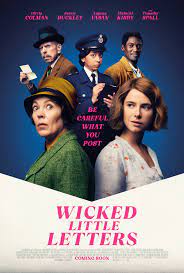
WICKED LITTLE LETTERS
UK, 2023, 100 minutes, Colour.
Dear Coleman, Jessie Buckley, Timothy Spall, Gemma Jones, Anjana Vasan, Eileen Atkins, Joanna Scanlan Lolly Adefope, Hugh Skinner.
Directed by Thea Sharrock.
They certainly are!
England, 1920, still feeling the aftermath of the war and the war dead, a small English village, Hampton. This is all based on an actual story, rediscovered in 2017, comic writer (half of the In-Between as, Jonny Sweet) saw it as an opportunity to write a wry British comedy. So, the basic facts might be based on reality, the way the characters act, their interactions, serious and comic, may not be held this episode actually was.
Wicked letters have unpleasant contents. In this case, they are highly offensive, scabrous, touches of the obscene, course and crass language, swearing. Those who might be feeling fastidious, it might be best to give this one a miss. But, for those prepared to take the language in its context, this is, in fact, an entertaining comedy was a lot of critique of British life. And the makers have decided to introduce a number of black characters, policewoman, judge, whether they would not have been present in 1920. It would be interesting to imagine how Ealing Studios might have made this film within the context of the 1950s.
Wicked little letters can be seen as anticipating the trolling of 21st-century social media.
The cast is excellent. Olivia Coleman has proven herself in a wide range of roles, from the Queen in The Crown to her Oscar-four as Queen one in The Favourite. And Irish actress-singer, Jessie Buckley, has also shown her talent in a variety of different roles. Here they are pitted against each other, Olivia Coleman as the very prim, religious, repressed and righteous, Edith, seen at home with her emotionally monstrous father, quite a different role for Timothy Spall, and her ever-patient, easily-offended mother, Gemma Jones. And she is the recipient of the letters, her mother upset, her father angry, going to report to the local police.
And, the main suspect lives next door, an unmarried Irish mother with the daughter, Rose, Jessie Buckley. Most audiences would realise very quickly that Rose did not write the letters – and not necessarily a surprise when we discover, half way through, who is writing the letters.
But, the police, a lot of satire in their presentation, instantly ready to arrest Rose. The chief is blustering and self-important. It is one assistant, played by Hugh Skinner, is rather dim but fancies himself. And they have Gladys, having to call herself “woman police officer Gladys Moss”, looked down on, dismissed as a suffragette, who eventually enlists the help of an interesting group of ladies in the town, fine cameos from veterans Eileen Atkins, Joanna Scanlon, Lolly Adefope, to defend Rose who has been carted off to jail (paying her bail), and elaborating schemes to unmask the letter writer.
The two leads bring their respective characters to vivid life, Rose with the touch of the raucous but kindly, victimised, Edith the epitome of biblical quotes, repression, subservient to her demanding father, not entirely unhappy with all the publicity in the media as the letters victim.
The film is often very funny – and the final outburst of obscenities, definitely in context and a damning judgement, will probably make most audiences burst out laughing!
- Based on a true story? The right treatment? Serious? Comic? A British treatment, satire on British society?
- The title, stories of poison pen letters? Anticipation of social media patrolling? The effect on those involved, the targets, investigations, unmasking?
- The atmosphere of the town, small, after World War I, memories of the war, the war dead, the Irish moving to England? Small town atmosphere, people knowing each other? The streets, the homes, adjacent? Shared facilities, the bath? Gossip?
- The situation, it is, her age, the past love and her dismissing him (and the real story of her father emerging later), at home with her mother and father, her religiosity, Bible reading? Completely subservient to her father? Her friendship with Rose, next door, talk, walk along the beach?
- Rose, Irish background, with her daughter, the story of her dead husband in the war, the relationship with Bill? Raucous, the lovemaking and the crucifixion banging on the wall? At the pub, drinking, shouting? Her language? Her love for her daughter?
- The letters, the content, the language, obscene, personal attacks? Edith and the letters, her mother and father, the reaction, her father going to the police?
- The police, the satiric presentation, the chief, rushing to conclusions, his busy life, disregarding the writing, wanting results? Castable paperwork, personality, a bit dim, the investigations, sexist towards Gladys? Collaboration with the Chief? The further investigations, the interrogations, the arrest?
- Conclusion that Rose was writing the letters, her comment that she needn’t have written but could have given the insult to verbally? Her arrest? Her daughter, Bill, everybody observing? Going to jail, the experience of jail, seeing Edith at the station giving her testimony? The police treatment? Her life in jail, acceptance?
- Edith, reading the Bible, giving the interviews, the media, her liking the celebrity?
- Edith and her parents, her dominating father, completely unsympathetic, ruling her life? Her mother, the effect of the letters, the death? The funeral? The priest, the prisoners, the memories?
- Edith and her playing twist? Her friends? Going to the club? The games, the talk? The friends and their own ideas, able, strong-minded, the discussions with And and Kate? Suspicions? Deciding to post bail? Welcoming Roses?
- Rose, the return home, awaiting trial? The support of the friends? The revelation about Nancy’s father, Bill being upset? Rose being branded a liar?
- The letters starting again, the various targets, the insults? Even the police? The police and their reaction, still targeting Rose, the issue of the writing?
- Gladys, her father is policeman, her training, 1920, the screenplay making a point about this impossible situation of the time? Her having to identify herself as woman police officer? The interviews with Rose, the documents, her suspicions, but of holding the letter of the law? Her treatment by the chief? By the constable? Are life at home? Her decision to intervene, looked down on by Edith’s father? The writing, particularly lettering? Her teaming up with Mabel and the others? Trying to catch Edith? Stalking her, the stamps and the envelope, the unmasking?
- Rose, the trial, her being outspoken, the prosecutor, the defence, the witnesses? Are being branded a liar?
- The reconciliation with can build, love for her daughter?
- Half way through, the audience, probably already suspecting, seeing Edith writing the letters, delighting in the language, the animosity? Her being trapped, her reaction?
- The reaction of her father, her being taken away, the fell-Marist blast given at the end – and the audience laughing?
- Serious? Funny? The use of language – and in this context?
