Displaying items by tag: Peter Malone's Movie Reviews
Carry on up the Khyber
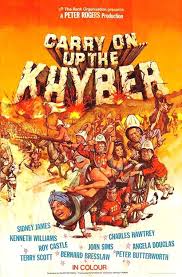
CARRY ON UP THE KHYBER
UK, 1968, 95 minutes, Colour.
Sidney James, Kenneth Williams, Charles Hawtrey, Roy Castle, Joan Sims, Bernard Bresslaw, Peter Butterworth, Terry Scott, Angela Douglas, Cardew Robinson, Julian Holloway, Peter Gilmore.
Directed by Gerald Thomas.
By 1968, the Carry on series had been popular for 10 years – and there were more than 10 years more to come.
For devotees of the series, this is considered one of the best, with some plot borrowed from the many stories of British presence in India, uprisings, British stiff upper lip… And plenty of the humour associated with the series.
For those who are beginning to dislike the series, put it down, it is considered one of the worst.
While the setup has its background of humour, Sid James as the British representative, Sir Ruff-Diamond, and Joan Sims as his pompously silly wife, various officials…, there are problems at the Khyber pass, Kenneth Williams as the local chief, doing his usual, Bernard Bresslaw with his name punning on Gunga din, wanting to oust the British.
Critics say that the basic premise is infantile. Rather, it is the kind of joking of young boys. The regiment protecting the past is the Foot and Mouth regiment, wearing kilts. And, the whole situation is whether somebody wears underpants or not, regulation say not, Charles Hwtrey doing his usual stick is found wearing underpants and a photo taken to be used with the locals to show they should not fear the British.
This joke continues throughout the film, poking fun at the British, especially the Sergeant Major played by Terry Scott.
There is a huge bombardment sequence at the end while the British sit at their table, enjoying their lavish meal, everything being shot up around them, including the orchestra who has been playing and, after their being shot at, getting up to continue playing, the only person noticing the damage is the fake religious preacher played by Peter Butterworth.
And, what is the strategy for finally defeating the uprising, the kilted men all lining up at the moment of ceasefire, raising their kilts and the Indians running for the hills.
For Better, For Worse
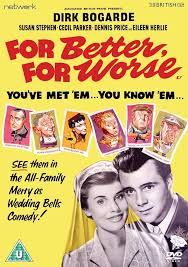
FOR BETTER, FOR WORSE
UK, 1954, 85 minutes, Colour.
Dirk Bogarde, Susan Stephen, Cecil Parker, Eileen Herlie, Athene Seyler, Dennis Price, Pia Teri, James Hayter, Thora Hird, George Woodbridge, Charles Victor, Sidney James, Robin Bailey.
Directed by J. Lee Thompson.
British domestic story from the mid-1950s – and, on the evidence of this film, it would seem a long time ago.
It was something of a prestige film at its time, written and directed by J. Lee Thompson who was to go on to international success with many films, especially The Guns of Navarone and a number of Charles Bronson thrillers. At this time Dirk Bogarde was emerging as a comedian, after many thrillers, especially with Doctor in the House. Susan Stephen was a regular star of this period. Cecil Parker was a very popular character actor – and there are so many more character actors in the supporting roles in this film which makes it so much more enjoyable as we recognise them.
Dirk Bogarde, playing 10 years younger than he actually was, earnestly wants to marry Susan Stephen. The film opens as they watch a romance on screen, then a proposal, then the meeting with her mother, Eileen Herlie, who becomes almost immediately sympathetic, and then the meeting with her father, Cecil Parker, demanding but far less pompously aristocratic than in many of his roles.
There is the issue of getting a job which he eventually does with the government but is it enough to live on? And what about a house? They go to a one-room flat, managed by Dennis Price, there are arguments for and against but their placing the deposit.
One of the main sections, especially for some comedy, has Susan Stephen preparing a dinner for her parents – and the elderly neighbour who is always coming in to use the phone, interfering, but ultimately nice; the local cleaner, played by Thora Hird, who is helpful in preparing the dinner; James Hayter as the plumber who is at the end of an attack by the husband. The other big scene is the arrival of so much furniture, with Charles Victor and George Woodbridge as the sympathetic carriers – and then a glimpse of Sidney James, not so sympathetic.
If this appeals, with its mid-1950s British style, beliefs about the working husband, the wife staying at home…, Then this may be an appealing pastime. (And, for distribution in the US, as with many British the time, very strange title changes – and this one was called, of all things, Cocktails in the Kitchen.)
Pacific Destiny
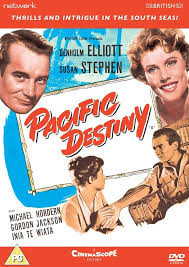
PACIFIC DESTINY
UK, 1956, 97 minutes, Colour.
Denholm Elliott, Susan Stephen, Felix Felton, Peter Bathurst, Clifford Buckton, Michael Hordern, Gordon Jackson.
Directed by Wolf Rilla.
Very much a film of the mid-1950s. It presupposes the British Empire and colonialism – though with some more benign perspectives. But it was released as a time when there was growing movement for independence, especially in African countries. At the same time, Simba, was released showing the impact of the Mau Mau and movements for independence in Kenya.
The film is based on a memoir by Arthur Grimble who was sent, rather young, to colonies in the Pacific, “wet behind the ears” as the authorities would have thought, making mistakes, growing to appreciate the local culture, becoming something of a mediator. His played by Denholm Elliot at the beginning of his career, not such a credible screen presence in this role as some of his contemporaries like Dirk Bogarde or Donnell Sinden or Peter Finch. (Denholm Elliot was far more successful in a long career roles, principal and support.)
Susan Stephen, popular at the time, plays his pregnant wife and support. Michael Hordern does his thing as the crusty retiring administrator there are some moments with Gordon Jackson. Some British actors combined with Pacific actors to play the leads and the members of the various tribal factions in the islands.
The setting is 1925. The presence of the British taken for granted. The indigenous people of the various islands shown with some of their culture, conflict with the British, some reconciliation with the British and a general perspective that there should be some respect and understanding by those in the position of overlords with those whom they are purporting to serve.
Cairo Road
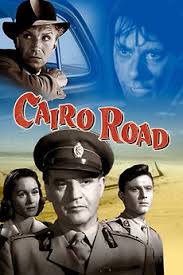
CAIRO ROAD
UK, 1950, 95 minutes, Black and white.
Eric Portman, Laurence Harvey Harold Lang, Gregoire Aslan, Karl Stepanek, John Gregson, Marne Maitland, Abraham Sofaer.
Directed by David McDonald.
With the British film industry building itself after World War II, a number of action features were filmed on location. They drew on the talented cast of British supporting players, veterans like Eric Portman and emerging stars, as here, Laurence Harvey and John Gregson.
Filming was done in Egypt. However, the very British leads were meant to be Egyptian police authorities (with British accents). Eric Portman could always show that he was in command of the situation, serious-minded, clear diction, often relentless. Laurence Harvey, in an early film, played the earnest subordinate, eager to please, continually making mistakes.
The central theme is drug running, interesting from a later point of view to see drugs and dealers in the earlier part of the 20th century.
There is a murder of businessman, police investigations, the raid on a ship, various chases, two guilty brothers, turning on each other, more murders and then the solution.
- Title and the focus of Egypt’s, Egypt 1950, location photography and atmosphere, black-and-white photography? The musical score?
- The drug situation, the role of the police, personalities, methods, local, international connections? The range of drug dealers, their backgrounds, local, international?
- Eric Portman as the commander, age, experience, manner, his attitude towards his assistant, the other members of staff, expectations? In action, shrewd, follow through, investigations?
- Laurence Harvey as the newcomer, married, from Paris, eager to please, his theories, putting them into action, his mistakes, the stealing of the vehicle, often with success?
- The range of local characters, businessmen, the murders, the brothers, one in prison, the ship, the captain of the ship, the surveillance by the Coast Guard and personnel?
- The details of the transport of the drugs, by ship, by road, camels…?
- Struggles within the group, controls, betrayals, murders, mistakes? And the final solution?
Hell House LLC II: Abaddon Hotel
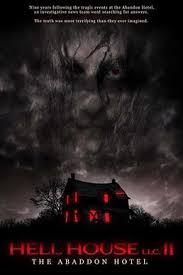
HELL HOUSE LLC II: THE ABADDON HOTEL
US, 2018, 90 minutes, Colour.
Vas Eli, Jillian Geurts, Joy Shatz.
Directed by Stephen Cognetti.
“Found Footage” films were very popular in the first decades of the 21st-century with the success of the Blair Witch project. They reported to have film material of mysterious events which were then gathered together and released as feature films.
The original Hell House LLC proved to be quite popular amongst the this afficionardos of found footage films. It focused on a disaster at the renovated hotel, looking at the various characters involved in opening up the hotel, the people involved in the disaster, the consequent media explorations, journalists, visits to the site, mysterious characters and happenings.
This film returns to the hotel after the previous events but goes back further into the history of the hotel, the owner, sinister accusations and implications.
And, once again, the film was introduced as a documentary, television interviewers, popular programs mysteries, visiting the site, suspicious behaviour, disappearances, violence, and a great deal of speculation.
Designed for those who enjoyed the first film – and a link to a sequel, not so well received but there were two further sequels.
Hell House LLC III: Lake of Fire
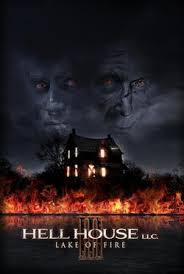
HELL HOUSE LLC III: LAKE OF FIRE
US, 2019, 85 minutes, Colour.
Gabriel Chytry, Elizabeth Vermilyea, Sam Kazzi.
Directed by Stephen Cognetti.
Most bloggers were very critical of this film, complaining that it was is not exactly a “found footage” film and did not have the scares of the previous films. But, there was some praise for the film. Most of the bloggers decided that this was the end of the franchise – in fact, there were two more Hell House films, at least.
Once again, the film is presented as a documentary with some found footage, journalists coming to the house, discussions with a journalist, producers of the television show.
What is different is that a millionaire is putting on an interactive show, Insomnia, very much a Faustian story. And, there are quite a number of interviews with the various members of the cast.
But, there is an aura about the hotel, suggestions, once again, some supernatural interventions.
With members of the cast and the producer, some of the characters are clearer to appreciate than in the previous films, and with the journalists.
There is also a difference with the introduction of a priest, friend of the producer, and his being interviewed with quite some speculations about the supernatural and diabolical presence.
While there might not be quite the horror aspects and scares of the previous films, there is still an eerie atmosphere, the hotel itself and its history, some weird behaviour on the part of the producer, and implications of the story of Faust and the pact with the devil.
Up Pompeii
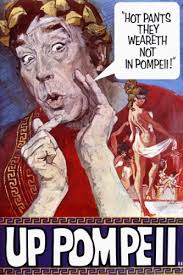
UP POMPEII
UK, 1971, 90 minutes, Colour.
Frankie Howerd, Patrick Cargill, Bill Fraser, Michael Hordern, Barbara Murray, Lance Percival, Adrian Foster, Bernard Bresslaw, Roy Hudd, Lally Bowers, Kenneth Cranham.
Directed by Bob Kellett.
Comedian, Frankie Howerd, popular on British radio and television, had a successful television series, 14 episodes, in the late 1960s, Up Pompeii. And here is a version made for the cinema screen, with Talbot Rothwell, writer of the Carry on films, having a credit for idea.
The basic idea is humorous enough, Frankie Howard as a slave in Pompeii the year of its destruction, A.D. 79 – but, for film purposes, the Emperor is Nero who reigned 15 years earlier!
Frankie Howerd’s style of comedy was to confide in the audience, looking straight to camera and the audience, plenty of remarks, reminding everyone that this is a film, anticipating action and jokes. The idea here is that there is conspiracy against Nero amongst senators and military of Pompeii. Howerd’s Lurcio works for Ludicrus Sextus (the film’s names of characters rivalling those of the Asterix films), the pompous senator, played with the right kind of satire by Michael Hordern. There is his wife and her ambitions, his young son and his sexuality problems, a clash with a Roman sergeant in the marketplace and the focus on a scroll with a list of conspirators.
Anything could happen – and does.
However, the writers and the cast have drawn on an enormous catalogue of sex jokes. And most of them are here, some very obvious, some familiar – touch of innuendo (though the screenplay is too obvious for innuendo). Some are signalled, Frankie Howard drawing attention to them and reacting sometimes with prudery.
And, looking back, it may be surprising to find such an amount of nudity in British comedy at the beginning of the 1970s – reticence is not the order of the day here.
So, once again, an opportunity to see and gain something of an awareness of popular British comedy in the early 1970s – but, so much depends on whether audiences are fans of Frankie Howerd himself and this kind of style. He then made The Chastity Belt and the World War II farce, Up the Front in the same style.
Mercy

MERCY
US, 2026, 100 minutes, Colour.
Chris Pratt, Rebecca Ferguson, Kali Reis, Annabel Wallis, Chris Sullivan, Kylie Rogers, Jeff Pierre, Rafi Gavron..
Directed by Timur Bekmambetov.
A surprising film. And some grim surprises about the future.
It is 2029. And, throughout the film, it is clearly signed that it is the second week of August of that year. Which means that we are in the near future, the vision of society here, of AI and its use and influence, may be only around the corner.
We are in Los Angeles, crime rising. The authorities have instituted what is called the Mercy Court, a way of dealing rapidly with the accused, the judge an artificial intelligence creation, here played perfectly by Rebecca Ferguson, with all the AI information at fingertips or the utterance of a single word.
Which raises the first question for the audience about how the authorities have so much information about individuals, groups, social media entries expertly stored and so quickly available, issues of ethics, issues of privacy which pervade the whole film.
In fact, the main part of the film is court case at Mercy, a detective, with alcoholism problems, Chris Raven, played effectively by Chris Pratt, accused of murdering his wife. But, he has no memory of the event. The clock is running. His trial will last 90 minutes and he has to prove his innocence, the judge programmed only to assess facts and evidence rather than work on any feelings or hunches, despite the accused’s arguments. This process takes place in a vast Mercy building, the judge on screen, the detective bound in a chair.
The visible countdown and a statistic visualised of the probability of the accused’s guilt always in view, there is a time tension throughout the film. As it emerges, it is a murder mystery with quite some complexity. There is detection work to be done. There are witnesses to be questioned. And they are all made available instantly, on screen, their lives, episodes, social media clips, the judge’s interrogation, and Chris Raven intervening.
What emerges is quite a complex plot, and conspiracy to murder with unforeseen implications. And, while the main action takes place in the rarefied atmosphere of the Mercy Court, there is a huge chase sequence, a truck with chemicals, police and the pursuit through the city, the killer with a hostage…
The screenplay has been devised to keep audience attention with the trial, the mystery, the complexities in the solution, some twists and surprises.
But, all the while, the film is challenging audiences about how much they agree with the philosophy of the Mercy Court, the availability so much private material at the beck and call of authorities, justice and ethical issues, and the role of the individual in this kind of society which, as the visuals continue remind us, is set in August 2029.
- The title, the court, mercy and justice?
- The 2029 setting, the second week of August? Science fiction, futuristic science-fiction, the very near future?
- The background of social media, artificial intelligence, storage of information, instead of easy access, information, visuals, episodes, data exploration? The future, the realities, the ethics, use and abuse?
- The American city, Urban, the streets, industry, homes, police, police action? The musical score?
- The court, and innovation for justice, dramatics and AI, her being programmed, justice and truth, evidence, not taking into account circumstances, emotions…?
- The basic situation, Chris Raven, his career as police and Detective expert, partnership with Jack? The first case for Mercy, the criminal and his condemnation? The visual file on him? Raven accused of killing his wife, the evidence, is being brought to justice, to Mercy, 90 minutes trial before judgement and possible execution?
- Chris Raven, and his work, his drinking, of drinking, secretly, concealing the drink, his relationship with his wife, with his daughter? With his friend, Rob Nelson? The circumstances of his wife’s death, his being drunk, arrested? The situation in the Mercy building, vast, in the chair, the screen with Judge Maddox? The range of technology at disposal, the ability of something it, momentary delays, the range, files, visuals? The preceding of the case?
- Patrick is a suspect, work as a chef, his being interrogated, arrested, the pursuit, his testimony about Raven’s wife, neglected, his alibi, there assessment of his guilt or innocence?
- His wife, her work, the connections, the gradual revealing of the situation, the chemicals, access, money? Rob Nelson is boss, his testimony? Charles Holt, his work, his testimony?
- The party, Nelson driving people to the party, people going home, analyse? Everybody turning up for work?
- The pace of the trial, the focus on the clock, Judge Maddox and her listening, allowing information, summoning it?
- The further complexities, Raven’s daughter, alienation, the discussions, the door ajar, somebody hiding in the house?
- The unfolding of the plot, the chemical, smuggled, payments, presumptions about drugs, information about explosives, the testimony Charles Holt? The discoveries about Rob Nelson, his lying, the photo, the two hearts, the revelation of his brother, the orphanage, the condemned killer by Mercy, the buildup to the motivation of revenge?
- The unfolding of the plot, the wife, her knowledge, the threats, the meetings, her being killed? Nelson, the truck, taking Raven’s daughter?
- The visuals of the pursuit of the truck, the crashes, having an action sequence in a confined scenario?
- The resolution, the pursuit, the truck, crashes, the danger to his daughter, Nelson and the explanation, the motivations, the visuals of the initial arrest, the consequences?
- The device of Raven and the visual percentages of guilt, going down, but keeping connected to get information, the appeal to Judge Maddox, the issue of the facts, evidence, the human element, hunches?
- The resolution of the case, Raven free, the visuals of Jack, the gradual revelation of her involvement, wanting a successful outcome, her manipulation, the arrest, the gun, her arrest?
- The film as a police action thriller, detection, court case, mystery, science fiction and anticipating and fearing the future, AI?
28 Years Later - the Bone Temple
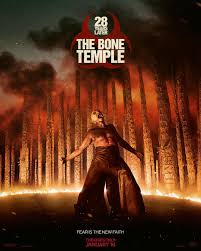
28 YEARS LATER – THE BONE TEMPLE
UK, 2026, 109 minutes, Colour.
Ralph Fiennes, Jack O'Connell, Chi Lewis-Parry, Alfie Williams, Erin Kellyman, Louis Ashbourne Serkis.
Directed by Nia Da Costa.
This chapter in the 28 series begins immediately after the conclusion of 28 Years Later. To appreciate what happens in this chapter audiences need to be quite up-to-date with the situations, the range of characters and their previous interactions and crises.
This is a film of frequently changing moods or, as one commentator put it more elegantly, “tonal shifts”. It opens with a scene of the infected pursuing a hunter, ripping his head off, eating his brains – a jolting sequence and images to begin with. And there are some jolting sequences to follow.
This is particularly true when the narrative takes up the story of the young boy, Jimmy, in the first film, in the church, saved by his father, given a cross, then surviving as an adult in 28 Years Later, finding his place in society, but gathering round him a number of young adults, all now with the variations on Jimmy in their names, his becoming a kind of satanic cult leader, especially with his new friend who was an important focus in the earlier film, Spike, Alfie Williams. He is played Jack O’Connell who has had a strange cinema year with the 228 Years Later films and his of the diabolical role in Sinners. Sir Jimmy now defies Spike to fight and to kill and to merit the name Jimmy. Sir Jimmy is now a megalomaniac leader who hears the voices of the devil, calling him Old Nick, and considers himself the Devil’s son.
Complete tonal shift: a return to the world Dr Kelson, Ralph Fiennes, who has survived for 28 years, continuing his pursuit of medicine, living in the vicinity of the extraordinary Bone Temple, skulls and bones of survivors. He encounters one of the infected, the giant Samson (and the actor Chi Lewis-Parry is noted as 6’9”). Menacing threats, but Dr Kelson nevertheless experiments with him, various medications, trying to humanise him.
Which restricts most of the action of this chapter in the series to the buildup to the confrontation between Sir Jimmy and the doctor. There are some flashbacks to the happy years, people living humanely, but then the infection and the dire takeover, violence and slaughter.
The audience knows the film is building up to a confrontation between Sir Jimmy and Dr Kelson, especially with Dr Kelson looking like a blood red warrior, the result of his taking iodine to repel infection and affecting his skin. But, he agrees to impersonate Satan for Sir Jimmy, some wild dancing gyrations on Ralph Fiennes’ part, until he recognises Spike, Samson returning more humane, remembering, speaking, and the strange vision of Sir Jimmy, reminded how God asked self-sacrifice from Jesus, now crucified on an upturned cross, asking his father forgive them for they know not what they do…
So, this is a doomed post-apocalyptic future. But, aficionados of the series will enjoy the brief epilogue, a moment with Ciaran Murphy and his daughter, taking us back 20 or more years to beginnings in 28 Days Later.
Writer, Alex Garland, seems preoccupied in recent years with current wars and future disasters with these films and Civil War and Warfare.
A strange cinema experience of changing moods and tonal shifts, from horror to humanity.
- The popularity of the series? This film made back-to-back with this criticism? Plot continuity, sets, issues, characters?
- The future, the effect of the plague, the infections, the visuals of the countryside, seemingly normal, the villages, the interiors, the Bone Temple and its vastness, the residence for Dr Kelson, the memories of the past, ordinary life, the train, the overwhelming infection? The musical score and songs?
- The opening with the hunter, the infected, Samson, ripping the head, devouring the brains? Horror atmosphere?
- The transition to Jimmy Crystal, memories of his past as a boy, and the church, the infection, his survival? His age, in the previous film, his personality, his gathering the young people around him, a type of cult leader, seeing himself as the son of the devil, Old Nick, hearing the voices, making the decisions? Violence, command, everybody’s name with a variation on Jimmy? Their appearances, the white wigs, their behaviour?
- The confrontation with Spike, with Jimmy and the previous film, Jimmy Crystal taunting Spike, the fight, and his reluctance, eventual action, his opponent in defeat, his being given the name Jimmy? The various personalities of the group? Young girl and her friendship with, her name, Kelly?
- The transition to Dr Kelson, the change of mood, tonal shift, his background, the 28 years survival, work as a doctor, in the previous film with the community, his going to the Temple, his laboratory, chemicals, books, his appearance, yellow, iodine stain, Jimmy mistaking him for Old Nick?
- Samson, infected, his size, his community, the encounter with Dr Kelson, his hopes for healing him, the chemicals, for memory, for sound, speech? Samson and his leaving, the community, the gradual coming back of memories, the train, as a boy, so the last, the book, the moon? Saying the word, moon? His eventual return to Dr Kelson?
- The savage sequence of the cult, the young people hunting, the pregnant girl, the old people in the house? The group arriving, brutality, mocking them, tying them up, peeling their skin, entrails, verbal brutality? Wanting them to fight? The young man, cutting down, the attacks and fights? The youngsters watching, Spike watching? The fire and destruction?
- Spike, the challenge, with the young man, with the pregnant woman watching, trying to escape, her fear of him and running away? The young girl? Combining with Spike, their hopes to escape?
- Jimmy Crystal, madness, arrogance, the binoculars, seeing Dr Kelson, equating him with Old Nick? His visit, Dr Kelson’s decision, playing along with the situation? The conversation, issues of faith, belief, the devil?
- The gathering, Dr Kelson and his performance, the dance and writhing? Jimmy Crystal content? Controlling the group? Dr Kelson recognising Spike, the change of attitude?
- The violence, Dr Kelson and his shrewdness, quoting the Gospels, Christ giving his life in the world, therefore Jimmy Crystal to give his life, the crucifix, upside down, his screams, father forgive them?
- A return to some kind of normality, Samson coming back, with the group, his memory, beginning to speak? Spike, the young girl – and a future?
- The pessimistic aspects of the film? Some survival? What hopes for the future of humans and the world?
League of Frightened Men, The
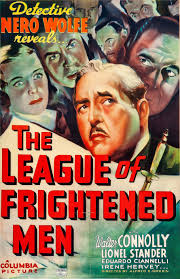
THE LEAGUE OF FRIGHTENED MEN
US, 1937, 71 minutes, Black-and-white.
Walter Connolly, Lionel Stander, Eduardo Ciannelli, Irene Hervey, Walter Kingsford, Ian Wolfe.
Directed by Alfred E. Green.
There are many brief supporting features of the 1930s available on YouTube, an opportunity to gauge something of audience tastes in those years, really films to support the main feature. The later equivalent of this kind of film was the television series episode.
Rex Stout was a popular crime writer of the period and created his Detective, Nero Wolfe. Columbia had made a small feature in 1936 with Edward Arnold as the Detective, a large and somewhat sedentary character. In this film it is Walter Connolly, jovial presence in supporting roles in many of the films of the period (but to die in 1940).
A feature of the two films was Nero Wolfe’s assistant, rehabilitated criminal with a tough exterior and local jargon at accent, played by Lionel Stander (some Rex Stout fans complaining that he was the opposite of the character in the novels - “less sophisticated” was a kinder comment). Wolfe also has a large very formal butler, once again a reformed criminal.
The film opens with the killing of several businessman and the revelation, very interesting to hear of about the 1910s, that they suspect a student at Harvard that they had hazed 20 years earlier, making him crippled, but now a successful crime writer – obviously looking for revenge. He is played by Eduardo Ciannelli, of the villain, so something of a sinister-looking hero here. The frightened gentleman are made up of character actors of the period. And, there is also a touch of romance.
Archie has to do a lot of the legwork, interrogations, pursuing characters… While Nero Wolfe does the thinking and theorising in his office.
And, as with any murder mystery, several suspects, some twists and the unmasking of the murderer.
