Displaying items by tag: Greta Lee
Minions & Monsters

MINIONS & MONSTERS
US, 2026, 90 minutes, Colour.
Voices of: Pierre Coffin, Alison Janney, Christophe Waltz, Zoe Deutch, Bobby Moynihan, Jeff Bridges, Jesse Eisenberg, Phil LaMarr, George Lucas, Trey Parker.
Directed by Pierre Coffin, Patrick Delage.
We have been living with the Minions, enjoying their mischievous company, since Despicable Me in 2010. With their size, yellow colour, one or two eyes, their distinctive language and chatter, their willingness to serve diabolical masters like Gru, audiences now have expectations of them, enjoying when they turn up in the movies (and in a range of commercials!).
The children’s audience will enjoy all the shenanigans here, the origin story of this group of minions, setting sail, settling in different lands, the various tyrants that they served, and, of all things, their finally arriving in the American West, pursuing a bandit and a train, discovering that it actually was being filmed. They are in Hollywood in the 1920s.
For the adult audience, especially movie fans, there are all kinds of references to early movies, experiments by Edward Muybridge, the Lumiere Bros, George Belies and the moon, and jokes recreating Charlie Chaplin in the cogs sequence in Modern Times, Harold Lloyd on his ladder in Safety Last, and glimpses of Buster Keaton, references to Citizen Kane, Hooray for Hollywood, We’re in the Money… and, the contemporary Hollywood Museum which has George Lucas himself. an exhibit in a glass case, asking to be released from his contract! In fact, this Minions film is really an homage to the movies and, especially to Hollywood in the 1920s, styles of filmmaking, the studio moguls, the directors, camerawork, introduction of sound, awards.
The main characters are the artistic James and his affable friend, Henry, and the good-natured Ed. In Hollywood, they do get a chance to make a movie – but, with the book of spells and their reading them out loud, strange creatures emerge. The culmination of the film is a kind of big gooey Godzilla equivalent, destroying LA in its path. Which means some kind of heroics, the massing together of the minions (which often happens throughout the film from early rowing in prehistoric boats to crowding on vehicles in Los Angeles and, incidentally, breaking the Hollywoodland sign).
A glance at the cast list shows that there is very strong voice talent.
All’s well that ends well, everybody happy with James’s movie, screening at the Chinese theatre, applause, awards, and, at last during the final credits, some upstaging of Gru. So, where to next! And soon!!
Tron: Ares
TRON: ARES
US, 2025, 119 minutes, Colour.
Jared Leto, Greta Lee, Jeff Bridges, Evan Peters, Jodie Turner-Smith, Hasan Minhaj, Arturo Castro, Gillian Anderson.
Directed by Joachim Honning.
Just over 40 years ago, there was a dramatic breakthrough in visual style in movies, focus on computer games in the early years, AI experimentation, IT business rivalries. This was Tron, starring Jeff Bridges. It can be seen as something of an alert to what was to come in imaginative moviemaking.
Then, 25 years later, 2020, the sequel: Tron: Legacy. In this meantime, IT technology, special effects and computer graphics had developed substantially. And the scenario moved from one generation, the Flynns, led initially by Jeff Bridges, and his rival with the ominous American name, Dillinger, David Warner. They have given way to the next generation and technology and business conflicts, Kevin Flynn, Bridges’ character, trapped in The Grid.
It is now only 15 years since Tron: Legacy. And the scenario has moved to the next generation, but the Flynn business taken over by two Korean-American sisters, one dead, the other, Eve Kom, played by Greta Lee, in the struggle with the new Dillinger generation, Julian, played by Evan Peter. One might say that Julian is not bothered by moral scruples – although his mother, a cameo by Gillian Anderson, does raise some questions of integrity. And, 40 years later, here is a venerable Jeff Bridges, a cameo reappearance as Kevin Flynn.
For the running time of the film, the central characters and the audience are confined, practically trapped, in the Grid. And in terms of characters, the scenario is confined to the key characters in the conflicts, Eve and her eager assistant as well as the public relations representative versus Julian. Not too many humans taking major roles. Sometimes, throughout the action, it is reassuring to see that some kind of normal life is going on in the background, the buildings in the streets, cars in the streets, glimpses of actual people…
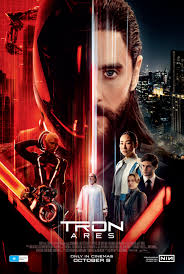
The main life characters, in fact, are AI created warriors, Ares, with the name of the God of War, played by a rather subdued in comparison with his other performances, Jared Leto. The other is Athena, Jodie Turner-Smith, African-American, with a gold shaved head, named after wisdom but certainly, as the action goes on, female version of Ares.
The technology explains how they are created, the work of Julian Dillinger, a certain time span before they disintegrate and are reassembled, but, as they interact with the humans, developing many human qualities themselves. Which builds up to a confrontation because Ares sees the malice of Julian and becomes an ally of Eve whereas Athena builds up the hostility and confrontations.
But, perhaps the principal impact of this version of Tron is in the visuals, the darkness of the Grid illuminated by flashing light, red light, swift moving, part of the battles as more and more creations take to battling against Eve, rather spectacular confrontations. And, eventually, as we guess, a dramatic one-to-one.
It looks as though Ares has the potential to become a kind of AI superhero if there are to be more adventures (and the screenplay more than indicates that this is the intention) and Ares is given something of a saviour figure status in a momentary recreation of da Vinci’s Last Supper with him at the centre.
Probably best for the fans and for any audiences interested in technological visual developments – and another superhero franchise.
- The franchise, over 40 years, the episode in 2011, 2025, the next generation?
- The original, the plotting, the Flynn family, the rivalry with the Dillingers, AI, the science and technology, the technical possibilities?
- The visuals, locations, labs, machines, special effects, the creation of Ares and Athena? The functioning? The musical score?
- The Flynns, Kevin trapped in the Grid, his reappearance?
- ENCOM, the history of the company, Eve, career, new manager, seth as her assistant, Ajay Singh and his expertise? The contrast with the Dillinger company, Julian, his motives, malicious, rivalries? The intervention of his mother? His staff, achievement, headquarters?
- The creation of Ares and Athena, AI, capacity for absorbing human qualities? Disintegration and reconstruction?
- Ares, his mission, the interactions with Eve, Alaska, the pursuit, the contrast with Athena, working for Julian? The buildup to conflict between the two?
- The character of Ares, machine, superhero qualities, humane qualities, action, interventions, skills, final achievement?
- Julian, his defeat? Eve, her final success?
- A film for the fans, the story and characters, the technology, the musical score, the special effects? Ready for a sequel?
Problemista
PROBLEMISTA
US, 2023, 105 minutes, Colour.
Julio Tores, Tilda Swinton, RZA, Isabella Rossellini, Catalina Saavedfa, James Scully, Greta Lee.
Directed by Julio Tores.
What is a problemista?
Writer, director, actor, Julio Tores, born in El Salvador, with his strong career in television background, popular in the US, dramatises an answer.
Anybody looking at the cast before watching the film will be quite surprised to find Tilda Swinton and Isabella Rossellini in the cast as well as rapper RZA.
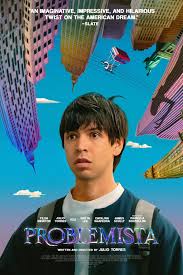
Tores plays Aleyandro, dreaming of being an artist, to design toys, applying for a job with Hasbro, rejected, then connecting with a cryogenic company – and a mission to recover 13 paintings by an artist who is being frozen, the commission from his haughty wife, played by Tilda Swinton, another very different performance. (If one wanted to see a haughty woman, imperiously impatient, continually demanding, momentarily relenting, then Tilda Swinton’s performance is well worth catching.)
All kinds of problems and complications, a range of characters and undermining Aleyandro – but his support from his mother and a reassurance at the end that his dreams well worthwhile.
- Julio Tores, writing, acting, directing? His career and background?
- The title, the tone, creative word? Aleyandro and his life and career?
- The El Salvador background, Aleyandro and his mother, her fostering him, his art, the dream of the cave?
- The surrealist comedy? Realism and fantasy? American style, Latin American style?
- The New York locations, the apartments, business offices, the Freeze Corporation and cryogenics, the art world and galleries, the affluent world, immigration officers? The musical score? Aleyandro, as a child in El Salvador, the relationship with his mother, her fostering his art? The move to New York, his aim, toy design, the Hasbro models, his applications, internship?
- Bobby, the dead artist, the nature of his art, cryogenics, the large paintings, 13 eggs? Aleyandro and the accident and the freezing? 30 days to deporting?
- Elizabeth, Bobby’s wife, her character, sharp, demanding, angry, petulant behaviour? Aleyandro assisting her, planning the exhibition, his migrant status and no pay, subletting his room, Craigslist jobs?
- The character of Bingham, hostile, undermining Elizabeth? The quest for the paintings, finding 12 of the 13, Dalia, past student, Bobby’s affair with her, Elizabeth’s jealousy and harsh review, Aleyandro’s apologetic letter? Dalia giving the 13th painting?
- Disputes with Elizabeth, Aleyandro and the filing system, the bitter phone call and argument, the imagining the dragon in the fights at the cave? Demands for copies, the freight issues and expenses, Aleyandro and his sex work? And the Hasbro development of one of his toys?
- Paralegal, the immigration officer, the development of the show, the dragon dream and Elizabeth? On the cable car? Arriving late, all the paintings sold?
- Aleyandro, reconciliation with his mother?
- Elizabeth, the decision to be frozen, her giving him the name of the Hasbro exploiter of his invention?
- The transition to the future, or reunited, Aleyandro is an old man, his success as a toy designer?
House of Dynamite, A
A HOUSE OF DYNAMITE
US, 2025, 119 minutes, Colour.
Idris Elba, Rebecca Ferguson, Gabriel Basso, Jared Harris, Tracy Letts, Anthony Ramos, Moses Ingram, Jonah Hauer-King, Greta Lee, Jason Clarke.
Directed by Kathryn Bigelow.
Highly explosive.
And, it is beyond highly explosive when there is a threat of nuclear destruction. And this is what A House of Dynamite dramatises, immersing the audience in the crisis, and asking the audience to decide what they would do, what decision they would make, in this world-grave situation.
Over the decades there have been quite a number of films about the nuclear threat. Several notable films emerged after the Russian-US confrontation in October 1962, the missiles of October. And the issue is dramatised in the many films and miniseries about JF Kennedy, especially 13 Days. In 1963-1964, there were Failsafe, Seven Days in May and the frighteningly satiric Dr Strangelove or; How I Learned to Stop Worrying and to Love The Bomb. There were a number of films in the early 80s in the same vein, Testament, The Day After.
But, here we are in the mid-2020s, Russian invasion of Ukraine, tensions with China, conflicts on the India-Pakistan border, Israel, Gaza and the Middle East, the bombing of Tehran…
This is an intense film, directed by Kathryn Bigelow who won an Oscar for her immersion in war, The Hurt Locker, then went on to the search for Osama bin Laden, Zero Dark Thirty. She brings the same tension to this film, giving a hypothetical scenario, the launching of a nuclear missile by an unknown attacker, threatening an American city, attempts to neutralise it, failures, a small window of time to ward off the attack, to make international contacts, diplomacy, the issue finally coming down to the decision of the American President.
The way that the drama heightens audience attention and anxiety is to introduce us to the wide range of officials in war departments, the White House, command posts in Alaska, crisis management groups in American cities, press briefings in Washington. Very quickly, the audience is introduced to, gets to know, sees in action, a wide range of experts, the pressure on them, intel coming in, changes in information, personal pressures, the demand for quick thinking, prudence, risk-taking, issues of responsibility and consequences.
In contact with Russian authorities, there is the powerful opinion of General Brody, Tracy Letts, strong hawkish stances. Important is the opinion of the Deputy National Security adviser played by Gabriel Basso, caught outside the White House, difficulties with connections, crowds, security getting into buildings, all the time having to make changing assessments as information comes in. His opinion is that the options for the president are national surrender or national suicide.
Just as the countdown is approaching, the screenplay goes back in time, the second part of the film focusing on the President, Idris Elba, enabling the audience to realise, even more fully, the responsibility of the President and his decision, personal cost, repercussions. And, memories of the version of Tom Clancy’s A Clear and Present Danger, the integrity and intelligence needed for the President with his finger on the nuclear button.
At each stage of nuclear fears over the decades, and the films dramatising the crises, audiences have been forced to focus very much on the strengths and weaknesses of incumbent presidents, Kennedy, Johnson, Reagan, George W. Bush – and, in 2025, Donald Trump.
A demanding film, an uncomfortable screen experience, and the film challenging each of us in the audience as to what decision, surrender or suicide, that we would make.
- Consciousness of the arms race, nuclear weapons proliferation, the danger of a nuclear attack? In the 21st-century?
- The dramatising of the possibility of such an attack? How plausible given 21st-century technology, surveillance, speed of reaction and information, possibilities for halting the attack?
- The screenplay, establishing the scenario of the attack, the situation in Alaska, the Armed Forces, their intelligence, their position near Russia? The recognition, communication? The officer in charge, his reaction, going outside into the snow? Contacting Washington? The role played during the attack?
- The screenplay and the narrative in Washington DC, the ordinariness of the day, Olivia Walker, at home, with her husband, depositions in Washington, going to headquarters? Her position, security issues, authorities, fellow workers? The significance of this room, security, the range of personnel, the backgrounds, personalities, interactions?
- The information about the attack, not identifying the source, the range of speculation? The film’s detailing the activities of each person, the responsibilities, their judgements, their personal reactions and the interplay for decisions?
- The connection with the various military personnel, shown in their situations, the Secretary for Defence, his location, personality, abilities, the connection with his daughter and contact with her, protecting her? On the move, his contact with the Deputy National Security Adviser? The adviser outside, the crowds, making his way to the office, phone calls, decisions, advice, security, entering the building? His being finally required to make an observation, Suicide or Surrender?
- The links with General Brady, his personality, staff, experience, at a distance, but surveillance connection? His hawkish attitudes? Listening for advice, following it, his assessment, the risk of defeat and humiliation?
- The failure to stop the missile? The visualising this on the screens? The repercussions for all concerned, disappointment, dismay, continuing planning? The uncertainty of the origins?
- The connection with the Russians, the disavowing the attack, the delays, the consultations, decisions and advice?
- The transition to the President, the screenplay going over the same time period, the activities of the President, his young Security Adviser in the car with him, the pressures on him, the social activities, everything genial, the crowds, the message, the president having to escape, the car, the advice?
- The personality of the president, his integrity, intelligence, capacity for decision-making, the range of the dilemmas presented to him, the personal repercussions for his wife and family, the nation, the advice of suicidal surrender?
- The screenplay not giving the final decision? Throwing it to the audience to empathise and identify with the situation, the decisions to be made, for the audience to make their decision and appreciate the basis for their decision?
