Displaying items by tag: Andrew Scott
Blue Moon
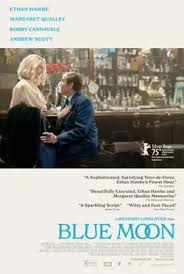
BLUE MOON
US, 2025, 100 minutes, Colour.
Ethan Hawke, Bobby Cannavale, Andrew Scott, Margaret Qualley, Patrick Kennedy, Jonah Lees, Simon Delaney, Cillian Sullivan.
Directed by Richard Linklater.
Blue Moon is probably the most popular song from the writing team, for over twenty-five years, of Richard Rogers and Lorenz Hart. It has a plaintive touch about it. And so does this portrait of Lorenz Hart.
Fans of the old MGM musicals may remember the 1948 Words and Music, a celebration of Rodgers and Hart, some biography but the staging of many of their songs. That is not the case here. This is a serious drama, going to a New York bar over one evening, warts and all portrait of Heart. The diminutive lyricist was played by Mickey Rooney in 1948. Perhaps easy casting. This time Hart is portrayed by Ethan Hawke, with a well-deserved Oscar nomination, the director, Richard Linklater, and camera work diminishing his stature to successfully effect.
The narrative setting is that of the opening in 1944 on Broadway of Rodgers and Hammerstein’s Oklahoma!, Hart replaced by Hammerstein (and the beginning of a very successful writing partnership, South Pacific, Carousel, The King and I, The Sound of Music). And Hart walking out of the opening night.
The Oscar-nominated screenplay by academic, Robert Kaplow, has an overall emphasis on words, The lyricist Hart is articulate, witty, clever, explaining his composing, play on words, internal puns, insight into the lyrics of the thousand songs that he wrote. He complains about the lyrics of Oklahoma (the wheat as high as an elephant’s eye!) But, when Rodgers and Hammerstein arrive, he has earnest conversation with Rodgers, played by Andrew Scott, revealing Hart’s erratic behaviour, the drinking benders and absences, unreliable, living with his mother, his homosexual orientation.
But, prior to the arrival of Rodgers, Hart is in conversation with the bartender, a listening responder, played by Bobby Cannavale. And there is some conversation, relishing words and sentence structures with a visitor who turns out to be E. B. White (author of Charlotte’s Web and Stuart Little). Hart drinks, relishes words, is indulgent in conversation.
And there is a further dramatic focus, how corresponding with the young student, Elizabeth Welland, played by a vivacious Margaret Quallley, who has been corresponding with him, seeing him as a mentor, he becoming more and more infatuated with her. (This part of the screenplay is based on their letters).
In many ways, this is a very sad story, a huge talent, the personal flaws, creativity combined with unreliability – and the pathos that soon after this episode he was to collapse and die.
A very effective behind-the-scenes theatrical drama.
- The title, the popular song, plaintive tone?
- The introduction, Lorenz Hart, in the street, collapse, hospital, his death? His life a wreck?
- A portrait of Hart, audience knowledge of him in his life, career, Rodgers and Hart, 25 years, the Broadway shows, the thousand songs, fame? Hart as a lyricist, Hart as a person?
- The confined action, set, the bar and its interior? The stairs? Eddie the bartender, the presence of E.B. White, the piano player, his military background, Sven the messenger, the waitress, the woman at reception? Atmosphere, music, the playing of Blue Moon?
- The opening night of Oklahoma, Rodgers and Hammerstein, the collaboration with Hammerstein (and indications of work with Stephen Sondheim), Hart walking out, the criticism of the lyrics, elephant high, the number of exclamation marks? His being hurt?
- The emphasis on words and conversation, the love of words, the power of words, Eddie listening and responding, the piano player responding, the conversation with White and the themes, articulate?
- Elizabeth Welland, the correspondence, his infatuation with her, time spent with her, as a mentor, anticipating her arrival, her presence, discussions with Hart, the lengthy private talk, her not loving him “in that way”, her life and relationships? Wanting to meet Rodgers, her mother working for him, going to the party, the effect on Hart?
- And his memories, brother, living with his mother, Richard Rodgers and long friendship, success, his drinking, gay orientation, going on benders, unreliable? Rodgers letting him go?
- Rodgers arriving, his personality, the impact of Oklahoma, and Hammerstein present, the audience response, praise, the critics’ response?
- The conversation between Rodgers and Hart, on the staircase, going back over the past, Rodgers] perspective on the friendship, the collaboration, the unreliability? Inviting him to write more songs for Yankee…?
- Hart and the encounter with Hammerstein?
- The parties, the invitations, the discussions? The crowd, the Mayor of Oklahoma City, atmosphere?
- Hart, finally left with Ed and the staff, Blue Moon?
- The pathos of the end of his life, standing alone, drinking, death?
Wake Up Dead Man. A Knives Out Mystery
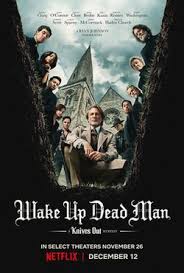
WAKE UP DEAD MAN
US, 2025, 144 minutes, Colour.
Daniel Craig, Josh O'Connor, Glenn Close, Josh Brolin, Mila Kunis, Jeremy Renner, Kerry Washington, Andrew Scott, Cailee Spaeny, Daryl MacCormack, Thomas Hayden Church, Jeffrey Wright, Annie Hamilton, James Faulkner, Bridget Everett.
Directed by Rian Johnson.
In 2019, movie audiences worldwide enjoyed a very entertaining murder mystery, Knives Out, a very starry cast, an offbeat private detective, genteel and from the South, Benoit Blanc, played by Daniel Craig. Three years later, writer-director, Rian Johnson, was successful again with The Glass Onion. And audiences wondered, now three years later again, whether this film, Wake Up Dead Man, could be a successful.
It is.
And, once again Daniel Craig’s charmingly eccentric Blanc, a star cast for character actors, a murder in an equivalently locked room, plenty of suspects, gradual revelations, twists (although many audiences probably pick the murderer but will be surprised at all the motivations and turns in the plot). There are references to Agatha Christie and Roger Ackroyd. And, Benoit Blanc uses the John Dickson Carr thriller, The Hollow Room, as a template for his theories.
No difficulties in recommending Wake Up Dead Man to murder mystery audiences – plenty to entertain, almost 2 ½ hours worth.
But, the surprise is the Catholicism pervading the whole story and treatment. Which meant checking whether writer-director, Rian Johnson is Catholic. In fact he grew up in a close evangelical community.
The filmmaker made Dead Man in large part to excavate his deeply religious youth, a core part of his identity that gradually faded in adulthood. “I slowly realized I was writing this through the lens of me, now,” Johnson says. “I had to step back into me, 30 years ago, and tap back into the things that inspired and drove me as a Christian”. David Canfield, 21 Nov. 2025. Hollywood Reporter.
The events take place in the fictional parish in New York state, Our Lady of Perpetual Fortitude, ruled over by an eccentric parish priest, Msgr Wicks, Josh Brolin rather savage, something of a cult leader in his hold over a group of parishioners, helping them, but exercising power, an angry man (and there is an interesting background to his place in the church), taking a stance against any inroads against him and the church, siege mentality. The common-sensed local Bishop, Jeffrey Wright, appoints an earnest young priest, Father Jud, to bring some balance to the parish. Father Jud is played by Josh O’Connor, one of his best performances, a former boxer with responsibility for death, changing his life, very much focus on Jesus of the Gospels, pastorally earnest. (Perhaps Rian Johnson had seen Mark Wahlberg as Father Stu!) An eventual clashing with the parish priest and his loyal parishioners.
The film introduces quite a range of characters, all potential suspects, the devoted manager of the parish, Glenn Close; the local doctor, Jeremy Renner; the local lawyer, Kerry Washington; an oddball novelist, Andrew Scott; a wheelchair-confined cellist, Cailee Spaeny; the caretaker, Thomas Hayden Church; a young would-be politician, Daryl McCormack (who has a marvellous short scene where he explains how he has campaigned in an enormous litany of every cause, every controversy, every movement in contemporary politics, especially in the USA).
And the murder takes place on Good Friday, and some rather fanatical beliefs and manoeuvrings in rising from the dead.
One of the features prominent in the film is that of confession, several between Msgr Wicks and Father Jud, some revelations of conscience, personality, some twists of conscience. And, Benoit Blanc, who declares himself absolutely rationalist, has to admire Father Jud, wants to save him from all the suspicions, sees that his Gospel compassion has something to commend it and arranges that the final revelation should take place in the church, everybody present, and that the murderer admits guilt in the framework of confession.
Many audiences will just observe this Catholic framework – but, the characters, the situations, the sins, repentance, the contrast between authoritarianism and pastoral enthusiasm make a difference for a Catholic audience.
- Audience enjoyment murder mysteries? Literary tradition from Agatha Christie, John Dickson Carr…? The film tradition? This third Benoit Blanc mystery?
- Audience enjoyment of Daniel Craig as Benoit Blanc, from the south, manner, speaking, clothes, style? The previous films, his status as detective, clues, interrogations, explanations, the dramatic confrontations, the accused, the suspects, the murderer?
- Father Jud and his story, writing up the accounts, his voice-over, his own story, young, boxer, killing his opponent, later saying he hated him, his sense of guilt, his discovery of Jesus, motivations, priesthood, the interview with the Bishop, his being reprimanded by the panel, his manner, vocabulary, talk about his faith and pastoral perspective? The Bishop sympathy, the new appointment?
- The warning about Msgr Wicks, Jud arriving, the encounter, at Wicks’ and his appearance, manner, way of speaking? His long status of the church? The back story, his father, widower, becoming a priest, establishing the church, his daughter and her ways, pregnancy, unknown father, the ministry of her father, his death at the altar, the inheritance, her wanting it, the destruction of the church and her anger, the encounter with Martha as a little girl, her death? The father and the mausoleum? Msgr Wicks, ordained, the church, the small congregation?
- Msgr Wicks, conservative, angry, feeling the church was under siege, his hold over the community, words of help, yet humiliating them, making them dependent? His thundery sermons? The encounter with Jud, the boxing, the sparring and the demonstration of asserting oneself? The issue of confessions, his talk about himself, especially the sexual dimensions of his life, and the later information about his prostate surgery and his assertions? Forcing Jud to confess to him? Jud and the uncomfortable experiences? The prayer penances? Time passing?
- The information about Martha, as a little girl, with the elderly priest and her devotion, the fight with his daughter and her death? The doing all the work in the parish, older, prim and proper, accounts, the organ playing, her devotion to Msgr Wicks? Her reaction to Jud? To the other parishioners? The homilies and her looking in admiration to the monsignor?
- Dr Nat, the doctor, devoted to his wife, her suddenly leaving him, his drinking, wanting her back? Vera, the lawyer, keeping the parish accounts? Cyrus, her looking after him, his growing up, his political ambitions, the sequence of his describing all the issues and causes that he had tried out? His use of the media, filming everything? Simone, her age, playing the cello, her incapacities, retiring, giving her money to the Parish? Lee, author, the lurid titles, his retirement, his house has a fortress with a defensive mode? Supportive of monsignor?
- The image of the Catholic Church, the progressive and pastoral perspectives as embodied by Jud, contemporary involvement in the Gospel and Jesus message for those in need? The contrast with the isolating, the defensive, the exercise of power, and the moral double standards?
- Monsignor and his meetings, the revelation of the meeting where he denounced everyone, their loyalties to him, the humiliations?
- The presence of Samson, gardener, alcoholic, monsignor rehabilitating him, Martha and her devotion? The television, his watching the matches? The interrogations by Blanc?
- Jud, his prayer meeting, their attendance, the reactions, the monsignor coming in, punching Jud? The atmosphere for Holy Week?
- Good Friday, the ceremony, all present, the homily, the singing of the chant with the cross, monsignor exiting, his collapse, Jud going in, dead, stabbed, the blood? The closed room?
- The police, the information, Jud under suspicion, his behaviour? The personality of the investigator, her tough stances, interrogations, suspicions of Jud?
- The calling in of Benoit Blanc, entering the church, the discussions with Jud, his not being a believer, the vocalising of attitudes of agnostics and atheists, criticism of belief? Yet his polite listening to Jud and the others, and his later moments of acknowledgement of faith and belief, his finally organising the final confession? His methods, the reliance on The Hollow Room, John Dickson Carr, going to the various possibilities?
- The developments of the case, the issue of the excavator for the mausoleum, the autopsy, Jud being present, having to leave the room, monsignor being buried in the mausoleum? Martha, her fussing, with the police, with Benoit Blanc, her belief in the resurrection, her continued prayer?
- The resurrection episode, Samson in the coffin, emerging investments, the range of cameras in the church and the mausoleum, motions filming, Jud arriving and slipping in the mud? His seeing the light, discovering Samson, his death? The police and further suspicions? Martha and her acknowledging that monsignor had risen from the dead and gone to heaven?
- The revelation that Cyrus was Msgr’s son, the unknown mother, Vera and her disgust and relationship with Cyrus, his bonding with monsignor, taking his name, being the heir, wanting to discover his grandfather’s inheritance? The keepsake, the apple, the lawyer, the search of documents? Benoit Blanc and Jud and their search?
- The further investigations, going to the doctor’s house, the discovery of monsignor’s body, the doctor dead, the further mystery?
- Jud, his sense of guilt, wanting to confess? Benoit Blanc’s reaction, assembling everybody in the church, the explanations, but his wanting to show compassion like Jud to those in need of compassion? Arranging the confession sequence?
- Martha, the confession, her explanations, the various clues, the background of the old priest, her devotion to him as a little girl, her contempt for his daughter, the truth about the old man’s death, swallowing the jewel, its being buried with him, Martha keeping the secret? Her shock at hearing the truth, turning against monsignor, side issue of the phone call to find out who booked the machine, Jud and his long discussions with Louise, pastoral compassion? That Martha had booked the machine, to get to the body of the old man, to retrieve the jewel? The solution to the mystery, the camera and the experts explanation about time lapse, Jud and his concealing the drink and monsignor’s reputation, but his collapse with the drugs, Martha selling the emblem on to the chasuble (and the background of the visit to the bar and the implement, Jud and his despair, throwing the implement through the window, their being two? The doctor doing the stabbing? Not able to find the alcohol container behind the door? Her plot with the doctor, to resurrect monsignor through Samson, the doctor and his greed, killing Samson, his explanation to Martha, going back to the house, the issue of the poisoned drink, Martha distracting the doctor, switching the cups, his death, her throwing him down the steps? Her retrieving the jewel? Her drinking the poison, her death?
- The aftermath, Vera leaving town, Cy and his further political ambitions, Lee and his book on publication and signing autographs, Simone playing the cello again?
- Jud, the discussions with the bishop, the support from the Bishop, going back to the church, the audience thinking he was using the money from the jewel – the renovations of the church, the restored crucifix – and the final revelation of the jewel buried in the crucifix?
- Satisfying murder mystery, death in the locked room, clues, investigation, solution?
Back in Action
BACK IN ACTION
US, 2025, 114 minutes, Colour.
Jamie Foxx, Cameron Diaz, Mckenna Roberts, Rylan Jackson, Kyle Chandler, Glenn Close, Jamie Demetriou, Andrew Scott.
Directed by Seth Gordon.
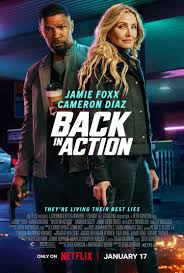
After more than 10 years away from the screen, Cameron Diaz, so popular in the 1990s and 2000s, returns to the screen, with some enthusiasm.
This is an enjoyable action show even if, some critical of this kind of show tell su we have seen most of it before. But, is that necessarily a bad thing!
Cameron Diaz works here with Jamie Foxx, secret agents, plenty of action to establish their characters, but betrayals, suspicion of the MI6, their being abducted, a fight in the air, crash landing and the decision to disappear and lead an ordinary life.
Then 15 years later, we see the now-ordinary American couple, their two teenage children, the complaining suspicious daughter, the precocious young son, devoted parents in Middle America, at home, sports and teachers meetings, Mother too demanding. Then exhibiting rather martial arts skills when least expected.
Blame social media for breaking the secrecy but, in an encounter in a club to rescue her daughter, mother goes into action and is photographed, displayed on social media, their American handler immediately coming to catch up with them, his being shot at, and their going on the run with their children, no explanations, the children continually amazed.
They go to the grandmother in England, an elitist British spy in her day, owning a mansion – and, a great bonus, one of those very eccentric performances from Glenn Close. And, into the bargain, the MI6agent is played by Andrew Scott, increasingly popular and versatile on stage and screen, especially with his interpretation of Ripley.
Plenty of action, quite some comedy with the grandmother’s toyboy in training for the Secret Service and not too good at it, Jamie Demetrio, betrayals, climaxes, and final action in the Thames.
Yes, maybe we have seen a lot of it before, but no harm now in seeing it in the hands of Jamie Foxx and Cameron Diaz and Glenn Close.
- Straightforward title? The initial action, 15 years of domestic life, back in action?
- References to James Bond and Jason Bourne, espionage action, old-style films, dangers, undercover, expertise in fighting, weapons? The espionage situation, MI6, the CIA? Belarusian terrorists? The lull in the 15 years, then back in action, no holds barred? The musical score?
- The opening, the disguise, the social, Chuck and his control, meeting the host, getting his fingerprint, opening the safe, getting the key, the dangers, the escape? The encounter with Baron, the past relationship? On the plane, abducted, the fights, the death of the pilot, the crash, the parachute and the landing, the decision to disappear?
- The 15 years, domestic comedy, the almost-Boomers, their style, compared with the children, 14 and 12, life at school, studies and friends, boyfriends, the club and dances, the young boy intelligent, studious, and the parents spying on them, using all the technology, the reaction of the children?
- The episode at the club, the fight, going online, their being identified, Chuck arriving at the door, his being shot, the gunmen, getting the children, the car, the pursuit? The puzzle of the children? Emily and Matt have become very domesticated, but going into action again, Emily exhilarated by the fight the club?
- The issue of the key, Matt hiding it with Emily’s mother, going to England, the flight, the continued bewilderment of the children, at passport control, the fake passports, observed, getting the rental car, the drive, the pursuit, at the diner, the petrol in the flamethrower, the fighting techniques, the children in the English breakfast, using the pewter, enabling the pinpointing of their presence?
- The continued chase, barren in pursuit, shooting the truck with the pipes and blocking the road? Barren discovery going to Emily’s mother is? His knowing that Emily thought he was a traitor?
- Emily and the story about her mother, the dispute between them, boarding school in America, her mother is a spy? Glenn close enjoying this rule? Nigel, the toyboy, training for the Secret Service, his ineptness, his dumb remarks, yet the romance? Boys showing him up with throwing the darts and weapons?
- The siege of the house, finding the Chuck was the traitor, his explanation of his being sacked because of their disappearance? His contact with the various groups?
- Emily’s mother, her manner, career, tough, British, not embracing? It is in Nigel? Matt recovering the key? The abduction of the children? The discovery of the event at the Tate Modern?
- Dressed up for the occasion, getting in, Chuck with the key, Daphne and her controls, the option, the bidders, turning the lights of the city on and off, opening the floodgates for the Thames?
- Confrontations, the pursuit, taking the children, on the boat, Chuck in his communication with Daphne, grandmother to the rescue with the shooting, Emily and Matt, on the bikes, the tactics, into the boat, risking the children, the fights?
- Nigel, the encounter with Daphne on the crash, with the computer, his dithering, ultimately succeeding despite himself? Send himself as a hero?
- The final rescue, everybody in the US, the soccer match, the daughter and her success, reconciliation between Emily and her mother, Nigel present? Get into the car, and Barry with a proposal for future action?
Ripley
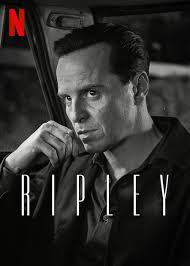
RIPLEY
US, 2023, 8X 56 minutes, black-and-white.
Andrew Scott, Dakota Fanning, Johnny Flynn, Margharita Buy, Kenneth Lonergan, Elliot Sumner, Maurizio Lombardi, Bokeem Woodbine, John Malkovich, Fisher Stevens.
Directed by Stephen Zaillian.
Tom Ripley is the literary creation by crime novel writer, Patricia Highsmith. Over the decades, he has had many incarnations, Alain Delon in the 1960s, Purple Noon, Dennis Hopper in the 1970s, The American Friend, strikingly in 2000, Matt Damon in The Talented Mr Ripley, John Malkovich in Ripley’s game, 2002. (Wikipedia indicates quite a number of other films, especially from the 1950s to the 1970s.)
This time he is played by Irish actor, Andrew Scott, completely convincing. And this time Dicky Greenleaf is played by Johnny Flynn and Marge by Dakota Fanning. There is a strong supporting cast of British, American and, especially, Italian actors.
It is a television series of eight episodes. This gives the screenplay enough time to offer sequences plenty of time to develop, sometimes giving the impression of events happening in real time.
But, one of the key assets for the film is its black-and-white photography, often described by reviewers and bloggers as “pristine” (clean and fresh as if new; spotless). Comments cannot do justice to the clarity of the black-and-white, some of the cities of Italy enhanced by the quality of the photography.
Tom Ripley is a conman. Tom Ripley is also a psychopath, not just a sociopath who can smile and charm but is self-absorbed, but is also criminally insane, and unscrupulous murderer. Every actor who plays Ripley has to be persuasive with charm but yet able to show the in the madness, the unscrupulous narcissism.
Ripley has offered the opportunity to go to Italy by wealthy American businessman, played by playwright Kenneth Lonergan, to persuade his son Dicky to come back to the US. Ripley takes the money, visits Dicky, sees the lifestyle, enviously and vicariously starts to live it, overcoming any suspicions by Dicky, but not by Marge. Which leads them to Ripley is murdering Dicky, covering the murder shrewdly, Tom becoming Dicky in the comfortable life in Rome, then in Venice. And, he is always one step ahead though there are many close calls.
The screenplay for this series has been written by veteran writer-director, Steven Zaillian, celebrated writer of many significant films from Schindler’s List, Gangs of New York, the Irishman.
- The work of Patricia Highsmith? The different versions of her Ripley stories?
- Ripley, a conman, psychopath, his success, an amoral character?
- The previous versions and comparisons? The value of the television series, eight episodes?
- The decision to film in black and white, the striking photography, “pristine”? Of the locations, towns, the beach, Naples, Rome, San Remo, Palermo, Venice? The musical score?
- The pacing with eight episodes, some action in real time, the strong attention to detail for developing the plot?
- The casting, Andrew Scott embodying Ripley?
- The introduction, New York City, the petty conman, his character, seeing him in action, the summons by Herbert Greenleaf, his wife, business interests, the proposal about his son? Ripley being tracked down by the private detective, the conversation? Explanations of Richard Greenleaf, Dickie and his leaving, settling in Italy? Ripley accepting the mission, the money, the travel to Italy?
- The town, Atrani, life there, the coast, Dickie, his age, lifestyle, wealth, relationship with his parents, alienation, dabbling in art? His relationship with Marge? Her writing a book? Her devotion to him? He to her? Is reading the manuscript and giving suggestions, her response? Ambiguous attitudes towards Tom?
- Tom, his arrival, ingratiating himself, his schemes, revelation of the truth about his mission, bonding with Dickie, not with Marge? Freddie and his visit, Tom’s dislike? The invitation to Cortina and its consequences? The lifestyle in the town, Tom, emulating Dickie, caught wearing his clothes and Dickie’s off-hand response?
- Tom writing to Herbert Greenleaf, money issues? The father and his letters, dismissing Tom, urging Dickie to be suspicious? The decision to go to San Remo, hiring the boat, Tom, calm, waiting for the moment, malevolent, killing Dickie, taking his ring, all the effort to come to shore, the body overboard, the rocks on the boat? The later recovery, the police investigations, the reports in the media?
- The details of Tom’s life, in the town, the various characters, learning Italian, the banks? The train rides? The hotels and reception? The feel of Italy in 1961?
- Tom, his skills at evading detection, going back to the town, Dickie’s clothes, typewriter? The smuggler and the previous proposition to smuggle, selling the boat? American Express in Rome? Tom becoming Dickie, his clothes, manner? Settling in Rome, expensive hotels?
- The various letters, the importance of the typewriter and its flawed letter e, Freddy’s visit, Tom and his coping, levels, the plan to kill him, the alcohol, the blood on the floor, taking the body, the elevator and its not working, dragging him down the steps, in the street, the car and his working out which one, holding him up, the witness walking his dog and the later visit to the police? The details of the drive, repeated several times, the via Appia, the taxi drivers, going back to retrieve the passport, his settling back at the apartment? Cleaning the blood? The importance of the landlady, her kindness to him, showing him the apartment, her receiving the police?
- Inspector Ravini, the visits, Tom and his calm during the interviews, the blood on the path? Marge, the visit, his meeting her in the cafe, her telling Ravini and his not believing her?
- The character of Ravini, the interviews, Tom on the edge, Max and his relationship with Freddie, wanting to meet Dickie? The media reports, suspicions on Tom? On the newspaper, the visualising of the articles, the pressure? Then on Dickie? The finding of the boat, the bank fraud and Tom fixing the signatures? The various phone calls from the bankers? Tom cashing the money? Getting the permission to go to Palermo
- The twist, Tom and the media and photos in Palermo, moving hotel? The decision to leave, the false clue about Tunis?
- Tom, in Venice, alive, revealing the visiting, Marge and her visit? The art world and the dealer? Marge intruding? Herbert Greenleaf arriving, the dangers, exposure, the private detective and his arrival, accusing Tom? The further discussions, speculation, the forged letters, the money to the landlady, the ring, the assumption that Dickie had killed himself?
- Tom, the art dealer, the Picasso, getting a new name and passport?
- Marge, publishing the book, the irony of Ravini seeing the photo of the actual Dickie?
Vanya
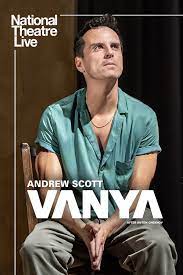
VANYA
UK, 2023, 100 minutes, Colour.
Andrew Scott.
Directed by Sam Yates.
This is a filmed version of a celebrated theatrical performance by Andrew Scott in a contemporary version of Anton Chekhov’s Uncle Vanya.
For those not familiar with the plot of Chekhov’s famous play, it would be recommended to check out a synopsis, a general impression of the drama, the characters and their interactions so as to be able to identify the characters here, generally with Chekhov’s names but Marina becoming Maureen, for instance, and references to Ivan more than Vanya.
And, the setting is transferred from Russia to an estate to Ireland, a farm, Ivan/Vanya the manager, his relationship with his niece, Sonia, his response to his uncle, the pompous filmmaker, Alexander, with his new younger wife, Helena, who is the object of attraction by the local doctor, Michael. There is also the local friend, Liam and his wife.
Identifying the characters is important because the key aspect of this theatrical piece is that Irish actor, Andrew Scott, plays all the roles. It is a very impressive tour-to-force, Scott alone on stage, altering his voice, establishing mannerisms, stylised movement to indicate characters, the use of his body and limbs to indicate different characters, stances, walking, from Scott who is simply dressed in shirts and trousers and shoes.
As well as the acting, Scott has to do quite an amount of stage business throughout, lights on and off, going into cupboards and out, a gimmick to indicate a wolf whistle, boiling the kettle, cup of tea, bottle of alcohol and continually lighting up…
For Chekhov lovers, the noticing of the parallels and adaptations will be intriguing. For those not familiar with Chekhov, it may be quite an effort to follow the whole play and its thrust, its themes of age, regrets, loves and relationships, vanities, the range of the faults and foibles of human nature.
For those watching Vanya on streaming, it may be helpful to turn on the subtitles – which indicate which character is actually speaking.
So, whether Chekhov and Uncle Vanya are familiar or not, this hundred minute piece is well worth seeing to be amazed at the talent and skills of one actor holding the stage. While the audience is shown and audience applause is heard, audiences watching this film version will be glad that they are seeing close-ups of Andrew Scott and his performance, enhancing the intensity and communication.
All of Us Strangers

ALL OF US STRANGERS
UK, 2023, 105 minutes, Colour.
Andrew Scott, Paul Mescal, Jamie Bell, Claire Foy.
Directed by Andrew Haigh.
With strangers in the title, and referring to everyone, strangers to one another, strangers in our relationships, this is a very melancholy title.
The screenplay, based on a novel by Japanese author, Taichi Yamada, was written by Andrew Haigh who has had a successful career writing and directing screenplays which probe same-sex relationships, Weekend, Looking. He also wrote and directed the insightful film about an aged married couple, 45 Years.
Irish actor, Andrew Scott, has had a substantial career since he was very young, Moriarty to Benedict Cumberbatch as detective in the series, Sherlock, C in the James Bond film, Spectre, and as a comic priest in Phoebe Waller’s comedy series, Fleabag. This is one of his best and most moving performances.
He plays Adam, in his 40s, alone, lonely, a gay man who has had not had an emotional relationship. He is a screenwriter, probing his own history in his writing. Scott makes Adam someone whom we respond to with care, concern about his loneliness, occupying a room in a huge new high-rise apartment block in London, but the other flats still empty. He encounters Harry, Paul Mescal (Normal People, Aftersun, Foe, Gladiator 2) at his door, Harry drinking, suggestive, but Adam closing the door on him.
But we know that Harry will persevere, something will develop between the two.
While watching the film, the key word that emerges in our consciousness is “empathy”. Adam is such a pleasing and sympathetic character who invites our empathetic attitude towards him, for him as a person, for him as a lonely man, for him as a man with a homosexual orientation. And the theme that the film explores is what is “being in love” for Adam.
This is a question is posed to him by his mother. And the appearance of Adam’s father and mother takes us into a different realm in the storytelling. They have been dead for 30 years, sadly killed in a car crash when Adam was 12. But, as he looks at the box of photos from the past, he has an overwhelming desire to visit the house again, takes the train, walks the street, encounters his parents, goes into the house, sits down and talks with them. They are played very effectively (and we remember Billy Elliot and The Crown) by Jamie Bell and Claire Foy.
So happy is Adam in his parents and rediscovering them, that he goes back, encountering his mother alone, she innocently asking about his girlfriend, he telling her about his orientation, her being rather bewildered, not knowing how to talk with her son. In his next visit, he encounters his father has been told by his wife about Adam and mentions that she needs to rearrange a few things in her mind. What follows is a powerful discussion about Adam and his experiences as a young boy, bullied at school, his father realising the orientation and the question between them of why his father never spoke to him about the issues and why he never spoke to his father.
These revisits to his parents have a disturbing effect on Adam, waking disturbed, Harry there as support for him. The line between fantasy and reality is disappearing.
These ghostly themes continue with some farewells, and a very sad ending.
In these years of discussion about same-sex relationships, talk about blessings of same-sex unions, this is an empathetic film for a wide audience.
- The title? Melancholy? Relationships?
- The London setting, the block of flats, high, empty, the interiors, the corridors, the lifts? The musical score?
- Adam’s story? The performance by Andrew Scott, empathy? His age, screenwriting, exploring his past, living alone, lack of relationships? Hearing the alarm, going outside, looking up, seeing Harry? Harry and his visit, the talk, Adam shutting the door? Harry’s later return, his story, father, alienated, his mother? Adam inviting him in, the talk, the touch of tension, Harry relaxed, the drink, discussion about the difference between gay and queer, the physical attraction, the sexual encounter, the aftermath?
- Adam and his writing, seeing the photos of the past, the audience learning that his parents had died in a car crash, black ice, father instantly, mother later, losing an eye? The house, his desire to visit the house?
- Adam and his physical condition, health? The screenplay showing him to visit the house, the encounter with his parents, the return visits, his waking up? The line between reality and dream? Sometimes overlapping? At home and sleeping and waking, Harry reassuring him? Waking up on the train, but this being part of dreams? Seeing Harry in the underground, following him, alone on the train?
- And these scenarios as possibility for his screenwriting, exploring and understanding his past?
- Going home, comfortable, his parents at the age they died, their welcoming him, the characteristics, father being jovial, mother loving her son and being fussy? His happiness in meeting them again? The decision to return, the visit with his mother, her asking about girlfriends, getting him something to eat, his revealing his orientation to her, her not understanding, her being uncomfortable? The visit to his father, his father reassuring him that his mother had told him, that she just had to rearrange some things in her mind, Adam telling his father the things were different, his telling about equality, marriage, less prejudice, but sometimes this rising as it did in the past? His father and his understanding, memories of Adam at school, Adam talking about the bullying, calling him girl, the boys and girls both critical? His father saying he was aware of this? Adam asking why he didn’t come into to talk with him? His father asking why Adam didn’t tell his father?
- The final visit, the outing with his parents, the restaurant and the waitress, the family meal? But his parents not eating, a more ghostly presence, telling him that had to leave, and wanting them to stay, even to visit them once a year? The question about whether the death was instant, his mother not seeing well, but Adam reassuring them they died quickly? And then disappearing?
- Adam returning home, going to Harry’s apartment, finding Harry dead? Harry outside, knowing that his body was in the other room? Adam reassuring him, settling him down, urging him to go to see his mother?
- Reality and fantasy, ghostly presences?
- And Adam, his illness, live in dying, his memories in coming to terms with his life, in love with Harry (and his mother asking him this explicitly,?
- An empathetic film for gay audiences? An empathetic and invitational film for wide audiences?
