Displaying items by tag: Jeffrey Wright
Wake Up Dead Man. A Knives Out Mystery
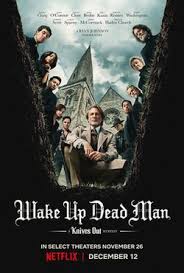
WAKE UP DEAD MAN
US, 2025, 144 minutes, Colour.
Daniel Craig, Josh O'Connor, Glenn Close, Josh Brolin, Mila Kunis, Jeremy Renner, Kerry Washington, Andrew Scott, Cailee Spaeny, Daryl MacCormack, Thomas Hayden Church, Jeffrey Wright, Annie Hamilton, James Faulkner, Bridget Everett.
Directed by Rian Johnson.
In 2019, movie audiences worldwide enjoyed a very entertaining murder mystery, Knives Out, a very starry cast, an offbeat private detective, genteel and from the South, Benoit Blanc, played by Daniel Craig. Three years later, writer-director, Rian Johnson, was successful again with The Glass Onion. And audiences wondered, now three years later again, whether this film, Wake Up Dead Man, could be a successful.
It is.
And, once again Daniel Craig’s charmingly eccentric Blanc, a star cast for character actors, a murder in an equivalently locked room, plenty of suspects, gradual revelations, twists (although many audiences probably pick the murderer but will be surprised at all the motivations and turns in the plot). There are references to Agatha Christie and Roger Ackroyd. And, Benoit Blanc uses the John Dickson Carr thriller, The Hollow Room, as a template for his theories.
No difficulties in recommending Wake Up Dead Man to murder mystery audiences – plenty to entertain, almost 2 ½ hours worth.
But, the surprise is the Catholicism pervading the whole story and treatment. Which meant checking whether writer-director, Rian Johnson is Catholic. In fact he grew up in a close evangelical community.
The filmmaker made Dead Man in large part to excavate his deeply religious youth, a core part of his identity that gradually faded in adulthood. “I slowly realized I was writing this through the lens of me, now,” Johnson says. “I had to step back into me, 30 years ago, and tap back into the things that inspired and drove me as a Christian”. David Canfield, 21 Nov. 2025. Hollywood Reporter.
The events take place in the fictional parish in New York state, Our Lady of Perpetual Fortitude, ruled over by an eccentric parish priest, Msgr Wicks, Josh Brolin rather savage, something of a cult leader in his hold over a group of parishioners, helping them, but exercising power, an angry man (and there is an interesting background to his place in the church), taking a stance against any inroads against him and the church, siege mentality. The common-sensed local Bishop, Jeffrey Wright, appoints an earnest young priest, Father Jud, to bring some balance to the parish. Father Jud is played by Josh O’Connor, one of his best performances, a former boxer with responsibility for death, changing his life, very much focus on Jesus of the Gospels, pastorally earnest. (Perhaps Rian Johnson had seen Mark Wahlberg as Father Stu!) An eventual clashing with the parish priest and his loyal parishioners.
The film introduces quite a range of characters, all potential suspects, the devoted manager of the parish, Glenn Close; the local doctor, Jeremy Renner; the local lawyer, Kerry Washington; an oddball novelist, Andrew Scott; a wheelchair-confined cellist, Cailee Spaeny; the caretaker, Thomas Hayden Church; a young would-be politician, Daryl McCormack (who has a marvellous short scene where he explains how he has campaigned in an enormous litany of every cause, every controversy, every movement in contemporary politics, especially in the USA).
And the murder takes place on Good Friday, and some rather fanatical beliefs and manoeuvrings in rising from the dead.
One of the features prominent in the film is that of confession, several between Msgr Wicks and Father Jud, some revelations of conscience, personality, some twists of conscience. And, Benoit Blanc, who declares himself absolutely rationalist, has to admire Father Jud, wants to save him from all the suspicions, sees that his Gospel compassion has something to commend it and arranges that the final revelation should take place in the church, everybody present, and that the murderer admits guilt in the framework of confession.
Many audiences will just observe this Catholic framework – but, the characters, the situations, the sins, repentance, the contrast between authoritarianism and pastoral enthusiasm make a difference for a Catholic audience.
- Audience enjoyment murder mysteries? Literary tradition from Agatha Christie, John Dickson Carr…? The film tradition? This third Benoit Blanc mystery?
- Audience enjoyment of Daniel Craig as Benoit Blanc, from the south, manner, speaking, clothes, style? The previous films, his status as detective, clues, interrogations, explanations, the dramatic confrontations, the accused, the suspects, the murderer?
- Father Jud and his story, writing up the accounts, his voice-over, his own story, young, boxer, killing his opponent, later saying he hated him, his sense of guilt, his discovery of Jesus, motivations, priesthood, the interview with the Bishop, his being reprimanded by the panel, his manner, vocabulary, talk about his faith and pastoral perspective? The Bishop sympathy, the new appointment?
- The warning about Msgr Wicks, Jud arriving, the encounter, at Wicks’ and his appearance, manner, way of speaking? His long status of the church? The back story, his father, widower, becoming a priest, establishing the church, his daughter and her ways, pregnancy, unknown father, the ministry of her father, his death at the altar, the inheritance, her wanting it, the destruction of the church and her anger, the encounter with Martha as a little girl, her death? The father and the mausoleum? Msgr Wicks, ordained, the church, the small congregation?
- Msgr Wicks, conservative, angry, feeling the church was under siege, his hold over the community, words of help, yet humiliating them, making them dependent? His thundery sermons? The encounter with Jud, the boxing, the sparring and the demonstration of asserting oneself? The issue of confessions, his talk about himself, especially the sexual dimensions of his life, and the later information about his prostate surgery and his assertions? Forcing Jud to confess to him? Jud and the uncomfortable experiences? The prayer penances? Time passing?
- The information about Martha, as a little girl, with the elderly priest and her devotion, the fight with his daughter and her death? The doing all the work in the parish, older, prim and proper, accounts, the organ playing, her devotion to Msgr Wicks? Her reaction to Jud? To the other parishioners? The homilies and her looking in admiration to the monsignor?
- Dr Nat, the doctor, devoted to his wife, her suddenly leaving him, his drinking, wanting her back? Vera, the lawyer, keeping the parish accounts? Cyrus, her looking after him, his growing up, his political ambitions, the sequence of his describing all the issues and causes that he had tried out? His use of the media, filming everything? Simone, her age, playing the cello, her incapacities, retiring, giving her money to the Parish? Lee, author, the lurid titles, his retirement, his house has a fortress with a defensive mode? Supportive of monsignor?
- The image of the Catholic Church, the progressive and pastoral perspectives as embodied by Jud, contemporary involvement in the Gospel and Jesus message for those in need? The contrast with the isolating, the defensive, the exercise of power, and the moral double standards?
- Monsignor and his meetings, the revelation of the meeting where he denounced everyone, their loyalties to him, the humiliations?
- The presence of Samson, gardener, alcoholic, monsignor rehabilitating him, Martha and her devotion? The television, his watching the matches? The interrogations by Blanc?
- Jud, his prayer meeting, their attendance, the reactions, the monsignor coming in, punching Jud? The atmosphere for Holy Week?
- Good Friday, the ceremony, all present, the homily, the singing of the chant with the cross, monsignor exiting, his collapse, Jud going in, dead, stabbed, the blood? The closed room?
- The police, the information, Jud under suspicion, his behaviour? The personality of the investigator, her tough stances, interrogations, suspicions of Jud?
- The calling in of Benoit Blanc, entering the church, the discussions with Jud, his not being a believer, the vocalising of attitudes of agnostics and atheists, criticism of belief? Yet his polite listening to Jud and the others, and his later moments of acknowledgement of faith and belief, his finally organising the final confession? His methods, the reliance on The Hollow Room, John Dickson Carr, going to the various possibilities?
- The developments of the case, the issue of the excavator for the mausoleum, the autopsy, Jud being present, having to leave the room, monsignor being buried in the mausoleum? Martha, her fussing, with the police, with Benoit Blanc, her belief in the resurrection, her continued prayer?
- The resurrection episode, Samson in the coffin, emerging investments, the range of cameras in the church and the mausoleum, motions filming, Jud arriving and slipping in the mud? His seeing the light, discovering Samson, his death? The police and further suspicions? Martha and her acknowledging that monsignor had risen from the dead and gone to heaven?
- The revelation that Cyrus was Msgr’s son, the unknown mother, Vera and her disgust and relationship with Cyrus, his bonding with monsignor, taking his name, being the heir, wanting to discover his grandfather’s inheritance? The keepsake, the apple, the lawyer, the search of documents? Benoit Blanc and Jud and their search?
- The further investigations, going to the doctor’s house, the discovery of monsignor’s body, the doctor dead, the further mystery?
- Jud, his sense of guilt, wanting to confess? Benoit Blanc’s reaction, assembling everybody in the church, the explanations, but his wanting to show compassion like Jud to those in need of compassion? Arranging the confession sequence?
- Martha, the confession, her explanations, the various clues, the background of the old priest, her devotion to him as a little girl, her contempt for his daughter, the truth about the old man’s death, swallowing the jewel, its being buried with him, Martha keeping the secret? Her shock at hearing the truth, turning against monsignor, side issue of the phone call to find out who booked the machine, Jud and his long discussions with Louise, pastoral compassion? That Martha had booked the machine, to get to the body of the old man, to retrieve the jewel? The solution to the mystery, the camera and the experts explanation about time lapse, Jud and his concealing the drink and monsignor’s reputation, but his collapse with the drugs, Martha selling the emblem on to the chasuble (and the background of the visit to the bar and the implement, Jud and his despair, throwing the implement through the window, their being two? The doctor doing the stabbing? Not able to find the alcohol container behind the door? Her plot with the doctor, to resurrect monsignor through Samson, the doctor and his greed, killing Samson, his explanation to Martha, going back to the house, the issue of the poisoned drink, Martha distracting the doctor, switching the cups, his death, her throwing him down the steps? Her retrieving the jewel? Her drinking the poison, her death?
- The aftermath, Vera leaving town, Cy and his further political ambitions, Lee and his book on publication and signing autographs, Simone playing the cello again?
- Jud, the discussions with the bishop, the support from the Bishop, going back to the church, the audience thinking he was using the money from the jewel – the renovations of the church, the restored crucifix – and the final revelation of the jewel buried in the crucifix?
- Satisfying murder mystery, death in the locked room, clues, investigation, solution?
Phoenician Scheme, The
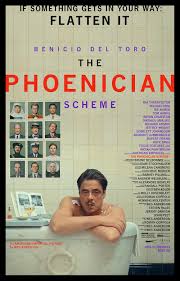
THE PHOENICIAN SCHEME
US, 2025, 101 minutes, Colour.
Benicio del Toro, Mia Threapleton, Michael Cera, Riz Ahmed, Tom Hanks, Bryan Cranston, Mathieu Amalric, Richard Ayoade, Jeffrey Wright, Scarlett Johansson, Benedict Cumberbatch, Rupert Friend, Hope Davis, Bill Murray, Charlotte Gainsbourg, Willem Dafoe, F. Murray Abraham, Stephen Park, Alex Jennings, Donald Sumpter, Scott Shepherd.
Directed by Wes Anderson.
A significant part of the review for The Phoenician Scheme is to look at the huge credits list, many of the cast having appeared in a number of Wes Anderson films. And, of course, expectations from writer-director, Wes Anderson. Anderson has been writing and directing films, including two animation films, for more than a quarter of a century. His tyle and his exploration of themes is, to say the least, highly distinctive.
And, The Phoenician Scheme, is quite idiosyncratically distinctive. It is very stylised in the visuals, the traditional box screen frame, the framing of action, the references to paintings and the staging looking like 20th century paintings. Then there are the performances, also stylised, often life theatre performances, eccentric and clipped delivery of lines, postures and posing. And, for those audiences ready to surrender to Anderson, there are many who do, these visuals and the performances are readily engaging.
There is a plot. The setting is 1950, an entrepreneurial businessman from Hungary, Korda, played perfectly, both seriously and ironically, by Benicio del Toro. He has survived several plane crashes, assassins out to get him and sabotage his plan for development, rails and tunnels in Phoenicia. We are presented with a chart indicating his plans as well as the contacts he must make to improve a shortfall in income project. They serve as chapters for the film.
Korda has many children, his own and adopted, hoping for an Einstein for the future. But his only daughter, Liesl, a novice nun, played by Mia Threapleton, is seconded, initially unwillingly and firmly committed to her vocation, to be his heir. (Mia Threapleton is following in the footsteps of her mother, Kate Winslet, a very interesting role.) And, there is Kord’a new assistant, expert on insects, played with accent by Michael Cera.
Interspersed throughout it is round table conference of elders who are monitoring Korda’s behaviour judging him and his morality accordingly.
The encounters with the various characters for financial help are highly entertaining, eccentric and satirically humorous in their way, incorporating the various stars listed above until a culmination in the fearsome presence of Benedict Cumberbatch Korda’s brother.
Then there are Korda’s memories and dreams, flashbacks in black-and-white, some of his near death, or momentary post-death, experiences, some ecclesiastical in an Orthodox style, others with biblical overtones, again with a number of stars – and a cameo by Bill Murray, who has been working with Anderson for a long time, culminating in his presence as God.
Anderson has a wry and offbeat sense of humour, so often the unexpected, some realism and then some surrealism, farcical moments, deadly serious moments, tantalising the audience, a treat for those who are willing to be tantalised.
- A Wes Anderson film, style, visual, verbal, humorous, satirical, ironic? Underlying serious themes? The strengths of his casts, many actors reappearing in his films?
- The visual style of the film, but colour like 20th century contemporary paintings? Sets and decor? Photography, the black and white flashbacks? Staging of the action, like stage performance, all postures and posings? The stylised action sequences? The performances, stylised and realism? The language of the screenplay, the particular style of delivery? The overall effect and response?
- The setting in 1950, memories of World War II, business enterprises after the war, international entrepreneurs, international projects and finance?, Double dealing?
- The explanation of Korda, his business acumen, the 5%? The background of his marriages? Children and adopted children, hoping for an Einstein? His relationship with his daughter, novice nun, seconding her, naming her as his heir? His staff, his planes, the plans to kill him, his surviving the various crashes?
- The plane ride, his assistant cut in half and swept away, the crash, surviving? Meeting his daughter, her personality, severe, dedicated to the convent, contact with the mother superior, wanting to make her vows? Her not knowing her father, his reputation with her? Her unwillingness to be part of his empire? The plan, her observing his behaviour, learning more about him, her beads, images, sign of the cross, holy water?
- Bjorn, Scandinavian background, accent, present on the plane, his role as assistant, his expertise on insects, his attraction to Liesl, declarations? The comic style of his character, interactions?
- The Phoenician scheme itself, tunnels and railway, the finance, the image on the screen with the various contacts for making up the gap in finance? The structure of the film, the various contacts?
- The background of the assembly, the business discussions, the following of Korda, the decisions about his business and morality?
- The Americans, in the tunnel, on the train, the discussions, suspicions, the meeting with the Prince of Phoenicia, the attack by the camel riders, the Prince saving Korda? The financial discussions, the proposal of the basketball competition, the Prince and his ignorance of the game, Korda hopeless, the skill of the two Americans, yet the Prince succeeding? Getting a grant?
- Going to Marseille Bob, the manager of the club, past relationship with Korda, Liesel and Bjorn observing, the raid on the club, the freedom fighters, the personality of Sergio, Bob upset about the roof, and Korda taking the bullet for Bob? Getting the grant?
- Marty, fast talking American, suspicious of Korda, Korda shot, Marty providing the blood transfusion, making an agreement?
- Going to see Hilda, the distant cousin, her financial knowledge, the prospect of the marriage, her place in the family, with Liese?
- The flight, going to see Nubar, the crash, the jungle, Bjorn and his being unmasked as an agent, his siding with Korda, Korda in the quicksand, Bjorn rescuing him, the arrival of Sergio and his revolutionaries, taking the group to safety?
- The encounter with Nubar, looking sinister, the relationship, the mastermind behind the assassination attempts, discussing the family, the finance, the satirical physical fight between Nubar and Korda?
- Korda, death experiences, near death, his life before him, black-and-white photography, the bearded Orthodox-like sequences, the characters, judgements? The biblical sequences, the personalities, the pageantry, Bill Murray as God?
- Liesl, the contact with the mother superior, her being present for the business deals, the money for the community? Liesl opting to leave the convent?
- The finale, Korda and his being honest, losing everything, restaurant, the working in the kitchen, father and daughter, reconciled, and a happy life?
- The Phoenician Scheme movie
- Wes Anderson
- Peter Malone's Movie Reviews
- Benicio del Toro
- Mia Threappleton
- Michael Cera
- Riz Ahmed
- Tom Hanks
- Brian Cranston
- Jeffrey Wright
- Richard Ayeode
- Benedict Cumberbatch
- Scarlet Johansson
- Charlotte Gainsbourg
- F Murray Abraham
- Willem Dafoe
- Rupert Friend
- Donald Sumpter
- Mathieu Amalric
- Bill Murray
- Hope Davis
- Alex Jennings
American Fiction
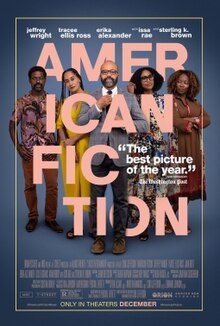
AMERICAN FICTION
US, 2023, 117 minutes, Colour.
Jeffrey Wright, Sterling K.Brown, Issa Rae, Erika Alexander, Tracee Ellis Ross, John Ortiz, Leslie Uggams, Adam Brody, Keith David, Myra Lucretia Taylor, Raymond Anthony Thomas.
Directed by Cord Jefferson.
Quite a generalised title and audiences will have their own ideas of what American fiction is, whether they like it or not. With this humorous, satiric story, there is a lot to like, as well as a great deal of disapproval!
American Fiction was nominated for five Academy Awards, including Best Film, Best Actor, Best Supporting Actor, music – and winning for Best adapted screenplay by the director, Cord Jefferson. So, quite some standing amongst the American films of 2023.
We are introduced to Thelonious Ellison (and his nickname, Monk, after the musician). He is played by Jeffrey Wright, Oscar nominee. He lectures at the University, has written books, can be a stuffy academic, disdainful when he listens to a reading by a successful novelist, using the language and jargon of the streets to illustrate African-American life. He thinks that this is destined to appeal to the consciences of one people.
Monk is alienated from his family, though bonding with his sister who, sadly dies. His mother is becoming senile and the issue of the aged care. His plastic surgeon, gay brother, Oscar nominee Sterling K.Brown. Which brings him back to his family life, not very happy about it, but very attracted to Coraline who lives across the street, beginning a relationship with her. But she will feel the effect of his crankiness.
And, Monk is cranky with his publisher, upset at lack of progress with his own books, then getting the mischievous idea to write an anonymous parody of the kind of book he loathes. They create an anonymous author, a former prisoner, background, not well educated… And, his dismay when publishing agents enthusiastically praise the manuscript, huge advance payment, want instant publication, Hollywood after the film rights. And his surly assertion for a four letter title – which is accepted.
And his friend likes the book, praising it, furthering his crankiness.
He is also a member of a book judging committee, having discussions with the author of the book he loathed who makes some interesting comments about his, not knowing he was the author. The publishers then enter his book into the competition and, of course, in a climax scene at a banquet, he is the winner.
Tongue goes firmly into cheek for the final part of the film, the discussion with the Hollywood producer, discussions about all kinds of possible endings – which are visualised for us. But, will Monk succumb to success and popularity, or…?
And for non-Americans, enjoyable to see Americans sending themselves up!
1. The focus on American literature, American fiction, Afro-American fiction, serious, popular, academic interpretations,?
2. The opening, introducing Theolnious Ellison, nickname Monk, age, endemic position, lectures, attitude towards literature, discussions with the students, Flannery O’Connor, the discussion about the word “negative”, student walking out? The discussion with the Dean, complaints against Monk, his going to Boston, attitude towards his family, suggested that he take time off? The prospect of his new book? His past books, academic, well reviewed, not red?
3. Monk going to Boston, meeting Lisa, revelations about the past, his father’s favourite, the rule of his father, doctor, Lisa and Clifford being doctors, going to visit their mother, her presence, personality, beginnings of senility?
4. The panel, the few people attending? Hispresence at Sentara Golden’s reading, the acclaim, standing ovation, his puzzle, her book, the title, popular African-American language, content?
5. Lisa, her collapse, her death, the funeral, their mother, Cliff arriving, is attitude, from Phoenix, plastic surgeon, the clashes with Monk? The issue of his sexual orientation, marriage breakup, lover, whether his father knew? His mother’s saying she was glad he was not gay?
6. Monk and is meeting with Arthur, promoting his books, the conversation, is one and his exasperation with the popular literature, for black audiences, for white audiences, their sense of guilt, feeling the need to read such books, their interpretation?
7. His decision to write the book, imagining the situations, the confrontation between the characters, their asking him for advice, setting up the situations – a quick device for establishing the writing of the book? Taking it to Arthur, his reaction? The decision to send it out? The publishers, their acceptance, rave comments, the huge money advance, the impact on Monk, the phone calls, the PR buildups, Arthur urging Monk to assume the author’s character, tone of voice, vocabulary? Monk and his hesitation? Decision for it to go ahead? The film offer? The meeting with Wylie, the false background, his being a fugitive, prison sentence, telling his story on his own style?
8. The complications for monk with his mother, Lisa having helped, money issues, Cliff not having money, the reliance on Lorraine, her devotion to the family, to Agnes, to Monk? Maynard, the police, the past friendship, Lorraine and Maynard as a couple, the proposal? The visits to the aged care home, Agnes’s reactions, moving in, emptying the house, souvenirs for Lorraine? That they would movie in after the wedding?
9. Monk, the encounter with Coraline, helping with the groceries, her ex-husband, the growing friendship, conversations, her having read his books, the relationship? Her coming to meals, the across the street? The bonding? A humane outlet for Monk?
10. The publication of the book, the issue of the cover, the issue of the title, Monk and his proposing Fuck, initial reactions, the decision? The publication, the acclaim, popularity, sales? The film rights? Wylie, the meeting, the ambulance for his mother, rushing out, wildly interpreting this is his apprehensive is about the police? Adding to the credibility?
11. Coraline reading the book, Monk and his negative reactions, the clash?
12. The competition, the request to Monk to be on the panel, Sentara Golden on the panel, the other members, white, the range of books, discussion about reading the first hundred pages? Sentara and her dislike of Fuck? Monk warming to her, but the clash and the argument?
13. The buildup to the awards, the invitation to Coraline? Announcing the winner, the acclaim?
14. The ending of the film, creative fiction, one going to the podium, taking the trophy, but the variety of possible endings, discussing them with Wylie for the film, speculations? Acceptance, Coraline, the speech, the reconciliations all round, the speculation that the police had identified the author, fugitive, the police invasion, the shootout?
15. The serious dimensions about American literature, images? The satirical take on American fiction?
O.G.
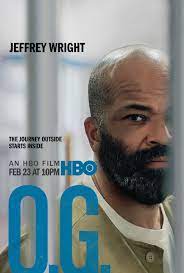
O.G.
US, 2018, 113 minutes, Colour.
Jeffrey Wright, Theothus Carter, William Fichtner, Boyd Holbrook, Mare Winningham, David Patrick Kelly, Yul Vazquez.
Directed by Madeleine Sackler.
O.G. stands for Original Gangsta.
This is a very serious film about prison life. It was filmed on an actual prison and many of the cast are prisoners rather than actors, including The authors Carter who plays Beecher.
However, the focus of attention is Louis, played effectively by Jeffrey Wright. He committed a crime, a murder during a robbery when he was young and has spent 24 years in prison, good conduct, and now promoted for parole. These are the final weeks of his prison sentence and he is trying to keep his record clean.
There are groups in the prison, drug dealing, partisans, the young newcomer, Beecher, tempted to join the gang but taken on by Louis to persuade him not to. Louis gets him job in the car machine department where he works.
There are the expected scenes of prison life, interactions, cells, the yard… There are also scenes with the guards, especially Louis and a sympathetic guard played by William Fichtner.
The film was directed by documentary maker, Madeleine Sackler. She belongs to the Sackler family very much involved in the promotion of OxyContin and the various trials against the family. There are some adverse blog comments about the money for the making of this film from her family and other derogatory remarks about them. (See the documentary, The Crime of the Century, directed by Alex Gibney and All the Beauty and Bloodshed, directed by Laura Poitras.)
Be that as it may, this is a strong documentary portraying American prison life.
- An American prison film? Fiction? Documentary aspects?
- The prison location, cells, offices, dining, the yard, mechanic shop…? The musical score?
- Jeffrey Wright as Louis? 24 years in prison? The effect? The exploration of his character, survival in prison, lessening of his sentence, possibility for parole? His concern about his final weeks? His life in prison, the routines, the discussions with the guards, his work as a mechanic, his friends in the shop? Beecher and his arrival, the gangs in the prison, Louis fighting Beecher, wanting to save him, his explanations? The activities of the gang, drug importation? The authorities and severe interrogation of Louis? Calling him in, strict search? Humiliation? His discussions with Beecher, getting the job? The confrontation in the shop, shouting about the gun, the guards coming in, the falling of the attempt?
- Louis, the recollections about the crime, the robbery, his shooting? The attempt restorative justice, his agreeing, the facilitators in the prison and the meetings? The sister of the victim, his apologies, her not being able to agree to his release?
- The guards, their work, Danvers, friendship, interrogating and threatening Louis, the final farewell? The referral authorities, severe attitudes and interrogations?
- Beecher, crime, in prison, to be with the gang in the prison, the effect of Louis and his intervention?
- Louis, the final weeks, the dreams of freedom, waking again, the final, the clothes, his box, walking free?
