Displaying items by tag: Johnny Flynn
Goodbye June
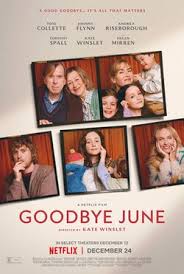
GOODBYE JUNE
UK, 2025, 114 minutes, Colour.
Helen Mirren, Timothy Spall, Kate Winslet, Andrea Riseborough, Johnny Flynn, Toni Collette, Fisayo Akinade, Stephen Merchant.
Directed by Kate Winslet.
A film with an appeal to a wide audience. It is a solid British drama. It has a very strong British cast. And, it is the first film directed by Kate Winslet, based on a screenplay by her son, Joe Anders (his father theatre and film director, Sam Mendes, and in his early 20s writing the film). Family.
Very often people don’t like to use the word death, burying the phrase, passing away, or the euphemism, passed. But here is a film about death and dying and no hesitations.
Over the decades audiences have been in admiration for Helen Mirren and the variety of roles that she has played. Helen Mirren turned 80 in 2025 and here she is playing a terminally ill mother family, collapsing at the opening of the film, rushed to hospital, decisions to stay in hospital for some kind of palliative care before her death. And many moments when we the audience share her physical pain.
The focus is on her three daughters, how they relate to their mother, how they relate to each other, their own families. And, with their mother so close to death, they are very conscious of their disputes but having the opportunity to display them, become more aware of, and, with the quiet intervention of their mother, facing up to the realities of their lives, in the past and the present.
The portrayals of the three sisters are very strong. Kate Winslet herself plays the oldest of the three, the reliable one, talented in her work, supporting others financially, children of her own that she feels she does not seen enough of, her husband away on business. By contrast, the second daughter, played by Andrea Riseborough (and glimpses of Stephen Merchant as a husband) is devoted to her children but, soon seen to be a controller, and heavy resentments towards her older sister.
But there is quite a contrast with the third sister, played by Toni Collette, caught up in New Age meditations and practices, living on the continent, with her classes, strong emotions, but afraid that time is passing her by.
The always reliable Timothy Spall plays June’s husband – an interesting portrait of the loving husband but who finds it hard to express emotions, taking refuge in sitting around and nodding off, after the canteen the pub, challenged by his daughters – and a wonderfully emotional sequence when he does a karaoke song, devoted to June.
And, then there are the grandchildren – it is Christmas time and they are preparing to take part in a Christmas pageant. They perform for their grandmother in hospital, more details of the Gospel story in the play than in many explicitly Christmas films. (And the entertaining line with grandfather playing the innkeeper, replying to Mary and Joseph that there is no room at the inn because “it’s Christmas and were very busy”.)
And back again to June, loving her family, not blind to their failures, finding ways to bring them even closer together (, moving sequences on truth-telling and re-discovering love) – and, a pleasing variation on the title when she leaves her letter to her unborn granddaughter, urging her to live her life to the full. And it is signed, Goodbye June.
- A film about death and dying? Illness? Palliative care and decisions? Family support?
- Using the language of death and dying, not just simply “passing”?
- The work of Kate Winslet, her son writing the screenplay, her direction, her performance and presence?
- The situation, the family, the mother’s illness, treatment, failing, the prospect of dying, soon? The impact on her husband, the past relationship, his coping and not coping? The response of her daughters, the contrasts, the emotion of her son, the grandchildren?
- June, her age, her marriage, for children, her love them? Her understanding them? The nature of her illness, the treatment, her collapse in the kitchen, getting her to the hospital, the surgery, the gathering of the family? Her response? Her knowing her condition?
- The doctors, the surgery, their explanations, Molly and her harsh responses, the doctor clicking his pen at her outburst? The decisions? The couple with the palliative care, June and her plan for her future? Molly’s angry outburst? Julia and her apologies?
- The decision for June to stay in hospital, Molly setting up the roster, not coinciding with Julia? The family and their keeping to the roster, the effect on them all? June, her pain, alleviation, sense of peace, patient with her children, her decision to try to reconcile them?
- Julia, the oldest, her marriage, her children, the Down Syndrome youngest? Her absent husband and his business, connections? The children and the Christmas play, dropping them at school, the arguments in the car? Her work, responsibilities – and later revelation of her paying for mortgages for her parents, for Molly…? Strong in herself, yet often angry? The interchanges with Molly?
- Molly, her appearance, her marriage, the children, the baby, bonding with her children, busy at home, to the hospital, her response to her mother, her harshness in listening to the doctors, to the palliative care team? Her roster? Anger with Julia? Her husband in the background, at home, with the children?
- Connor, living at home, waking, hearing his mother? His age, highly emotional, his response to his mother, to his father, staying at home and caring? Taking his mother to the hospital, his grief, emotions? Relationship with his sisters? His presence?
- Helen, New Age, in Germany, her sessions, her talk, her clientele, the exercises, the phone call, her coming to London, her mother’s comment about her not wearing yellow, the bond with her mother, with the others? The discovery of her pregnancy? Her partner, her later story about his relationships, Gustav and his being available for surrogacy? Helen. her age, emotions, apprehensive?
- Bern, the long marriage, his age, appearance, seemingly distracted, with his wife, at home, leaving the tap running, the flooding of the house? His relationship with his daughters? Seemingly self-preoccupied? Food, the pub, the beer, the football matches and his shouting? Fixing the television?
- Days passing, the roster the visits, the effect on June, health, her pain, the relief?
- The staff, the character of Angeli, his background, his name, his kindness to Helen, their bonding, his discussions with the children? In the interfaith chapel? Connor wandering into the Chapel, returning, with Angeli, the touch of the hand – and at the end of the final party, as a couple?
- June and her wanting to reconcile Julia and Molly, the plan with Angel, summoning them, the hurry, June’s device of getting them tell her right the letter to Helen’s child, straight talking to them? The scene together, the corridor, who first? Molly and her own idolising of Julia in the past, imitating her, Julia leaving when Molly was 13,feeling a sense of loss, betrayal? Envy of Julia and her accomplishments? Getting the Snickers, eating? Julia and a declaration about herself, having to take all the responsibilities? The bonding between the two, decision to cook the Christmas meal together?
- Connor and his exasperation with his father, his father going to the pub, telling his father off, in the pub, Bern choosing Georgia on my mind, substituting Junie, the emotional love for his wife, his son hearing it, their bonding? The house flood, Bern’s denial, different accommodation?
- The decision for the Christmas play, everybody turning up, the focus on Christmas, details of the Christmas play, the Gospel story, the performance, the humour, the joy?
- June, with Bern, her dying?
- The aftermath, the party, everybody together, joy, reconciliation, the toast to June?
- The finale, her letter to Helen’s child, expression of love, touches of immortality, the nice touch with the title, Goodbye June.
Ripley
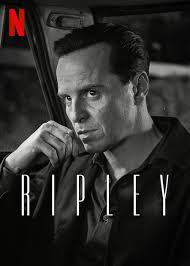
RIPLEY
US, 2023, 8X 56 minutes, black-and-white.
Andrew Scott, Dakota Fanning, Johnny Flynn, Margharita Buy, Kenneth Lonergan, Elliot Sumner, Maurizio Lombardi, Bokeem Woodbine, John Malkovich, Fisher Stevens.
Directed by Stephen Zaillian.
Tom Ripley is the literary creation by crime novel writer, Patricia Highsmith. Over the decades, he has had many incarnations, Alain Delon in the 1960s, Purple Noon, Dennis Hopper in the 1970s, The American Friend, strikingly in 2000, Matt Damon in The Talented Mr Ripley, John Malkovich in Ripley’s game, 2002. (Wikipedia indicates quite a number of other films, especially from the 1950s to the 1970s.)
This time he is played by Irish actor, Andrew Scott, completely convincing. And this time Dicky Greenleaf is played by Johnny Flynn and Marge by Dakota Fanning. There is a strong supporting cast of British, American and, especially, Italian actors.
It is a television series of eight episodes. This gives the screenplay enough time to offer sequences plenty of time to develop, sometimes giving the impression of events happening in real time.
But, one of the key assets for the film is its black-and-white photography, often described by reviewers and bloggers as “pristine” (clean and fresh as if new; spotless). Comments cannot do justice to the clarity of the black-and-white, some of the cities of Italy enhanced by the quality of the photography.
Tom Ripley is a conman. Tom Ripley is also a psychopath, not just a sociopath who can smile and charm but is self-absorbed, but is also criminally insane, and unscrupulous murderer. Every actor who plays Ripley has to be persuasive with charm but yet able to show the in the madness, the unscrupulous narcissism.
Ripley has offered the opportunity to go to Italy by wealthy American businessman, played by playwright Kenneth Lonergan, to persuade his son Dicky to come back to the US. Ripley takes the money, visits Dicky, sees the lifestyle, enviously and vicariously starts to live it, overcoming any suspicions by Dicky, but not by Marge. Which leads them to Ripley is murdering Dicky, covering the murder shrewdly, Tom becoming Dicky in the comfortable life in Rome, then in Venice. And, he is always one step ahead though there are many close calls.
The screenplay for this series has been written by veteran writer-director, Steven Zaillian, celebrated writer of many significant films from Schindler’s List, Gangs of New York, the Irishman.
- The work of Patricia Highsmith? The different versions of her Ripley stories?
- Ripley, a conman, psychopath, his success, an amoral character?
- The previous versions and comparisons? The value of the television series, eight episodes?
- The decision to film in black and white, the striking photography, “pristine”? Of the locations, towns, the beach, Naples, Rome, San Remo, Palermo, Venice? The musical score?
- The pacing with eight episodes, some action in real time, the strong attention to detail for developing the plot?
- The casting, Andrew Scott embodying Ripley?
- The introduction, New York City, the petty conman, his character, seeing him in action, the summons by Herbert Greenleaf, his wife, business interests, the proposal about his son? Ripley being tracked down by the private detective, the conversation? Explanations of Richard Greenleaf, Dickie and his leaving, settling in Italy? Ripley accepting the mission, the money, the travel to Italy?
- The town, Atrani, life there, the coast, Dickie, his age, lifestyle, wealth, relationship with his parents, alienation, dabbling in art? His relationship with Marge? Her writing a book? Her devotion to him? He to her? Is reading the manuscript and giving suggestions, her response? Ambiguous attitudes towards Tom?
- Tom, his arrival, ingratiating himself, his schemes, revelation of the truth about his mission, bonding with Dickie, not with Marge? Freddie and his visit, Tom’s dislike? The invitation to Cortina and its consequences? The lifestyle in the town, Tom, emulating Dickie, caught wearing his clothes and Dickie’s off-hand response?
- Tom writing to Herbert Greenleaf, money issues? The father and his letters, dismissing Tom, urging Dickie to be suspicious? The decision to go to San Remo, hiring the boat, Tom, calm, waiting for the moment, malevolent, killing Dickie, taking his ring, all the effort to come to shore, the body overboard, the rocks on the boat? The later recovery, the police investigations, the reports in the media?
- The details of Tom’s life, in the town, the various characters, learning Italian, the banks? The train rides? The hotels and reception? The feel of Italy in 1961?
- Tom, his skills at evading detection, going back to the town, Dickie’s clothes, typewriter? The smuggler and the previous proposition to smuggle, selling the boat? American Express in Rome? Tom becoming Dickie, his clothes, manner? Settling in Rome, expensive hotels?
- The various letters, the importance of the typewriter and its flawed letter e, Freddy’s visit, Tom and his coping, levels, the plan to kill him, the alcohol, the blood on the floor, taking the body, the elevator and its not working, dragging him down the steps, in the street, the car and his working out which one, holding him up, the witness walking his dog and the later visit to the police? The details of the drive, repeated several times, the via Appia, the taxi drivers, going back to retrieve the passport, his settling back at the apartment? Cleaning the blood? The importance of the landlady, her kindness to him, showing him the apartment, her receiving the police?
- Inspector Ravini, the visits, Tom and his calm during the interviews, the blood on the path? Marge, the visit, his meeting her in the cafe, her telling Ravini and his not believing her?
- The character of Ravini, the interviews, Tom on the edge, Max and his relationship with Freddie, wanting to meet Dickie? The media reports, suspicions on Tom? On the newspaper, the visualising of the articles, the pressure? Then on Dickie? The finding of the boat, the bank fraud and Tom fixing the signatures? The various phone calls from the bankers? Tom cashing the money? Getting the permission to go to Palermo
- The twist, Tom and the media and photos in Palermo, moving hotel? The decision to leave, the false clue about Tunis?
- Tom, in Venice, alive, revealing the visiting, Marge and her visit? The art world and the dealer? Marge intruding? Herbert Greenleaf arriving, the dangers, exposure, the private detective and his arrival, accusing Tom? The further discussions, speculation, the forged letters, the money to the landlady, the ring, the assumption that Dickie had killed himself?
- Tom, the art dealer, the Picasso, getting a new name and passport?
- Marge, publishing the book, the irony of Ravini seeing the photo of the actual Dickie?
One Life
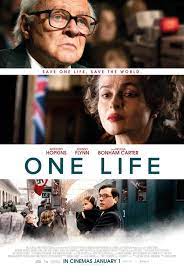
ONE LIFE
UK, 2023, 110 minutes, Colour.
Anthony Hopkins, Johnny Flynn, Helena Bonham Carter, Jonathan Pryce, Lena Olin, Romola Garai, Adrian Rawlins, Marthe Keller, Alex Sharp, Ziggy Heath, Samantha Spiro.
Directed by James Hawes.
There is great symbolism in the name of this film, British Nicholas Winton, one life and what he achieved. There is also the symbolism of anyone saving one life and that being an achievement.
In 2000 there was a popular documentary, narrated by Judi Dench, Oscar-winner for Best Documentary, Into The Arms of Strangers: Stories of the Kindertransport,, documenting a significant rescue of Jewish children from Czechoslovakia in 1938-1939. The children had been stranded, ousted by the Nazis after the occupation of the Sudetenland, many of their parents destined for the camps. A group of British helpers and locals, with the connections of Nicholas Winton, a young banker from London, getting the approval of the rabbi and the authorities, organising British passports for the children, adopting families and a financial deposit, were able to save 669 children on train journeys from prior to London. With the invasion of Poland September 1939, many children ready to move, but the program halted.
There were several other documentaries on Nicholas Winton and the children, especially the trilogy of films All My Loved Ones (1999), Nicholas Winton - The Power of Good (2002), Nicky's Family (2011) by Czechoslovakian (born in Bratislava, Slovakia), Matej Minak.
Here is a drama, rather than a documentary, based on the characters and events. And, as might be expected, the film is a very moving experience.
The framework of the screenplay is the 1980s, the older Nicholas Winton, retired, at home with his wife, expecting a grandchild, clearing the house and destroying some old documents, but finding a significant scrapbook of 1938-1939, photos of the children, newspaper articles, and Winton wanting it to find a significant home. In this he was aided by several authorities but especially by Robert Maxwell’s wife, articles, television programs.
And, of course, the strength of the film is in Anthony Hopkins’ screen presence and performance, Hopkins performing this role in his mid-80s. Veteran Swedish actress, Lena Olin, plays his wife.
Throughout the film there are strong flashbacks to what actually happened in Prague, versatile actor Johnny Flynn plays the younger Nicholas Winton, a concerned Britain, banker, friends in Prague, visiting, wanting to do something, the locals, including Romola Garai as Doreen and Alex Sharp as Trevor, are initially wary but all work together to identify the children, photograph them, list details, arrange with rather severe bureaucrats in London for passports, find adoptive parents, get financial deposits for the trip and the immediate settlement.
Nicholas Winton was helped by his German-born mother, very supportive and determined, especially in confronting authorities, a fine performance by a vigorous Helena Bonham Carter.
Audiences familiar with Nicholas Winton will have seen footage (available on YouTube) of the famous television program, reviewing Nicholas Winton’s life, where the compere asked anyone in the audience who had been helped by Winton to stand up. All those in the studio audience stood. A very moving moment at the time, and now in the film.
One Life is a reminder that there were so many in Europe who shielded and hid Jewish families, many who rescued them, and, as always, lest we forget.
- The story of Nicholas Winton and the rescue of the children from Czechoslovakia? Audience knowledge of Nicholas Winton, the documentaries about him and the transport children?
- A true story, the 1930s, the anticipation of World War II, anti-Semitism, Nazi expansion? The arrest of adult Jews, the children, stranded, their rescue by train? Adoption in England?
- The initial focus on the older Nicholas Winton, as played by Anthony Hopkins, the 1980s, his age, his marriage, children, home, retirement? The insertion of the flashbacks to 1938, Johnny Flynn as the younger Nicholas Winton, his mission and its achievement? The screenplay moving backwards and forwards in time, anchored in Anthony Hopkins’ strong screen presence, and Johnny Flynn’s persuasive performance, determination, hesitation, achievement in the past?
- 1938, Nicholas Winton, his strong-minded mother, German, coming to the UK with her husband, Jewish background? The changing of the name during World War I? A strong influence on her son? His role as a banker, conventionally British, of the time? Yet his concern, his friends in Czechoslovakia? His decision to go to Prague, the encounter with the group, the meeting with Doreen, her scepticism, Trevor, the local members, their concern, social action? The dangers? The imminent German invasion of the Sudetenland?
- Nicholas, his determination, his organisational skills, money and finance, raising donations, contacts in England? Working with the group, the visits of the rabbi, the Rabbi and his scepticism? Persuaded? Nicholas and his meeting the people, especially the children, their conditions, squalid, poverty, the parents, the wary father and then his change, fearing that Nicholas was a German authority? The range of photos, the young girls, their age, the little boys? Later sequences of Winton looking at the photos, wistful, remembering, regretful?
- The return to England, the character’s mother, her understanding, support, going to the officials, the issue of the passports, the hesitation of the bureaucrats? The personal appeal to the bureaucrat, his family, his agreement, supplying the passports?
- The organising of the children, getting all the details, the lists, the files, coordinating the train trips, the passports, organising the adopting families in England, and the financial deposit? The energy of the film in the sequences in showing the urgency, Nicholas and his mother, and those working in Prague, Doreen and Trevor, the locals?
- The scenes of the trains, the children, the farewells and grief, the hopes of the parents, arriving in England, the families, the allotments? Separation of families?
- The news of the invasion of Poland, the stopping of the program, the last train, the guards on the train and their treatment of the children, looking down on the adults accompanying them?
- The war, 669 children saved, the vast number unable to be transported?
- The 1980s, Nicholas and his wife, her fussing, wanting the house cleared, his throwing out rubbish, files, but the folder and the scrapbook, memories of Trevor? His going to visit the authorities, decisions for the scrapbook in museums? His wanting something more active? The connection with Robert Maxwell, going to see Lady Maxwell, her interest, the news items, reporting?
- The television program, Your Life, Nicholas vaguely watching it, his wife not liking the program? His being invited, the tracking down of some of the children and what happened to them in England? The program, his being in the front row, sitting next to one of the children, the reconciliation?
- The re-creation of the famous television program, Nicholas and his wife present, other two children next to him, the praise of his life, and the invitation to anyone in the audience who had a connection with the rescue children to stand up, everybody in the audience rising? The emotion?
- Prague, Doreen and Trevor, the information as to their surviving, subsequent work?
- The title of the film, saving long life, contributing to saving many lives?
