Displaying items by tag: Margaret Qualley
How to Make a Killing
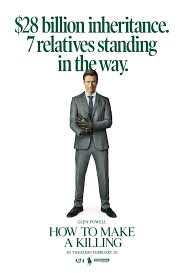
HOW TO MAKE A KILLING
US, 2026, 105 minutes, Colour.
Glen Powell, Margaret Qualey, Jessica Henwick, Bill Camp, Ed Harris, Topher Grace, Zach Wood, Andrew Lukis.
Directed by John Patton Ford.
Quite a slick 21st century American entertainment, the world of wealth, loss of wealth, ambitions, amoral, turning immoral, murder – murders.
And a generally glossy affluent setting, some moderate hardships in New Jersey, the affluent world of New York. And, leading the cast is popular Glen Powell, several starring roles each years since his break out in Maverick, along with Margaret Qualley, an even more frequent screen presence in recent years.
This is a murder drama, a touch of the serious, a touch of the satiric, not intending to be a film for thoughtful reflection on ethical and moral issues – though, there is quite an unexpected twists towards the end which certainly gets the central character thinking.
In the final credits, there is an acknowledgement that this film was inspired by the 1949 British film, Kind Hearts and Coronets, and the novel on which was based. This was a film, certainly, from another era, effective serious/satiric British filmmaking, and the famous tour-de-force performance by Alec Guinness playing all those to be murdered by the ambitious central character.
The origins of How to make a Killing may be of little interest to the 21st-century audience. However, those who remember and appreciated the original have the advantage of knowing what is going to happen. But, they will have the regrets that while there are victims here to be killed, they are played by a varied including Bill Camp, Topher Grace and, ultimately, Ed Harris.
So, the audience is invited to have sympathy for Glen Powell’s ability to bring grinning charm despite his ordinary upbringing even though he discovers he is heir to millions. He is Beckett Redfellow, his pregnant mother disowned by her wealthy father, having to go to work, and Beckett finishing up in a clothing store.
As a boy, he fell for the charms of the rather dominating Julia who grows up to be the dominating Margarette Qualey, false charms, ready to twist any man around her little finger. And she does.
The screenplay, remembering the original, has the whole story told in flashback, Beckett on death row, execution imminent, and the prison chaplain, a serious priest, asking the question and spending the whole film listening to Beckett’s interesting story and his murderous quest for his fortune – including quite the finale and the deathly confrontation with his grandfather.
The unexpected twist towards the end leads the story in a somewhat different direction.
An easy night out kind of entertainment.
- The 21st century American entertainment, ambiguous hero, romantic entanglements, ambition and greed, murders, the law?
- The credit with the note about Kind Hearts and Coronets, 1949, inspiring this film?
- Beckett Redfellow, his story, in death row, execution close, the arrival of the priest, prison chaplain, Beckett telling his story, the priest listening, his interventions, encouraging? The execution time, the prayer?
- The flashbacks to the past, Mary, wealthy family, her dominating father, the attraction, the date, her pregnancy, the birth sequence, the father collapsing and dying? Her father confronting her, denunciation, cutting her off? Bringing up her baby, encouraging him, her hard work, Beckett as an adult, his life, prospects?
- Explaining the issue of money, the family, the family tree, those between him and the fortune?
- His mundane life, accommodation, his job, the clothing store, Julia arriving, the flashbacks to the flirtation in the past, her being dominating, his response? In the store, memories, announcing her engagement? His having to give up his job because of the owner and replacement? Going to the warehouse, working there, the beginning of his plan? The encounter with his uncle, sympathetic, giving him the job, privileges?
- The first victim, playboy, extravagant, wild scenes, on the yacht, Beckett present, the plan, the rope, the anchor, his death?
- The final sequence – and the repetition for each of the victims?
- Noah, music and art, the gallery, the encounter with Beckett, the discussions, friendship, revelations, Noah and his death?
- The FBI, the couple, the interrogations?
- Stephen, money, swindles, religion, his following, his speeches, Beckett pretending to interview him, the boastful interview, the sword, the revelation, Stephen’s many enemies, the contrivance of his death?
- The aunt, the adoptions, her charity, her personality, her teeth, the whitening, her death?
- Julia, her continued appearances, dominating, charm and ruthlessness, her husband, his inefficiency, wealth, losing, her asking for the loan, the various visits to Beckett, seductive and tantalising, the ultimatum? The timing, blackmail, Beckett hurrying to the office, the encounter with Lyle, the confrontation, collapse, the FBI, the accusation, the evidence, the murder?
- Ruth, her relationship with Noah, about to break it, the attraction to Beckett, him to her, her life, working in the garment industry, the outings with Beckett, his falling in love with her, the time together, the proposal, the plan for the engagement, the party, and their fashionable apartment?
- Beckett, prospering, arrogant, wealth, lifestyle, the meetings of the wealthy board, his uncle, his uncle’s collapse and death?
- His grandfather, personality, in the shadows, emerging, inviting Beckett to dinner, his dilemma about his engagement party, his arrival, the vast mansion, the meal, the discussions, the grandfather and his rifle, eating attacking his grandson, Beckett and his defence, firing the arrows, the death of his grandfather? His hurrying back to the party? Ruth and her waiting, her decision to walk out on Beckett?
- The arrest, the irony of his being arrested for a murder he did not commit? Interrogation, the evidence, the trial, being found guilty? Julia, her testimony, talking of Beckett always loving her? Julia with the incriminating photos?
- His finishing his narration for the priest, going to execution, the stay, Julia and her letter assisting him, her visit to the prison, the breakup, his desperation? Her deal, his signing away all his wealth to her?
- The finale, the priest in the bar contemplating what he had heard, Beckett released, Ruth, meeting him, giving him the hair token of his mother which he often looked at, motivation, her driving away? Julia in the parking lot – and future, Beckett subservient to her?
Blue Moon
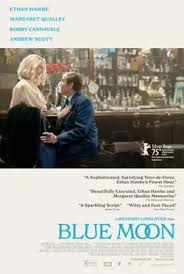
BLUE MOON
US, 2025, 100 minutes, Colour.
Ethan Hawke, Bobby Cannavale, Andrew Scott, Margaret Qualley, Patrick Kennedy, Jonah Lees, Simon Delaney, Cillian Sullivan.
Directed by Richard Linklater.
Blue Moon is probably the most popular song from the writing team, for over twenty-five years, of Richard Rogers and Lorenz Hart. It has a plaintive touch about it. And so does this portrait of Lorenz Hart.
Fans of the old MGM musicals may remember the 1948 Words and Music, a celebration of Rodgers and Hart, some biography but the staging of many of their songs. That is not the case here. This is a serious drama, going to a New York bar over one evening, warts and all portrait of Heart. The diminutive lyricist was played by Mickey Rooney in 1948. Perhaps easy casting. This time Hart is portrayed by Ethan Hawke, with a well-deserved Oscar nomination, the director, Richard Linklater, and camera work diminishing his stature to successfully effect.
The narrative setting is that of the opening in 1944 on Broadway of Rodgers and Hammerstein’s Oklahoma!, Hart replaced by Hammerstein (and the beginning of a very successful writing partnership, South Pacific, Carousel, The King and I, The Sound of Music). And Hart walking out of the opening night.
The Oscar-nominated screenplay by academic, Robert Kaplow, has an overall emphasis on words, The lyricist Hart is articulate, witty, clever, explaining his composing, play on words, internal puns, insight into the lyrics of the thousand songs that he wrote. He complains about the lyrics of Oklahoma (the wheat as high as an elephant’s eye!) But, when Rodgers and Hammerstein arrive, he has earnest conversation with Rodgers, played by Andrew Scott, revealing Hart’s erratic behaviour, the drinking benders and absences, unreliable, living with his mother, his homosexual orientation.
But, prior to the arrival of Rodgers, Hart is in conversation with the bartender, a listening responder, played by Bobby Cannavale. And there is some conversation, relishing words and sentence structures with a visitor who turns out to be E. B. White (author of Charlotte’s Web and Stuart Little). Hart drinks, relishes words, is indulgent in conversation.
And there is a further dramatic focus, how corresponding with the young student, Elizabeth Welland, played by a vivacious Margaret Quallley, who has been corresponding with him, seeing him as a mentor, he becoming more and more infatuated with her. (This part of the screenplay is based on their letters).
In many ways, this is a very sad story, a huge talent, the personal flaws, creativity combined with unreliability – and the pathos that soon after this episode he was to collapse and die.
A very effective behind-the-scenes theatrical drama.
- The title, the popular song, plaintive tone?
- The introduction, Lorenz Hart, in the street, collapse, hospital, his death? His life a wreck?
- A portrait of Hart, audience knowledge of him in his life, career, Rodgers and Hart, 25 years, the Broadway shows, the thousand songs, fame? Hart as a lyricist, Hart as a person?
- The confined action, set, the bar and its interior? The stairs? Eddie the bartender, the presence of E.B. White, the piano player, his military background, Sven the messenger, the waitress, the woman at reception? Atmosphere, music, the playing of Blue Moon?
- The opening night of Oklahoma, Rodgers and Hammerstein, the collaboration with Hammerstein (and indications of work with Stephen Sondheim), Hart walking out, the criticism of the lyrics, elephant high, the number of exclamation marks? His being hurt?
- The emphasis on words and conversation, the love of words, the power of words, Eddie listening and responding, the piano player responding, the conversation with White and the themes, articulate?
- Elizabeth Welland, the correspondence, his infatuation with her, time spent with her, as a mentor, anticipating her arrival, her presence, discussions with Hart, the lengthy private talk, her not loving him “in that way”, her life and relationships? Wanting to meet Rodgers, her mother working for him, going to the party, the effect on Hart?
- And his memories, brother, living with his mother, Richard Rodgers and long friendship, success, his drinking, gay orientation, going on benders, unreliable? Rodgers letting him go?
- Rodgers arriving, his personality, the impact of Oklahoma, and Hammerstein present, the audience response, praise, the critics’ response?
- The conversation between Rodgers and Hart, on the staircase, going back over the past, Rodgers] perspective on the friendship, the collaboration, the unreliability? Inviting him to write more songs for Yankee…?
- Hart and the encounter with Hammerstein?
- The parties, the invitations, the discussions? The crowd, the Mayor of Oklahoma City, atmosphere?
- Hart, finally left with Ed and the staff, Blue Moon?
- The pathos of the end of his life, standing alone, drinking, death?
Honey, Don't
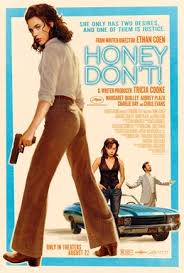
HONEY, DON'T
US, 2025, 89 minutes, Colour.
Margaret Qualley, Aubrey Plaza, Chris Evans, Charlie Day.
Directed by Ethan Coen.
Back in the day, as they say, Hollywood used to churn out brief, B-budget, action melodramas, often as supports to the main feature. One of the words used to describe these shows was “hard-boiled”.
Which comes to mind as we watch Honey, Don’t. It has been co-written by director, Ethan Coen, with his wife, Trisha Cooke. It is a follow-up to their similar hard boiler, Drive Away Dolls – and a third film in this trilogy has been planned. Ethan Coen, with his brother Joel, The Coen Brothers, built up an enormous reputation over 30 years with a great variety of entertaining films. Directing separately now, Joel went on to make his version of Macbeth with Denzel Washington and his wife, Frances McDormand. Ethan, on the other hand, has gone in the direction that was foreshadowed by their very entertaining, Fargo.
Honey of the title is Margaret Qualley (who starred in the previous film). She is a private eye out in the California desert area of Bakersfield. She is tough. She is single-minded. She is tall. She walks with a very self-confident and stylish sashay. She meets her clients, very direct in discussions, investigates. In her private life, she has lesbian relationships, especially with a policewoman played by Aubrey Plaza.
The film opens with a mysterious death, a car accident – not! Of course – a mysterious woman stealing a ring from the body of a dead woman… The dead woman had the day before contacted Honey for an appointment. Honey is now investigating.
There are a lot of eccentric supporting characters around Bakersfield, in the bar, the shops, and Charlie Day at the police headquarters forever trying to chat Honey up and make a date, seemingly oblivious of her reality.
But, some of the leads point to an evangelical church in the town and its pastor, played by Chris Evans. Over the years and with some revelations, some of the pastors have been exposed as double or triple standards in their behaviour, rousing up their congregations with vigorous holy exhortations, making their congregations dependent on them, and, privately, sexual predators. And Chris Evans, formerly Captain America, makes the Rev Drew Devlin, one of the sleaziest of all pastors, with his sermons on the importance of submission and then exercising overmastering with fragile members of the community.
Ethan Coen and Trisha Cooke have written what seems often a slapdash screenplay, and that seems to be something that they intended, memories of the past, small budget, eccentric characters, strange episodes, leaving the impact to the audience the supply some of the connections. For once, the screenplay and the film could have actually been longer – especially for a comeuppance of the Rev Drew Devlin.
Idiosyncratic as we watch, and Margaret Qualley commands the screen.
Substance, The
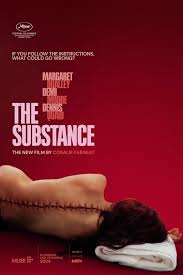
THE SUBSTANCE
US, 2024, 140 minutes, Colour.
Demi Moore, Margaret Qualley, Denis Quaid.
Directed by Coralie Fargeat.
The substance is a serious, challenging drama on some key contemporary issues, winner of the Best Screenplay Award at Cannes, 2024. However, it could also be described as “not for the fainthearted”. The Australian government classification is indicative: R18+ ‘High impact violence, blood and gore’.
The film was written and directed by French filmmaker, Coralie Fargeat (whose previous feature film, 2017s Revenge, which treated similar themes with pervasive blood). This film, in fact, was made in Paris but with American key leads. Coralie Fargeat is an angry filmmaker, standing up and strongly assertive for women, targeting the exploitation of the “male gaze” and women’s treatment by sleazy males, here in the television industry and advertising.
To indicate the serious treatment here, this reviewer immediately started to think about Stevenson’s Dr Jekyll and Mr Hyde, the doctor at home and his experimentation, taking substances, and his public persona, charming but sinister, Mr Hyde. In fact, the director herself has suggested thinking about Oscar Wilde’s The Picture of Dorian Gray, the ugly ageing portrait at home, the seemingly perennial youthful public figure. And, some reviewers also offer helpful cinema and theatre comparisons, the 1966 Seconds, with Rock Hudson, a banker wanting to start his life again with a new identity and a new face. Another suggestion is the story of the ageing and fading star, Norma Desmond, in Sunset Boulevard.
Star of this film is Demi Moore, 40 years after she began her film career – appearing in this film and her being exposed in so many ways seems a courageous choice on her part. She plays a Jane Fonda like television host of aerobic exercises for women, quite a celebrity, a corridor filled with flattering posters… But, she is 50. She is 20 years over the expected age for such a less celebrity. She has to go. She is involved in a car crash – ironically as she stares at her image being torn down from a boulevard billboard.
While the film has a range of male characters, they are presented as leering, stupid, followers, incompetent… And, at the head, is Dennis Quaid as an over-the-top sleazy television producer. Satirical, maybe, but #Me Too exposes and court cases indicate the elements of truth.
This film runs for 140 minutes so the audience has plenty of time to contemplate what is happening, the ageing star taking the substance, the consequences for her inner self to emerge, physically, thirtysomething mentality and appearance, to take her place. The new self, is Sue, played by Margaret Qualey who is appearing in more and more significant roles in recent years. She is the right age for the male gaze, for audience popularity – and she basks in it only to be the agent of her own downfall. Some of the transformation sequences have their harrowing and startling moments, commentators referring to as “body horror”. But, as with Jekyll and Hyde, there has to be a reckoning, Jekyll becoming a monster, Hyde and his exposure.
Which means that the climax of the film has high monstrous elements, physically, psychologically, violently, a climax and a New Year’s Eve television show where everyone is spattered with the blood of the creatures.
Symbolically, the film opens with a popular star on the Hollywood catwalk of Fame , gradually deteriorating and ignored – and, that is where the film ends, a star is born and dies.
- The title, the focus, anonymous name, powerful substance program, consequences?
- The work of the director, angry, targeting the male gaze, portraying ridiculous men, sleazy men? Presenting ambitious women? Glamorous women? Issue of ageing? Public response, television audiences?
- The plausibility of the plot, the history of bodily enhancements? Consequences, glamorous appearance, ageing, artificiality? Surgeons – but, here, self-and administered procedures? The strict instructions, no deviation?
- Demi Moore and her career, parallels with her character? No holding back in her performance? Margaret Qualey, young, glamour, success, ambition, ruthlessness, self-centredness?
- The opening, the Hollywood star, preparing, success, age, people ignoring it, walking over it? Spilling the food? And the return to the star at the end, Elizabeth Sparkle and her face and the prosthetics, disappearing?
- Elizabeth Sparkle, her story, the parallel with the Jane Fonda row pick programs? At 50, appearance, age, her team, her slogans, the corridor, her portraits? Her being fired, interactions with Harvey? His associates? His sleazy interventions? The impact, the billboard, taking her down, the car crash, no injuries, the assistant, his insinuations, the address on her coat?
- Elizabeth and her moral stance, 50, her career, vanity, pride, her home in luxury, the big poster? Her angers, the quest for her successor? The maid, cleaning, boning the agency, the number, going, the backyard, stooping to go in, her locker, material, taking it home, the audience seeing the implications? Her decision to go ahead?
- The Dr Jekyll and Mr Hyde theme? The director and her reference to the Picture of Dorian Grey? 21st-century versions, female versions? The same issues?
- The drama of the transformation, the frank presentation of the bodies, naked, vulnerable, the emergence of Sue? The seven days for each of them to live, the transfer and’s? The rules? No deviation?
- Sue, going to the studio, with Harvey, the two men and the auditions and their male gaze, criticisms of the women are auditioning, the response to Sue? Harvey and his excitement, the executives? The program, the rehearsals, the exercises, her style, the supporting cast, her looking at the audience? Success? Provision to be absent for a week to care for her mother? Harvey and his enthusiasm? The success of the program? The risks, deviating, the consequences for Elizabeth and her finger?
- The success of weeks for each of the characters, Elizabeth collapsing, in the house, the gift of the French cookbook and the recipes, watching television, her anger with Sue? Going to collect the supplies? The discussions with the anonymous voice? Sue, success, summoned to Harvey, her fears, the offer of hosting the New Year’s Eve show?
- Sue, her life, the men, sex, Oliver across the way? The consequences for her, drinking, the deviations?
- Elizabeth, her anger, the temptation to stop the program, her motivation for not going through that, her change of mind, part of the process, stopping?
- Sue, the New Year’s Eve, the dress, Harvey and the executives? The style of the show? The previous incident with a lump in her buttock, drawing it out? The restroom, her teeth, the body degenerating, in the corridor, smiling without opening her mouth? Her fleeing, going home, the confrontation with Elizabeth, the injections, the viciousness of the fight, Elizabeth and her age, monstrosity? Her being bashed?
- The transformation in Sue, the prosthetics, the ugliness, the faces, Elizabeth and Sue, going to the studio, Elizabeth mask, the audience reaction, the revelation, the consequences, the crowds, the men denouncing her as monster, the violence, the vast spattering of blood?
- The fact that the two women wore one, depending on each other, the final collapse, Elizabeth and her face, on the Hollywood star, disappearing? And the cleaners coming over it?
- The description of the film as a horror film, as body horror, the classic allusions, the two aspects of the one personality, the public charm, the private monstrosity?
Kinds of Kindness
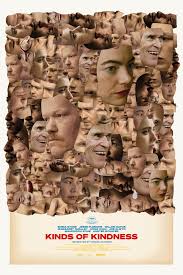
KINDS OF KINDNESS
US, 2024, 164 minutes, Colour.
Emma Stone, Jesse Plemons, William Dafoe, Margaret Qualley, Hong Chau, Joe Alwyn, Mamoudou Athie.
Directed by Yorgos Lanthimos.
Writer-directors, Yorgos Lanthimos, would probably agree that his perspective on life, especially in his earliest films, was “warped”. And, with Poor Things and Kinds of Kindness, that his sense of humour was also “warped”. His kinds of kindness are not exactly kind. Something more like “destructive kindnesses”.
This is a film containing three films linked by themes and linked by the actors. It is a cinematic triptych. Each panel of a triptych to be seen by itself, but also with its links to the other panels, combining for an overall view. And this seems to be what the director wants here, three stories, and a linking theme. Overall, it is a theme of coercive power. And that coercive power means extreme manipulation of victims, tyrannical domination mixed with power complacency, physical and mental cruelty and violence. But, with his warped sense of humour, the director also offers wry satire.
The contribution of a core cast enhances the impact of the drama/humour. Emma Stone has proven herself with two Oscars, appearing in the director’s The Favourite and winning her second Oscar for Poor Things. She shines as the principal character in the third story, a story of a pseudo-messianic cult, she has a divinity in search of a religious figure who has the power to raise people to life. The power of the cult dominates her and her companion in the search.
Jesse Plemons (in 2023 Killers of the Flower Moon, Civil War) won the Best Actor award at the 2024 Cannes film Festival. He shines in the first of the stories, a primly rather straightlaced yes-man to a controller who can only be described as wicked (Willem Dafoe who also appears in the three stories). In a moment of moral questioning, his morale collapses, made to feel even more dependent than before, commanded to kill someone. By contrast in the second film, he plays a police officer is anthropologist wife disappears, reappears, his moral and mental collapse as he determines that she is a double. And this part of the triptych also introduces the theme of cannibalism.
Each story shows the versatility of the characters and the talent of the rest of the cast, Dafoe, Margaret Qualley with four roles including twins, Hong Chau, Joe Alwyn and Mamoudou Athie.
So, after watching the three stories, the three panels of the triptych, the audience is left quite disturbed, moments of black humour, moments of horror, moments of disgust, some grim perspectives on the shallowness, the malice, the cruelty of human nature.
- The work of the director, perspectives, offbeat? Greek background? International career and outreach?
- The title, the tone, the issues? Irony, satire, absurdity? Black and bleak perspective?
- The film as a triptych, the one film, the three parts interconnecting: coercive power, manipulation and submission, aberrant behaviour, sex and violence, violent deaths?
- The work of the cast, in each story, different, appearance, accent, behaviour…?
- The first story: the focus on Robert, exact, controlled, look and clothes, diet, relationship with his wife,+? The encounters with Raymond, his personality, appearance, speaking, controlling, with Vivian as his companion, the meetings with Robert, the international business, the order to kill the victim, Robert’s failures, change of heart, anguish, changing eating habits, going to Raymond, rebuked and rejected by Raymond, the past encounters, sexual? The gifts of the sporting trophies, the gift of the racquet, Robert and his wife, valuing the trophies? The disappearance of the is one? The buyers and the possibilities of selling the trophies, the bargaining? Robert and his encounter with Rita, organising the date, her being in hospital, his discoveries at seeing Raymond, her being controlled, failing with the killing? His change of heart, going back to Raymond, and the vicious running over the victim? And his contentment in the threesome?
- The second story: Daniel, policeman, good service, friendship with Neil, the discussions, the meal, Neil and Martha, memories of Liz, the issue of the video, their watching, the shock of the group sex? Daniel, Liz surviving, the other members of the expedition dead? Hospital? His erratic behaviour, police work, the shooting of the passenger, licking the blood, being suspended? Neil trying to help? At home, the interactions with Liz, her behaviour, different? With her father, narrating the dream, dogs living as humans? Going to please Daniel, his withdrawing, not eating, asking her to cut off her finger, her cooking it, his giving it to the dog? Her frustration, his demanding the liver, her cutting it out? The alternate Liz, arriving, his embracing her??
- Third story: the background of the cult, the members, garb, the enclosure, the rituals? The leadership of Omi and his wife? Manner, style? Emily and Andrew, members of the cult? Emily and her control, going to the morgue, choosing the girl as able to raise the dead, the attendant, the corpse, her attempt a raise the dead, her desperation, rejected? Emily and Andrew, their travelling together, a speedy and reckless driving, the mission, searching for the special person who can raise the dead? Emily, her visits to her daughter, leaving the presence? The encounters with her husband, her daughter? The invitation to the meal, the drugs and headroom, his rape, her being rejected by the cult? Her growing desperation, the instructions by Omi and his wife? Her dream, drowning, the rescue? Rebecca, coming to the diner, the explanations? Emily, her decisions, pretending to have the dog, wounding it, Ruth as the vet, kindly? The next encounter, bugging Ruth, Rebecca satisfied, killing herself, going to the morgue, the dead body, Ruth – and the raising to life? Andrew and Emily reinstated?
- The mid-credits final sequence, the irony of the dead man raised to life, after being killed by Robert, raised by Ruth, and eating the sandwich and spilling the ketchup? Final ironies?
Drive-away Dolls
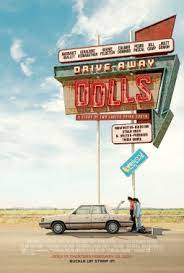
DRIVE-AWAY DOLLS
US, 2024, 84 minutes, Colour.
Margarette Qualey, Geraldine Viswanathan, Beanie Feldstein, Joey Slotnick, C.J.Wilson, Colman Domingo, Pedro Pascal, Bill Camp, Matt Damon.
Directed by Ethan Coen.
This is the first film made by Ethan Coen without his brother, all. Joel Coen had also worked by himself with his version of Macbeth, starring Denzel Washington and his wife, Frances McDormand.
The Coen Brothers have always made films which can be described as offbeat, comic, rye, ironic, with particular perceptions and observations on American society.
This film could be described as a caper, with violence, especially with its opening and a cameo by Pedro Pascal nervously in a diner, clutching a case, confronting the owner, pursued, decapitated and the case stolen. This certainly offers an ironic tone. And the setting is 1999.
The film then changes tone quite completely, sex and sexuality, lesbian sex, frank, explicit, descriptions, language, and this continuing throughout.
There are two central characters, Jamie, Margaret Qualley, vivacious, from Texas, exuberantly extrovert (but many criticising her broad Texas accent as unreal, over the top), in a relationship with a policewoman, Suki, Beanie Feldstein. We are also introduced to a rather prim Marian, Geraldine Viswanathan, working in her office, her co-worker flirting but she looking severe, correcting his vocabulary. She is later seen reading Henry James the Europeans throughout the film. Jamie and Suki breaking up, a point of contention a small dog who will reappear throughout the film.
Marian has decided to travel to Tallahassee and Jamie decides to travel with her, going to driveaway company with the manager, Bill Camp (and a joke about his name, Curly and their being forward in addressing him but this only having just met him), then thugs turn up for the car which is transporting the case seen at the beginning of the film as Well Is the head of the victim. So, caper, and pursuit. The two thugs, in their characters, in their interactions and behaviour, the moments of violence, one smooth talking and explaining his tactics, reminiscent of the two thugs in Fargo.
And their Chief is played by Colman Domingo, answering to a boss on the phone. On the way, the girls see a poster of a politician wanting re-election, Conservative, values-stances, and he is played by Matt Damon.
Jamie decides that Marian is too buttoned up, takes her to various lesbian sex clubs, encounters with a lesbian sports team, Jamie intruding with a partner into a hotel room, later Marian going for a lonely walk and accosted by the police, having to spend a night in jail.
The two thugs are tracking down the women, misled by the lesbian sports team to go to a remote African-American club, chatting to an old man, finding that have been taken in – and the thugs continuing with the squabbling.
When the girls’car breaks down, they find what is in the boot of the car – not only the head, but the mysterious case contains models of various replica dildoes (Jamie trying one out). Jamie also phoned Suki with some information but is not believed, but finally Suki deciding to come down to Tallahassee.
There are some flashbacks which explain Marian’s sexual orientation, watching a nude bathing neighbour, making a peep hole in the fence…
When the girls are abducted, tied up, interrogated by the Chief, there are some absurd: twists on the plot, one of the thugs going berserk and shooting his partner and the Chief, the girls escaping. They then decide to get $1 million from the political candidate whose replica they have. They confront Matt Damon, then he decides to attack them, masked, but Suki is on the spot, shootout.
Marian finishes reading the Europeans. They have made copies of the candidates dildo, and the desire to go to Massachusetts, this is 1999, where same-sex marriages are available. Happy ending.
Many audiences will turn up to see a Coen film. It may be put off by the initial violence and decapitation. Others might be put off by the lesbian sequences and their explicitness. So, the film is for the broadminded, perhaps a bit more broadmindedly than usual.
Sanctuary/ 2022

SANCTUARY
US, 2022, 95 minutes, Colour.
Margaret Crowley, Christopher Abbott.
Directed by Zach Ziglom.
This is a psychodrama. It could also serve as a dramatic illustration of a psychosexual situation. It is a two-hander and practically all of the action takes place in a hotel room – some moments outside the room in the corridor and an opening elevator. The invitation for the audience is to observe, possibly identify with one or other of the characters, reflect on the interactions, the interdependency, the future of the characters.
The film opens with the young business executive, Hal played by Christopher Abbott, with a business-looking blonde young woman, Rebecca, entering and going through the details of a legal contract with him. But, Hal begins to object to the questions – and it emerges that he wrote the whole scenario and dialogue himself. The two are in a role-play, created by Hal, performed, ever more independently, by Rebecca.
What we are shown is a dominatrix situation, Rebecca employed by Hal who feels he has been belittled, underestimated by his successful father (seen in a photograph with his son). The issue is Hal’s inadequacy as a person, and the connection of this inadequacy with his sexuality. Interestingly, in terms of understanding himself, it is Hal who writes the various scenarios, seeming to have some insight into himself but then very dependent on Rebecca’s responses. She humiliates him, his having to clean the floor, self-deprecation, sexual experiences.
As the film progresses, Rebecca seems to assert more independence from Hal and the scenarios, walking out, tantalising him that there was video of all their activities and his consequent smashing of the room to find the camera. Rebecca attempts to leave, Hal bringing her back. And Rebecca assert herself once more, discussing the contract, wanting Hal to invest his salary in her, and the suggestion arising that instead of Hal, Rebecca could be the CEO with Hal remaining at home in support.
Since this is a psychodrama, all options are open however practical, pragmatic or non-pragmatic they might be in reality. And the final question, the final image, what is the real relationship between Hal and Rebecca.
Which means that this psychosexual exploration may have limited interest and appeal, especially because of the claustrophobic confinement.
- A psychodrama? Psychosexual issues? Domination? The screenplay film as a case study?
- Audience response to this kind of psychodrama, observing, identifying, questioning, reflecting?
- The claustrophobic effect of the drama, in the one hotel suite, main room, bathroom? Going out to the corridor, the open elevator? The musical score?
- The introduction to Hal, his age, appearance, the photo with his father, his father the entrepreneur? The arrival of Rebecca, her appearance, blonde wig, stern, her papers, contracts? Initial audience response to each of them? Changing throughout the film?
- The reality of the situation, Rebecca and the lines, going through the scenario, Hal and his reactions, the fact that he had written the scenarios? The previous relationship, the contract, her role as a dominatrix, his role as the client, his having some kind of control through writing the scenes?
- The drama of the interactions, Rebecca and her control, the lines, criticism from Hal, her improvising, the discussions? The humiliation, stripping, cleaning the floor? The sexual encounter and her tantalising him, controlling him? The video, his searching for a, smashing the room, electrocution, the sexual effect? Sanctuary as the safe word"
- Hal, his relationship with his father, his father’s treatment of him, humiliating him, his mother, preparing to go to the function with her?
- Rebecca, the interactions, the control, her leaving, Hal coming to the elevated to get her back, twice?
- The development of the scenario, Hal and his suggestions, Rebecca in control? The issue of her payment, the money, the discussion of his salary, giving it to her, the possibility of selling his shares in buying back the company, Rebecca and her place in the company, becoming the CEO, his becoming the equivalent of the wife at home?
- The revelation of Rebecca’s strengths, of Hal’s weaknesses, the finale and the relationship between them, the kissing, the future?
