Displaying items by tag: Paul Mescal
Hamnet
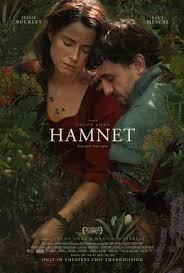
HAMNET
UK, 2025, 125 minutes, Colour.
Jessie Buckley, Paul Mescal, Emily Watson, Joe Alwyn, David Wilmot, Jacobi Jupe, Noah Jupe, Olivia Lynes.
Directed by Chloe Zhao.
Hamnet, or Hamlet, the name of Shakespeare’s son, the title of, perhaps, his most famous play.
In fact, we know very little about Shakespeare’s private life. He was from Stratford-on-Avon, he married Anne Hathaway, had an older daughter, Susanna, and twins, one of whom was Hamnet who died of the plague, very young.
What we have in this film, most arrestingly, a Shakespeare’s story from the imagination Northern Ireland’s novelist, Maggie O’Farrell, her 2020 novel. Oscar-winning director for Nomadland, Chloehao, worked with the novelist on the screenplay, presenting a more straightforward telling of the story, especially of Shakespeare’s wife, here called Agnes.
Agnes is a child of nature, a wild child, said to be connected with witches, knowing the seasons, cultivating fruits and able to make potions. And, she is played by Jessie Buckley, one of her many and varied excellent performances (and Jessie Buckley is also Irish, as is Paul Mescal who plays Shakespeare, quietly restrained). Will Shakespeare teaches at the local school, encounters Agnes, is caught up in the magic of her personality and they marry.
This is story has her staying in Stratford, giving birth to her children, sometimes with great stress, loving her husband but knowing that he has a creative talent, likes to write in his room, gives her asent that he should go to London and develop his work in the theatre. (It is only later in the film that Agnes and the audience eventually come to London.)
Agnes delights in her children, especially the twins, and the likeable and lively Hamnet (attractively played by Jacob Jupe. Hamnet is devoted to his father, practices swordfights, the children doing a rendition of the opening speech of Macbeth’s witches.
But, the plague, and Hamnet willing to take the place of his sick sister, the sadness of his death, Shakespeare’s absence, his being away eventually take its toll on Agnes’s emotions.
The major part of the film stays in Stratford, the green wildness of the forests, the glimpse of the Tudor streets and houses and church spire. But, when Agnes does go to London, sees the crowds coming into the Globe theatre, pushes her way to the stage, and the performance of Hamlet begins, this becomes most moving.
For this reviewer, this last part of the film is one of the most deeply memorable in cinema, Agnes watching as the play unfolds, the theme of death, absence, ghosts, the rejection of Ophelia and the emotions, the final confrontation with Laertes and… the rest is silence. Shakespeare himself, playing the ghost, watches Agnes’s response from the wings of the stage, one of the best dramatisations of what catharsis actually means, Agnes, slowly, surprised, coming to terms with all that has happened to her, some kind of purification of her emotions – and a strong reminder that the audience, involved i the n a play, responding to a tragedy, experiences their own dramatic catharsis.
Hamnet has won a number of awards, Best film, and many well-deserved awards for acting for Jessie Buckley.
- The focus on hand, explanation of the name, Shakespeare’s son, Shakespeare’s play?
- An imagination of Agnes and will Shakespeare and their children, family life, Shakespeare as a playwright, life and work in London? Not history?
- The Stratford settings, the opening with the forest, the trees, the grounds, the locks, holes, the sense of nature? The house, interiors, dimly lit? The town square and the church spire? The atmosphere of 16th-17th century Stratford? The contrast with London, the dark, the streets, the river, the globe theatre, exteriors and interiors? The atmospheric score and final song?
- The focus of Agnes, with the Eagle, swooping on the landing on her wrist, her background, her mother and which, of wild child, the sense of nature, this by her father, alienated from her stepmother? Living in the woods?
- Will, the scene in the classroom, the repetition, his encounter with Agnes, the attraction, for both, the story of Orpheus and you registry, the courting, the opinions of the family, his parents? Bartholomew? The sexual encounter, Agnes and Mary, the questions? The marriage ceremony?
- Jessie Buckley’s presence and performance as a this? Intense? In the forest, her communications, the background of witchery? Her pregnancy, giving birth in the woods, the difficulties, her daughter? Will’s response?
- Passing, will and his room, his writing, parchment, his imagination? Like Agnes? The new pregnancy? Will in London? The difficulty of birth, the size of the twin child, the dead child, Agnes’s response? Her power and its revival? Will’s arrival, his joy?
- Will, dissatisfied, wanting more in life, the decision to go to London? Is in support, his absences, the children, beginnings of alienation? His returns? The children growing up – and the sequence of their playing the role of the witches at the opening of Macbeth?
- Judith, the older daughter, her place in the household, Hamlet and his sister, the change of clothes, interchangeable? Hamlet and his lover’s father, the sword fighting sequence?
- Will, in London, his writings, the growing reputation, this is not the focus of the film?
- The Shadow play of the pestilence, Judas and his illness, Hamlet is generosity, willing to take her place, his illness, suffering, death, the pain for the family? Agnes and her grief? Mary and her support? Will and his return, Agnes upset, the blame? The discussions between the two, the new house, the biggest in Stratford, some compensation, and is in the upstairs room and her memories?
- The religious beliefs, the question background, the church visit? Yet Agnes and her nature believes? Special powers?
- Agnes and his stepmother, the poster for Hamlet? Her being upset? The continued support of Bartholomew?
- The decision to go to London with her brother, arriving, the bewilderment of the city, the globe theatre, the facade, the crowds coming in, the crowds inside,ne, those on the balconies?
- Will, his group in London, to be or not to be, the rivers edge? The glimpses of the rehearsal, the actor, Hamlet’s attitude towards year, will watching, making repetition, the intensity of his feelings of love and rejection?
- The play, and his bewildered, the crowds, the opening, the ghost, the beginning of suggestions for linking Hamlet, his illness, his death, afterlife, with the details of the play? The ghost and his speeches, afterlife, the condemnations, his brother and his wife, the fighting with Laertes, the speeches, everybody becoming more involved, the Queen’s death, the death of the king, and to the front of the stage, in Bloom blonde rather than in dark clothes, looking to the audience, the hands or reaching out, Agnes and the touch, the experience of the catharsis, from the plane, from her inner feelings, some kind of healing and understanding?
- Will, the part of the ghost, the speeches, the intensity of the meaning, his looking at Agnes?
- The glimpse of Hamlet at the end, the bond between will and Agnes, the impact of his son and death, the play and part is a meaning of catharsis of healing?
History of Sound, The
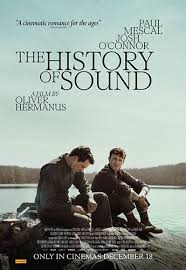
THE HISTORY OF SOUND
US, 2025, 128 minutes, Colour.
Paul Mescal, Josh O'Connor, Chris Cooper, Leo Cocovinis, Raphael Sbarge, Molly Price, Tom Nellis, Emma Canning.
Directed by Oliver Hermanus.
This film opens with the camera gliding down a beautiful river, a voice-over describing love for music, explaining how different notes are visualised as colours. The voice is that of Lionel, a young boy absorbed by sound and music, listening to his Kentucky farmer father playing the fiddle and singing local ballads. The title seems to indicate that this will be a documentary – and, by the end, the audience has documented the collecting and recording on wax cylinders of so many of the traditional ballads. However, The History of Sound is an intense personal drama.
In 1916, Lionel Gaines a scholarship in music to travel to Boston. In a pub, he encounters a young man singing a ballad at the piano, David, who then invites Lionel to sing. Lionel is played by Paul Mescal, frequently on screen in recent times from Gladiator II to playing Shakespeare in Hamnet. David is played by Josh O’Connor, also frequently on screen, the Mastermind, Wake Up Dead Man. They are both at their best, quite intense. Their common interest in songs, their friendship, turns into a love, which will have both fulfilment and devastation for each of them.
This is quite a long film, a great number of lingering sequences, the cameras staying on faces, the countryside, long periods for the background musical score. (And, surprisingly, the author, Ben Shattuck, has adapted his own short story for the screenplay.)
Action in World War I intervenes, David going to war, Lionel staying behind. But, on David’s return, the two go on their travels to Maine, visiting villages, visiting families, camping out, encountering all kinds of people who have treasured the ballads from the past, and their being encouraged to record their songs. And, so, as in different countries, as here in Maine, the heritage and history of music and song is captured and preserved.
The latter part of the film focuses on Lionel rather than David. Lionel travels, is part of a choir in Rome, decides to move to Oxford, begins a relationship with a wealthy young woman, breaks it as he returns to Kentucky at the death of his mother. He will later go to England and visit the Lake District.
And then, plot development that we have not anticipated, its emotional effect on Lionel which seems to be destructive.
And, The History of Sound might have ended there – but there is an epilogue, featuring Chris Cooper, indicating that whatever the tragedies there are in life, there are possibilities for overcoming them, for making good, for achievement, for purpose in life and contributing to the betterment of the world.
- The title and expectations? Sound, recordings, the colour of sound?
- The period, 1910-1980, Kentucky and its landscapes, the farm, the Homestead? Boston, music school? The travel through the countryside of Maine? Oxford? Rome? The Lake districts? The range of scenery and beauty?
- The music, the background score, the range of songs, balance, all throughout the film? The impact of the songs?
- Lionel, the voice-over, his explanations of sound and colour, particular notes and colours, the scenery of the river during his explanations? His age, at home, his father and the fiddle, songs, his mother? The Kentucky background?
- His scholarship, to Boston, 1916, hearing David sing, discussion, the people in the pub, the quiet, final scene, David accompanying, the impact? The love of music? The attraction, going home, the sexual attraction and experience? David in listing, going to the war, Lionel remaining in Boston?
- The end of the war, David and his experiences, silence about them? His story of his uncle, the travels to England, collecting the songs, the house in Newport? The invitation to Lionel to go on the travels?
- The two, the rugged countryside, camping out, the range of people, the recording equipment, the wax, the explanations, the children holding their throats and experiencing the vibrations of sound? The range of the tour and the experiences? And the bond between the two, love and sexuality?
- The return, David and his disappearance? While and his return home, his mother? The family, the grandfather?
- Lionel, of music, possibilities, memories of David, and Italy, the choir in Rome, his success? The encounter with the young man, the invitation to Venice, his decision to move on? Going to Oxford, success? The encounter with Clarissa, the attraction, sexual, going to visit her parents, the mansion, the relationship? Lionel wandering the house, the paintings and the explanation, the wealth, the piano, lying on the floor, memories of David?
- The news of his mother’s illness, the confrontation with Clarissa, her reaction, his leaving, the return home, his cleaning the house, the death of his mother? Working, the encounter with a couple, the friendship from school days, there sitting?
- His decision to go to Boston, looking for David, looking for the cylinders, the encounter with the teacher, the news of David to death longs since? The reason for no reply to his letters? The story of David’s marriage? Seeking out the wife, the encounter with her husband, mother and baby, and not sending any letter to him, returning the letters? Her explanations, David in Newport, knowing him from the girl, the marriage, his moods, the British marriage, his killing himself?
- The impact on Lionel, the decision to travel to Lake districts, getting lost, meeting a couple, the music?
- The end of the story – then the epilogue, 1980, Lionel in his 70s, his life, success, his book, the radio interview, his explanations of himself? His life, achievement, love of music? The arrival of the box, the container, the cylinders after so many decades, 60 years? Listening to music, listening to the words of David? The final meaning to his life?
Gladiator II
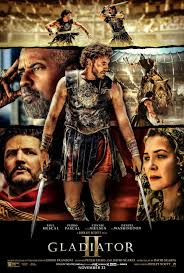
GLADIATOR II
US, 2024, 148 minutes, Colour.
Paul Mescal, Denzel Washington, Pedro Pascal, Connie Neilson, Joseph Quinn, Fred Hechinger, Lior Raz, Derek Jacobi, Matt Lucas, Tim McInerny.
Directed by Ridley Scott.
While sequels are often welcomed by an audience, they also often find it difficult to maintain the standard of the original film. Which is the case here. Gladiator won the Oscar for Best Picture in 2000 as well as an Oscar for Russell Crowe in his role as the strong Roman warrior, Maximus. She is one was a triumph for prolific director, Ridley Scott.
It was something of a surprise when plans were made over 20 years later for this sequel. The focus is on the son of Maximus who died in the first film, his son with Lucilla, the daughter of Marcus Aurelius. He is Lucius, played by Paul Mescal, seen first quietly living in North Africa, the Romans attacking under the leadership of General Acacius, Pedro Pascal, the North Africans defeated, taken to Rome, sold as slaves, many commandeered as gladiators.
Audiences will see the parallel scenario with the original film, the provinces, Roman warfare, prisoners, slavery, the Colosseum, gladiators, harsh life, brutality in the arena, political intrigue.
As with the original film, Gladiator II looks quite spectacular, special effects, naval battle sequences, extraordinary fights in the Colosseum especially against monstrous effect monster monkeys, and the recreation of a battle sequence in the Colosseum. Many of these scenes are very violent, and some of them exceedingly brutal in the impact. Sometimes we might wonder, as we watch the brutality of the fights and audience excitement that we are very much like these vicious Romans and their control of human life with thumbs down.
As with the Emperor, Commodus in the original film, there are two rather despicable emperors this time, the twins Geta and Caracalla (Joseph Quinn and Fred Hechinger) as symbols of the decline of the Roman Empire. Returning from the original film is Connie Neilson as Lucilla, daughter of Marcus Aurelius, mother of Lucius, recognising him, trying to make contact, eventually sacrificing herself for him. She is also in a relationship with General Acacius. One of the difficulties for the impact of the drama is that while Paul Mescal is exceedingly serious and single-minded as Lucius, he is not charismatically engaging for the audience a little in here and charm, while Pedro Pascal as Acacius does have leadership charism.
But, the big difference for this drama is the presence of Denzel Washington as the former slave with political and power ambitions, based on an actual character, Macrinus, a master in buying slaves, controlling the gladiators, with entree to the Emperor’s, deals with corrupt senators, waiting for his power grab moments, unscrupulous with his violence, even with the Emperors.
Given the limitations, the repetitions in parallels with the original, and the single-minded sternness of Paul Mescal as Lucius, audiences who enjoy Roman epics, will enjoy Gladiator II as well.
- The impact of the original film? Its legacy? So many years for a sequel? The continuity? The scenario of the first parallel scenario of the sequel?
- The work of Ridley Scott, epics? And audience response?
- The settings, North Africa, the city, the battles, the Navy, the Roman conquest? The road to Rome? The entry? The Colosseum, the quarters for the gladiators? The animals? The use of the Colosseum, fights, naval battles? The royal palace? Homes? The market for gladiators? The musical score?
- The links with the original, the mentions of Maximus, the flashbacks and the appearance of Russell Crowe? Connie Neilson as Lucilla, her relationship with Maximus, with, discovering with Lucius? Derek Jacoby as the senator?
- Africa, Lucius and his life there, relationship with his wife, warrior, silent about his identity, the local authorities, the attack of the Romans, the details of the battles, strategies, defeat? Imprisonment? The death of his wife, seeing her pass into the next life, grief?
- The prisoners going to Rome, the entrance to the city, the legions and the triumphant entry, general Acacius, his relationship to Lucilla, his tribute to the Senate, their suspicions, their wanting him to go on further conquests? His own response, with Lucilla, his significance in the revolt against Rome, his legions at Ostia, the sending of the message, his being trapped, sparing Lucius, his own death? Lucilla’s grief?
- The role of Macrinus, dented Washington’s presence, slave, freed, ambitions for the Senate, ruling Rome? The auctions of slaves, seeing Lucy is in action, his talents, strength, perseverance, purchase? His master of slaves and the treatment of the slaves? The training, the accommodation in the below the Colosseum? The fight in the Colosseum, the monstrous monkeys and battles, UCS and his survival? The response of the crowds, the emperors, thumbs up?
- The personality of Lucy is, silent about his identity, his anonymity in Africa, his relationship, the defeat, the death of his wife? With the other slaves? With the master of slaves, his being tested? With Macrinus? With Lucilla, her visit, his identity, his resistance? His eventually changing, the encounter with Acacius, the fight in the arena, spared, acacias death?
- The background of the emperors, their status, twins, effete life, games, the court, the worms? The attitude of the Senators? Acacius? Macrinus and his setting them up, the death of Geta?
- Arrow colour, wilfulness, childish, nominating his monkey as senator?
- Lucius, behind-the-scenes, the ex gladiator, observing, supportive Lucius, his sending him to Ostia to bring the troops?
- The buildup, the taking of Lucilla, in the arena, her death, the many troops converging on Lucius?
- The troops arrival, Macrinus and his control, his deals with the senators, the corrupt senator, the gambling, the meeting of the senators, Gracchus and the past, and government, decline? The death of Gracchus?
- The troops arriving, Lucius and his a leadership, the confrontation with Macrinus? And the future?
All of Us Strangers

ALL OF US STRANGERS
UK, 2023, 105 minutes, Colour.
Andrew Scott, Paul Mescal, Jamie Bell, Claire Foy.
Directed by Andrew Haigh.
With strangers in the title, and referring to everyone, strangers to one another, strangers in our relationships, this is a very melancholy title.
The screenplay, based on a novel by Japanese author, Taichi Yamada, was written by Andrew Haigh who has had a successful career writing and directing screenplays which probe same-sex relationships, Weekend, Looking. He also wrote and directed the insightful film about an aged married couple, 45 Years.
Irish actor, Andrew Scott, has had a substantial career since he was very young, Moriarty to Benedict Cumberbatch as detective in the series, Sherlock, C in the James Bond film, Spectre, and as a comic priest in Phoebe Waller’s comedy series, Fleabag. This is one of his best and most moving performances.
He plays Adam, in his 40s, alone, lonely, a gay man who has had not had an emotional relationship. He is a screenwriter, probing his own history in his writing. Scott makes Adam someone whom we respond to with care, concern about his loneliness, occupying a room in a huge new high-rise apartment block in London, but the other flats still empty. He encounters Harry, Paul Mescal (Normal People, Aftersun, Foe, Gladiator 2) at his door, Harry drinking, suggestive, but Adam closing the door on him.
But we know that Harry will persevere, something will develop between the two.
While watching the film, the key word that emerges in our consciousness is “empathy”. Adam is such a pleasing and sympathetic character who invites our empathetic attitude towards him, for him as a person, for him as a lonely man, for him as a man with a homosexual orientation. And the theme that the film explores is what is “being in love” for Adam.
This is a question is posed to him by his mother. And the appearance of Adam’s father and mother takes us into a different realm in the storytelling. They have been dead for 30 years, sadly killed in a car crash when Adam was 12. But, as he looks at the box of photos from the past, he has an overwhelming desire to visit the house again, takes the train, walks the street, encounters his parents, goes into the house, sits down and talks with them. They are played very effectively (and we remember Billy Elliot and The Crown) by Jamie Bell and Claire Foy.
So happy is Adam in his parents and rediscovering them, that he goes back, encountering his mother alone, she innocently asking about his girlfriend, he telling her about his orientation, her being rather bewildered, not knowing how to talk with her son. In his next visit, he encounters his father has been told by his wife about Adam and mentions that she needs to rearrange a few things in her mind. What follows is a powerful discussion about Adam and his experiences as a young boy, bullied at school, his father realising the orientation and the question between them of why his father never spoke to him about the issues and why he never spoke to his father.
These revisits to his parents have a disturbing effect on Adam, waking disturbed, Harry there as support for him. The line between fantasy and reality is disappearing.
These ghostly themes continue with some farewells, and a very sad ending.
In these years of discussion about same-sex relationships, talk about blessings of same-sex unions, this is an empathetic film for a wide audience.
- The title? Melancholy? Relationships?
- The London setting, the block of flats, high, empty, the interiors, the corridors, the lifts? The musical score?
- Adam’s story? The performance by Andrew Scott, empathy? His age, screenwriting, exploring his past, living alone, lack of relationships? Hearing the alarm, going outside, looking up, seeing Harry? Harry and his visit, the talk, Adam shutting the door? Harry’s later return, his story, father, alienated, his mother? Adam inviting him in, the talk, the touch of tension, Harry relaxed, the drink, discussion about the difference between gay and queer, the physical attraction, the sexual encounter, the aftermath?
- Adam and his writing, seeing the photos of the past, the audience learning that his parents had died in a car crash, black ice, father instantly, mother later, losing an eye? The house, his desire to visit the house?
- Adam and his physical condition, health? The screenplay showing him to visit the house, the encounter with his parents, the return visits, his waking up? The line between reality and dream? Sometimes overlapping? At home and sleeping and waking, Harry reassuring him? Waking up on the train, but this being part of dreams? Seeing Harry in the underground, following him, alone on the train?
- And these scenarios as possibility for his screenwriting, exploring and understanding his past?
- Going home, comfortable, his parents at the age they died, their welcoming him, the characteristics, father being jovial, mother loving her son and being fussy? His happiness in meeting them again? The decision to return, the visit with his mother, her asking about girlfriends, getting him something to eat, his revealing his orientation to her, her not understanding, her being uncomfortable? The visit to his father, his father reassuring him that his mother had told him, that she just had to rearrange some things in her mind, Adam telling his father the things were different, his telling about equality, marriage, less prejudice, but sometimes this rising as it did in the past? His father and his understanding, memories of Adam at school, Adam talking about the bullying, calling him girl, the boys and girls both critical? His father saying he was aware of this? Adam asking why he didn’t come into to talk with him? His father asking why Adam didn’t tell his father?
- The final visit, the outing with his parents, the restaurant and the waitress, the family meal? But his parents not eating, a more ghostly presence, telling him that had to leave, and wanting them to stay, even to visit them once a year? The question about whether the death was instant, his mother not seeing well, but Adam reassuring them they died quickly? And then disappearing?
- Adam returning home, going to Harry’s apartment, finding Harry dead? Harry outside, knowing that his body was in the other room? Adam reassuring him, settling him down, urging him to go to see his mother?
- Reality and fantasy, ghostly presences?
- And Adam, his illness, live in dying, his memories in coming to terms with his life, in love with Harry (and his mother asking him this explicitly,?
- An empathetic film for gay audiences? An empathetic and invitational film for wide audiences?
Foe
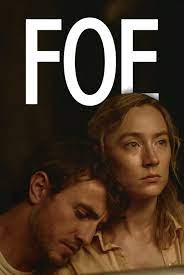
FOE
Australia, 2023, 110 minutes, Colour.
Saoirse Ronan, Paul Mescal, Aaron Pierre.
Directed by Garth Davis.
From a novel by Iain Reid who collaborated with the director on the screenplay. It is a slow-burn drama, (some bloggers complaining that the fire took a long time even to kindle). However, for those who enjoy intriguing dramas, elements of the unknown, the probing of relationships, there is much to commend a careful watching of Foe.
Foe has a global theme, the continued destruction of planet Earth, ambitious moves towards settlements on other planets, preparations for work on space stations. It is 2065, frighteningly close to the present, the continuing barrenness of the planet and it should be so close. There are sequences of devastated countryside (filmed in Queensland, Victoria, South Australia). However, as with global filmmaking these days, the setting for the story is the midwest of the US (and with an Australian director, Garth Davis (Lion, Mary Magdalen) two Irish leads, and a British lead).
While it is important to focus on the futuristic, science-fiction aspects of the scenario, in many ways, they are quite secondary, simply offering the opportunity for the main theme, the exploration of a marriage. We see a couple who have been married for seven years, he on the property and in the house owned by his family for centuries, working in a large chicken processing plant, she working as a local waitress in a diner. Saoirse Ronan is Hen. Paul Mescal is Junior. The marriage is not always easy, Hen wondering about the affection of her husband, dreaming of something better. Junior seems to be satisfied where he is. Quite a lot of scenes between the two leads dramatising the tensions, ups and downs of the marriage. No children.
Then the science enters in the form of a government agent, Terrance, played by Aaron Pierre, very British in his delivery. The government has investigated the couple, wants Junior to spend a year on a space station, a sign of the future. He lets the couple ponder this for a year, then returning, the plan to go into action, and the proposal, definitely science-fiction here with artificial intelligence, robotics, and plans to create exact replicas, physical, mental, emotional, some company for Hen during her husband’s absence.
While the initial part of the film has been a probing of the marriage, this intensifies with Terrance’s presence, interrogations, tests, trying to understand each of the characters, the relationship, so that the substitute will be a proper companion.
While there is scientific success, there are some emotional complications, building up to quite a dramatic conclusion, surprising dramatics, and the final solution which we may have been anticipating.
There is very little futuristic technology seen in the film, that being kept to the very end. Rather, this is a psychological study of two people in a futuristic setting and challenge. And a slow-burn.
(Recently, with the same time sitting, a more elaborate conflict between humans and AI creations was seen in The Creator.)
1. Title? Enemies? Marriage? Interaction between Hen and Junior? Terrance as a foe?
2. Science-fiction? Earth and its destruction? Survivors? Quality of life? Space travel, space stations, a future?
3. Artificial intelligence, robotics, clones, the creation of perfect copies, physical, emotional, mental?
4. 2065, not so long into the future? The possibilities of Earth degradation? The possibilities of technological development?
- The settings, filmed in Australia, the American midwest, barren plains, vast open spaces, no rain, poor crops, the Homestead from the past, the elaborate chicken factory, the diner? The musical score?
- The picture of the marriage, seven years, Hen in the shower, voice-over, pondering Junior’s love for her or not? His being rooted in the area, pride, family? Her work in the diner? His work in the chicken factory? Life at home, his storing everything, the piano, her love of playing, Junior not wanting her to play? The change, playing, consistent – then destroying the piano?
- The arrival of Terrance, the car, isolated area, the government, his proposal, their reactions? His building up the possibilities? His return after a year?
- The process, interviews with Junior, Terrance getting to know every aspect of his life, the scenes of interrogation, the physical tests, psychological tests, emotional tests? The effect on Jr? The effect on? Criticisms, observations, becoming more involved? Terrance and the intrusion into their lives, talk, drinking, the attraction?
- The scenes of ordinary life, the chicken factory, the diner? The episode of Junior out in the fields, the flying saucers, his being injected, his returning to the house, the confrontation?
- The twist in the plot, the government preparing the complete replicant, the confrontation between the two, the humanity of the replicant, Junior returning from the space station, detached? The effect on Hen, the companionship with the replicant?
- Terrance, the crew, technology, observations, the scene of their toasting their success?
- The replicant, his humanity, the pathos of his last moments, the death, the corpse?
- The aftermath of the marriage, Hen and her comments about leaving the envelope, the blank page inside? Her explaining her ambitions to do more, Terrance and his sympathy?
- Hen, her disappearance, Jr by himself, the reappearance, more formal, learning, the indication that she did not have all of Hen’s knowledge, Junior accepting her as companion?
- Hen, in the plane, the pass comments about air travel, her leaving behind her replicant, going on a personal quest?
Carmen/ 2022
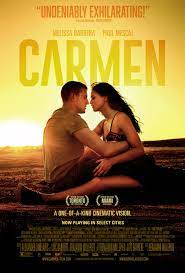
CARMEN
France/Australia/US, 2022, 116 minutes, Colour.
Melissa Barrera, Paul Mescal, Rossy de Palmer, Elsa Pataki, Benedict Hardie, Tara Morice.
Directed by Benjamin Millepied.
This interpretation of the Carmen story, based on Prosper Merimee’s 1845 novel with influences by Pushkin’s story, The Gypsy, rather than be says Opera, will be an acquired taste. With the French born choreographer, Benjamin Millepied, now working in the US, directing his first feature film after music videos, a huge emphasis in this version is dance.
Yet, one could describe the visual style and the staging of particular scenes as “operatic”, stylised, set pieces, larger than life. And, yet, many of the sequences are presented with a sense of “realism”. But, interspersed are touches of magic realism, ghostly appearances, scenes of fire, memories. The Internet Movie Database offers a summary: Benjamin Millepied's complete reimagining of CARMEN tells a story through an experimental dreamscape featuring an original score and songs. Yes, an experimental dreamscape.
And dance. This is a story of a young dancer, Carmen, Mexican, her flamenco-dancing mother, menaced by a young boy from the cartels shooting her. Her mother has urged her to go to Los Angeles, to find her friend, managing a nightclub there, Massilda. But, she has to get through the border, a dreary desert outpost, staffed by former soldiers to ward off migrants, violently. One of the soldiers is Aidan, a retired Marine, relying on his sister, with some friends, a boxer, but depressed in being stranded on the border.
As regards the drama, touches of melodrama, there is shooting at the border, Aidan defending some of the refugees, helping Carmen, driving away. They helped on the road by friendly taxi driver whose name is Angel. And another dancer friend drives them to Los Angeles. Which means than a lot of the film takes place within the nightclub, quite a range of dance which should exhilarate audiences who have come for the dancing. Aidan hangs out but feels the police will be after Carmen and himself and wants to move on. He gets an opportunity for getting some money from a friend who sponsors bareknuckle fighting – which provides something of a climax for the film, but presented, as is some of the other dancing, with ballet style, but this crowd excited by the violence, a stomping dance sequence.
Melissa Barrera (In the Heights, Scream) is a dramatic Carmen. Paul Mescal (Normal People, After some) blends passive moments with active moments. But, a star for Pedro Almodovar for many decades, Rossy de Palms, draws audience attention more than the star-crossed lovers. She is a powerful presence even when not singing or dancing. Elsa Pataki has a good role as the assistant at the nightclub. Carmen was filmed in Australia in 2021, the Broken Hill area for the desert sequences, some drab Sydney locations for the nightclub and the boxing. And many Australian actors, including Tara Morice, and dancers in the cast.
There are several songs, a great deal of choral chant throughout (incorporating some of the Bizet lyrics), but the strong impact is of the musical score itself, by Nicholas Brittell, powerful at times, the score seeming to drive on the action and the drama.
Some audiences have been enraptured, others alienated, and all stops in between.
1. The original novel, Bizet’s Opera, the many adaptations, films of the Opera, Carmen Jones in the 1950s? This new interpretation?
2. The work of the director, his reputation as a choreographer, his first feature film, his experience in music videos? Collaboration with the screenplay? The introduction of music, songs, their range, the choral background, the driving musical score? His interaction of dance, the range of dance, flamenco, modern dance, ballet, stomping dance…? The insertion of songs and dance into the screenplay and narrative?
3. The adaptation of the original story, the role of Carmen, the touch of the femme fatale, the soldier, love, danger?
4. The realistic, surrealistic settings, the desert (Australia standing in for Mexico), the drab border situation, the visuals, Los Angeles, the streets, the nightclub, the bareknuckle fighting? The comment on the experimental dreamscape? The move from realism to the surreal, to touches of magic realism, the importance of fire, the sparks, the ordinary slit, the burning globe…? Ghostly appearances?
5. Carmen, her relationship with her mother, her mother dancing, the little boy, shooting her, the Mexican cartels, the danger for Carmen, going to the border, the encounter with Aiden, the crossing of the border, the military patrol, the shootings, Aidan helping her, the truck, the taxi and Angel driving, his support, the dancer and his driving, arriving in Los Angeles, the goal of the meeting Masilda? The club, her being given refuge, Aiden with her, the bond with Michelle, memories of her mother, in the club, Gabriele, the dances? Carmen and the relationship with Aiden? The dancing? The need for escape, farewelling Must still do, going to the boxing, the pursuit, Aiden shot, the surrealism of the final dance between the two? Her future?
6. Aiden, Marine background, his service, the effect, with the others at the border, the patrol, their attitudes, his injured friend, reliance on his sister, life on the border, the patrols, attitude towards the refugees, the violence and the shooting? His helping Carmen, the escape, the taxi, the drive to Los Angeles, finding the nightclub, must still do welcoming him, his observing Carmen at the nightclub, the sexual encounter, his fear for the police pursuing, needing money, going to his friend, the arrangement for the bareknuckle fighting, his taking Carmen, the fight and its brutality, getting the money, the police arriving, the chase, the shooting, his being wounded, with Carmen, the symbolism of the final dance?
7. Miss older, her friendship with Carmen’s mother, the nightclub, her appearance, command, singing, dance? Support of Carmen? The farewell?
8. The people at the nightclub, Gabriel, the dances, the rooms of the club, the dance area, the theatrical area, performance?
9. Audience response in terms of the drama and melodrama, in terms of the dreamscape, the experimental style of the film, the musical score, the songs, the range of dancing?
