Displaying items by tag: Richard Linklater
Blue Moon
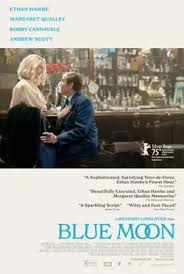
BLUE MOON
US, 2025, 100 minutes, Colour.
Ethan Hawke, Bobby Cannavale, Andrew Scott, Margaret Qualley, Patrick Kennedy, Jonah Lees, Simon Delaney, Cillian Sullivan.
Directed by Richard Linklater.
Blue Moon is probably the most popular song from the writing team, for over twenty-five years, of Richard Rogers and Lorenz Hart. It has a plaintive touch about it. And so does this portrait of Lorenz Hart.
Fans of the old MGM musicals may remember the 1948 Words and Music, a celebration of Rodgers and Hart, some biography but the staging of many of their songs. That is not the case here. This is a serious drama, going to a New York bar over one evening, warts and all portrait of Heart. The diminutive lyricist was played by Mickey Rooney in 1948. Perhaps easy casting. This time Hart is portrayed by Ethan Hawke, with a well-deserved Oscar nomination, the director, Richard Linklater, and camera work diminishing his stature to successfully effect.
The narrative setting is that of the opening in 1944 on Broadway of Rodgers and Hammerstein’s Oklahoma!, Hart replaced by Hammerstein (and the beginning of a very successful writing partnership, South Pacific, Carousel, The King and I, The Sound of Music). And Hart walking out of the opening night.
The Oscar-nominated screenplay by academic, Robert Kaplow, has an overall emphasis on words, The lyricist Hart is articulate, witty, clever, explaining his composing, play on words, internal puns, insight into the lyrics of the thousand songs that he wrote. He complains about the lyrics of Oklahoma (the wheat as high as an elephant’s eye!) But, when Rodgers and Hammerstein arrive, he has earnest conversation with Rodgers, played by Andrew Scott, revealing Hart’s erratic behaviour, the drinking benders and absences, unreliable, living with his mother, his homosexual orientation.
But, prior to the arrival of Rodgers, Hart is in conversation with the bartender, a listening responder, played by Bobby Cannavale. And there is some conversation, relishing words and sentence structures with a visitor who turns out to be E. B. White (author of Charlotte’s Web and Stuart Little). Hart drinks, relishes words, is indulgent in conversation.
And there is a further dramatic focus, how corresponding with the young student, Elizabeth Welland, played by a vivacious Margaret Quallley, who has been corresponding with him, seeing him as a mentor, he becoming more and more infatuated with her. (This part of the screenplay is based on their letters).
In many ways, this is a very sad story, a huge talent, the personal flaws, creativity combined with unreliability – and the pathos that soon after this episode he was to collapse and die.
A very effective behind-the-scenes theatrical drama.
- The title, the popular song, plaintive tone?
- The introduction, Lorenz Hart, in the street, collapse, hospital, his death? His life a wreck?
- A portrait of Hart, audience knowledge of him in his life, career, Rodgers and Hart, 25 years, the Broadway shows, the thousand songs, fame? Hart as a lyricist, Hart as a person?
- The confined action, set, the bar and its interior? The stairs? Eddie the bartender, the presence of E.B. White, the piano player, his military background, Sven the messenger, the waitress, the woman at reception? Atmosphere, music, the playing of Blue Moon?
- The opening night of Oklahoma, Rodgers and Hammerstein, the collaboration with Hammerstein (and indications of work with Stephen Sondheim), Hart walking out, the criticism of the lyrics, elephant high, the number of exclamation marks? His being hurt?
- The emphasis on words and conversation, the love of words, the power of words, Eddie listening and responding, the piano player responding, the conversation with White and the themes, articulate?
- Elizabeth Welland, the correspondence, his infatuation with her, time spent with her, as a mentor, anticipating her arrival, her presence, discussions with Hart, the lengthy private talk, her not loving him “in that way”, her life and relationships? Wanting to meet Rodgers, her mother working for him, going to the party, the effect on Hart?
- And his memories, brother, living with his mother, Richard Rodgers and long friendship, success, his drinking, gay orientation, going on benders, unreliable? Rodgers letting him go?
- Rodgers arriving, his personality, the impact of Oklahoma, and Hammerstein present, the audience response, praise, the critics’ response?
- The conversation between Rodgers and Hart, on the staircase, going back over the past, Rodgers] perspective on the friendship, the collaboration, the unreliability? Inviting him to write more songs for Yankee…?
- Hart and the encounter with Hammerstein?
- The parties, the invitations, the discussions? The crowd, the Mayor of Oklahoma City, atmosphere?
- Hart, finally left with Ed and the staff, Blue Moon?
- The pathos of the end of his life, standing alone, drinking, death?
Nouvelle Vague
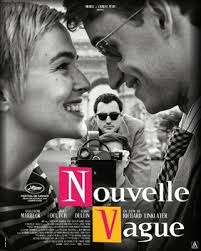
NOUVELLE VAGUE
France/US, 2025, 106 minutes, Black-and-white.
Guillaume Marbeck, Zoe Deutch, Aubry Dullin, Adrien Rouyard, Antoine Besson, Bruno Dreyfyrst, Benjamin Clery.
Directed by Richard Linklater.
1959. A quiet1950s was about to end. The revolutions of the 1960s were about to begin.
It was an outstanding period for French cinema. France already had at the first public cinema screenings, then a great tradition of directors, writers, performers. But, in the mid-50s, a group of young cineastes contributed to the magazine, Cahiers du Cinema. They knew film. They loved analysing film in all its aspects. They became noted critics. But, many of them had a great yen to get behind the camera, not only to write, but to direct. They were symbolic of the New Wave, the Nouvelle Vague.
In many ways, this is their initial story. The screenplay highlights three names, François Truffaut, Claude Chabrol and, the subject of this film, Jean-Luc Godard. Truffaut is seen having a great triumph at the Cannes Festival with The 400 Blows. Claude Chabrol was beginning a long career especially with crime thrillers. And, Godard was edgy, dissatisfied with not having directed, all kinds of ideas but lacking the means to put them into action.
This is the story of the key production in Paris in 1959 which was released under the title A Bout de Souffle, best known from its English title, Breathless.
American director, Richard Linklater, obviously has a passionate admiration for the French New Wave. Right throughout the film, well known and not so well-known cinema figures are named when they appear on screen, celebrated directors like Robert Bresson and Eric Rohmer, stars like Juliette Greco, cinematographer, Raoul Coutard. And, where possible he has employed lookalike actors for the central characters. He has chosen actors cannily resembling Truffaut, Chabrol and Godard, dark glasses and cigarettes. And, for the star of the film, Jean-Paul Belmondo, almost exact replica in Aubry Dullin. The other star of the film was the American, Jean Seberg, and Zoe Deutch certainly brings Seberg to life and a marvellous resemblance.
Godard is a driven creator, great faith in himself, easily able to disregard the pressures of the producer, the feelings of his stars, inventive in his camera style, wanting spontaneity, not writing screenplays in advance, capitalising on the moment. He is presented as something of an egotistic genius – and, Breathless and his subsequent career show that he was not entirely wrong! (Godard died in 2021, at the age of 91, 138 directing credits, certain writing credits – a career of six decades.)
This film also offers a marvellous opportunity to observe the process of filmmaking, the role of the writer and director, the choices by cinematographer and collaboration with the creative artists and his camera/cameras. We appreciate the location photography, stunt work, the many takes, the pressures on the cast, issues of make up, black-and-white photography, and the moods and whims of Godard as a decides to film, take a break, suddenly end filming for the day…
While the film shows a genial Belmondo and his collaboration with Godard, the portrait of Jean Seeberg is more complex, at the beginning her career, her success with St Joan and clashes with Otto Preminger, her coming to France, reacting to the situation, some immediate alienation from Godard’s ideas and processes, but sticking with it. (Recently Kristin Stewart starred as the actress in Seberg; however that portrait film begins after the completion of Breathless and tracks FBI interest in her life and career and political implications.)
Probably Nouvelle Vague has limited interests for the general public – but it is an opportunity for those who love cinema, for those aspiring to work in cinema, for those who remember the films from the era to have a film experience worth relishing.
- The title and expectations, audience knowledge of the Nouvelle Vague, French cinema, 1950s, Cahiers du Cinema, critical background, intellectual background, cinema technical background?
- Richard Linklater making this French film? The French screenwriters, his American perspective, admiration for the Nouvelle Vague?
- The decision for black-and-white photography, the parallels with the cinematography for Breathless? The audience sharing the experience of cinematography, 1959?
- The significant characters in this period, the directors, Truffaut, Chabrol, Godard? The choice of actors who physically resemble them? The range of other characters, their names coming up on screen to identify them? Directors, Robert Bresson at work, actors, producers, cinematographers, agents…? A sense of documentary realism along with this creative fiction?
- 1959, François Truffaut and the success of The 400 Blows at Cannes? His influence, friendship with Godard, Godard going to Cannes for the event? Chabrol and his thrillers? Eric Rohmer and other directors?
- The focus on Godard, his previous career, age, wanting to direct, his theories, his philosophies, wanting spontaneity, activity, with cameras, with the cinematographer, hand-held, concealed, moving in the streets, the cast? The producers – and his clashes?
- The choice of the topic, influence of Truffaut, Jean-Paul Belmondo, the actor physically resenting him, the choice of Jean Seberg and the actor resembling her?
- Jean Seberg, her career, St Joan, Preminger, husband, manager, come to Paris, the encounters with God guard, finding him difficult, the interactions, the style of filming, wanting spontaneity, no screenplay? Seberg, American, personality, film star, in Paris, with the press?
- The scenes of shooting the film, Godard erratic, time of, early closure, days off, his moods. discussing the ideas, Belmondo and his collaboration? The discussions with Raoul Coutard and his expertise as cinematographer, blending with Godard? Close-ups, dialogue, the kisses, the action in the street, the gangster sequences…?
- The effect on Godard, the touch of narcissism, perfectionism, spontaneity, ideas, relentless, clashes with the producer?
- Ultimately completing the film, Belmondo’s long run through the fields, prospects, the new style? The impact of the final sequence and the close-up?
- The final information, the careers of Truffaut and Chabrol, Belmondo and his success, Seberg and her career, the importance of Breathless and its influence on filmmaking, Godard himself and a 60 year career?
Hit Man/ 2023
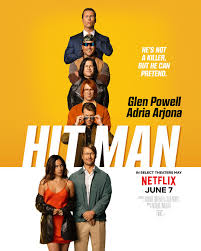
HIT MAN
US, 2023, 115 minutes, Colour.
Glen Powell, Adria Arjona, Austin Amelio, Retta, Sanjay Rao, Molly Bernard, Evan Holtzman.
Directed by Richard Linklater.
With a direct title like Hit Man, we know what to expect. And, the expected happens, but, of course, with some differences.
This is a film by prolific filmmaker for more than 30 years, Richard Linklater, based in Austin, Texas usually, though this time in New Orleans. Linklater was able to explore relationships with his Before Trilogy, trace the development of a child to adolescence over 12 years in Childhood, and is always able to blend comedy with seriousness.
This time, in collaboration with his star, Glen Powell (emerging into prominence with Top Gun Maverick, Anything But You, Twisters), he has gone for offbeat comedy.
Powell is playing a character based on a real-life person (though Linklater emphasises that they have added the murders which didn’t happen in real life!). Gary teaches at the University, an academic who enjoys his work. However, he is also employed by the local police with their work in profiling as well as entrapment of a range of citizens who are searching to employ a hitman. He is open to change his persona, quite inventively, and an enjoyable collage of characters, men and women, old and young, rich and poor, make rendezvous meetings to hire him. Then the collage of them all being arrested, astounded, in prison.
But, this kind of story needs a femme fatale. She arrives in the form of Andrea Arjona, wanting to get rid of her obnoxious husband. Gary is in the character of Ron, tough, reliable hitman, but, he falls for her. Fans of crime writers may be on the alert, especially for film buffs, and though the work of James M.Cain and Raymond Chandler. Chandler adapted Cain’s novel, Double Indemnity, 1944, an archetypal story of the victim of the femme fatale.
This is all interestingly and entertainingly played out, scenes with the aggressive and jealous husband, a colleague of Gary who is not above some blackmail, some very pleasant police officers with integrity, and, then the death of the husband. Whodunnit?
Because of the complications when the wife he is the news of her husband’s death, when Gary has to unmask his hitman facade, will it be a happy ending?
That doesn’t happen in this kind of thing – but, spoiler alert, some unanticipated, surprising happy ever after!
- The title? Expectations?
- The New Orleans setting? Homes, police precincts, college? Clubs, the streets? The musical score?
- The screenplay based on actual characters and events – but the screenplay adding the killings? Stability of the plot, the professor, schools in undercover work, consequences?
- Gary, in class, the students, themes and studies? Is private life? His connection with the police? The set-ups, his skill in reading characters, the arrests?
- The squad, setting up criminals, the variety of settings, the variety of characters, the collage of interviews, Gary and the various characters, the discussions, the entrapment? The consequences?
- The squad, there were, confidence in Gary? Jasper, blowing his cover? Calling in Gary, setting up the character of Ron? Diffidence, his success, the performances, the affirmation? Jasper and his surliness?
- The situation with Madison, his character, Ron, the meeting, listening to her, falling for her, her story? Giving her advice? The relationship? His cover? Do with her husband, the issue of divorce, his manic aggression, hatred for Madison?
- The irony of his contacting Gary for a killer against Madison? The revelation? Jasper and his encounter, something of the situation, action, blackmail?
- Madison falling in love with Ron, reaction to his being Gary? The death of her husband, Gary and his suspicions? The squad, the pressure on Gary to trap Madison? His going to the house, his double game, indicating answers for her, her getting away?
- The epilogue, their being together, getting away with murder?
- The blend of the serious and comic?
