Displaying items by tag: Peter Malone's Movie Reviews
Fil, Le/ The Thread
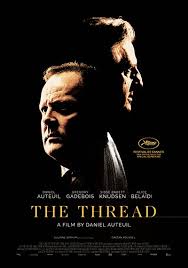
LE FIL/ THE THREAD
France, 2024, 115 minutes, Colour.
Daniel Auteuil, Gregory Gadebois, Sidse Babett Knudsen, Alice Belaide, Gaetan Roussel, Florence Janas.
Directed by Daniel Auteuil.
The Thread is a courtroom drama, French style. It is very much a film by Daniel Auteuil, the celebrated French actor for many decades, who has written, produced, directed and acted in the central role of the defence lawyer, Maitre Jean Monier.
The film is based on an actual place, and a memoir by the lawyer defending. A woman has been killed, an alcoholic, wife and mother, suspicion on her husband, who is seen at home with the children, devoted, preparing their meals, a kind man, suddenly arrested, the main plausible suspect in the murder.
Jean is separated from his lawyer wife but works in collaboration with her, discussing his meeting with the accused, his belief in his innocence, the intensity of his commitment to defending the accused. The proceedings become something of a crusade for Jean.
While there are many similarities to court cases dramatised in English-language films, there are differences, a bench, judges presiding, the way testimony of witnesses is handled, the behaviour of the prosecution as well as the defence – and the interventions of the judge.
Courtroom dramas do tend to be interesting, the audience invited to be members of the public in the court but also to take on some of the attitudes of the jury, sympathy or not for the accused, the credibility of the witnesses, one or other of them in this case losing their temper in the stand. How much evidence is circumstantial? The reliability of witnesses? Beyond reasonable doubt?
The focus of the case is the accused going to see his friend at the local bar, their discussions, the possibility for committing the murder and burying the body.
Which means then that there is the double interest throughout the film, the proceeding of the case, sympathy for the accused, something of a laid-back performance from Gregory Gadebois, a large man, quiet, seemingly bewildered by what is happening to him.
And, the case proceeds, verdicts, and intervention by the judge. And, probably, the film’s audience winding down, everything clear and settled – but, it is not, and the final part of the film has quite some dramatic impact, a highly emotional and moral challenge.
- Based on a true story? The memoir of the lawyer? The title, the focus on the thread, evidence?
- 21st-century murder case, the episodes in 2017, the family situation, the arrest of Nicolas, the meal with his children, his being held for three years? The flashbacks to his going to the bar, the discussions with Roger, the discussions with Roger’s wife? The reconstruction of the situation, Nicolas’s wife and her alcoholism, absence, on the city bench? The car, the witnesses about the car, the man who saw the three figures, his interpretation? The finding of the body?
- Jean, his reputation as a lawyer, losing a case, prosecutor, his wife and the relationship, her work? His going to the station, the meeting with Nicolas, the discussions, the questions? The impact on him, his decision to take the case? Convinced of Nicolas’ innocence? The preparation for the case, the evidence, after three years and Nicolas consistent?
- Nicolas, scene with his children, the meal, his arrest, in prison, the three years, meek, listening, attitude towards Jean, gratitude towards him? Receiving respect from Jean?
- The French legal process, the Judge, the bench, the jurors? The interrogations, the witnesses? The technical witnesses about the wounds, the body? The witnesses observing the scene, the young woman, the driver and his angry reactions, rebuked by the judge? Roger’s wife and her testimony?
- The character Roger, the flashbacks, his attitude towards Nicolas’s wife, urging him to get rid of her? His death, not able to testify?
- The questions, the skill of the prosecutor, the defence, the interventions of the judge? The final speeches? The seeming guilt, no other possibilities for murderer? The decision of the jury, the juror explaining to Jean the influence of the judge for the decision?
- Nicolas, his resigned reaction, 20 years, keeping the children, the background discussions of their mother, the tensions, prospects for divorce, her death?
- The effect on Jean, years passing, summoned to Nicolas – and audience response to the revelation about his sexual behaviour, his wife’s knowledge, the threats, divorce and her making manifest the truth, killing her?
Bolero/ 2024
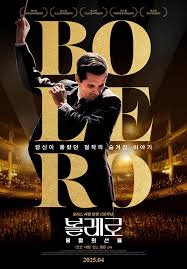
BOLERO
France/Belgium, 2024, 120 minutes, Colour.
Raphael Personnaz, Doria Tillier, Jeanne Balibar, Emmanuelle Devos, Vincent Perez.
Directed by Anne Fontaine.
As soon as the first notes, the first few bars, are heard, so many listeners will instantly identify the beginning of Bolero. It was composed in 1928 for a 17 minute ballet, almost 100 years now of popularity. And many will be able to identify the composer as Ravel Though they may not remember that his first name was Maurice.
Here is a fine cinema experience to learn something about Maurice Ravel, a portrait of him as a person but also a portrait of an intense composer.
Well worth seeing is the opening collage, the notes of Bolero, then an extraordinary range of scenes, some wonderful variations on the music, visualised, especially in dance, from orchestral to jazz and beyond.
The film opens in 1903, the young Ravel, son of a Basque mother, encouraged to go to a recital to win a prize. He does not. And, with something of a quietly introverted morose personality, he has a mixture of pride and doom as he works as composer and orchestra conductor.
The screenplay then moves to the 1920s, Ravel conducting, actually well appreciated in France and beyond, the collage of his travelling to the United States and touring, successful concerts. He is supported by his mother as well as by his manager, Marguerite, a very sympathetic Emmanuelle Devos. In society, he is tantalised by evocative ballet entrepreneur, Ida Rubenstein, played by actress and dancer Jeanne Balibar, and emotionally devoted to Misia, Doria Tillier, several times married sister of his close friend, Cipa, Vincent Perez. A strong cast. The film has been directed by Anne Fontaine (Coco Before Chanel, the wonderful World War II film, Les Innocentes, and, in Australia, Adoration).
The sequence where Ravel hears some of the notes for Bolero, sitting at the piano, trying them out, some variations, the development, the rhythms, the tune, the pounding base, presents a credible visualising of a composer at work. And, the music will recur, Ida Rubenstein with a supporting female and male ensemble will, at first to Ravel’s dismay, then his finally accepting it and the immediate, but unexpected, acclaim.
This portrait indicates that Ravel did experience some wonderful creativity in his music, composition, performance. But, a complex character, reserved, sometimes shy in manner, supported by the women in his life, a mixture of intensity and detachment, not always easy to get on with.
The film initially recreates the atmosphere, costumes and decor, music and society prior to World War I. There are some World War I episodes where Ravel has actually volunteered for service and works in sanitation, the war experience having some consequences. But, in fact, Ravel was something of a music celebrity, the 20s being very much his significant time, but, building on that celebrity during the 1930s.
This is a French cinema tribute to a French composer – and the celebration of his master composition, Bolero.
- Audience awareness and admiration for Bolero? Knowledge of Maurice Ravel? A life portrait? Portrait of a composer?
- The Paris settings, 1903, the 1920s, style, costumes and decor, the changing with the decades, the episode of the war, uniforms, action, hospitals? The 1920s? The world of music? Orchestras? Ravel and his travel, the sequences are concerts in the United States?
- The visit with our debt to the factory, walking through, the machines, the sound of the rhythms, the beat – and leading into Bolero?
- The opening credits, the introduction to the music, the collage of the variety of interpretations, arrangements, performances? The universal appeal of Bolero?
- 1903, Ravel and his background, his Basque mother, her influence and confidence, his going to the recital, performance, the other pianists, the panel sitting immobile, his not winning the prize? Nor later attempts?
- The transition to 1923, his status, composer, performances, piano, orchestra? The sequences showing him composing, his explanations of his inspiration, methods, inspirations?
- His relationship with his mother, concern about her, her death? His relationship with Marguerite, agent, support, interpretation? His dependence on her? Her character, her presence, performances, support, in crises moments?
- The presence of Ida , the Rubenstein ballet background, her place in society, the relationship with Ravel, tantalising, moody, the request for the music for a ballet, her demands, his avoiding her, the discussions? The pressure on him?
- This is to the bordello, the women, society, with the prostitute, the discussions?
- Ravel and his personal idiosyncrasies, the example of the shoes, his demands, secure with his chosen shoes? The help of his housekeeper?
- The relationship with Misia, his friendship with Cipa. His discussions with his friend about Misia, her marriages, married for money, place in society, his infatuation with her? Over the years, the meetings, social, public, dancing, music?
- The impact of the American tours? International reputation?
- Ida and the pressure for the ballet, his lack of inspiration? The sequence of the piano, the rhythms, the factory and the machines, incessant beat, then the notes of the tune, experimenting, playing them, the gradual cumulative effect? The credibility of the sequences for showing inspiration and the creation of the music?
- Ravel and his like and dislike of the music, its recurring in his imagination? Ida and her response? The choreography of the ballet? The intensity, Ida at her sensuality, the central character, movement and performance? The other dancers, male and female, the cumulative effect of the ballet?
- The performance, Ravel not wanting to be there, talking with Misia, his return, the response, the beginning of the applause, the cumulative effect, standing ovation, his response, bow of acknowledgement?
- The later years, Ravel growing old, the accident, physical repercussions, his death in 1937? His life and achievement?
- The final note that every 15 minutes Bolero is being played somewhere around the world?
Vatican Affair/ A Qualsiasi Prezzo
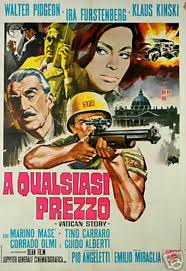
THE VATICAN AFFAIR/ A QUALSIASI PREZZO
Italy, 1968, 93 minutes, Colour.
Walter Pidgeon, Ira Firstenberg, Klaus Kinski, Marino Mase, Corrado Olmi, Roberto Maldera, Guido Alberti.
Directed by Emilio Maraglia.
In the aftermath of all the attention by the world with the second Vatican Council, 1968 saw a number of films focused on the Catholic church and the Vatican, Shoes of the Fisherman, Operazione San Gennaro, Operazione San Pietro. And the Vatican Affair - or the Italian title, At Whatever Price.
All of these films were heist capers, sometimes with American stars with the local Italian cast. In this case, the lead is veteran actor, Walter Pidgeon, an American professor, researching the Vatican Treasury, presenting his thesis to the Pope. And, puzzled by his rather stiff manner and bearing, we discover that he is blind.
And then we enter the realm of, perhaps, fantasy. He has organised a master theft at the Vatican Treasury, all with the aid of his chauffeur guiding him in walking and positioning himself, but also gathering a set of expert criminals, holding their records as ransom, a circus performer, Ira Furstenberg, an explosives expert seen in action, Klaus Kinski, a thief, Roberto Maldera, and a nervous expert, Corrado Olmi.
There is a lot of atmosphere of the Vatican throughout the film, the Cardinal in charge of the Treasury, the papal audience, various dignitaries, priest guides in the museums, meetings at friary and various friars…
Most of the film, of course, is the performance of the robbery, great attention to detail and timing.
The attitude of the professor is sometimes puzzling, urbane but ruthless, no particular development of the other characters except the unfaithful wife and potential liaisons.
And, a quietly urbane finale with the law triumphing.
Five Golden Dragons
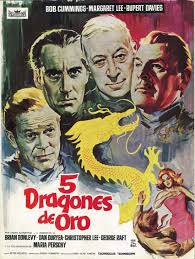
FIVE GOLDEN DRAGONS
UK/Hong Kong, 1967, 93 minutes, Colour.
Bob Cummings, Margaret Lee, Rupert Davies, Klaus Kinski, Maria Rohm, Sieghardt Rupp, Roy Chiao, Brian Donlevy, Dan Duryea Christopher Lee, George Raft, Maria Pershing, Yukari Ito.
Directed by Jeremy Summers.
A routine action show of the 1960s, loosely based on a story by Edgar Wallace. It was the kind of popular entertainment of the period, very television-oriented, ageing stars, stars of popular series, international flavour, and attractive Hong Kong photography and settings.
Hong Kong was under British rule at the time and Rupert Davies appears as the Commissioner. There is also a mysterious financial group, the Golden dragons who meet wearing elaborate masks and then revealed as veterans from the 1930s and 40s, Brian Donleavy, Dan Duryea, George Raft – and joined by Christopher Lee.
There are further complications with criminals wanting to take possession of the money of the Golden dragons. This leads us to a variety of nightclubs, some singing performances, some double-dealing, secret rooms… And there are some of the local police investigating. And, in the middle, is popular star of earlier years, Robert Cummings, now Bob Cummings, boost of his TV show, walking through this film as if it was a light comedy, chewing gum, a very strange choice for the film.
British actress Margaret Lee, appears as one of the chief villains.
Just a reminder of what popular action shows were being made in the 1960s, the shift to television, basic plots, straightforward filming and editing, probably fairly basic in those times, and even more so now!
Lust for a Vampire
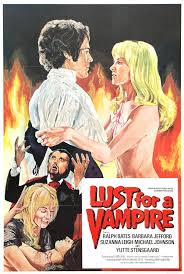
LUST FOR A VAMPIRE
UK, 1971, 93 minutes, Colour.
Barbara Jefford, Ralph Bates, Susanna Leigh, Yutte Stensgaard, Michael Johnson, Helen Christie, Mike Raven, Christopher Cunningham, Harvey Hall, Michael Brennan, Jack Telford, Christopher Neame..
Directed by Jimmy Sangster.
This is a film from Hammer Studios, based on writings by Sheridan Le Fanu, the Irish writer who preceded Bram Stoker with vampire stories. Two other films were associated with this feature, The Vampire Lovers and Twins of Evil.
Hammer had moved into horror films in the 1950s with Frankenstein and Dracula stories, featuring Christopher Lee and Peter Cushing and ensemble casts. By 1970, with the 60s enabling more “open” storytelling, especially in sexuality sequences, this film tries to capitalise on this, especially the setting and the finishing school of glamorous young adult women.
The basic plot is the familiar one, a Castle of vampires and their emerging every 40 years, wreaking harm on the village, the village people up in arms and finally storming the castle. Interestingly, they call on a bishop to lead them in the siege, his praying, restraining them and urging that vampires are killed by a stake through the heart. And, of course, they can be repelled by a cross or a crucifix.
An affluent and rather arrogant novelist appears doing some research, becomes infatuated with one of the young women who disappears. In the meantime, a sinister count appears, looking like a younger and minor Christopher Lee (whose actual eyes are used in a final confrontation scene) who is able to resurrect the daughter of the castle who then insinuates herself into the school, falling in love with the author, vaporising the very prim teacher and researcher who is infatuated with her (played by Ralph Bates who also appeared in Horror of Frankenstein). And there is the mysterious Countess played by Barbara Jefford.
Hammer films were always intriguing, sometimes classics, sometimes exploitative, especially in the later years, as with this film.
Long Walk, The
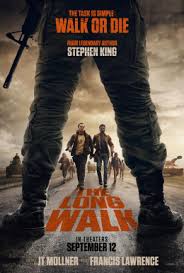
THE LONG WALK
US, 2025, 108 minutes, Colour.
Cooper Hoffman, David Jonsson, Garrett Wareing, Tut Nuyot, Charlie Plummer, Ben Wang, Mark Hamill, Judy Greer, Josh Hamilton.
Directed by Francis Lawrence.
Any long walk is very demanding. And, for the most part, the action in this film is a very long walk, demanding endurance, and demanding endurance from the audience responding and identifying with the characters. In fact, it is a long slog.
The film is an adaptation of Stephen King’s 1979 novel, published under his alternate name, Richard Bachman. And it is set in a kind of alternate United States, reminiscent of Alex Garland’s recent film, Civil War. The US is in decline, financial impoverishment, a strong military presence, evocative of some of the American experiences of 2025.
The film opens with a letter to Raymond Garrity (played by Cooper Hoffman, the son of Philip Seymour Hoffman). He has been chosen by lottery to participate in the long walk. And his mother, Judy Greer, is very upset. But Ray is determined, farewells his mother and joins the other lottery winners at the starting point.
And, then we discover that there are about 50 men, that they will continue to walk, in fact over 300 Miles, and if they go under 3 mph, stray onto the side, fall and don’t get up, they will, and the first death scene is horrifying, they will be shot by soldiers walking with them. There is to be only one survivor – and the reward will be the fulfilment of whatever the winner wishes. And, in charge of the walk, standing like General Patton in his tank, is the gruff, wearing sunglasses, major, rallying the men with macho patriotic urging but merciless when they fail. He is played by Mark Hamill.
This means that we get to know quite a number of the men on the walk, white, black, Native American, Asian descent… We learn their stories, their hopes, their determination, we experience their clashes, some mutual support, and some strong friendships. While Ray has his story and motivation, the strong character on the walk is Pete, a very empathetically by the British actor, David Jonsson.
They walk and walk, some collapsing, many shot, havoc played with their health, with their bodies, bodily functions, physical demands, psychological demands, clashes and crises, determination.
The film has been directed by Francis Lawrence who is best known for his direction of The Hunger Games films.
When films dramatize demands on human suffering, they can be described in the first words of Psalm 129/130, De Profundis, ‘out of the depths’. But, with its grim picture of this alternate universe, there seems to be No Exit, what some pessimistic commentators name, “Enter the Void”.
There is some kind of resolution to this walk, a winner, who expresses his wish – but the film ends and, suddenly, we are confronted by what we have seen, felt, and are left, disturbed, to question what it all could mean.
- The title and focus? The structure of the film, the lottery, assembly, the details of the walk, the military background, endurance, elimination, final survivor?
- The books of Stephen King? This earlier work, originally written when he was 19, published in 1979, Richard Bachman? King and his age, the experience of the Vietnam war, the 1960s and 1970s? The effect on those who served? An American consciousness?
- The situation of the US in this scenario, decline, morale, economic difficulties, leadership, the military? The idea of the walk, the lottery, its being televised, people along the route? The purpose?
- The opening, the letter to Ray, the words on the screen, Ray at home, his age, the later filling in of his background, his father, outspoken, arrested, the fascist atmosphere, his stances, principles and execution? His injunctions to his son? His mother, the bonding between them, her not wanting him to go, the pathos of the farewell, her coming during the walk, his response, giving up or not?
- The gradual revelation of Ray’s motive in going on the walk, the flashback and the visuals of the major, his father’s execution, his wanting vengeance on the Major? And the irony of the Major urging him along during the walk?
- The lottery, the 50 young men, the assembly, seemingly random choices, Ray and his arrival, the encounter with Pete, initial friendship and understanding, the bonding?
- The fact of the major in his Jeep, following, the guards along the way, the morale boosting? Then the rules, never under 3 mph, the time for bending down, not straying off the road? The military, supplying food and water, but also shooting their victims? This atmosphere and audience response?
- The signalling of the miles walked, the various days, ultimately over 300 miles? The stamina, the motivation, food and drink, bodily functions, the strain on the body, on the spirit? And the impact of the deaths on the role?
- The film’s focus on the smaller number of men while showing the bigger group always, and its diminishing?
- The focus on Ray, audience sympathy with him, his age, memories of his father, relationship with his mother? The gradual revelation of his vengeful motivation?
- Pete, his age, experience, family background, the contrast with Ray? African-American? Racial issues? The friendship with Ray, talking, sharing stories, walking together, over the miles, over the hours, the details of their friendship, bonding, revelations to each other? The two of them with the other members walking?
- The portrait of Barkovitch, his age, appearance, slight, his manner, challenging, bitterness, mockery, his victim, the victim falling, being shot? The repercussions for the others in the group, blaming him, the continued walk, his attitudes, not wanting to be blamed, revealing something his background, his attempts at some kind of justification, reconciliation? Ultimately his death?
- The Native American, his appearance, on the march, motivations, with the others, sense of rebellion, the military, surviving for so long, his ultimate reaction, his death and the Native American rituals?
- Stebbins, appearance, stamina, motivations, at a distance from the others, difficulties, eventual talking, his death?
- Harkness, slight, his notebook, wanting to write a book, the reaction of the others, and his death?
- Curley, young, bright, the first victim?
- Arthur Baker, racial background, cheerful attitude, continuing on the walk, the effect on him, death?
- Hank Olsen, small, Asian background, determined, cheeky, injury to his foot, persevering, ultimately dying?
- The days and nights, Ray and his shoes, walking barefoot? Supported by Pete? The major and his interventions?
- The move towards the end, the only two left, Ray and the discussions about his motivation, examining himself, his decision to die and leave the end to Pete?
- Pete, his success, the acclamation by the major, the crowds, to have anything he wanted, his altruistic motivation initially, his memories of Ray’s story, asking for the gun, getting it, shooting the major? Acting on behalf of Ray? And the film ending and the audience left with what would happen to Pete as he moved off?
Love Hurts/ 2025
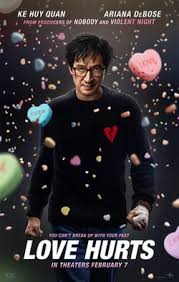
LOVE HURTS
US, 2025, 83 minutes, Colour.
Ke Huy Quan, Ariana DeBose, Mustafa Shakir, Lio Tipton, Daniel Wu, Cam Gigandet, Marshawn Lynch, Andre Eriksen, Rhys Darby, Sean Astin.
Directed by Jonathan Eusebio.
While there are some rather secondary themes of love, this is a film where the title Hurts is much more important!
This is a very brief action show, one of thousands in the history of cinema. However, it is a show of the 21st-century, very significantly promoting a range of characters with different ethnic backgrounds in the United States. And, there is a lot of violence, stylised in its way, some of it very serious, especially in the deaths of character who certainly didn’t deserve it and had some audience sympathy, but also in the elaborate martial arts choreography.
Ke Huy Quan certainly has a Jackie Chan look about him, physically, and then in the extensive fights and martial arts manifestations.
In fact, the director of has a long list of credits as stunt coordinator, martial arts and fight coordinator. And, two of the stars have something of a similar background, especially the central character played by Ke Huy Quan. (And, the main fighters, the two brothers Marvin and Knuckles, and the hitman, The Raven – a hugely imposing physical presence by Mustafa Shakir – are all in their mid-late 50s!).
The Raven and Ashley, Ivan’s real estate agency assistant (Lio Tipton) provide quite some humour with poetry, violence, and romance. And there is Rhys Darby as the Kiwi accountant.
Familiar themes, Russians in the US, money deals, betrayals, thugs, tracking down those who betrayed them…
However, the film is a star vehicle for Ke Huy Quan who had appeared in the number of films in the 1980s but had not prospered in the film or television industry as an actor. Then, he won the Oscar for Best Supporting Actor in Everything, Everywhere, All at Once. And here he is teamed, not always romantically credible in the scenario, with Oscar winner Ariana DeBose, for West Side Story.
While Marvin had been a hitman for his brother, Knuckles, he has moved away, disillusioned, helping their associate, Rose, to disappear. Now, everybody seems to be after him even though he is now a respectable, award-winning, real estate agent (and many sequences illustrating this).
He has a rival in the estate agency business and a very sympathetic boss played by Sean Astin – but it was not necessary in the scheme of things that they should each die so brutally.
Happy ending, declarations of love – the audience might hope for this but may not be persuaded.
Harry Belafonte: Sing Your Song
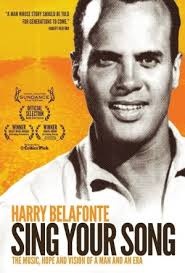
HARRY BELAFONTE: SING YOUR SONG
US, 2011, 104 minutes, Colour.
Directed by Susanne Rostock.
An important documentary on the life of singer, actor, significant 20th century activist, Harry Belafonte. It was produced by his daughter, Gina Belafonte, and released in 2011 when he turned 84. He still had another 12 years of life.
Fortunately, there is an extraordinary amount of material for incorporation into this documentary, background footage of New York in the 20s, 30s and 40s, theatrical material, clips from movies, television footage, interviews… And, close-up commentary from Belafonte himself throughout the film, personal reflections.
He was born in New York City, a broken home, work as a janitor, invited to the American black theatre, finding his ability to act and sing, advised by Paul Robson to “sing your song”.
With the personal narration, the audience is invited not only into his life and his career, but into his passion and activism.
For movie fans, there are clips from his films, especially the buildup to Carmen Jones.
For television fans, there are many excerpts from his appearance on television, and a wide range of performances of his many songs. He was promoted by Ed Sullivan and challenged Sullivan on promoting African-American stars. On tour in the south, he bonded with Marge and Gower Champion despite criticisms of shared stage and touching. This also happened in the 60s when singing with Petula Clark on television, she held his arm, upsetting the sponsors and the networks and audiences, Petula Clark taking a firm stand for Belafonte.
In the 50s and 60s, Harry Belafonte was well aware of race issues and these are visualised in footage from the period, his meeting with Martin Luther King and the continued friendship, supporting him with the March on Washington, getting many film personalities in support, Marlon Brando, Paul Newman, James Garner… As well as performers like Nina Simone.
The Kennedy period is particularly interesting with the March on Washington but also the attitudes and behaviour and discussions with John F. Kennedy as well as Robert Kennedy – and then, 1968, and the impact of the assassinations of Martin Luther King and Robert Kennedy.
And 1968 was significant with the pre-election conventions, Chicago, the Chicago Seven, riots and demonstrations… As well as the attitude towards Vietnam and protests.
Belafonte became very aware of Africa, taking groups of politicians and media personalities on tour and discussions of their effect. He promoted South African singers. And, in the 1980s, with We the People, concern about famine and start visualising of this in Ethiopia. Later he was to be a friend of Nelson Mandela.
There are some insights into his family life, three wives, interviews with some of them, and interviews with his children. Then, his marriage to photographer, Pamela, late in life. And also causes in other countries, like Haiti.
The film ends in 2011 but, as indicated, Harry Belafonte had another decade of life and activity.
Arrowhead/ Alien /Arrival
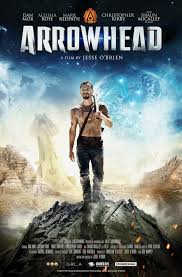
ARROWHEAD/ ALIEN ARRIVAL
Australia, 2016, 98 minutes, Colour.
Dan Moore, Aleishaa Rose, Mark Redpath, Christopher Kirby. Voice of: Shaun Micallef.
Directed by Jesse O'Brien.
Australian director, Jesse O’Brien, made a short film and then amplified it into this feature. It is basically a science-fiction film, with some space travel, landing on an alien planet, alien creatures as well as an exploration of futuristic technology. It was made on a small budget, and in the desert sequences filmed in South Australia, around Coober Pedy.
However, it begins with a military situation, a clash between two generals, the victory of one, the imprisonment of followers of the other. There is a striking opening sequence where the prison soldiers are at work, under guard, the situation with an extractor machine, the prisoners taking advantage, even the central character trapped by a chain, shooting his leg off to prevent his going into the extractor. He is rescued and with the technology reconstituted with an artificial leg.
He is then called on by the defeated general to go on a mission, to get information from a planet. The film then turns into space action, the journey, the range of technology and means of communication (and, a surprise to many who admire him from his television programs and comedy skills, the technological voice is that of Shaun Micallef).
There are various complications on the planet, working on the technology, finding a rival scientist and interactions with her, the discovery of the body of another scientist, and some strange mindbending experiences with deaths, reconstructions – especially with the aid of a strange and devouring alien creature who absorbs the hero, who then can emerge reconstituted.
Years pass, the hero alone, the betrayal of the scientist, the confrontation with the general leading the uprising, the technology and the robots indicating that they have information to share, final confrontations.
In many ways the film is elementary although the opening sequence in the prison is effective, the landscapes of the alien moon impressive, and, on a small budget by first-time director, providing a science fiction adventure for those enthusiastic about the genre.
Freakier Friday
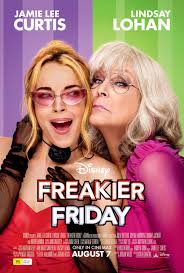
FREAKIER FRIDAY
US, 2025, 110 minutes, Colour.
Jamie Lee Curtis, Lindsay Lohan, Julia Butters, Sofia Hammons, Mark Harmon, Manny Jacinto, Chad Michael Murray, Maitreyi Ramakrishnan.
Directed by Nisha Ganatra.
Half a century ago there was a very popular version of Mary Rodgers’ novel, Freaky Friday with Jodie Foster and Barbara Harris as mother and daughter changing identities. And there have been quite a number of versions of Freaky Friday over since, especially in 2003 with Jamie Lee Curtis and Lindsay Lohan. So, if you can wait long enough, there will be sequels. And, the sequel will be even freakier!
And, as time passes, Lindsay Lohan as Anna is now the mother of a teenager, Harper (Julia Butters – that little girl who had the critical conversation on the veranda with Leonardo DiCaprio in Once Upon a Time in Hollywood). Which means that Jamie Lee Curtis as Tess is now Grandma. But, how are they going to make the basic story freakier? And another couple!
The answer is to have Anna fall in love with Eric (Manny Jacinto) a charming gentleman chef from London whose wife has died and his daughter, now at school with Harper and bitter enemies, Lily (Sofia Hammons), wants to go back to England. Harper, of course, a Californian surfing teenager, has no desire to go to London.
You never know where fortune tellers with powers are to be found these days but this one here has a full-time job at Starbucks but takes time off to read palms. And she is ultimately very surprised at the freakier changes of identity.
This is a film very much for teenage girls (teenage boys barely get a look in) and girls under 12 point found it very interesting puzzle about all the fuss. The parent generation will now be identifying with Lindsay Lohan. And, all the rest can sit back and enjoy Jamie Lee Curtis (who becomes that London teenager) doing Granny-looking youngster antics while coping with some aches and pains!
Mark Harmon was there 22 years ago as was Chad Michael Murray, both of them reappearing, somewhat subdued.
One caution for older members of the audience, including this reviewer, the concentration needed for having to keep remembering who was who in who’s guise, was far more demanding than expected.
There is a rock concert finale, Anna having wanted to be a musical star but having to look after her daughter, the possibility of a crisis at the end as Harper, looking like Anna, has to sing her song, but the screenwriter provides a neat solution so that the song goes ahead, everybody is happy, the two girls learn to appreciate their parents, bond with each other – and, to leave readers in suspense and no spoiler, guess where they decide to live as one big happy family!
- The many film versions of this story? The genre of body-swapping? Comic consequences? Appearances and reality? 2003, Jamie Lee Curtis and Lindsay Lohan? Two decades later and a sequel? And multiplying the body-swapping?
- The Los Angeles settings, homes, school, the music world, surfing, chefs and cooking? The songs and musical score?
- Reintroducing Tess and Anna, 20 years, Tess as grandmother, Anna as single mother, her music career, not fulfilled, becoming a producer and manager, her client and her personality and tantrums, arranging the concert? Harper, teenager, surfing, the family bonds? Are the school, the clashes with Lily, British accent and manner, the sabotage of the chemistry experiment, leading to the spectacle of the cake fight and the attack on the principal?
- The principal’s office, the reaction of the girls, Anna meeting Eric, British background, Filipino background, chef, widower, the attraction? Falling in love? The reaction of the girls?
- Six months later, the engagement, wedding preparations, the prospect of moving to London? Lily and her personality, clashes with her father, Harper and her reaction, not wanting to leave Los Angeles?
- The visit to Starbucks, the palm reader, the words, memories of the past body-swap, lightning striking twice, the double swapping?
- Audiences coping with Anna as Harper, Harper as Anna, Lily as Tess, Tess as Lily? The comedy of Tess acting as a teenager, Lily as a grandmother, with aches, Anna and Harper, mother and daughter? The range of comedy, situations?
- The plan to sabotage the move to London, the two girls, in the appearances of Tess and Anna? Tess and her behaving like a teenager, out of control, especially the car and the driving, the connivances? Harper appearing as her mother? Anna being her daughter?
- The enjoyment of the vice versa experiences? But Eric and his bewilderment? And his wanting to do the best by his daughter, the breaking of the engagement?
- The two girls in their other forms, conniving, going to see Jake, at the record store, the tantrums and stupidities, trying to get his help? The immigration interview and the revelations for Harper?
- The buildup to the concert, the singer and her tantrums, Anna’s song, the crisis, her playing in the background, Harper upfront, the success of the song, Eric hearing, the appeal to him, carried to the front, the happy reunion? And reversal two characters?
- The wedding party background, Eric and his mother, the other relations?
- Everyone back to normal, Tess happy, Eric and Anna happy, and the two girls becoming friends – and, of course, not going to London!
