Displaying items by tag: Charlie Plummer
National Anthem
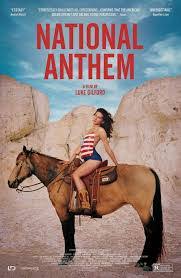
NATIONAL ANTHEM
US, 2023, 99 minutes, Colour.
Charlie Plummer, Eve Lindley, René Rosado, Mason Alexander Park, Robyn Lively, Joey DeLeon.
Directed by Luke Gilford.
One might wonder about the title and what would emerge. There is a rather soul-felt rendering of the national anthem towards the end of this film.
The themes are complex. The focus is on Dylan, an effective performance by Charlie Plummer, Lean on Pete, Words on a Bathroom Wall. He works on construction sites, lives with his alcoholic and rather slatternly mother, looking after his younger brother. He is quiet and introverted.
Lining up for work one day, he is hired to clean up an area, occupied by a rodeo group. And, this is where the film is unexpected. The group is a gay group of riders and followers. They follow the rodeos, some of them riding, Dylan even having the opportunity to sit on a bull.
He becomes infatuated with Sky, Eva Lindley, one of the troupe, sexually attracted. However, he also gradually becomes involved in the lifestyle of the rodeo group, sexual liaisons, awakening all kinds of ambitions in Dylan, wanting to leave, buying a trailer, clashes but reconciliation with his mother, the continued care of his brother and introducing him to the group which the young boy relishes.
The scenario is open-ended, the issue of Dylan moving away and achieving a life of his own. However, the film does introduce its audience to an unexpected and unusual subcultural group.
- The work of the director, photography, music videos, his first feature film, based on his photography monograph, National Anthem, the focus on the rodeos and queer culture?
- The New Mexico setting, the towns, homes, construction sites, the countryside, the rodeo, the camp, clubs and bars? The musical score?
- The title, the American way of life, for all? And the final singing of the anthem with strength?
- Dylan’s story, the absent father, his mother, drinking, men, lacking care of her children, his confrontations with her, her stealing his money, ups and downs, reconciliations? His care for his brother, coming home from work, the meals, homework, talking, consoling him, the bed, day by day?
- Dylan’s age, a sheltered life, introverted, guitar and his music? Looking for jobs, Pepe choosing him, going out to the house in the fields, carrying the bales? Returning home? The encounter with some of the personalities?
- The audience discovering the queer culture with the group, the various members, cross dressing, drag queen, songs, the gay community? Pepe and his leadership?
- Dylan, the encounters with Sky, fascinated, the sexual response, out on the rocks, his fantasy of her, the American flag, on the horse? Sky in real life, trans person, the continued meetings with Dylan, the attraction, riding out into the desert, dancing, song?
- The rodeo, the crowds, the queer group, the different personalities, flamboyant, supported, Pepe and his riding the bull, the offer to Dylan, his riding, the fall, breaking out, his sense of exhilaration?
- Becoming more and more involved with the group, Carrie and life story, background, orientation, clothes, female identification, conversations, sympathy, friendship with Cassidy, helping him?
- The communal sexual behaviour, Dylan caught up, the threesome, its effect? Questions to himself, sexuality? Comfortable with the group, the visit to the supermarket, Sky touching up his eyes blue, going home, Cassidy’s response? Later Cassidy going with the group, blue eye line, make up? Dylan and the dress, and his drag performance, surprising the audience, surprising the cinema audience, surprising himself?
- His returning home, discussions with his mother, his money, her taking it, her change of heart, the reconciliation?
- Dylan, wanting to go by himself, the money, buying the trailer, Sky and her just wanting friendship and sexual association, by herself, Carrie, the farewell – and Dylan going to an uncertain future?
Long Walk, The
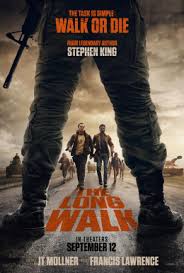
THE LONG WALK
US, 2025, 108 minutes, Colour.
Cooper Hoffman, David Jonsson, Garrett Wareing, Tut Nuyot, Charlie Plummer, Ben Wang, Mark Hamill, Judy Greer, Josh Hamilton.
Directed by Francis Lawrence.
Any long walk is very demanding. And, for the most part, the action in this film is a very long walk, demanding endurance, and demanding endurance from the audience responding and identifying with the characters. In fact, it is a long slog.
The film is an adaptation of Stephen King’s 1979 novel, published under his alternate name, Richard Bachman. And it is set in a kind of alternate United States, reminiscent of Alex Garland’s recent film, Civil War. The US is in decline, financial impoverishment, a strong military presence, evocative of some of the American experiences of 2025.
The film opens with a letter to Raymond Garrity (played by Cooper Hoffman, the son of Philip Seymour Hoffman). He has been chosen by lottery to participate in the long walk. And his mother, Judy Greer, is very upset. But Ray is determined, farewells his mother and joins the other lottery winners at the starting point.
And, then we discover that there are about 50 men, that they will continue to walk, in fact over 300 Miles, and if they go under 3 mph, stray onto the side, fall and don’t get up, they will, and the first death scene is horrifying, they will be shot by soldiers walking with them. There is to be only one survivor – and the reward will be the fulfilment of whatever the winner wishes. And, in charge of the walk, standing like General Patton in his tank, is the gruff, wearing sunglasses, major, rallying the men with macho patriotic urging but merciless when they fail. He is played by Mark Hamill.
This means that we get to know quite a number of the men on the walk, white, black, Native American, Asian descent… We learn their stories, their hopes, their determination, we experience their clashes, some mutual support, and some strong friendships. While Ray has his story and motivation, the strong character on the walk is Pete, a very empathetically by the British actor, David Jonsson.
They walk and walk, some collapsing, many shot, havoc played with their health, with their bodies, bodily functions, physical demands, psychological demands, clashes and crises, determination.
The film has been directed by Francis Lawrence who is best known for his direction of The Hunger Games films.
When films dramatize demands on human suffering, they can be described in the first words of Psalm 129/130, De Profundis, ‘out of the depths’. But, with its grim picture of this alternate universe, there seems to be No Exit, what some pessimistic commentators name, “Enter the Void”.
There is some kind of resolution to this walk, a winner, who expresses his wish – but the film ends and, suddenly, we are confronted by what we have seen, felt, and are left, disturbed, to question what it all could mean.
- The title and focus? The structure of the film, the lottery, assembly, the details of the walk, the military background, endurance, elimination, final survivor?
- The books of Stephen King? This earlier work, originally written when he was 19, published in 1979, Richard Bachman? King and his age, the experience of the Vietnam war, the 1960s and 1970s? The effect on those who served? An American consciousness?
- The situation of the US in this scenario, decline, morale, economic difficulties, leadership, the military? The idea of the walk, the lottery, its being televised, people along the route? The purpose?
- The opening, the letter to Ray, the words on the screen, Ray at home, his age, the later filling in of his background, his father, outspoken, arrested, the fascist atmosphere, his stances, principles and execution? His injunctions to his son? His mother, the bonding between them, her not wanting him to go, the pathos of the farewell, her coming during the walk, his response, giving up or not?
- The gradual revelation of Ray’s motive in going on the walk, the flashback and the visuals of the major, his father’s execution, his wanting vengeance on the Major? And the irony of the Major urging him along during the walk?
- The lottery, the 50 young men, the assembly, seemingly random choices, Ray and his arrival, the encounter with Pete, initial friendship and understanding, the bonding?
- The fact of the major in his Jeep, following, the guards along the way, the morale boosting? Then the rules, never under 3 mph, the time for bending down, not straying off the road? The military, supplying food and water, but also shooting their victims? This atmosphere and audience response?
- The signalling of the miles walked, the various days, ultimately over 300 miles? The stamina, the motivation, food and drink, bodily functions, the strain on the body, on the spirit? And the impact of the deaths on the role?
- The film’s focus on the smaller number of men while showing the bigger group always, and its diminishing?
- The focus on Ray, audience sympathy with him, his age, memories of his father, relationship with his mother? The gradual revelation of his vengeful motivation?
- Pete, his age, experience, family background, the contrast with Ray? African-American? Racial issues? The friendship with Ray, talking, sharing stories, walking together, over the miles, over the hours, the details of their friendship, bonding, revelations to each other? The two of them with the other members walking?
- The portrait of Barkovitch, his age, appearance, slight, his manner, challenging, bitterness, mockery, his victim, the victim falling, being shot? The repercussions for the others in the group, blaming him, the continued walk, his attitudes, not wanting to be blamed, revealing something his background, his attempts at some kind of justification, reconciliation? Ultimately his death?
- The Native American, his appearance, on the march, motivations, with the others, sense of rebellion, the military, surviving for so long, his ultimate reaction, his death and the Native American rituals?
- Stebbins, appearance, stamina, motivations, at a distance from the others, difficulties, eventual talking, his death?
- Harkness, slight, his notebook, wanting to write a book, the reaction of the others, and his death?
- Curley, young, bright, the first victim?
- Arthur Baker, racial background, cheerful attitude, continuing on the walk, the effect on him, death?
- Hank Olsen, small, Asian background, determined, cheeky, injury to his foot, persevering, ultimately dying?
- The days and nights, Ray and his shoes, walking barefoot? Supported by Pete? The major and his interventions?
- The move towards the end, the only two left, Ray and the discussions about his motivation, examining himself, his decision to die and leave the end to Pete?
- Pete, his success, the acclamation by the major, the crowds, to have anything he wanted, his altruistic motivation initially, his memories of Ray’s story, asking for the gun, getting it, shooting the major? Acting on behalf of Ray? And the film ending and the audience left with what would happen to Pete as he moved off?
Return, The/ 2024
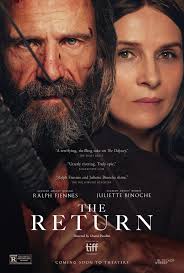
THE RETURN
Ralph Fiennes, Juliette Binoche, Charlie Plummer, Marwan Kenzari, Claudio Santamaria, Angela Molina.
Directed by Uberto Pasolini.
One of the most significant returns in classical literature is that of Odysseus and his long journey back after the end of the Trojan War to his native Ithaca, a voyage of 10 years, many delays, many adventures, many challenges, an Odyssey.
In the past, there have been a number of films about the adventures of Odysseus/Ulysses in the 1950s with Kirk Douglas, in the 1997 television adaptation with Armand Assante and Greta Scacchi. Christopher Nolan is in production for a vast treatment of the Odyssey.
This version focuses on the last part of Homer’s epic. Which means that there are none of the adventurous and mythological episodes. It opens with a naked Odysseus stranded on the beach of Ithaca. He is found by a sympathetic slave, cared for, revives, keeps his identity secret, keeps up the appearance of a beggar.
Which means that this is a rather gripping personal drama, especially with Ralph Fiennes as Odysseus, bringing his powerful presence to the screen, the audience able to appreciate what is happening to him not only through what he says but with the intensity that Fiennes is able to communicate with his body language, manifesting, without words, much of the torment of his inner feelings.
And, there is Juliette Binoche as Penelope, the wife that he left behind, waiting for him, believing that he will return, sitting at her loom, declaring she will name a suitor after she finishes the garment, pulling it apart at night, starting again the next day. And she has been waiting 20 years, the 10 years of the war, the 10 years of her husband’s Odyssey. There is also their son, Telemachus, played by Charlie Plummer, disturbed by his father’s absence, disturbed by his mother’s behaviour, and the collapsed state of Ithaca in Odysseus’s absence.
Also of note for the film is the terrain of the island, fields, beaches, waves crashing on cliffs, waterfalls, steep mountains (filmed in Corfu), and the huge stone palace on the mountain top, fierce and foreboding, and its dimly lit interiors.
Ithaca is in chaos. There is a mounting number of suitors for her hand, lounging around, violent, demanding of Penelope. And she continues to resist, supported by her devoted nurse (Angela Molina).
And, so the questions. Will Odysseus make himself known? Will Penelope recognise him after this time? How will he encountere his son and Telemachus’s reaction? And what of the suitors and their idleness, exploiting the inhabitants of Ithaca?
The climax builds. Penelope has named the day to nominate the suitors she would choose. They gather. Odysseus in disguise is present. Telemachus is also present. And, as in the epic, Penelope demands that the suitors emulate Odysseus with his bow and arrow to be the successful suitor.
Suddenly, violence is let loose, Odysseus manifesting himself, a vicious eruption, combat, slaughter, and the drama of the aftermath for Odysseus and Penelope, in view of what they we have seen. Will they be able to come together after the 20 years of physical and emotional distance.
With its serious dialogue, with its pauses, the intense drama, often interior, The Return plays something like an Opera scenario without the singing and music. Others have suggested that it is performed rather in the manner of a Shakespearean play. This is important to note for audiences who might have different expectations about this version of Homer, this time not the Odyssey as such, but, as the title highlights, the intensity of The Return.
(It is a surprise to find that the film has been cowritten and directed by Italian born, British director, Uberto Pasolini, a long-time producer, directing only four films including two beautifully quiet and recommended British films, Still Life and Nowhere Special.)
- The status of Homer and his epics? Audience knowledge of the Iliad and the Odyssey? Of Odysseus, Penelope, Odysseus and his wanderings home?
- The focus on the final chapters of The Odyssey, the title and simply, the Return? None of the popular stories of the epic? Memories of Troy, the battles, the wooden horse, the destruction? No mention of the gods, especially Athena and her role in Odysseus’ return?
- The Greek locations, Corfu standing in for Ithaca, the cliffs, plains, waterfall, mountains? The scenes of the village, poverty and homes, the commanding palace on the mountain, the interiors, the lighting? The atmospheric musical score?
- The screenplay, the dialogue, the interiority of the characters, interchanges? Operatic without the stylised singing? Like a Shakespearean performance?
- The cliffs, Odysseus on the shore, naked, found by Eumaes his family, cared for, revived? Seen as a bigger, questions about the Trojan War, Odysseus and his memories, his account, regrets? The eager listening? His hearing about Penelope, the suitors, about Telemachus? Biding his time?
- Penelope, the happy marriage, her husband going to the, the birth of Telemachus, his growing up, 20 years of the war and the Odyssey? Her waiting for her husband, devoted, her spending her time at the loom, the range of suitors, her putting them off, the loom for her father-in-law’s death? A relationship with Telemachus, his impatience, denouncing his father? The devotion of the nurse?
- The range of suitors, their motivations, personalities, exploitation of the people, exploitation of the land, Ithaca and its collapse? The idling around the palace, the rivalries, hunting? Their being put off? A new suitor arriving and his being wounded, being thrown back into the water?
- Antinous, his presence, devotion to Penelope, attitude towards Telemachus, the scene with his night with the slave girl? His conversations with Penelope, urging his cause?
- Odysseus, his recovery, his going out into the countryside, his dismay? Hearing the story of the suitors? His desire to go to the palace, the episode with the dog which recognised him, the reaction of the suitors, ridicule, hostility, his asking for food? The confrontation and his ability to kill the opponents? The withdrawal of the suitors?
- Telemachus, his criticisms, his sailing off, the dangers and his return? The suitors and their hostility? The desire to hunt him down?
- Odysseus, food, his being washed, the nurse recognising his will and in scar, his urging her to silence?
- The meeting with Telemachus, the revelation that he was his father, Telemachus and his hostile reaction? The hunt, the suitors, Odysseus knocking his son, Eumaes and the helpers, the pursuit, climbing the cliff, safe? Telemachus and his interactions with his father? Accusations, criticisms?
- The pressure on Penelope, her undoing the weaving, continuing the next day, her upset and tearing it apart? Antinous and his pressurising Penelope? Her decision to name one of the suitors?
- The gathering, Odysseus present? Telemachus? Penelope and her setting the test of the bow and the arrows? The attempts of the various suitors and their failure? Penelope telling Telemachus to give the bow to his father? Odysseus, warming the bow, twisting it between his legs, setting it up, firing the arrow?
- The suitors and their upset, Odysseus and his firing all the arrows, killing the suitors? The closing of the doors? Telemachus, the confrontation with Antinous, his mother telling him not to kill the suitor, his killing him?
- The consequences, blood, the deaths? Telemachus and his decision to sail away?
- The encounters between Odysseus and Penelope, the conversations, his leaving, her devotion, the past, the war, his return, the violence, the deaths of the suitors? His turning over the loom, opening the door, ascending to the bedroom? Their talk, to understand each other, to overcome the violence in the past, sharing these memories, some forgiveness, acceptance, and hope for the future?
