Displaying items by tag: Harry Belafonte
Harry Belafonte: Sing Your Song
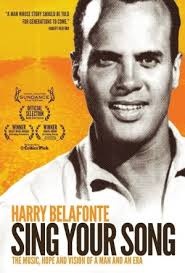
HARRY BELAFONTE: SING YOUR SONG
US, 2011, 104 minutes, Colour.
Directed by Susanne Rostock.
An important documentary on the life of singer, actor, significant 20th century activist, Harry Belafonte. It was produced by his daughter, Gina Belafonte, and released in 2011 when he turned 84. He still had another 12 years of life.
Fortunately, there is an extraordinary amount of material for incorporation into this documentary, background footage of New York in the 20s, 30s and 40s, theatrical material, clips from movies, television footage, interviews… And, close-up commentary from Belafonte himself throughout the film, personal reflections.
He was born in New York City, a broken home, work as a janitor, invited to the American black theatre, finding his ability to act and sing, advised by Paul Robson to “sing your song”.
With the personal narration, the audience is invited not only into his life and his career, but into his passion and activism.
For movie fans, there are clips from his films, especially the buildup to Carmen Jones.
For television fans, there are many excerpts from his appearance on television, and a wide range of performances of his many songs. He was promoted by Ed Sullivan and challenged Sullivan on promoting African-American stars. On tour in the south, he bonded with Marge and Gower Champion despite criticisms of shared stage and touching. This also happened in the 60s when singing with Petula Clark on television, she held his arm, upsetting the sponsors and the networks and audiences, Petula Clark taking a firm stand for Belafonte.
In the 50s and 60s, Harry Belafonte was well aware of race issues and these are visualised in footage from the period, his meeting with Martin Luther King and the continued friendship, supporting him with the March on Washington, getting many film personalities in support, Marlon Brando, Paul Newman, James Garner… As well as performers like Nina Simone.
The Kennedy period is particularly interesting with the March on Washington but also the attitudes and behaviour and discussions with John F. Kennedy as well as Robert Kennedy – and then, 1968, and the impact of the assassinations of Martin Luther King and Robert Kennedy.
And 1968 was significant with the pre-election conventions, Chicago, the Chicago Seven, riots and demonstrations… As well as the attitude towards Vietnam and protests.
Belafonte became very aware of Africa, taking groups of politicians and media personalities on tour and discussions of their effect. He promoted South African singers. And, in the 1980s, with We the People, concern about famine and start visualising of this in Ethiopia. Later he was to be a friend of Nelson Mandela.
There are some insights into his family life, three wives, interviews with some of them, and interviews with his children. Then, his marriage to photographer, Pamela, late in life. And also causes in other countries, like Haiti.
The film ends in 2011 but, as indicated, Harry Belafonte had another decade of life and activity.
Sunday Best: The Untold Story of Ed Sullivan
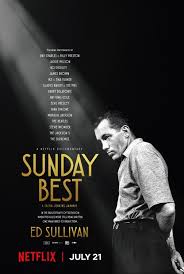
SUNDAY BEST: THE UNTOLD STORY OF ED SULLIVAN
US, 2025, 90 minutes, Colour.
Interviews: Harry Belafonte, Berry Gordy, Jackie Jackson, Smokey Robinson, Dionne Warwick, Otis Williams.
Performances by: Ray Charles, Billy Preston, Jackie Wilson, Bo Diddley, James Brown, Ike and Tina Turner, Gladys Knight and the Pips, Harry Belafonte, Nat King Cole, Elvis Presley, Nina Simone, Mahalia Jackson, The Beatles, Stevie Wonder, The Jackson 5, The Supremes.
Directed by Sacha Jenkins.
Ed Sullivan was one of the earliest television celebrities, hosting his own show. He completed 25 years as host, finishing in 1971 – and dying three years later.
For Americans, in their millions, who watched his show every Sunday night, he was a welcome figure in their homes. For those who observed him from afar, he seemed somewhat of severe face, rather stilted introductions. In fact, early in his career, there were complaints about his unsmiling presence, some even claiming that he had a steel plate in his head (and he received many sympathetic letters!).
This is a very sympathetic portrait of Ed Sullivan, using a great deal of footage from the 1930s to the 1970s, often his own words, and, as indicated, some voice impersonation of his words.
Sullivan began his career as a journalist, interested in writing, then becoming a sports journalist and significant in his field. He was then transferred to theatre and Broadway, and from the mid 1930s was a popular host for many years of an annual concert. This brought him to the attention of CBS and the offer of hosting a show – but with some scenes of critique of his poor performance and bad reviews.
However, Sullivan had an ability for tapping into talented performers, offering opportunities for a whole host of stars – and the film incorporates substantial performances from many of these stars, as indicated in the above credits, which means that we are not only watching Ed Sullivan but we are getting a strong impression of the Ed Sullivan show.
One of his most significant stances was against racism, welcoming a whole host of African-American performers, especially with Harry Belafonte in the early 1950s, Belafonte challenging him, their forming a very strong friendship. And there was great hostility to the show in the southern states – although, it seems, a number of people did watch the show in their homes without letting this be known. To highlight this theme, there are quite a number of inserts of footage of racism and segregation of those years, Rosa Parks, a number of politicians from the South.
By the end of this documentary, audiences will have a very favourable impression of Ed Sullivan as a person, despite the limitations of his sometimes stern-looking presentation, his talent for promoting so many significant performers of the 20th century, and, importantly, his contribution to the breaking down of many racist attitudes of the period.
