Displaying items by tag: Garrett Wareing
Long Walk, The
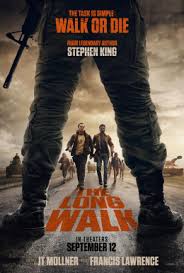
THE LONG WALK
US, 2025, 108 minutes, Colour.
Cooper Hoffman, David Jonsson, Garrett Wareing, Tut Nuyot, Charlie Plummer, Ben Wang, Mark Hamill, Judy Greer, Josh Hamilton.
Directed by Francis Lawrence.
Any long walk is very demanding. And, for the most part, the action in this film is a very long walk, demanding endurance, and demanding endurance from the audience responding and identifying with the characters. In fact, it is a long slog.
The film is an adaptation of Stephen King’s 1979 novel, published under his alternate name, Richard Bachman. And it is set in a kind of alternate United States, reminiscent of Alex Garland’s recent film, Civil War. The US is in decline, financial impoverishment, a strong military presence, evocative of some of the American experiences of 2025.
The film opens with a letter to Raymond Garrity (played by Cooper Hoffman, the son of Philip Seymour Hoffman). He has been chosen by lottery to participate in the long walk. And his mother, Judy Greer, is very upset. But Ray is determined, farewells his mother and joins the other lottery winners at the starting point.
And, then we discover that there are about 50 men, that they will continue to walk, in fact over 300 Miles, and if they go under 3 mph, stray onto the side, fall and don’t get up, they will, and the first death scene is horrifying, they will be shot by soldiers walking with them. There is to be only one survivor – and the reward will be the fulfilment of whatever the winner wishes. And, in charge of the walk, standing like General Patton in his tank, is the gruff, wearing sunglasses, major, rallying the men with macho patriotic urging but merciless when they fail. He is played by Mark Hamill.
This means that we get to know quite a number of the men on the walk, white, black, Native American, Asian descent… We learn their stories, their hopes, their determination, we experience their clashes, some mutual support, and some strong friendships. While Ray has his story and motivation, the strong character on the walk is Pete, a very empathetically by the British actor, David Jonsson.
They walk and walk, some collapsing, many shot, havoc played with their health, with their bodies, bodily functions, physical demands, psychological demands, clashes and crises, determination.
The film has been directed by Francis Lawrence who is best known for his direction of The Hunger Games films.
When films dramatize demands on human suffering, they can be described in the first words of Psalm 129/130, De Profundis, ‘out of the depths’. But, with its grim picture of this alternate universe, there seems to be No Exit, what some pessimistic commentators name, “Enter the Void”.
There is some kind of resolution to this walk, a winner, who expresses his wish – but the film ends and, suddenly, we are confronted by what we have seen, felt, and are left, disturbed, to question what it all could mean.
- The title and focus? The structure of the film, the lottery, assembly, the details of the walk, the military background, endurance, elimination, final survivor?
- The books of Stephen King? This earlier work, originally written when he was 19, published in 1979, Richard Bachman? King and his age, the experience of the Vietnam war, the 1960s and 1970s? The effect on those who served? An American consciousness?
- The situation of the US in this scenario, decline, morale, economic difficulties, leadership, the military? The idea of the walk, the lottery, its being televised, people along the route? The purpose?
- The opening, the letter to Ray, the words on the screen, Ray at home, his age, the later filling in of his background, his father, outspoken, arrested, the fascist atmosphere, his stances, principles and execution? His injunctions to his son? His mother, the bonding between them, her not wanting him to go, the pathos of the farewell, her coming during the walk, his response, giving up or not?
- The gradual revelation of Ray’s motive in going on the walk, the flashback and the visuals of the major, his father’s execution, his wanting vengeance on the Major? And the irony of the Major urging him along during the walk?
- The lottery, the 50 young men, the assembly, seemingly random choices, Ray and his arrival, the encounter with Pete, initial friendship and understanding, the bonding?
- The fact of the major in his Jeep, following, the guards along the way, the morale boosting? Then the rules, never under 3 mph, the time for bending down, not straying off the road? The military, supplying food and water, but also shooting their victims? This atmosphere and audience response?
- The signalling of the miles walked, the various days, ultimately over 300 miles? The stamina, the motivation, food and drink, bodily functions, the strain on the body, on the spirit? And the impact of the deaths on the role?
- The film’s focus on the smaller number of men while showing the bigger group always, and its diminishing?
- The focus on Ray, audience sympathy with him, his age, memories of his father, relationship with his mother? The gradual revelation of his vengeful motivation?
- Pete, his age, experience, family background, the contrast with Ray? African-American? Racial issues? The friendship with Ray, talking, sharing stories, walking together, over the miles, over the hours, the details of their friendship, bonding, revelations to each other? The two of them with the other members walking?
- The portrait of Barkovitch, his age, appearance, slight, his manner, challenging, bitterness, mockery, his victim, the victim falling, being shot? The repercussions for the others in the group, blaming him, the continued walk, his attitudes, not wanting to be blamed, revealing something his background, his attempts at some kind of justification, reconciliation? Ultimately his death?
- The Native American, his appearance, on the march, motivations, with the others, sense of rebellion, the military, surviving for so long, his ultimate reaction, his death and the Native American rituals?
- Stebbins, appearance, stamina, motivations, at a distance from the others, difficulties, eventual talking, his death?
- Harkness, slight, his notebook, wanting to write a book, the reaction of the others, and his death?
- Curley, young, bright, the first victim?
- Arthur Baker, racial background, cheerful attitude, continuing on the walk, the effect on him, death?
- Hank Olsen, small, Asian background, determined, cheeky, injury to his foot, persevering, ultimately dying?
- The days and nights, Ray and his shoes, walking barefoot? Supported by Pete? The major and his interventions?
- The move towards the end, the only two left, Ray and the discussions about his motivation, examining himself, his decision to die and leave the end to Pete?
- Pete, his success, the acclamation by the major, the crowds, to have anything he wanted, his altruistic motivation initially, his memories of Ray’s story, asking for the gun, getting it, shooting the major? Acting on behalf of Ray? And the film ending and the audience left with what would happen to Pete as he moved off?
