Displaying items by tag: Peter Malone's Movie Reviews
Chris Hemsworth: A Road Trip to Remember
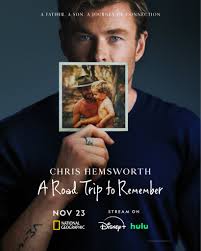
CHRIS HEMSWORTH: A ROAD TRIP TO REMEMBER
Australia/US, 2025, 52 minutes, Colour.
Directed by Tom Barbor-Might.
The road trip of the title is a journey back into the past of Chris Hemsworth’s father, Craig Hemsworth, with incipient Alzheimers.
Chris Hemsworth is able to use his status and influence to finance this beautifully made documentary, his visit to his father, a genial man, Craig Hemsworth, who spent time in the Northern Territory in the 1980s, in a remote town, working with the indigenous men in capturing wild bulls. Supported by his wife, it was a significant time for Chris, born in 1983, and the family living in this territory setting.
In the 1990s, the family moved to Melbourne, Craig Hemsworth working in child protection. While Chris is at the centre of the film with his father, his mother, Leonie, makes many appearances and interview comments. It would have been interesting to have contributions from his two brothers, actors Luke and Liam Hemsworth.
Chris Hemsworth has a discussion with an expert on Alzheimer’s and the brain, Suraj Samtani, seeing him in conversation with Chris but also speaking directly to camera, especially with diagrams and interesting explanations of the structure of the brain, its activity, brain damage, especially for Alzheimer’s and the possible therapies to keep the ageing person’s brain active, personality alive, revisiting the past and memories, engaging in conversations.
However, it is clear from some of the discussions that the Alzheimer’s is advancing. Eventually, Chris Hemsworth does ask his father what he might fear, how he sees the future, the father not wanting to be a burden as he becomes more disabled.
The advantage of being a star celebrity is that Chris Hemsworth was able to organise the family home in Melbourne where they lived in the 1990s to be furnished and redecorated as it was at the time, getting his father to go back and relive remember those times.
Hemsworth rode motorbikes in the past, raising them, and he Chris ride through the Northern Territory outback, and great joy in rediscovering his indigenous friends from many decades earlier, a wonderful reunion.
As with his film roles, even Thor, Chris Hemsworth has a comfortable and easy screen presence and is able to take the audience with him. His father also has great charm and presence and elicits a great deal of audience interest, empathy as well as sympathy for what the future might be for him.
This is a National Geographic production.
Solo Mio
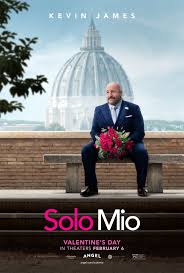
SOLO MIO
US, 2026, 96 minutes, Colour.
Kevin James, Nicole Grimaudo, Jonathan Roumie, Kim Coates, Alyson Hannigan.
Directed by Charles Kinnane, Daniel Kinnane.
No, not the popular song Il Sole Mio (which is played during the film) but rather, solo mio, translated, perhaps, “just me”.
Many audiences, overwhelmed by so many action shows, often say that they would like to see something pleasing, the light touch, interesting and engaging characters, events and occasions – and a touch of travel.
Which is what Solo Mio does provide. It has the endorsement of Angel Studios, of many faith values films (and, surprisingly here in a supporting role is Jonathan Roumi, who plays Jesus in The Chosen). And the production company actually calls itself Higher Standards.
The star is the comedian, Kevin James as Matt, rather benign here, a marriage proposal, acceptance, helped by the children in his art class at school. Then off to Italy, a Rome wedding. But it does not quite turn out that way.
Matt had booked the church then a cycling honeymoon tour with groups of honeymooners. Actually, this does provide some glimpses of Rome and Italy, happy memories for those who have visited. Two couples in particular take on Matt to try to bring him out of himself in his upset.
The main person who helps is the owner of a Café bar, Gia, a vivacious personality that everyone, especially the audience, cannot help but like. Nicole Grimaudi certainly charms us all. She takes Matt under her wing, encouraging him, consoling him, even taking him and his fellow-honeymooners when the group goes to Tuscany, to visit her family – and, who turns out to be her uncle, none other than Andrea Bocelli (who plays the piano and sings). Nessun Dorma plays a pivotal role in the events. And, to cap it all off, there is a crowded Piazza in Siena and a horse race.
Actually, there is surprising twist at the end when Matt’s fiancee turns up for some explanations.
Of course, we all wanted a happy ending so that’s what happens and, not a spoiler but rather a promotion move, an uncredited singer at the final Italian concert is, in fact, Ed Sheeran.
Solo Mio provides a light pleasant outing.
For those who would like something stronger, there is the sensuous and smouldering 21st century interpretation of Emily Brontë, Wuthering Heights.
- The title, Matt standing alone at the altar…?
- Light entertainment, the endorsement of Angel Studios and Higher Standards production? A film for the widest audience?
- The setting, Matt and his art class, Heather, the children joining in, the proposal, her acceptance? Joy? Travel to Italy, church, the congregation, the dinner, plan? Matt, his age, eagerness, standing, the long wait, note, Heather disappearing?
- Audience sharing Matt’s disappointment, the discussions at the hotel, his room, the arrangements, the honeymoon tour, the bikes? The two honeymoon couples, their stories, physical therapist marrying his personal therapist, their characters and discussions, the couple who had divorced twice and married three times, their interactions, distinctive characters, Julian and his intervening?
- Matt going to the bar, the encounter with Gia, warm, attractive, friendly, helping out Matt? Following him around, the club the dancing, the other couples present? Their observations? Matt and his conversations? On the bike by himself?
- Italy, Rome, the landmarks, the popular vistas? Atmosphere? The musical score, including O Sole Mio, Nessun Dorma?
- Matt, his memories of Heather, his disappointment? The group going to Tuscany, Gia offering them to go to her family home, that Andrea Bocelli was her uncle, his playing, singing, singing with Matt? The welcome of the family, the issue of the rivalry, Gia and her rival with the bar, the horses, Siena, the crowds, the race, her losing?
- Her return to Rome, Matt returning, disappointment, his friends? Jar and her disappearance? Hurt?
- Heather and her reappearance, her explanation, Gia emerging, the twist that Gia had been helping her all the time?
- And, the emotional crises, and a happy ending?
Wuthering Heights/ 2026
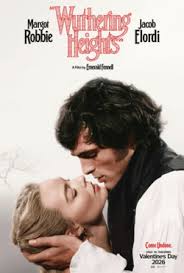
WUTHERING HEIGHTS
UK, 2026, 136 minutes, Colour.
Margot Robbie, Jacob Elordi, Hong Chau, Alison Oliver, Shazad Latif. Charlotte Mellington, Owen Cooper, Vy Nguyen.
Directed by Emerald Fennell.
While it is an obvious thing to say, every reader of Emily Bronte’s 1847 novel brings their own the imagination to her evocative words. And, imaginations are subjective, creating location images, creating the look and sound characters, heightening the action the more we become involved as we read.
The Internet Movie Database indicates that there have been 15 versions of Wuthering Heights since 1920. Here is a 21st-century interpretation/imagining/imaging with soundtrack/popular and character casting. And, when the writer-director is Emerald Fennell (with her provocative films, Promising Young Woman and Saltburn), her imagining may be very different from many in the audience, especially those who have read the book, but, especially, those who cherish the book.
Initial reviews and comments have been very forthright from those who cherish the novel. Many thumbs down as they can manage. But, for those who have not read the novel, there are possibilities of interpretation, interest and fascination.
And, certainly to be noted with this interpretation, key characters and elements of the novel have been rearranged, omitted, while retaining core characters and plot elements of Emily Bronte’s his imagination.
The Yorkshire moors are craggy and mightily forbidding. The Earnshaw home is squalid and dilapidated. The Linton household is opulent. Costumes are lavish. The soundtrack is a blend of classical, old-style ballads, modern sounds and rhythms. The narrative and storytelling is highly emotional, melodramatic.
Interest is in the casting. Margot Robbie is as we might expect as the passionate, conflicted, Catherine. In the first half, Jacob Elordi’s Heathcliff resembles his creature from the recent Frankenstein, intensely savage but humane, intensely passionate and sadistic in the second half.
In fact, our acceptance of Catherine and Heathcliff (after a very Dickensian hanging sequence, crowds cheering as the opening to the film) is made possible by the very effective youngsters, Charlotte Mellington and after his award-winning performance in Adolescence, Owen Cooper.
Martin Clunes stands out with his performance of Cathy’s father, memorable. The character of Nellie is brought to the forefront, her relationship with Catherine, disappointment, betrayal, sinister intervention, played by Hong Chau. There is a great challenge for Alison Oliver as Isabella, initially sheltered and simple (and some audiences laughing at her), then becoming Heathcliff’s victim, co-dependence – is also seem to be the case between Heathcliff and Cathy.
Which means then that Emerald Fennell’s vision of Wuthering Heights Heights, a 21st-century sensibility of passion and the erotic, has elements of Dickens, 19th century romanticism, the popularity of Gothic melodrama, destiny and doom. (Edgar Linton’s description of the situation is that it is, in Emily Brontë’s sensibility, the word “untoward” and the word to describe Heathcliff several times is “fiend”. And we might wonder what Emily Brontë’s reaction would be were she to watch this version.)
This Wuthering Heights highlights, whether it be the 19th century or the 21st-century, love, passion, hatred, betrayal, destruction.
______________________
When the 2011 version of Wuthering Heights was released, starring Kaya Scodelario and James Howson, adapted by Andrea Arnold, same issues were raised as for the 26 version. The following comments are relevant to 2026.
Wuthering Heights is Emily Bronte’s 19th century literary classic. There have been a number of versions, especially the romantic doom and gloom of William Wyler’s 1939 version with Laurence Olivier and Merle Oberon. In a cinematic sense, Olivier with his theatrical delivery became the visual equivalent of the Bronte prose and Merle Oberon’s classic beauty was that of Catherine Earnshaw. The Internet Movie Database lists 15 version since 1920. Luis Bunuel made a version in Spanish (Abismos de Passion). Keith Michel and Claire Bloom in 1962 and Ian Mc Shane was Heathcliff on television in 1967. Anna Calder Marshall teamed with Timothy Dalton (also a smouldering theatrical presence) in 1970. In the 1990s, Ralph Fiennes was Heathcliff to Juliet Binoche’s Catherine. Tom Hardy, who has proven himself a strong and versatile actor, was Heathcliff in a British television in 2009 with Charlotte Riley.
Audiences expecting a continuation of that kind of classic cinema should not venture into this much more experimental interpretation unless they want to see something quite different and to be challenged.
Andrea Arnold made her mark with awards for her contemporary domestic dramas, Red Road and Fish Tank. Now she takes her visual style back into the 19th century and the Yorkshire moors and dales.
A gathering in the dark. Dim hallway. A face. Sky vista. A half-framed picture of two riders. Quivering camera.
This is the technique that Andrea Arnold brings to this 129 minute version of Wuthering Heights. It is both intimate and sometimes off kilter. It is dark. It is grubby. It is episodic. Characters are sometimes glimpsed, then contemplated in close-up. The first part of the film, centred on the dingy Earnshaw farm, has little relief. The second part of the film with much more attention given to the Linton mansion is much more sunny (at times), even with blue skies, the interiors, with some red walls, far more colourful than we had become accustomed to.
The director and her director of photography are attempting an interpretation of the novel via the visual style rather than literary style, although the screenplay offers much of Emily Bronte’s words. It is a disruptive style, at times upsetting, at times puzzling with its idiosyncratic handheld camera work that avoids finesse or neatness. And there are several jolts as characters use expletives that Emily Bronte may not have even known.
This is the context for unsettling characters. Hindley Earnshaw is a brute. His foreman, Joseph, has moments of cruelty. The rest of the family are there, often in the dark, not particularly delineated. Except for Cathy, in her teens, a wild, impetuous young woman. Into this household comes a black slave, bought in charity in Liverpool, to be brought into this Yorkshire life and to become a Christian, Heathcliff. Already this is a jolt for purists, but one of the most interesting features of the film. At first, Cathy spits at him. But, soon, they are kindred spirits, escaping to the top of the heights, riding over the moors. Heathcliff becomes the centre of the film. His plight holds the interest and the emotions.
When Cathy goes to the Linton home and finds herself at home in this different environment, Heathcliff leaves. He disappears for some years.
When he returns, there is different casting for both Heathcliff and Cathy. The continuity between Solomon Glave as the young Heathcliff (offbeat and memorable) and James Howson as the older and more sophisticated Heathcliff is well sustained. This means that Heathcliff’s made passion and revenge and his cruel marriage to Isabella more credible. However, the younger Cathy (Shannon Bear) is what can be called a buxom country lass, full of verve, even of song, impetuous, contradictory, at home at the Earnshaw farm rather than at the Linton’s. However, the older Cathy (Kaya Scodelario) is glamorous and svelte (despite her attempts at a rough accent). Many audiences will find it hard to accept this transformation. Which undermines the drama and Cathy’s responses to Heathcliff.
Edgar Linton is what was once called ‘a wet and a weed). Isabella is hard done by. Nelly Dean must have been there earlier but emerges more significantly when Heathcliff returns. It is Lee Shaw as Hindley who is the most consistent character.
Doubtless there will be more versions of Wuthering Heights. This is the more puzzling and challenging one.
- The impact of this version of Wuthering Heights? The traditional films? The novel? Romantic, stark, dingy? Writer-director Emerald Fennell’s films, tone, direct, sensuality and sexuality?
- Emily Bronte and her writing skills, the characters of Wuthering Heights, its atmosphere? Status and language? Descriptions? Emotions and passion? The range of film and television versions? Her experience in her age?
- Emerald Fennell, the lavish style of her film, and the poverty and squalor of the Earnshaws, the experience of Heathcliff, adopted, servant, place in the family, family, growing up with Cathy?
- The tone of the opening, Dickensian, the gallows, the rabble-rouser, the crowd, the silence, then the shouts, the glee, the nun and her severity? A comment on 19th century society?
- The streamlining of Emily Brontë’s plot, changes in detail of background, characters? Something of the core of the original novel?
- The recreation of the Earnshaw home, dark and squalid, large, the barns, Mr Earnshaw and his age, drinking, gambling, attitude towards his daughter, a mixture of love, treating her with contempt, introducing Heathcliff into the home, favouring him, disciplining him, the effect on Heathcliff?
- Cathy and Heathcliff as children, out on the moors, together, Cathy and her superiority, Heathcliff as servant? The building up of the relationship between them? Company, declarations?
- The years passing, their growing up? Heathcliff, adult, wild, the hair, going about his work, refusing to learn to read? Cathy, the attractive young woman, yet wild? Her whims? Treatment of Heathcliff? His response?
- The arrival of the Lintons, the mansion, Cathy seeing it from the hill, going to visit, looking over the wall, Edgar with Isabella, recounting the plot of Romeo and Juliet, her spectacles? Edgar as a member of the gentry, manners, dress? Isabella, her age, awkward, isolated? Discovering Cathy, bringing her in, her staying, her experience of the opulence of the house, the friendship of Isabella, the treatment by Edgar?
- Mr Earnshaw, his reactions, taunts, his deterioration, health, bad teeth, drinking?
- The role of Nellie, the choice of an ethnic actress, but not for Heathcliff and the novel’s heritage for him? Childhood companion of Cathy, always present, and with Heathcliff? Her infatuation with Cathy? The years passing, her place in the house, her attitude towards Heathcliff? Jealousy?
- Cathy, the emphasis on sexuality, her appearance, clothes, sexual experience, out in the crags? The proposal, her decisions, the discussions with Nellie, Nellie knowing Heathcliff was listening, leading Cathy on, her declaration of humiliation – and Heathcliff missing the fact that she said she loved him?
- Heathcliff, his disappearance, riding off, Cathy upset? Nellie satisfied? The prospects for Cathy, the marriage with Edgar, her pregnancy?
- The years passing, Isabella, her fondness for Cathy, the doll’s house, clothes, the relationship with Edgar, the lavish house, the decorations, clothes? Cathy neglecting her father, going to see him, his state, his death, the funeral?
- Heathcliff’s return, as a gentleman, yet not being able to read? The intensity of the relationship with Cathy, the collage of the sequences of their lovemaking, the intensity, deceptions? Cathy and her pregnancy, not telling Heathcliff?
- Heathcliff, his revenge on Cathy, Isabella, taking her, subduing her, humiliating her, sadomasochistic? Isabella and her consent, the codependency? The comparison with Cathy and Heathcliff and their codependency?
- Heathcliff buying the house, living there, the taunt to Cathy? Isabella in the house, the writing of the letters, trying to provoke Cathy, Nellie receiving them and destroying them?
- Cathy’s discovery about Nellie, banishing her? But the situation, the death of the child, the blood? Cathy and her deterioration? Her death?
Heathcliff, the impact of Cathy’s death, Isabella, the Lintons, Edgar Linton and his disillusionment with Cathy? The fatal future?
Secret Agent, The/ O Agente Secreto
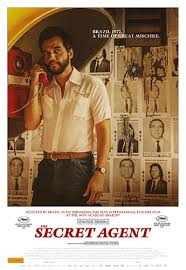
THE SECRET AGENT/ O AGENTE SECRETO
Brazil, 2025, 161 minutes, Colour.
Wagner Moura, Carlos Francesco, Tania Maria, Roberio Diogenes, Maria Fernanda Candide, Gabriel Leone.
Directed by Kleber Mendonça Filho
The title has been used a number of films about espionage. It is not quite the meaning for this Brazilian film. It has won awards at festivals, Oscar nominations, and a Golden Globe for Best Actor in a drama for the star, Wagner Moura, popular in Brazilian films and seeing and the number of international films.
Latin-American audiences will be immediately on the wavelength of this film, set in 1977, a time of authoritarian oppression, secrecy, violence – not just in Brazil, remembering the time of the generals in Argentina, the Pinochet dictatorship in Chile… For audiences not immediately familiar with this history of these cultures, a great deal of attention is required to understand, to appreciate, what is going on affecting the central characters.
And, this is a long film, most of the action taking place in 1977 but moving into significant flashbacks which require some concentration to appreciate how they reveal the characters. And, at times, there are fast forwards to the 21st-century, two women in an office with their computers listening to tapes of interviews from the earlier period.
The film opens with Marcelo driving through the desert, a service station, a dead body, police arriving, interrogation, creating an atmosphere. He then drives to the city of Recife where an elderly woman, full of vitality and energy, runs a refuge: a teenager run away from home, a dentist and her daughter, political refugees from Angola, and a place for Marcelo and the revelation of his real name is Armando.
The film becomes rather surrealistic with a giant shark which has bitten off a human leg, an expert supervising the extraction, the police present (and a strange sequence where the severed leg, larger than life, its marauding through a park area targeting couples involved in sexual activity – and the comment that the media have taken up this story, exploiting it to cover actual corruption.
We discover that Armando has been targeted by a corrupt businessmen taking over faculty research at the University, the death of his wife, his entrusting his son to his in-laws, the sympathetic grandfather a projectionist at the local cinema, and a special focus on screenings of Jaws and the young boy’s nightmares.
The drama involves the businessman hiring and negotiating fees with assassins, their searching out a local killer, involvement of the local police, chases and shootouts, Armando in the meantime looking for evidence about his family, discussions with a sympathetic underground couple to get a passport, atmosphere of intrigue and dangers.
Even though the film is long, audiences might have wanted a bit more at the end as the film moves into the 21st-century, the role of the women listening to the tapes investigating corruption in the past – and a visit to the young son, now working in a medical centre, symbolic that from the darkness of the past and disorder, light can emerge.
- Brazil, the 1970s, government, of oppression, persecutions? Impact for a Brazilian audience, non-Brazilian audience?
- The locations, the Brazilian countryside, desert, cities, Recife, San Pablo? The urban centres, official officers, police, homes and apartments? The countryside, the service stations, the open spaces? The musical score, contemporary songs?
- The impact of the opening, Armando driving through the desert, the service station, the owner, the dead body, the police arriving, the search and interrogation? His driving on? Atmosphere of mystery?
- The various chapters, the titles and focus?
- Armando, arriving in the city, the contact with Donna Sebastiana, her age, chatter, story, refuge for displaced persons, Clovis going from his family, Haraldo and his mystery, the couple from Angola, the dentist and her daughter? The community, the familiar scenes together? Armando and the liaison with the dentist?
- Building up Armando’s past, the range of flashbacks? The scenes with Chiotti, killers, the contracts and the bargaining? Their travel, local contacts, picking out an assassin, bargaining about the price? The killer and his son? The setting up of Armando, the killer with the photo, identifying him at the bureau of identity, not shooting, Armando escaping, the pursuit, Armando asking the police chief, his sending his sons, the shootout, their deaths, the wounding of the assassin, the trail of blood, the barbers, the son pursuing him, shot dead?
- The background flashbacks, the University, the team, their investigations? Chiotti and his interventions, demands, the threats? Fatima and her response, her death? Armando and his grief at his wife’s death, the son, giving him to the care of his grandparents?
- The grandparents, genial, the grandfather and his working at the cinema, the facade of the cinema, the range of films shown, the emphasis on Jaws? Armando and his visits, the bond with his son, the drawings, the discussion about sharks, nightmares? His plan for the passports, to get out of Brazil with his son? The grandfather realising this? The assistant at the cinema, getting the information, passing it on to the assassin?
- The episode with the shark, the severed leg, its size, the expert, the police chief and his sons, the identification of the leg, the later sequences of the leg on the rampage, the parks, the couples and sex activity, the attack of the leg? The suggestion that the media use this story to cover up actual corruption?
- Elza, her assistant, their helping people in trouble, the recording of the interview, the issue passports, their help?
- The 21st-century, the young women, computers, listening to the tapes, googling information?
- Armando, wanting to find information about his mother, at the bureau, the support of the police?
- The information about his death? The 21st-century, the young women, the interview with Fernando, his medical work, Armando son, the Medical Center, formally the cinema, his not remembering his father, his grandfather showing him Jaws and no more nightmares?
- The memories of the 1970s and oppression? Brazilian hopes for the 21st-century?
Josephine and Men
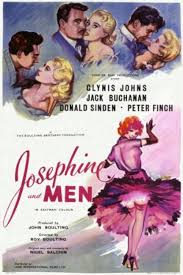
JOSEPHINE AND MEN
UK, 1955, 95 minutes, Colour.
Glynis Johns, Donald Sinden, Jack Buchanan, Peter Finch, Heather Thatcher, Ronald Squire, William Hartnell, Gerald Sim, Victor Maddern, Thorley Walters, Laurence Naismith, John Le Mesurier, Lisa Gastoni.
Directed by Roy Boulting.
This is an all-stops-out comedy drama of the mid-1950s. It has a strong leading cast but it is also a film with many well-known British character actors in supporting roles.
The Josephine of the title is played by Glynis Johns, busy, organised, intervening, engaged to Donnell Sinden, an upcoming businessman. Also around is her playboy uncle who narrates the story into a bartender, played by veteran Jack Buchanan, in films since 1917, Broadway since 1924, very well known for his starring role in The Bandwagon. And, then there is the emerging Peter Finch as a playwright.
The film should have worked better than it does. Perhaps Nigel Balchn, creator of thriller novels and screenplays is not the best choice for writing this kind of comedy drama. And, Roy Boulting had great success with films like Brighton Rock.
The actors give their all but the treatment seems, at least in retrospect, somewhat laboured. Josephine with a compulsion to help needy men, encountering the disorganised playwright, breaking the engagement to the businessman, marrying the playwright and, over the years, supporting him, urging him, and his having great success. On the other hand, the businessman has resigned, successful but suddenly turning up on their doorstep with the police after him because of allegations of fraud.
And, at the same time, the wandering, uncle also turns up.
So, Josephine with her compulsion needs to be helping the businessman on the run and so neglecting her husband. All kinds of complications, misunderstandings, the police in pursuit and interrogations, some amusing supporting characters with their roles.
But, many decades later, does not have the impact it may have had in its day.
Up the Front

UP THE FRONT
UK, 1972, 89 minutes, Colour.
Frankie Howerd, Bill Fraser, William Mervyn, Linda Gray, Jonathan Cecil, Dora Bryan, Stanley Holloway, Bob Hoskins, Peter Bull, Vernon Dobtcheff..
Directed by Bob Kellett.
Frankie Howerd had a long career in comedy, especially in television and films. During the 1960s and early 1970s he appeared in The Chastity Belt and, especially, the comedy television series Up Pompeii. He also appeared in several Carry on films.
Frankie Howerd characteristically broke the fourth wall, looking at the audience, looking straight to camera, confiding all his thoughts and feelings, his jokes, his mischief, and the touch of the affected disapproval at times to the audience.
This film, playing with the Pompeii title, is set in World War I, Up the Front, starting in an aristocratic mansion, Frankie Howerd is Lurk, a servant, hypnotised during a show, then volunteering for the war – and all kinds of adventures and misadventures in France at the front.
Once again, a considerable number of British character actors are there in support. But, Frankie Howerd is an acquired taste, popular in his time, but not so lasting. Which means that this is a film for his fans and for those studying the style of popular British film comedy in the 1960s and 1970s.
I've Gotta Horse
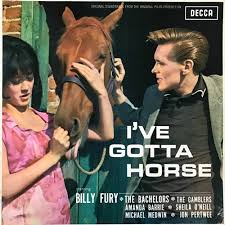
I’VE GOTTA HORSE
UK, 1965, 92 minutes, Colour.
Billy Fury, Michael Medwin, Amanda Barrie, The Bachelors, Bill Fraser, Leslie Dwyer, Marjorie Rhodes.
Directed by Kenneth Hume.
Billy Fury was a popular British singer of the 1960s. He came after such celebrities as Tommy Steele and Cliff Richard. And they coincided with The Beatles and the emergence of The Rolling Stones. They are symbolic of a change in taste for popular music from the 1950s to rock ‘n’ roll.
Billy Fury made few films. And, in this one, he appears as himself, a friendly and genial personality, lover of animals – which he was in real life. He had a racehorse, Anselmo, who features also in this film, receiving a credit as do Billy Fury’s dogs.
The film is very slight in plot, the putting on a show. Michael Medwin, with Amanda Barrie as his assistant, is Billy’s manager. The producer is the perpetually grumbling and demanding Bill Fraser. The popular group, The Bachelors, provide a supporting cast.
Audiences will share the joy incest of character actor, Leslie Dwyer, as Billy’s friend and assistant, joining in the singing and dancing, enjoying himself.
The film is full of songs, the popular style of the late 1950s into the 1960s, very reminiscent of Cliff Richard (as is the whole film). It would seem that any occasion offers the opportunity for a song. And, there are quite a number of song and dance routines on stage.
And, there are a lot of animals, including songs about them and the title song as well. Plenty of dogs, and some racehorses and a big finale race.
Billy Fury is not so well remembered these years – but, this is a pleasant reminder of his abilities and personality, there is also a reminder that this film was released in 1965, the year of the release of the Beatles’ A Hard Day’s Night, indicating a different musical style and sensibility.
Carry on Cabby
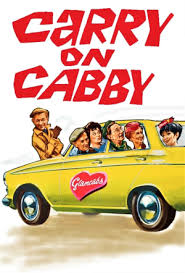
CARRY ON CABBY
UK, 1963, 91 minutes, Black-and-white.
Sidney James, Hattie Jacques, Kenneth Connor, Charles Hawtrey, Esma Cannon, Liz Fraser, Bill Owen, Milo O'Shea, Judith Furse, René Houston, Jim Dale, Amanda Barrie, Norman Chappell.
Directed by Gerald Thomas.
Not originally intended as a Carry on comedy. It was Called Me a Cab, written by Sid Green and Dick Hills, writers for the comedy team of Morecombe and Wise. But, with the popularity of the Carry on series, regular writer, Talbot Rothwell adapted it.
This means there are two different features for this Carry on comedy. There is far more plot and character development and interaction. And, the film relies far less on sexual references and jokes and innuendo. In fact, Sid James, apart from being a workaholic taxi driver and neglecting his wife, is quite respectable.
The film also acknowledges support from the taxi companies in London. And, with many variations on the theme, it shows how significant taxis can be.
Sid James loves driving taxis, worked with his partner, played in his usual way by Kenneth Connor (who does have to dress up as a female taxi driver at one stage). And Sid James is married to Hattie Jacques. The comment is that she thinks this is the best of her Carry on films – and, she is at her best, creating a character, a greater range of emotions than a stern matron! Charles Hawtrey does his usual simple-minded shtick. But, there is the advantage of Milo O’Shea as a taxidriver in an early role, veteran Esma Cannon, Liz Fraser, and introducing to the series, Jim Dale as a frantic father and Amanda Barrie.
When Sid James is caught up in taxi problems and neglects his wife’s anniversary celebrations, she decides to set up a rival company, not letting him know. She buys many taxis, gets glamorous drivers, is able to steal his clientele, with digs at ogling males. So, plenty of shenanigans. But, when the Glam firm is so successful, Sid James has to use his wits to bring down the company.
So, a lot of comedy, some slapstick, some tense situations, and the good idea of having some robbers hijack Hattie Jacques’s car and everybody then in on the act to track the robbers with the whole taxi fleet.
Enjoyable, British filmmaking in the 1960s, and the most PG rated of all the Carry on films!
Are You Being Served?
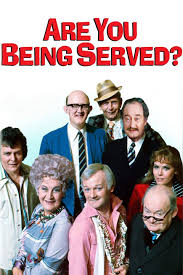
ARE YOU ARE BEING SERVED?
UK, 1977, 95 minutes, Colour.
John Inman, Mollie Sugden, Frank Thornton, Trevor Bannister, Wendy Richard, Arthur Brough, Nicholas Smith, Harold Bennett, Arthur English, Karan David, Glyn Houston, Andrew Sachs, Sheila Staefel.
Directed by Bob Kellett.
This television spin-off of the very popular British television comedy series came out in the middle of the long season of the series, 1977, the series ranging from 1972 to 1985, with the same central cast over the many years. Many of them regrouped in 1992-93 for 12 episodes of Are You Being Served, Again? (And John Inman was in Australia in 1981 for16 episodes, with opera singer and actress June Bronhill, for Are You Being Served in Australia? (
The audience coming to this film without knowing anything of the television background will find a very broad comedy, very much in the music hall tradition, creativity with stereotypic characters, farcical situations and behaviour, more than a touch of caricature, a range of very obvious jokes, always very broad humour and plenty of innuendo. Which may illustrate the type of British humour on television in the 1970s, thinking of On the Buses, Up Pompeii… (And the director of this film, Bob Kellett, directed the film versions of Up Pompeii and Up the Front.)
For those familiar with the television series (and it has been continually repeated on streaming television over the decades), they will enjoy meeting up with all the familiar characters, especially John Inman’s Mr Humphreys and his deliberately mincing style, Mollie Sugden as Mrs Slovombe and her touches of snobbery and being unanimous about her opinions, Wendy Richards as the young assistant from the store, Nicholas Smith as the rather pompous superior, Frank Thornton with his roving eye, Trevor Bannister as the cheeky junior, Arthur Brough as the old man, Arthur English as the practical man who one-ups them all in this film, and some scenes with Harold Bennett as the owner of the store. They play on their familiar types all the way through.
However, while the film opens with the store and Sheila Staefel trying on hats, the plan is that they all go to Spain for a group holiday, the preparations, the photos and passports, at the airport, the hotel – where, of all people, Andrew Sachs with memories of Fawlty Towers is the manager this time of the hotel, having to deal with an uprising of terrorists, the guests having to stay in tents overnight, all the mixups with the tents, confusion with notes to each other, a huge toilet with all kinds of toilet jokes, and a final shootout with the Brits being victorious.
So, an enjoyably reunion of the Grace Brothers staff!
Agua Sala/ Salt Water
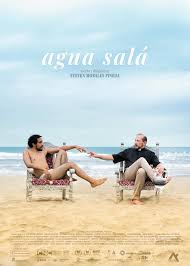
AGUA SALA/ SALT WATER
Colombia, 2024, 83 minutes, Colour.
Luis Mario Jimenez, Oscar Salazar.
Directed by Steven Morales Pineda.
At the centre of this film is the issue of sexual encounters, sexual abuse of children, especially by clergy, and the consequences.
The main character here, Jacobo (Luis Mario Jimenez) is a lively 33 year old living in a coastal town in Colombia. He has trained as a nurse but has been overwhelmed by the Covid experience (the film made in 2021, people wearing masks…), But offering yoga classes. He clashes with his mother, remarried twice, care for half brother who has a crippled foot, many friends in the town. He is gay and has a boarder and partner who is married with a pregnant wife.
Several times, he looks on his phone at reports of a priest accused of sexual abuse, the accusations and indications of Vatican files, the priest continually proclaiming his innocence. It is clear that Jacobo has had this kind of experience in his past.
Then the priest in question, now aged 50, considering leaving the church, still denying all the accusations, comes to the town and visits Jacobo. This is where the screenplay becomes complex – especially since it is based on the school experiences of the writer and director. In many ways Jacobo welcomes the visit, the contact again, the two reminiscing with many memories of school, Jacobo benefiting by the introduction to literature and wider horizons. One of his friends arrives, announcing that his wife is pregnant, but is disgusted at the presence of the priest – and, again, obviously memories, this time very unhappy.
Jacobo moves his partner out, makes the room available for the priest, who comes to live, many outings on the beach, discussions, memories, music, buying a small accordion for Jacobo to play, their singing. The complication is that the priest is still religious in his heart, with his Bible, declaringthat any text will resonate in some way with the reader, explicit mention of the text about light hidden under a bushel and that truth will be made manifest.
There is the sexual attraction, Jacobo wanting more, quite a long scene where the priest helps Jacobo to shave his moustache and beard, no words, just a musical accompaniment and leaving this evocative and emotional experience to the audience. And, then, Jacobo walks to the beach, shedding all his clothes, and then imagining the priest present.
There is a final sequence, the priest outside, Jacobo inside and a kind of grill separating them (Jacobo previously mentioning the place of his first confession), seeming like a confessional experience but with the priest seriously explaining his decision to move away.
Interestingly, from a Catholic spirituality perspective, the film is divided into chapters, each based on the titles of the weeks in the Spiritual Exercises of St Ignatius Loyola, the third week divided into two, calling and Passion/cross. (Only one review found which mentions this but no explanation.) And, it is noted that Jacobo was seen reading a book, Como esta tarde para siempre) by Jaime Manrique, about two seminarians in love.)
A different perspective, Latin-American perspective, on relationships between priests and children.
