Displaying items by tag: Martin Clunes
Wuthering Heights/ 2026
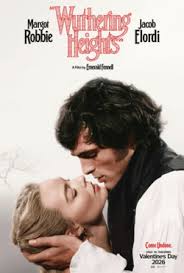
WUTHERING HEIGHTS
UK, 2026, 136 minutes, Colour.
Margot Robbie, Jacob Elordi, Hong Chau, Alison Oliver, Shazad Latif. Charlotte Mellington, Owen Cooper, Vy Nguyen.
Directed by Emerald Fennell.
While it is an obvious thing to say, every reader of Emily Bronte’s 1847 novel brings their own the imagination to her evocative words. And, imaginations are subjective, creating location images, creating the look and sound characters, heightening the action the more we become involved as we read.
The Internet Movie Database indicates that there have been 15 versions of Wuthering Heights since 1920. Here is a 21st-century interpretation/imagining/imaging with soundtrack/popular and character casting. And, when the writer-director is Emerald Fennell (with her provocative films, Promising Young Woman and Saltburn), her imagining may be very different from many in the audience, especially those who have read the book, but, especially, those who cherish the book.
Initial reviews and comments have been very forthright from those who cherish the novel. Many thumbs down as they can manage. But, for those who have not read the novel, there are possibilities of interpretation, interest and fascination.
And, certainly to be noted with this interpretation, key characters and elements of the novel have been rearranged, omitted, while retaining core characters and plot elements of Emily Bronte’s his imagination.
The Yorkshire moors are craggy and mightily forbidding. The Earnshaw home is squalid and dilapidated. The Linton household is opulent. Costumes are lavish. The soundtrack is a blend of classical, old-style ballads, modern sounds and rhythms. The narrative and storytelling is highly emotional, melodramatic.
Interest is in the casting. Margot Robbie is as we might expect as the passionate, conflicted, Catherine. In the first half, Jacob Elordi’s Heathcliff resembles his creature from the recent Frankenstein, intensely savage but humane, intensely passionate and sadistic in the second half.
In fact, our acceptance of Catherine and Heathcliff (after a very Dickensian hanging sequence, crowds cheering as the opening to the film) is made possible by the very effective youngsters, Charlotte Mellington and after his award-winning performance in Adolescence, Owen Cooper.
Martin Clunes stands out with his performance of Cathy’s father, memorable. The character of Nellie is brought to the forefront, her relationship with Catherine, disappointment, betrayal, sinister intervention, played by Hong Chau. There is a great challenge for Alison Oliver as Isabella, initially sheltered and simple (and some audiences laughing at her), then becoming Heathcliff’s victim, co-dependence – is also seem to be the case between Heathcliff and Cathy.
Which means then that Emerald Fennell’s vision of Wuthering Heights Heights, a 21st-century sensibility of passion and the erotic, has elements of Dickens, 19th century romanticism, the popularity of Gothic melodrama, destiny and doom. (Edgar Linton’s description of the situation is that it is, in Emily Brontë’s sensibility, the word “untoward” and the word to describe Heathcliff several times is “fiend”. And we might wonder what Emily Brontë’s reaction would be were she to watch this version.)
This Wuthering Heights highlights, whether it be the 19th century or the 21st-century, love, passion, hatred, betrayal, destruction.
______________________
When the 2011 version of Wuthering Heights was released, starring Kaya Scodelario and James Howson, adapted by Andrea Arnold, same issues were raised as for the 26 version. The following comments are relevant to 2026.
Wuthering Heights is Emily Bronte’s 19th century literary classic. There have been a number of versions, especially the romantic doom and gloom of William Wyler’s 1939 version with Laurence Olivier and Merle Oberon. In a cinematic sense, Olivier with his theatrical delivery became the visual equivalent of the Bronte prose and Merle Oberon’s classic beauty was that of Catherine Earnshaw. The Internet Movie Database lists 15 version since 1920. Luis Bunuel made a version in Spanish (Abismos de Passion). Keith Michel and Claire Bloom in 1962 and Ian Mc Shane was Heathcliff on television in 1967. Anna Calder Marshall teamed with Timothy Dalton (also a smouldering theatrical presence) in 1970. In the 1990s, Ralph Fiennes was Heathcliff to Juliet Binoche’s Catherine. Tom Hardy, who has proven himself a strong and versatile actor, was Heathcliff in a British television in 2009 with Charlotte Riley.
Audiences expecting a continuation of that kind of classic cinema should not venture into this much more experimental interpretation unless they want to see something quite different and to be challenged.
Andrea Arnold made her mark with awards for her contemporary domestic dramas, Red Road and Fish Tank. Now she takes her visual style back into the 19th century and the Yorkshire moors and dales.
A gathering in the dark. Dim hallway. A face. Sky vista. A half-framed picture of two riders. Quivering camera.
This is the technique that Andrea Arnold brings to this 129 minute version of Wuthering Heights. It is both intimate and sometimes off kilter. It is dark. It is grubby. It is episodic. Characters are sometimes glimpsed, then contemplated in close-up. The first part of the film, centred on the dingy Earnshaw farm, has little relief. The second part of the film with much more attention given to the Linton mansion is much more sunny (at times), even with blue skies, the interiors, with some red walls, far more colourful than we had become accustomed to.
The director and her director of photography are attempting an interpretation of the novel via the visual style rather than literary style, although the screenplay offers much of Emily Bronte’s words. It is a disruptive style, at times upsetting, at times puzzling with its idiosyncratic handheld camera work that avoids finesse or neatness. And there are several jolts as characters use expletives that Emily Bronte may not have even known.
This is the context for unsettling characters. Hindley Earnshaw is a brute. His foreman, Joseph, has moments of cruelty. The rest of the family are there, often in the dark, not particularly delineated. Except for Cathy, in her teens, a wild, impetuous young woman. Into this household comes a black slave, bought in charity in Liverpool, to be brought into this Yorkshire life and to become a Christian, Heathcliff. Already this is a jolt for purists, but one of the most interesting features of the film. At first, Cathy spits at him. But, soon, they are kindred spirits, escaping to the top of the heights, riding over the moors. Heathcliff becomes the centre of the film. His plight holds the interest and the emotions.
When Cathy goes to the Linton home and finds herself at home in this different environment, Heathcliff leaves. He disappears for some years.
When he returns, there is different casting for both Heathcliff and Cathy. The continuity between Solomon Glave as the young Heathcliff (offbeat and memorable) and James Howson as the older and more sophisticated Heathcliff is well sustained. This means that Heathcliff’s made passion and revenge and his cruel marriage to Isabella more credible. However, the younger Cathy (Shannon Bear) is what can be called a buxom country lass, full of verve, even of song, impetuous, contradictory, at home at the Earnshaw farm rather than at the Linton’s. However, the older Cathy (Kaya Scodelario) is glamorous and svelte (despite her attempts at a rough accent). Many audiences will find it hard to accept this transformation. Which undermines the drama and Cathy’s responses to Heathcliff.
Edgar Linton is what was once called ‘a wet and a weed). Isabella is hard done by. Nelly Dean must have been there earlier but emerges more significantly when Heathcliff returns. It is Lee Shaw as Hindley who is the most consistent character.
Doubtless there will be more versions of Wuthering Heights. This is the more puzzling and challenging one.
- The impact of this version of Wuthering Heights? The traditional films? The novel? Romantic, stark, dingy? Writer-director Emerald Fennell’s films, tone, direct, sensuality and sexuality?
- Emily Bronte and her writing skills, the characters of Wuthering Heights, its atmosphere? Status and language? Descriptions? Emotions and passion? The range of film and television versions? Her experience in her age?
- Emerald Fennell, the lavish style of her film, and the poverty and squalor of the Earnshaws, the experience of Heathcliff, adopted, servant, place in the family, family, growing up with Cathy?
- The tone of the opening, Dickensian, the gallows, the rabble-rouser, the crowd, the silence, then the shouts, the glee, the nun and her severity? A comment on 19th century society?
- The streamlining of Emily Brontë’s plot, changes in detail of background, characters? Something of the core of the original novel?
- The recreation of the Earnshaw home, dark and squalid, large, the barns, Mr Earnshaw and his age, drinking, gambling, attitude towards his daughter, a mixture of love, treating her with contempt, introducing Heathcliff into the home, favouring him, disciplining him, the effect on Heathcliff?
- Cathy and Heathcliff as children, out on the moors, together, Cathy and her superiority, Heathcliff as servant? The building up of the relationship between them? Company, declarations?
- The years passing, their growing up? Heathcliff, adult, wild, the hair, going about his work, refusing to learn to read? Cathy, the attractive young woman, yet wild? Her whims? Treatment of Heathcliff? His response?
- The arrival of the Lintons, the mansion, Cathy seeing it from the hill, going to visit, looking over the wall, Edgar with Isabella, recounting the plot of Romeo and Juliet, her spectacles? Edgar as a member of the gentry, manners, dress? Isabella, her age, awkward, isolated? Discovering Cathy, bringing her in, her staying, her experience of the opulence of the house, the friendship of Isabella, the treatment by Edgar?
- Mr Earnshaw, his reactions, taunts, his deterioration, health, bad teeth, drinking?
- The role of Nellie, the choice of an ethnic actress, but not for Heathcliff and the novel’s heritage for him? Childhood companion of Cathy, always present, and with Heathcliff? Her infatuation with Cathy? The years passing, her place in the house, her attitude towards Heathcliff? Jealousy?
- Cathy, the emphasis on sexuality, her appearance, clothes, sexual experience, out in the crags? The proposal, her decisions, the discussions with Nellie, Nellie knowing Heathcliff was listening, leading Cathy on, her declaration of humiliation – and Heathcliff missing the fact that she said she loved him?
- Heathcliff, his disappearance, riding off, Cathy upset? Nellie satisfied? The prospects for Cathy, the marriage with Edgar, her pregnancy?
- The years passing, Isabella, her fondness for Cathy, the doll’s house, clothes, the relationship with Edgar, the lavish house, the decorations, clothes? Cathy neglecting her father, going to see him, his state, his death, the funeral?
- Heathcliff’s return, as a gentleman, yet not being able to read? The intensity of the relationship with Cathy, the collage of the sequences of their lovemaking, the intensity, deceptions? Cathy and her pregnancy, not telling Heathcliff?
- Heathcliff, his revenge on Cathy, Isabella, taking her, subduing her, humiliating her, sadomasochistic? Isabella and her consent, the codependency? The comparison with Cathy and Heathcliff and their codependency?
- Heathcliff buying the house, living there, the taunt to Cathy? Isabella in the house, the writing of the letters, trying to provoke Cathy, Nellie receiving them and destroying them?
- Cathy’s discovery about Nellie, banishing her? But the situation, the death of the child, the blood? Cathy and her deterioration? Her death?
Heathcliff, the impact of Cathy’s death, Isabella, the Lintons, Edgar Linton and his disillusionment with Cathy? The fatal future?
