Displaying items by tag: Hong Chau
Wuthering Heights/ 2026
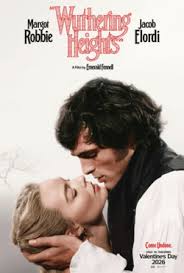
WUTHERING HEIGHTS
UK, 2026, 136 minutes, Colour.
Margot Robbie, Jacob Elordi, Hong Chau, Alison Oliver, Shazad Latif. Charlotte Mellington, Owen Cooper, Vy Nguyen.
Directed by Emerald Fennell.
While it is an obvious thing to say, every reader of Emily Bronte’s 1847 novel brings their own the imagination to her evocative words. And, imaginations are subjective, creating location images, creating the look and sound characters, heightening the action the more we become involved as we read.
The Internet Movie Database indicates that there have been 15 versions of Wuthering Heights since 1920. Here is a 21st-century interpretation/imagining/imaging with soundtrack/popular and character casting. And, when the writer-director is Emerald Fennell (with her provocative films, Promising Young Woman and Saltburn), her imagining may be very different from many in the audience, especially those who have read the book, but, especially, those who cherish the book.
Initial reviews and comments have been very forthright from those who cherish the novel. Many thumbs down as they can manage. But, for those who have not read the novel, there are possibilities of interpretation, interest and fascination.
And, certainly to be noted with this interpretation, key characters and elements of the novel have been rearranged, omitted, while retaining core characters and plot elements of Emily Bronte’s his imagination.
The Yorkshire moors are craggy and mightily forbidding. The Earnshaw home is squalid and dilapidated. The Linton household is opulent. Costumes are lavish. The soundtrack is a blend of classical, old-style ballads, modern sounds and rhythms. The narrative and storytelling is highly emotional, melodramatic.
Interest is in the casting. Margot Robbie is as we might expect as the passionate, conflicted, Catherine. In the first half, Jacob Elordi’s Heathcliff resembles his creature from the recent Frankenstein, intensely savage but humane, intensely passionate and sadistic in the second half.
In fact, our acceptance of Catherine and Heathcliff (after a very Dickensian hanging sequence, crowds cheering as the opening to the film) is made possible by the very effective youngsters, Charlotte Mellington and after his award-winning performance in Adolescence, Owen Cooper.
Martin Clunes stands out with his performance of Cathy’s father, memorable. The character of Nellie is brought to the forefront, her relationship with Catherine, disappointment, betrayal, sinister intervention, played by Hong Chau. There is a great challenge for Alison Oliver as Isabella, initially sheltered and simple (and some audiences laughing at her), then becoming Heathcliff’s victim, co-dependence – is also seem to be the case between Heathcliff and Cathy.
Which means then that Emerald Fennell’s vision of Wuthering Heights Heights, a 21st-century sensibility of passion and the erotic, has elements of Dickens, 19th century romanticism, the popularity of Gothic melodrama, destiny and doom. (Edgar Linton’s description of the situation is that it is, in Emily Brontë’s sensibility, the word “untoward” and the word to describe Heathcliff several times is “fiend”. And we might wonder what Emily Brontë’s reaction would be were she to watch this version.)
This Wuthering Heights highlights, whether it be the 19th century or the 21st-century, love, passion, hatred, betrayal, destruction.
______________________
When the 2011 version of Wuthering Heights was released, starring Kaya Scodelario and James Howson, adapted by Andrea Arnold, same issues were raised as for the 26 version. The following comments are relevant to 2026.
Wuthering Heights is Emily Bronte’s 19th century literary classic. There have been a number of versions, especially the romantic doom and gloom of William Wyler’s 1939 version with Laurence Olivier and Merle Oberon. In a cinematic sense, Olivier with his theatrical delivery became the visual equivalent of the Bronte prose and Merle Oberon’s classic beauty was that of Catherine Earnshaw. The Internet Movie Database lists 15 version since 1920. Luis Bunuel made a version in Spanish (Abismos de Passion). Keith Michel and Claire Bloom in 1962 and Ian Mc Shane was Heathcliff on television in 1967. Anna Calder Marshall teamed with Timothy Dalton (also a smouldering theatrical presence) in 1970. In the 1990s, Ralph Fiennes was Heathcliff to Juliet Binoche’s Catherine. Tom Hardy, who has proven himself a strong and versatile actor, was Heathcliff in a British television in 2009 with Charlotte Riley.
Audiences expecting a continuation of that kind of classic cinema should not venture into this much more experimental interpretation unless they want to see something quite different and to be challenged.
Andrea Arnold made her mark with awards for her contemporary domestic dramas, Red Road and Fish Tank. Now she takes her visual style back into the 19th century and the Yorkshire moors and dales.
A gathering in the dark. Dim hallway. A face. Sky vista. A half-framed picture of two riders. Quivering camera.
This is the technique that Andrea Arnold brings to this 129 minute version of Wuthering Heights. It is both intimate and sometimes off kilter. It is dark. It is grubby. It is episodic. Characters are sometimes glimpsed, then contemplated in close-up. The first part of the film, centred on the dingy Earnshaw farm, has little relief. The second part of the film with much more attention given to the Linton mansion is much more sunny (at times), even with blue skies, the interiors, with some red walls, far more colourful than we had become accustomed to.
The director and her director of photography are attempting an interpretation of the novel via the visual style rather than literary style, although the screenplay offers much of Emily Bronte’s words. It is a disruptive style, at times upsetting, at times puzzling with its idiosyncratic handheld camera work that avoids finesse or neatness. And there are several jolts as characters use expletives that Emily Bronte may not have even known.
This is the context for unsettling characters. Hindley Earnshaw is a brute. His foreman, Joseph, has moments of cruelty. The rest of the family are there, often in the dark, not particularly delineated. Except for Cathy, in her teens, a wild, impetuous young woman. Into this household comes a black slave, bought in charity in Liverpool, to be brought into this Yorkshire life and to become a Christian, Heathcliff. Already this is a jolt for purists, but one of the most interesting features of the film. At first, Cathy spits at him. But, soon, they are kindred spirits, escaping to the top of the heights, riding over the moors. Heathcliff becomes the centre of the film. His plight holds the interest and the emotions.
When Cathy goes to the Linton home and finds herself at home in this different environment, Heathcliff leaves. He disappears for some years.
When he returns, there is different casting for both Heathcliff and Cathy. The continuity between Solomon Glave as the young Heathcliff (offbeat and memorable) and James Howson as the older and more sophisticated Heathcliff is well sustained. This means that Heathcliff’s made passion and revenge and his cruel marriage to Isabella more credible. However, the younger Cathy (Shannon Bear) is what can be called a buxom country lass, full of verve, even of song, impetuous, contradictory, at home at the Earnshaw farm rather than at the Linton’s. However, the older Cathy (Kaya Scodelario) is glamorous and svelte (despite her attempts at a rough accent). Many audiences will find it hard to accept this transformation. Which undermines the drama and Cathy’s responses to Heathcliff.
Edgar Linton is what was once called ‘a wet and a weed). Isabella is hard done by. Nelly Dean must have been there earlier but emerges more significantly when Heathcliff returns. It is Lee Shaw as Hindley who is the most consistent character.
Doubtless there will be more versions of Wuthering Heights. This is the more puzzling and challenging one.
- The impact of this version of Wuthering Heights? The traditional films? The novel? Romantic, stark, dingy? Writer-director Emerald Fennell’s films, tone, direct, sensuality and sexuality?
- Emily Bronte and her writing skills, the characters of Wuthering Heights, its atmosphere? Status and language? Descriptions? Emotions and passion? The range of film and television versions? Her experience in her age?
- Emerald Fennell, the lavish style of her film, and the poverty and squalor of the Earnshaws, the experience of Heathcliff, adopted, servant, place in the family, family, growing up with Cathy?
- The tone of the opening, Dickensian, the gallows, the rabble-rouser, the crowd, the silence, then the shouts, the glee, the nun and her severity? A comment on 19th century society?
- The streamlining of Emily Brontë’s plot, changes in detail of background, characters? Something of the core of the original novel?
- The recreation of the Earnshaw home, dark and squalid, large, the barns, Mr Earnshaw and his age, drinking, gambling, attitude towards his daughter, a mixture of love, treating her with contempt, introducing Heathcliff into the home, favouring him, disciplining him, the effect on Heathcliff?
- Cathy and Heathcliff as children, out on the moors, together, Cathy and her superiority, Heathcliff as servant? The building up of the relationship between them? Company, declarations?
- The years passing, their growing up? Heathcliff, adult, wild, the hair, going about his work, refusing to learn to read? Cathy, the attractive young woman, yet wild? Her whims? Treatment of Heathcliff? His response?
- The arrival of the Lintons, the mansion, Cathy seeing it from the hill, going to visit, looking over the wall, Edgar with Isabella, recounting the plot of Romeo and Juliet, her spectacles? Edgar as a member of the gentry, manners, dress? Isabella, her age, awkward, isolated? Discovering Cathy, bringing her in, her staying, her experience of the opulence of the house, the friendship of Isabella, the treatment by Edgar?
- Mr Earnshaw, his reactions, taunts, his deterioration, health, bad teeth, drinking?
- The role of Nellie, the choice of an ethnic actress, but not for Heathcliff and the novel’s heritage for him? Childhood companion of Cathy, always present, and with Heathcliff? Her infatuation with Cathy? The years passing, her place in the house, her attitude towards Heathcliff? Jealousy?
- Cathy, the emphasis on sexuality, her appearance, clothes, sexual experience, out in the crags? The proposal, her decisions, the discussions with Nellie, Nellie knowing Heathcliff was listening, leading Cathy on, her declaration of humiliation – and Heathcliff missing the fact that she said she loved him?
- Heathcliff, his disappearance, riding off, Cathy upset? Nellie satisfied? The prospects for Cathy, the marriage with Edgar, her pregnancy?
- The years passing, Isabella, her fondness for Cathy, the doll’s house, clothes, the relationship with Edgar, the lavish house, the decorations, clothes? Cathy neglecting her father, going to see him, his state, his death, the funeral?
- Heathcliff’s return, as a gentleman, yet not being able to read? The intensity of the relationship with Cathy, the collage of the sequences of their lovemaking, the intensity, deceptions? Cathy and her pregnancy, not telling Heathcliff?
- Heathcliff, his revenge on Cathy, Isabella, taking her, subduing her, humiliating her, sadomasochistic? Isabella and her consent, the codependency? The comparison with Cathy and Heathcliff and their codependency?
- Heathcliff buying the house, living there, the taunt to Cathy? Isabella in the house, the writing of the letters, trying to provoke Cathy, Nellie receiving them and destroying them?
- Cathy’s discovery about Nellie, banishing her? But the situation, the death of the child, the blood? Cathy and her deterioration? Her death?
Heathcliff, the impact of Cathy’s death, Isabella, the Lintons, Edgar Linton and his disillusionment with Cathy? The fatal future?
Instigators, The
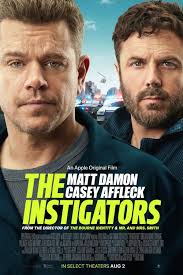
THE INSTIGATORS
US, 2024, 101 minutes, Colour.
Matt Damon, Casey Affleck, Hong Chau, Jack Harlow, Michael Stuhlbarg, Alfred Molina, Ron Perlman, Toby Jones, Ronnie Cho, Ving Rhames, Paul Walter Hauser.
Directed by Doug Liman.
This is a robbery story with a very strong cast, intended as an enjoyable pastime. Audiences might like to ponder who the actual instigators are in this story and what they were instigating in reality!
The setup is a buddy film, but two unlikely characters forced to work together, involved in a high-stakes robbery. We are introduced to the two, Matt Damon, always a solid presence, in therapy with his psychiatrist, Hong Chau, wanting an exact amount of money to be able to reunite with his son. By contrast, there is the alcoholic ex-conman played by Casey Affleck.
The situation is an election in Boston, Ron Perlman as the Mayor, corrupt, aiming for re-election against his ethnic rival, played by Ronnie Cho. The mayor is surrounded by his yes-men, especially his lawyer, played by Toby Jones.
In the meantime, there is a range of criminals played by Michael Stuhlbarg and Alfred Molina. They have the plan for the buddies, with the young nephew, to rob the vans carrying the money before it is delivered to the mayor.
They might be instigators but, of course, everything goes wrong. The money has already been transferred, they go into the Mayor’s office, still his keepsake with the number of his safe, a shootout, and escape in the van, chases through the city…
Ving Rhames appears as a corrupt police investigator.
When they are taken, there is a siege situation and the therapist is invited into mediate – enabling her to get out with some of the money to pay off Damon’s debt in view of a happy ending, and Casey Affleck escaping to Canada. The reason that they do escape and there is a happy ending is that the new Mayor, coming into possession of the money, anonymous money from the previous corrupt Mayor, is not declared and they can keep it as long as the two are not arrested and brought to court. So, off to Canada and happy ending.
The director is Doug Lyman (Bourne Identity, Jumper, Edge of Tomorrow), skilled at some action shows – but this is more relaxed for streaming audience.
- Title? Robberies? Who were the instigators?
- The Boston setting, the neighbourhoods, public spaces, the streets, car chases and pursuits, the mayor’s office, meeting places planning the robberies? The election – the rooms, corridors, social areas, the strong room with the safe? The musical score?
- The situation, introduction to Rory, therapy with the doctor, her questions, his responses, his crisis? The situation with his son? The need for money?
- The setting up of the robbery, the mind behind the robbery, his moods, dealing with his men, with Scalvo, young and inexperienced, the connections with Richie at the bakery? The plan, the testing of Rory and Cobby, details of the plan? The corrupt Mayor, as target, corruption and money?
- Rory and Cobby, personalities, interactions, slow, the as matter-of-fact, the precise amount needed, the bargain with the boss?
- The setup, the vans, the election night, the television news, the alternate candidate, Rory praising him, the presumption the corrupt Mayor would win? The scenes of the Mayor, his staff, tough tactics, reliance on his attorney, Alan Flynn?
- The comedy of the robbery gone wrong, the timing, the amount of money, the earlier van taking the money, guns and shooting, confrontations, the little money in the safe, Rory and the bag, the shooting, the deaths, Scalvo dead? Cobby wounded?
- Going to the doctor, the pressure on her, the discussion about her being a hostage, going with them, treating the wound, the consequences? Her later being chosen as the mediator for the hostages, her bargain with Rory and getting the money out under her uniform, helping Rory with his debt – but continually asking how he was feeling, especially during the negotiations? And copy finally returning to her?
- The mayor, his cronies, the defeat, Cobby with the money, the various positions, having the code number to the mayor’s safe, his not being able to remember, the various combinations?
- The boss, fleeing, contact with Richie, Richie and the interviews, sending the henchmen, tracking down Rory and Cobby, their escaping him? Frank, in the pay of the mayor, the dealings with Richie, his continued pursuit of Rory and Cobby? The finale and their doing the deal with him? And the final credits seen of the boss dead in the snow?
- The vans, the pursuits, the desperation of the chase, guns, Cobby wounded again, his complaints?
- The confrontation with the mayor, his desperation, the arrest, in jail?
- The return to the scene of the crime, Alan Flynn present, to do a bargain deal, opening the safe, all the money? The dilemma, the doctor as mediator? The device for escape, throwing the safes out the window, the scattering of money everywhere, the crowd racing for the money?
- Rory, finally, deciding to give himself up? The new mayor – and the information about the contracts, the new potential corruption? The two men let out, Rory going to see his son, reconciliation?
Kinds of Kindness
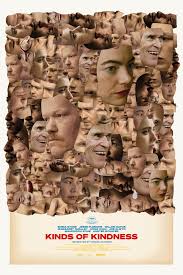
KINDS OF KINDNESS
US, 2024, 164 minutes, Colour.
Emma Stone, Jesse Plemons, William Dafoe, Margaret Qualley, Hong Chau, Joe Alwyn, Mamoudou Athie.
Directed by Yorgos Lanthimos.
Writer-directors, Yorgos Lanthimos, would probably agree that his perspective on life, especially in his earliest films, was “warped”. And, with Poor Things and Kinds of Kindness, that his sense of humour was also “warped”. His kinds of kindness are not exactly kind. Something more like “destructive kindnesses”.
This is a film containing three films linked by themes and linked by the actors. It is a cinematic triptych. Each panel of a triptych to be seen by itself, but also with its links to the other panels, combining for an overall view. And this seems to be what the director wants here, three stories, and a linking theme. Overall, it is a theme of coercive power. And that coercive power means extreme manipulation of victims, tyrannical domination mixed with power complacency, physical and mental cruelty and violence. But, with his warped sense of humour, the director also offers wry satire.
The contribution of a core cast enhances the impact of the drama/humour. Emma Stone has proven herself with two Oscars, appearing in the director’s The Favourite and winning her second Oscar for Poor Things. She shines as the principal character in the third story, a story of a pseudo-messianic cult, she has a divinity in search of a religious figure who has the power to raise people to life. The power of the cult dominates her and her companion in the search.
Jesse Plemons (in 2023 Killers of the Flower Moon, Civil War) won the Best Actor award at the 2024 Cannes film Festival. He shines in the first of the stories, a primly rather straightlaced yes-man to a controller who can only be described as wicked (Willem Dafoe who also appears in the three stories). In a moment of moral questioning, his morale collapses, made to feel even more dependent than before, commanded to kill someone. By contrast in the second film, he plays a police officer is anthropologist wife disappears, reappears, his moral and mental collapse as he determines that she is a double. And this part of the triptych also introduces the theme of cannibalism.
Each story shows the versatility of the characters and the talent of the rest of the cast, Dafoe, Margaret Qualley with four roles including twins, Hong Chau, Joe Alwyn and Mamoudou Athie.
So, after watching the three stories, the three panels of the triptych, the audience is left quite disturbed, moments of black humour, moments of horror, moments of disgust, some grim perspectives on the shallowness, the malice, the cruelty of human nature.
- The work of the director, perspectives, offbeat? Greek background? International career and outreach?
- The title, the tone, the issues? Irony, satire, absurdity? Black and bleak perspective?
- The film as a triptych, the one film, the three parts interconnecting: coercive power, manipulation and submission, aberrant behaviour, sex and violence, violent deaths?
- The work of the cast, in each story, different, appearance, accent, behaviour…?
- The first story: the focus on Robert, exact, controlled, look and clothes, diet, relationship with his wife,+? The encounters with Raymond, his personality, appearance, speaking, controlling, with Vivian as his companion, the meetings with Robert, the international business, the order to kill the victim, Robert’s failures, change of heart, anguish, changing eating habits, going to Raymond, rebuked and rejected by Raymond, the past encounters, sexual? The gifts of the sporting trophies, the gift of the racquet, Robert and his wife, valuing the trophies? The disappearance of the is one? The buyers and the possibilities of selling the trophies, the bargaining? Robert and his encounter with Rita, organising the date, her being in hospital, his discoveries at seeing Raymond, her being controlled, failing with the killing? His change of heart, going back to Raymond, and the vicious running over the victim? And his contentment in the threesome?
- The second story: Daniel, policeman, good service, friendship with Neil, the discussions, the meal, Neil and Martha, memories of Liz, the issue of the video, their watching, the shock of the group sex? Daniel, Liz surviving, the other members of the expedition dead? Hospital? His erratic behaviour, police work, the shooting of the passenger, licking the blood, being suspended? Neil trying to help? At home, the interactions with Liz, her behaviour, different? With her father, narrating the dream, dogs living as humans? Going to please Daniel, his withdrawing, not eating, asking her to cut off her finger, her cooking it, his giving it to the dog? Her frustration, his demanding the liver, her cutting it out? The alternate Liz, arriving, his embracing her??
- Third story: the background of the cult, the members, garb, the enclosure, the rituals? The leadership of Omi and his wife? Manner, style? Emily and Andrew, members of the cult? Emily and her control, going to the morgue, choosing the girl as able to raise the dead, the attendant, the corpse, her attempt a raise the dead, her desperation, rejected? Emily and Andrew, their travelling together, a speedy and reckless driving, the mission, searching for the special person who can raise the dead? Emily, her visits to her daughter, leaving the presence? The encounters with her husband, her daughter? The invitation to the meal, the drugs and headroom, his rape, her being rejected by the cult? Her growing desperation, the instructions by Omi and his wife? Her dream, drowning, the rescue? Rebecca, coming to the diner, the explanations? Emily, her decisions, pretending to have the dog, wounding it, Ruth as the vet, kindly? The next encounter, bugging Ruth, Rebecca satisfied, killing herself, going to the morgue, the dead body, Ruth – and the raising to life? Andrew and Emily reinstated?
- The mid-credits final sequence, the irony of the dead man raised to life, after being killed by Robert, raised by Ruth, and eating the sandwich and spilling the ketchup? Final ironies?
