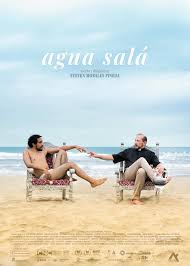
AGUA SALA/ SALT WATER
Colombia, 2024, 83 minutes, Colour.
Luis Mario Jimenez, Oscar Salazar.
Directed by Steven Morales Pineda.
At the centre of this film is the issue of sexual encounters, sexual abuse of children, especially by clergy, and the consequences.
The main character here, Jacobo (Luis Mario Jimenez) is a lively 33 year old living in a coastal town in Colombia. He has trained as a nurse but has been overwhelmed by the Covid experience (the film made in 2021, people wearing masks…), But offering yoga classes. He clashes with his mother, remarried twice, care for half brother who has a crippled foot, many friends in the town. He is gay and has a boarder and partner who is married with a pregnant wife.
Several times, he looks on his phone at reports of a priest accused of sexual abuse, the accusations and indications of Vatican files, the priest continually proclaiming his innocence. It is clear that Jacobo has had this kind of experience in his past.
Then the priest in question, now aged 50, considering leaving the church, still denying all the accusations, comes to the town and visits Jacobo. This is where the screenplay becomes complex – especially since it is based on the school experiences of the writer and director. In many ways Jacobo welcomes the visit, the contact again, the two reminiscing with many memories of school, Jacobo benefiting by the introduction to literature and wider horizons. One of his friends arrives, announcing that his wife is pregnant, but is disgusted at the presence of the priest – and, again, obviously memories, this time very unhappy.
Jacobo moves his partner out, makes the room available for the priest, who comes to live, many outings on the beach, discussions, memories, music, buying a small accordion for Jacobo to play, their singing. The complication is that the priest is still religious in his heart, with his Bible, declaringthat any text will resonate in some way with the reader, explicit mention of the text about light hidden under a bushel and that truth will be made manifest.
There is the sexual attraction, Jacobo wanting more, quite a long scene where the priest helps Jacobo to shave his moustache and beard, no words, just a musical accompaniment and leaving this evocative and emotional experience to the audience. And, then, Jacobo walks to the beach, shedding all his clothes, and then imagining the priest present.
There is a final sequence, the priest outside, Jacobo inside and a kind of grill separating them (Jacobo previously mentioning the place of his first confession), seeming like a confessional experience but with the priest seriously explaining his decision to move away.
Interestingly, from a Catholic spirituality perspective, the film is divided into chapters, each based on the titles of the weeks in the Spiritual Exercises of St Ignatius Loyola, the third week divided into two, calling and Passion/cross. (Only one review found which mentions this but no explanation.) And, it is noted that Jacobo was seen reading a book, Como esta tarde para siempre) by Jaime Manrique, about two seminarians in love.)
A different perspective, Latin-American perspective, on relationships between priests and children.
