Displaying items by tag: Pedro Pascal
Freaky Tales
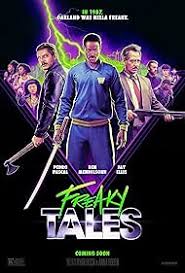
FREAKY TALES
US, 2024, 107 minutes, Colour.
Pedro Pascal, Jay Ellis, Ben Mendelssohn, Normani, Dominique Thorne, Jack Champion, Angus Cloud, Keir Gilchrist, Too #hort, Tom Hanks.
Directed by Anna Boden, Ryan Fleck.
Writing-directing team Anna Boden and Ryan Fleck has produced a number of interesting films like Half Nelson, Sugar in the 2000s and then great commercial success in 2019 with Captain Marvel. Worked extensively on television.
There are four freaky tales in this film and have been described as Tarantino-esque which indicates the topics, themes, treatment. The setting is 1987 and Ryan Fleck has gone on his memories of the period, Oakland California, the Grand Lake cinema, the background of rap musicians, video stores, racist conflicts…
American audiences will better appreciate this film than international audiences because of the detail, the focus in on particular rap artists, Sleepy Floyd, Too #hort, actors playing them and then their playing themselves… There are some top actors in the film, Pedro Pascal in the longest and most serious of the four, Ben Mendelssohn as a policeman. And, something of a spoiler, an appearance by Tom Hanks in the video store.
For audiences wanting something different about American life, especially the atmosphere of the 1980s, Freaky Tales is intriguing, sometimes disturbing, always interesting.
- The title and expectations? A warning?
- 1987, Oakland, California, Evergreen Catholic Theatre, the clubs, the streets, speeches battlegrounds? Diners, clubs and rap? The criminal world, the police world, corruption? The world of the basketball league, players? The director, Ryan Fleck, growing up in this world, drawing on his memories?
- The musical background, the clubs of the young people playing, breakdancing?
- The four stories, the interconnections, an overall portrait of Oakland?
- The first story, Lucid and his girlfriend, at the cinema, the movie references throughout, especially of the video store and Hank and his discussions with Clint? The young people, the club, the mixed races, the appearance of the Nazi group, the attack, the brutality? The meeting at the club, the votes hiring the police, or defending? The vote for defence? The elaborate weapons, the arrival, the attack, the comic book images of the fight and splatter? Victory? The antiracist stances?
- The background of the greenlight, the special power, the manifestations in the eyes, in the weapons, in the attack? And throughout the film? And suggestions of inner power and the ability to overcome – especially for sleepy Floyd?
- The second story, the two girls, in the bar, the arrival of the policeman, his manner, interrogation, the ice cream, bubblegum, his credits? The women and their resistance and hostility? The other customers? In the bus, their discussions, in the club, the host, inviting on stage, the misogynist lab, the response, the response of the crowds?
- The different the third story, Clint, with his pregnant wife, the phone call, the news of the murders, going back 24 hours, his life waiting car, his going to the video shop, Tom Hanks’s Hank, the discussion, going behind the scenes, the cards, the confrontation, the debt issues, Clint and his last stand, breaking the man’s finger, coming out, taking Sid and Nancy for his wife? The confrontation with the young man, his glint, the flashbacks, Clint killing his father, the guns, the shooting, while going to hospital, the arrest of the man? The encounter with the go-between, the further demands, the news of the baby survival, the police chief, taking Clint, holding him and the baby?
- The fourth story, an actual event reimagined, the police chief and the Nazis and his son, getting the information about the players, what was in their homes, the planning of the robberies while they were playing, the crowds arriving, the characters from the previous stories? The game, sleepy Floyd and his achievement? His mother, girlfriend, the attacks on the houses, the details of the robberies? Lucid his giving the information to sleepy Floyd?
- Floyd, Green light, his inner meditation, donning the costume, the weapons, the Tarantinoesque massacres? The confrontation with the police chief, with Clinton the baby, the explosion?
- The henchmen arriving at the house, finding sleepy Floyd, the final deaths?
- Clint, the baby and leaving?
- The postscript, sleepy Floyd and his system, inner strength, Superman, the gathering of all the people, the photo?
- Weird freaky stories and the weird freaky styles of storytelling?
Mandalorian and Grogu, The
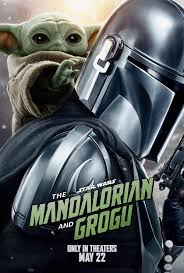
THE MANDALORIAN AND GROGU
US, 2026, 132 minutes, Colour.
Pedro Pascal, Brendan Wayne, Sigourney Weaver, Steve Blum, voices of: Jeremy Allen White, Stephen McKinley Henderson, Shirley Henderson, Martin Scorsese.
Directed by Jon Favreau.
It is 50 years since Star Wars surprised the world, delighted audiences, created a whole new perspective on Galaxy fantasies, some wonderful sequels, characters, laser action, the Force, and John Williams majestic score. The 21st century, some films, but the more recent emphasis has been the television series, the Mandalorian.
One of the creators of The Mandalorian was actor-director, Jon Favreau. Instead of the fourth in the series, he has opted for the big screen. For audiences who have enjoyed the series, familiar characters and material, action, and an opportunity to see it in a cinema atmosphere.
For audiences not familiar with the series, who hark back to the old days of the trilogies, it is something of a surprise. No opening with the galaxy far far away. No John Williams score. And, there is a rather more serious tone compared with the past, 3 CPO and R2D2, a range of strange characters and creatures, Jabba the Hut, Yoda, and we got to know Luke Skywalker, Princess Leia, Han Solo, Obi Wan Kenobi.
The Mandalorian is played by Pedro Pascal, seen in so many films and television series in recent years. But, he wears armour, is masked. This is something of a barrier to communicating his personality, having to rely on his voice and body language and action (and, in fact, it is Brendan Wayne, John Wayne’s grandson, who is actually in the armour). So no strong personal connection as we used to have with Han Solo.
But, there is Grogu, a diminutive Yoda-like creature, American-cute, but also able to participate in all the action (after he learns to press the right buttons).
But, there is plenty of action, the somewhat brutal introduction to the Mandalorian as a mercenary and his elimination of enemies and the Startroopers. He is employed by Colonel Ward, played by Sigourney Weaver. He has a mission to find the son of Jabba the Hut which leads to a kind of gladiatorial arena fight against monstrous creatures and robots. And, in space, attacks, fights, explosions…
For 21st-century audiences and series fans, a continuation of what they know. For older 20th century audiences, not quite what they might have been expecting.
- 50 years after the beginning of the Star Wars franchise? Through many films, through the Mandalorioan and television series? Continued popularity?
- The Star Wars Galaxy, the Empire, the Republic, the storm troopers, rebellion, mercenaries and battles? The weaponry, the starships?
- The continuation of the Mandala and television series? The changes from the original, the different opening, no John Williams score, the more serious tone, the intermittent light touches with Grogu and the small creatures?
- The hero, armour and masked, the less personalised character, the removal of his mask in the middle of the film, some sense of his humanity?
- The situation, the Mandalorian and his missions, reputation, for hire, seeing him in action, the fights, the enemy, the board meeting, the pressure of the leader, the subservience of the members, his shooting one of them? The attack by the Mandalorian, the pursuit, the deaths? His return?
- The importance of Grogu, the foundling, small, American cuteness, Yoda influence? Companion, presence, participating in the action, limited, liked by the audience?
- Colonel Ward, her control, the mission? The tradition of Jabba the Hut, his son, the twins and their hostility?
- The Mandalorian and, his mission, wanting the son, the hostility, the situation, the twins, the sinister role of Lord January, his betrayals?
- The gladiator sequence, creatures, the fights, the Mandalorian and his surrender, the response of the crowds, of Lord Janu?
- The rescue of the son, the small creatures and their technical skills, chatter, activities?
- The final flight, the dangers, the attack, explosions, survival?
- The return, Colonel Ward, her attitudes, to the final mission, Jabba the Hut;s son, final decisions?
- And the continuity of the story, the characters, the series?
Eddington
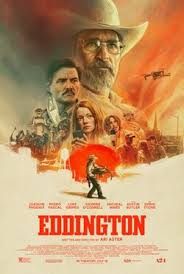
EDDINGTON
US, 2025, 148 minutes, Colour.
Joaquin Phoenix, Deirdre O'Connell, Emma Stone, Micheal Ward, Pedro Pascal, Cameron Mann, Matt Gomez Hidaka, Luke Grimes, Amelie Hoeferle, Clifton Collins Jr, William Belleau, Austin Butler.
Directed by Ari Aster.
Writer-director, Ari Aster (Heredity, Midsummer, Beau is Afraid) is not afraid of making demands on his audiences, a lot of thinking, a lot of discussion. He urges us to remember where we were in May 2020, the early covid months and lockdown, masks, vaccinations, controversies, conspiracy theories. He immerses us in Eddington, New Mexico, May 2020, and invites the audience to make comparisons.
But, this is the US, compliance and protest, the story of the sheriff, some American righteousness with devious intentions, campaigning to be mayor. While there is his storyline, the atmosphere widens with Black Lives Matter protests, some screaming left wingers, some disruptive right-wingers and increasing chaos and Antifa interventions. (It is amazing to know that President Biden was elected five months later, but then January 6th seven months later. Actually, with the second Trump presidency, it all looks strangely more familiar than we might have imagined.)
Aster stressed that he saw the pandemic as an inflection point that merely accelerated an inevitable series of events. Our brains were already broken by technology and media polarization, 2020 just provided a lethal dose of social isolation that permanently destroyed the societal norms we had been living with for the past century. Christian Zilko IndieWire
We see dramatised anger, paranoia, distortions, insanity, violent calculations and eruptions, conspiracies. A Rorshach test – beserk.
For over 30 years Joaquin Phoenix has been giving complex performances and this is amongst his best, playing the sheriff. Pedro Pascal, frequently present on our screens at this time plays his rival, the mayor. There are some interesting casting is, Emma Stone as the sheriff’s disturbed wife, Austin Butler as a right-wing evangelical agitator, British Michael Ward as the deputy sheriff.
There is always movement during the film but, as it moves towards its violent climax, it becomes, literally, all guns blazing – and an emotional unexpectedly calm but ominous ending.
- The date, may 2020, Covid, locked down, conspiracy theories, the Trump presidency? Seen in retrospect and memory?
- Eddington, New Mexico, the town itself, the streets and neighbourhoods, homes, mansions, offices, the hillside, the industrial complex? The musical score?
- The challenge to American audiences, international audiences observing, the 2020s, Covid, the Biden years, the second Trump presidency? Extreme right and conspiracies, militant action? Left-wing demonstrations? Political atmosphere?
- Joe Cross, an Everyman American, sheriff, his attitudes and behaviour, his views, relationship with his wife and tensions, with his mother-in-law, the sequences at home? With his deputies and relying on them, the racial mix? His clashes with the Mayor, the confrontations in the street, ideologies, business interests and development? The campaign for mayor? His decision, his posters, his billboards, those of the Mayor? His attitude towards masks, vaccines, spaces in lines, his behaviour in the supermarket? His wife unstable, the tensions and meals at home, issue of children, his mother-in-law and conspiracy theories?
- Industrial background, the financial interests, the buildings, the plants, work, development?
- Joe and his campaign, meeting people, confrontations with Ted, his two deputies and his reliance on them, their characters and behaviour, race issues?
- Ted, Mayor, his place in the town, contribution, his family, travelling with his son? Indications of the previous contact with Louise and its consequences for Joe? The campaign? His son and his relationship with him, the son’s friendship with Bryan, Brian and his background, political stances, demonstrations, Sara, the demonstrations, her political stances, Bryan wanting favour with her, a relationship?
- Vernon, his visit and meal with the family, his religious stances, the religious right? His interventions? His campaigns and rallies? On television? Ultimately Louise leaving home, joining him, seen on the television, pregnant?
- The situation of Black Lives Matter, Minneapolis and the demonstrations, the death of George Floyd? The occasion for demonstrations, protests, the involvement of citizens in the town, Joe and his dealing with the demonstrations?
- The switch in tone, Joe confronting tent, the slap, the humiliation, Joe and his killing the vagrant and putting his body in the water, confronting Ted, killing him and his son? Going to the house, setting up the robbery scenario, and his writing on the wall (and that later being the revelation of his guilt)?
- The further switch in tone, the plane load of protesters and their arrival? The intervention of Butterfly humane is, the people and nation, his authority, the shooting on the land, his investigations, examining the house, confronting Joe?
- Beginning of the mayhem, the armed pursuers, the protesters, Brian and Sarah and their interventions, Joe, covering himself, the clashes at home, getting the guns from the store, the transition to an all guns blazing scenario? Joe and his being wounded? And is being unmasked by Butterfly who sees the campaign poster in the office and makes the connection with the house?
- Joe, his involvement, the guns, his being stabbed, saved by Brian?
- A year later, Joe and his injuries, quadriplegic, cared for? His mother-in-law and her presence? Status, authority?
- Brian, symbolising ambitions and complacency? The television program with Vernon and his right-wing religion, Louise present? And Michael, surviving the fires and explosions, deputy sheriff?
- An American response to the film, depending on stances, political issues, conspiracy theories?
Fantastic Four, The: First Steps
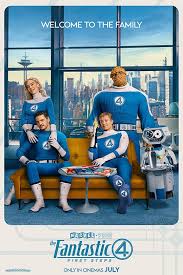
THE FANTASTIC FOUR: FIRST STEPS
US, 2025, 115 minutes, Colour.
Pedro Pascal, Vanessa Kirby, Egon Moss-Bachrach, Joseph Quinn, Julia Garner, Natasha Lyonne, Paul Walter Hauser, Sarah Niles, Mark Gattis. Voices of Ralph Ineson, Matthew Wood.
Directed by Matt Shakman.
2025 as been a superpower blockbuster movie year, Thunderbolts*, then DC with Superman and Marvel with The Fantastic Four. The latter two performed beyond expectations at the box office in the US and around the world. Still popular!
The Fantastic Four are not as familiar to moviegoers as Superman or Batman. There were two films in 2005-7 and an attempt to revive the franchise in 2017. This film is another attempt – and with the promise that the Fantastic Four will appear in forthcoming Avenger films.
One of the features of the Fantastic Four is that they are a very friendly group, especially likeable for the audience. For anyone not familiar with them, and for those who are, there is a prologue to this film, a TV program, a kind of This is Your Life summarising with clips the personal lives and origins and all the exploits of the Four, their venture into space, their DNA being altered, then becoming superheroes, and very popular with the citizens of New York City and the world.
Reed Richards, played sympathetically by Pedro Pascal, is the scientist, mathematician, intelligent, cerebral in his approach to crises. By contrast, Vanessa Kirby is his wife Sue Storm, her discovering she is pregnant, and she and the family, and the audience, happy anticipating the forthcoming birth. Then there is her younger brother, Johnny Storm, played enthusiastically by Joseph Quinn sometimes brash, literally full of fire, eager to be an uncle. The fourth member is Ben, played by Egon Moss-Bachrach, seen as his ordinary self in the prologue but then DNA drastically altered to some thing of a monster look, but genial behind all that orange granite that forms his exterior.
Casting is interesting because two of the Four are British, Vanessa Kirby and Joseph Quinn. Pedro Pascal is from Chile.
When Earth is threatened by a strange alien, the Silver Surfer (Julia Garner), and threatened by the archetypal cosmic villain, Galacticus (voiced by British Ralph Ineson), the Four go into space to confront him.
Part of the drama is their initial failure (though with some spectacular sequences in space, and, emotionally and dramatically, the birth of the baby), the brief press conference where they tell their adoring public that there is no hope, then the determination to find a way of confronting Galacticus who has set his ambitions on taking over the new born child and its powers.
Which means that the second part of the film is the confrontation of Galacticus, the intervention of the Silver Surfer, the giant Galactic is heavily treading through New York City demolishing huge areas (as Lex Luthor did in Superman) intense demonstration of the superpowers by the Four.
And, there is nothing like a baby to elicit audience sympathy – and there is a pleasing preview during the final credits of the baby at four, with his mother, just having spent a day reading Charles Darwin’s Origin of Species.
- The status of the Fantastic Four in the marvel comics, created by Stan Lee? The previous film versions, modest, this version as a new beginning?
- The basis of the plot, the Marvel universe, the four characters, Reed and Sue, their backgrounds, marriage? Johnny as Sue’s brother? The work with Ben?
- The opening, a kind of resume of the characters and their superpowers, their activities, their reputation in New York City?
- The relationship between Reed and Sue? Background of their space mission, the experience, overwhelmed, the changes in their DNA, superpowers? The marriage, Sue, discovering she was pregnant, Reed, the scientist and mathematician, his more cerebral approach, his joy? Johnny and his enthusiasm?
- Ben, in the television program, his normal self, the space experience, the DNA, the granite and its colour, his size? And his voice, human and humane, his interventions? The encounter with Rachel, the students and his comic behaviour with them, his later going to find Rachel?
- The situation with Galactus, origins, age, giant, sinister, eager for power, targeting the baby? The Silver Surfer, her appearance, the surfboard, through space, arriving on earth, the warning?
- The status of the Four, Ed Gilbert and his show, the program, the exploits, the public and acclaim?
- The decision to go into space, travel, the space ship, the equipment, technical skills, Reed and intelligence? The confrontation with the Silver Surfer, with Galactus, their being caught, the escape, travelling back to earth, the pursuit by the Silver Surfer, her skills, evading capture, each of the Four coping, Ben and his piloting, reading the calculations, Johnny and his attempts with his fire? Their eventually arriving home?
- Sue, pregnant during the return, her experience, everybody involved in the delivery of the baby, the happy birth? Franklin?
- The television show, Mary and her friendship, the press conference on return, no hope, the reaction of the public, gradually turning against them?
- Reed and his experiments with transportation, the plan to move the planet Earth to the outer reaches away from Galactus? Its failing?
- The determination to resolve the situation, the public learning about Galactus wanting the baby, accusations of selfishness with the family not giving up the baby? The calculations, seemingly impossible? The discovery of the lever, the calculations, the appeal to the public, the television response, the collecting all the materials, the building of the bridges, the issue of electricity, the world collaborating in blacking out to give full power?
- The plan, times square, the central landing, the ring to trap Galactus?
- The encounter with The Silver Surfer, her coming for the baby, the dialogue with Johnny, her back story, her experience with Galactus, giving up family for the sake of the planet? Her hostility, her embarrassment and shame, her finally turning against Galactus and sacrificing herself?
- The help of Harvey Elder, his role in the past, sinister, ruling in the subterranean area, the clashes with the Four, their appeal to him, selfish, but agreeing, taking all the refugees from New York City?
- The arrival of Galactus, gigantic, walking through New York, crushing the buildings, the tremors for those in the underground? Capacities, voice, penetrating sight to see the baby, his being blinded, the substitute group, but his seeing where it was hidden, the continued pursuit, Ben and his interventions, Johnny willing to sacrifice himself, read in the calculations, Sue and her willpower, forcing Galactus back, almost to the Circle, the machine, the 37 seconds, his destruction?
- The Four, acclaimed, the public, Ed Gilbert and the program, Mary and the studio, the sudden call and their going out on mission?
- The preview for the Avengers films, four years later, the baby and reading Charles Darwin, Sue finding the baby with the sinister hooded figure?
Materialists
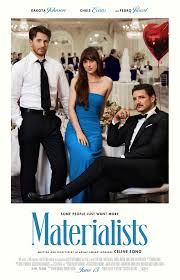
MATERIALISTS
US, 2025, 117 minutes, Colour.
Dakota Johnson, Chris Evans, Pedro Pascal.
Directed by Celine Song.
Here is a New York drama which is worth seeing – and, certainly, worth listening to.
Film has been written and directed by Korean-born, Celine Song. H er previous film, Past Lives, received Oscar nominations.
This is a film about a woman who works as a professional matchmaker, in a company which advertises, makes personal contacts, arranges meetings, especially dinners, according to the data they collect. In fact, Celine Song worked for six months in a matchmaking firm. She certainly draws on a lot of information as well as personal experiences.
One reason why the film is worth listening to is that the philosophy behind the matchmaking company, at least in the affluent areas of New York City, is, as the title indicates, materialist. The approach to setting up couples with hope for married unions is very much as what Christians often called “worldly”. And, in the case of Lucy, Dakota Johnson, whom we get to know very well during the film, she is very materialistic in her perspective. When she marries, she wants to marry into wealth, comfort, security, compatibility, not necessarily love as the Romantics would like.
In fact, she was in love with an actor, John, Chris Evans, often impoverished, now working in a catering firm, often servicing lavish materialist winnings. They are still friends, he in love with her, but she with her success ambitions held high. Then, at the wedding of a couple she organised, she encounters the brother of the groom, Harry, Pedro Pascal, and they are attracted to each other. Will this be the fulfilment of all her ambitions and her professional certainties? Maybe they would in another film, or in a television series, but there is much more to Materialists than this.
The three central characters are always interesting, Lucy often exasperating, a sympathy for John, questions about Harry and his motivations (and the rather startling discovery that amongst the criteria for matchmaking, an attraction for women is tall man, and that some men get their legs broken for height extension insertions!).
There is great power in several key speeches, well worth listening to and reflecting on: a long discussion between Harry and Lucy about their attitudes towards the criteria, to wealth, security, compatibility – but finally Lucy able to make a declaration honestly about her feelings, about whether marriages were for love or just deals and partnerships. There is also a very important discussion between Lucy and a client who was assaulted by the allotted partner, some of the shallowness of dating and its dangers, and her angry response. And, again, well worth listening to is a long discussion between John and Lucy, reflecting on their relationship over the years, love, emotions, his declaration of love rather than any deal, his image of growing old together, long-lasting commitment, personal interaction. And the fourth important discussion to listen to, Lucy’s final response.
The title, with its focus on material achievements and satisfactions, with their seeming priority over love, is certainly a challenge. Audiences identifying more immediately with Lucy, will be challenged. Audiences identifying with John be more hopeful, audiences identifying with Harry will have to give some serious thoughts to their attitudes. Materialist matchmaking is very much focused on success in this world, not appreciating the fact there are more profound values, especially love, the transcend the materialist ambitions.
- The emphasis of the title, a story about matchmakers, but the criteria for the matches, the boxes ticked, suitability is, financial issues and status, security, marriage and is business, and deal? The emphasis on the materialist criteria?
- New York City, the office of the matchmakers, the venues for ceremonies, wealthy mansions, sharing squalid apartments, the New York high life, restaurants, the small theatre and performance, out-of-town, the countryside, the country wedding celebration? Atmosphere? The tone of the musical score, the range of popular songs and their lyrics?
- The focus on Lucy, her age, little background of her family, the past and her relationship with John, her being interested in acting, his acting career, love for him, but her expectations for wealthy marriage and comfort? The encounter with Harry, the wedding, his attentions to her, her response, his digging all the right boxes, a “unicorn”? The possibilities for her future?
- The theme of the film and its critique of materialist ambitions and criteria for marriages? As dramatised in the collage of the variety of interviews, clients explaining themselves and their hopes, issues of age, appearance, sociability? Older men for younger women? The lonely women getting older? Sophie and her reactions to criticisms? The range of those working as matchmakers, violent running the office, celebrating their successes, Lucy and her nine successes? Her failure with Sophie and Mark?
- Audience response to the focus on materialist criteria and boxes ticked? The issue of love? Suitability? Values – and the quality of men affirming women as valuable? And the contrast?
- John, his age, or, acting career, some success, working as a caterer, the encounter with Lucy at the wedding, the discussions, the memories of the past, the flashback to Lucy getting out of the car, standing the street and blocking traffic with her confrontation? John and the play, success, the drinks afterwards, seeing Lucy with Harry, his reactions? Seeing him at his apartment, the slovenly behaviour of the partner in the apartment? His love for Lucy, continuing despite her behaviour?
- Lucy, the crisis with Sophie, the phone call to Mark, Sophie and the lawsuit, suing the company, Violet not blaming Lucy? Lucy trying to apologise, Sophie’s fears speech against her? It later, the phone call, Sophie wringing, John driving Lucy to the apartment, Lucy able to soothe Sophie, the embrace, passing the night, John waiting on the steps? And later Sophie’s contact that she had found somebody suitable?
- The strength of the dialogue, the manifestation of the three central characters, raising the issues of marriage, dating, deals, a vision of an ageing partnership?
- The power of several key speeches: the long discussion between Harry and Lucy about their attitudes towards the criteria, to wealth, security, compatibility – but finally Lucy able to say that she did not love him, nor he her, it was just to deal and partnership rather than love? The importance of the discussion with Sophie, and her raising the issues and the shallowness of dating, its dangers? The long discussion between John and Lucy, his declaration of love rather than deal, his image of growing old together, long-lasting commitment, personal interaction? And the final speech of Lucy’s acceptance?
- The happy ending, Lucy to resign but Violet offering her the post of leading the company? And the glimpse of all the people, couples, registry for marriage licenses, the cheerfulness, the atmosphere, and Lucy and John seen amongst them?
- The film and its title as a moral fable about the importance of marriage, commitment, it deeper values than wealth and security?
Gladiator II
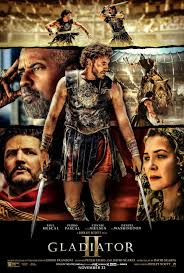
GLADIATOR II
US, 2024, 148 minutes, Colour.
Paul Mescal, Denzel Washington, Pedro Pascal, Connie Neilson, Joseph Quinn, Fred Hechinger, Lior Raz, Derek Jacobi, Matt Lucas, Tim McInerny.
Directed by Ridley Scott.
While sequels are often welcomed by an audience, they also often find it difficult to maintain the standard of the original film. Which is the case here. Gladiator won the Oscar for Best Picture in 2000 as well as an Oscar for Russell Crowe in his role as the strong Roman warrior, Maximus. She is one was a triumph for prolific director, Ridley Scott.
It was something of a surprise when plans were made over 20 years later for this sequel. The focus is on the son of Maximus who died in the first film, his son with Lucilla, the daughter of Marcus Aurelius. He is Lucius, played by Paul Mescal, seen first quietly living in North Africa, the Romans attacking under the leadership of General Acacius, Pedro Pascal, the North Africans defeated, taken to Rome, sold as slaves, many commandeered as gladiators.
Audiences will see the parallel scenario with the original film, the provinces, Roman warfare, prisoners, slavery, the Colosseum, gladiators, harsh life, brutality in the arena, political intrigue.
As with the original film, Gladiator II looks quite spectacular, special effects, naval battle sequences, extraordinary fights in the Colosseum especially against monstrous effect monster monkeys, and the recreation of a battle sequence in the Colosseum. Many of these scenes are very violent, and some of them exceedingly brutal in the impact. Sometimes we might wonder, as we watch the brutality of the fights and audience excitement that we are very much like these vicious Romans and their control of human life with thumbs down.
As with the Emperor, Commodus in the original film, there are two rather despicable emperors this time, the twins Geta and Caracalla (Joseph Quinn and Fred Hechinger) as symbols of the decline of the Roman Empire. Returning from the original film is Connie Neilson as Lucilla, daughter of Marcus Aurelius, mother of Lucius, recognising him, trying to make contact, eventually sacrificing herself for him. She is also in a relationship with General Acacius. One of the difficulties for the impact of the drama is that while Paul Mescal is exceedingly serious and single-minded as Lucius, he is not charismatically engaging for the audience a little in here and charm, while Pedro Pascal as Acacius does have leadership charism.
But, the big difference for this drama is the presence of Denzel Washington as the former slave with political and power ambitions, based on an actual character, Macrinus, a master in buying slaves, controlling the gladiators, with entree to the Emperor’s, deals with corrupt senators, waiting for his power grab moments, unscrupulous with his violence, even with the Emperors.
Given the limitations, the repetitions in parallels with the original, and the single-minded sternness of Paul Mescal as Lucius, audiences who enjoy Roman epics, will enjoy Gladiator II as well.
- The impact of the original film? Its legacy? So many years for a sequel? The continuity? The scenario of the first parallel scenario of the sequel?
- The work of Ridley Scott, epics? And audience response?
- The settings, North Africa, the city, the battles, the Navy, the Roman conquest? The road to Rome? The entry? The Colosseum, the quarters for the gladiators? The animals? The use of the Colosseum, fights, naval battles? The royal palace? Homes? The market for gladiators? The musical score?
- The links with the original, the mentions of Maximus, the flashbacks and the appearance of Russell Crowe? Connie Neilson as Lucilla, her relationship with Maximus, with, discovering with Lucius? Derek Jacoby as the senator?
- Africa, Lucius and his life there, relationship with his wife, warrior, silent about his identity, the local authorities, the attack of the Romans, the details of the battles, strategies, defeat? Imprisonment? The death of his wife, seeing her pass into the next life, grief?
- The prisoners going to Rome, the entrance to the city, the legions and the triumphant entry, general Acacius, his relationship to Lucilla, his tribute to the Senate, their suspicions, their wanting him to go on further conquests? His own response, with Lucilla, his significance in the revolt against Rome, his legions at Ostia, the sending of the message, his being trapped, sparing Lucius, his own death? Lucilla’s grief?
- The role of Macrinus, dented Washington’s presence, slave, freed, ambitions for the Senate, ruling Rome? The auctions of slaves, seeing Lucy is in action, his talents, strength, perseverance, purchase? His master of slaves and the treatment of the slaves? The training, the accommodation in the below the Colosseum? The fight in the Colosseum, the monstrous monkeys and battles, UCS and his survival? The response of the crowds, the emperors, thumbs up?
- The personality of Lucy is, silent about his identity, his anonymity in Africa, his relationship, the defeat, the death of his wife? With the other slaves? With the master of slaves, his being tested? With Macrinus? With Lucilla, her visit, his identity, his resistance? His eventually changing, the encounter with Acacius, the fight in the arena, spared, acacias death?
- The background of the emperors, their status, twins, effete life, games, the court, the worms? The attitude of the Senators? Acacius? Macrinus and his setting them up, the death of Geta?
- Arrow colour, wilfulness, childish, nominating his monkey as senator?
- Lucius, behind-the-scenes, the ex gladiator, observing, supportive Lucius, his sending him to Ostia to bring the troops?
- The buildup, the taking of Lucilla, in the arena, her death, the many troops converging on Lucius?
- The troops arrival, Macrinus and his control, his deals with the senators, the corrupt senator, the gambling, the meeting of the senators, Gracchus and the past, and government, decline? The death of Gracchus?
- The troops arriving, Lucius and his a leadership, the confrontation with Macrinus? And the future?
Wild Robot, The
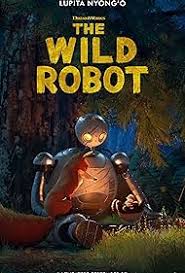
THE WILD ROBOT
US, 2024, 101 minutes, Colour.
Voices of: Lupita Nyong’o, Pedro Pascal, Kit Connor, Bill Nighy, Stephanie Hsu, Matt Berry, Ving Rhames, Mark Hamill, Catherine O'Hara.
Directed by Chris Sanders.
Fans of Peter Brown’s 2016 illustrated novel, The Wild Robot, will be delighted to see this film version. In fact, delight has been the response of audiences – and also of many critics.
We are definitely in the 21st-century with an animated family film focusing on a robot – although, Peter Brown in his detailed blog on the Internet about his writing his book over a period of eight years, has many interesting observations about origins of writing about robots as far back as the 1920s. But, to have a children’s film focusing on a robot, very much of our times. (And these years there are many films for adults with dramatic stories about androids and humans being served and protected by them as well as stories of betrayals.)
In trying to describe the perspectives of The Wild Robot, it could be said on the one hand that the picture of nature, animals in the forests, their personalities, is in the Disney tradition, especially of Bambi. And, on the other hand, the picture of robots, technology, artificial intelligence, is very much a contemporary perspective.
And, a robot in the wild, a robot whose name comes from her code initials, abbreviated to Roz, and the machine a female voice by Lupita Nyong’o. A shipwreck, Roz stranded, re-booted, the strong sense of mission (and her repeating her promotion instructions aloud). Needless to say, the wide range of animals, all enjoyably portrayed, do not respond well, fearful.
But, that is just the beginning. Two engaging characters emerge, a little Gosling bereft of family who gets the nickname Brightbird (Kit Connor) and an engaging fox, Fink (Pedro Pascal enjoying himself) whom nobody likes but who becomes a great favourite with the audience.
In fact, there is plenty of plot, Roz teaching the Gosling how to lie while looked down on by the rest of the geese; the bird migration led by the wise Longneck (Bill Nigh); some misunderstandings, some reconciliations, and Roz finally affirmed by the animals as she is able to help them in a very cold hibernation.
And, there is more with the robots, contact with the company, some ruthless executives, wanting to control Roz. While robots have no emotions, Roz learns more and more from her animal friends, standing up for herself and for them.
The film has been written and directed by Chris Sanders, best known for The Crudes series and, especially, charming action story, How to Train Your Dragon. Here he has been able to appeal to younger audiences with a great deal to interest and entertain an adult audience.
- Family-friendly animation, style, story, characters? Musical score?
- 21st-century, robots, artificial intelligence, techno developments? And memories of past animation, animals, the forests? The combination?
- The situation, the future, robots, the storm, the destruction, Roz stranded, programmed, promoting her services? The female voice? The encounter with the bear, the crushing of the geese, the survival of the Gosling, befriending it, training it, calling it Brightbill? The Fox, Fink, on the outer, yet bonding, helping with Brightbill? The possum, guides of how to mother they Gosling? But fear from the other geese?
- The range of animals in the forest, memories of Disney animals and Bambi? The fear of Roz? The importance of Brockville learning to fly, to swim, the training, eventual success?
- Brightbill, personality, growing, succeeding, information about Roz and the loss of his family? Hostility? The preparation for the migration, the role of Longneck? Brightbill and his agitation? The geese flying, the storm, taking refuge in the robot headquarters, the clashes and persecution, Brightbill not afraid, leading them to safety? Longneck sacrificing himself?
- The hibernation, the animals going into hibernation, Roz helping, their bonding with Roz? The squabbling, fights, traditions, Fink and his mediating? The episode with the bear?
- Roz, trying to reactivate, the links with the headquarters, the response at headquarters, the head, sending robots, locating Roz, the attack on the animals, the fight back, the fire?
- The geese returning, Brightbill, reconciliation with Roz?
- Roz, agreeing to leave, going back to the headquarters, working in the greenhouse, Brightbill and his visit, but her still having her emotional responses?
- The family friendly story about technology, operation by exploiters, but possibilities for harmony and peace?
Strange Way of Life
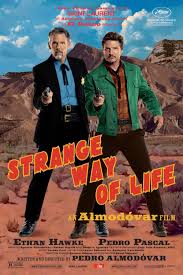
STRANGE WAY OF LIFE
Spain, 2023, 31 minutes, Colour.
Ethan Hawke, Pedro Pascal, Mona Rios, George Steane.
Directed by Pedro Almodovar.
Fans of Pedro Almodovar and audiences around the world would not have been expecting a Western from him. But, here it is, beautifully filmed in Spanish locations reminiscent of the spaghetti westerns, the recreation of the town, the sheriff and his duty, the pursuit of the killer and three guns confrontation. It was written in English, the second English language short film from Almodovar, the first being The Human Voice with Tilda Swinton. He then went on to make the full-length feature in English, The Room Next Door, with Julianne Moore and Tilda Swinton.
Almodovar’s own view of his film: A queer Western, in the sense that there are two men and they love each other. It's about masculinity in a deep sense because the Western is a male genre. What I can tell you about the film is that it has a lot of the elements of the Western. It has the gunslinger, it has the ranch, it has the sheriff, but what it has that most Westerns don't have is the kind of dialogue that I don't think a Western film has ever captured between two men.
Film opens with a mood setting: The title is inspired by the Portuguese poem song by Amália Rodrigues called "Estranha forma de vida" (Strange Way of Life), released in 1959 and sung by Brazilian singer Caetano Veloso and lip-synced by actor Manu Ríos at the beginning of this short film.
The film boasts two strong leads with Ethan Hawke and Pedro Pascal, Pedro Pascal riding into town to confront the sheriff and to save his son who has been accused of the murder of the sheriff’s sister-in-law, a woman with a bad reputation. Ethan Hawke is the sheriff.
The film has, as Almodovar indicated, quite a number of themes.
There is the variation on the western themes, the past gunfighters becoming respectable, working on the land or becoming law enforcers. In fact, the two have not met for 25 years, giving up their gunfighter past, Silver opting for the land, Jake for the law.
Then there is the issue of sexuality and sexual relationships, the flashback to the two young men in years gone by, with a number of señoritas, but then finding the attraction strong between the two of them. And Jake, breaking off the relationship. The impact of the two meeting again, Jake wary, Silver earnest, and their spending the night together and its consequences.
However, Jake is taking the law seriously, Silver leaving to go to his sons Homestead and warn him away, and Jake in pursuit.
There is the theme of the father trying to protect his son while angry and disgusted with him, giving him the chance to escape to Mexico and never come back. This involves wounding Jake but then attending him for his recovery.
In the final theme, Jake angry but convalescing, Silver reminiscing on the final words to give meaning to the film, that they could have spent a life together, especially with caring for each other.
