Displaying items by tag: Celine Song
Materialists
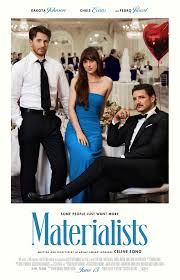
MATERIALISTS
US, 2025, 117 minutes, Colour.
Dakota Johnson, Chris Evans, Pedro Pascal.
Directed by Celine Song.
Here is a New York drama which is worth seeing – and, certainly, worth listening to.
Film has been written and directed by Korean-born, Celine Song. H er previous film, Past Lives, received Oscar nominations.
This is a film about a woman who works as a professional matchmaker, in a company which advertises, makes personal contacts, arranges meetings, especially dinners, according to the data they collect. In fact, Celine Song worked for six months in a matchmaking firm. She certainly draws on a lot of information as well as personal experiences.
One reason why the film is worth listening to is that the philosophy behind the matchmaking company, at least in the affluent areas of New York City, is, as the title indicates, materialist. The approach to setting up couples with hope for married unions is very much as what Christians often called “worldly”. And, in the case of Lucy, Dakota Johnson, whom we get to know very well during the film, she is very materialistic in her perspective. When she marries, she wants to marry into wealth, comfort, security, compatibility, not necessarily love as the Romantics would like.
In fact, she was in love with an actor, John, Chris Evans, often impoverished, now working in a catering firm, often servicing lavish materialist winnings. They are still friends, he in love with her, but she with her success ambitions held high. Then, at the wedding of a couple she organised, she encounters the brother of the groom, Harry, Pedro Pascal, and they are attracted to each other. Will this be the fulfilment of all her ambitions and her professional certainties? Maybe they would in another film, or in a television series, but there is much more to Materialists than this.
The three central characters are always interesting, Lucy often exasperating, a sympathy for John, questions about Harry and his motivations (and the rather startling discovery that amongst the criteria for matchmaking, an attraction for women is tall man, and that some men get their legs broken for height extension insertions!).
There is great power in several key speeches, well worth listening to and reflecting on: a long discussion between Harry and Lucy about their attitudes towards the criteria, to wealth, security, compatibility – but finally Lucy able to make a declaration honestly about her feelings, about whether marriages were for love or just deals and partnerships. There is also a very important discussion between Lucy and a client who was assaulted by the allotted partner, some of the shallowness of dating and its dangers, and her angry response. And, again, well worth listening to is a long discussion between John and Lucy, reflecting on their relationship over the years, love, emotions, his declaration of love rather than any deal, his image of growing old together, long-lasting commitment, personal interaction. And the fourth important discussion to listen to, Lucy’s final response.
The title, with its focus on material achievements and satisfactions, with their seeming priority over love, is certainly a challenge. Audiences identifying more immediately with Lucy, will be challenged. Audiences identifying with John be more hopeful, audiences identifying with Harry will have to give some serious thoughts to their attitudes. Materialist matchmaking is very much focused on success in this world, not appreciating the fact there are more profound values, especially love, the transcend the materialist ambitions.
- The emphasis of the title, a story about matchmakers, but the criteria for the matches, the boxes ticked, suitability is, financial issues and status, security, marriage and is business, and deal? The emphasis on the materialist criteria?
- New York City, the office of the matchmakers, the venues for ceremonies, wealthy mansions, sharing squalid apartments, the New York high life, restaurants, the small theatre and performance, out-of-town, the countryside, the country wedding celebration? Atmosphere? The tone of the musical score, the range of popular songs and their lyrics?
- The focus on Lucy, her age, little background of her family, the past and her relationship with John, her being interested in acting, his acting career, love for him, but her expectations for wealthy marriage and comfort? The encounter with Harry, the wedding, his attentions to her, her response, his digging all the right boxes, a “unicorn”? The possibilities for her future?
- The theme of the film and its critique of materialist ambitions and criteria for marriages? As dramatised in the collage of the variety of interviews, clients explaining themselves and their hopes, issues of age, appearance, sociability? Older men for younger women? The lonely women getting older? Sophie and her reactions to criticisms? The range of those working as matchmakers, violent running the office, celebrating their successes, Lucy and her nine successes? Her failure with Sophie and Mark?
- Audience response to the focus on materialist criteria and boxes ticked? The issue of love? Suitability? Values – and the quality of men affirming women as valuable? And the contrast?
- John, his age, or, acting career, some success, working as a caterer, the encounter with Lucy at the wedding, the discussions, the memories of the past, the flashback to Lucy getting out of the car, standing the street and blocking traffic with her confrontation? John and the play, success, the drinks afterwards, seeing Lucy with Harry, his reactions? Seeing him at his apartment, the slovenly behaviour of the partner in the apartment? His love for Lucy, continuing despite her behaviour?
- Lucy, the crisis with Sophie, the phone call to Mark, Sophie and the lawsuit, suing the company, Violet not blaming Lucy? Lucy trying to apologise, Sophie’s fears speech against her? It later, the phone call, Sophie wringing, John driving Lucy to the apartment, Lucy able to soothe Sophie, the embrace, passing the night, John waiting on the steps? And later Sophie’s contact that she had found somebody suitable?
- The strength of the dialogue, the manifestation of the three central characters, raising the issues of marriage, dating, deals, a vision of an ageing partnership?
- The power of several key speeches: the long discussion between Harry and Lucy about their attitudes towards the criteria, to wealth, security, compatibility – but finally Lucy able to say that she did not love him, nor he her, it was just to deal and partnership rather than love? The importance of the discussion with Sophie, and her raising the issues and the shallowness of dating, its dangers? The long discussion between John and Lucy, his declaration of love rather than deal, his image of growing old together, long-lasting commitment, personal interaction? And the final speech of Lucy’s acceptance?
- The happy ending, Lucy to resign but Violet offering her the post of leading the company? And the glimpse of all the people, couples, registry for marriage licenses, the cheerfulness, the atmosphere, and Lucy and John seen amongst them?
- The film and its title as a moral fable about the importance of marriage, commitment, it deeper values than wealth and security?
Past Lives
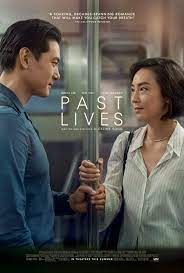
PAST LIVES
US, 2023, 105 minutes, Colour.
Greta Lee, Teo Yoo, John Magaro..
Directed by Celine Song.
It is said that writers should tell their own story. Playwright and director, Celine Song, draws on her own experience of her early years in Korea, her family migrating to Canada, her becoming a writer, marriage. But she enhances it with imagination, exploration of emotions, moments of communication, moments of silence.
There are several layers of meaning in the title, Past Lives. To else remembering their past and connections. However, there is an explanation of In-Yun (in-yuen) a Buddhist influence way of thinking, reincarnation, connections and past lives, bonding in the present, future connections.
Basically, the narrative takes place in three-time eras, opening in the present, going back 24 years, advancing 12 more years, coming back to the present. But the opening is tantalising, three adults at a bar, and a voice urging the audience to look at them, what the connections might be, the possible relationships. And the central character, Nora (Greta Lee) looks directly at camera. What are we thinking? What are we wondering? Who are these three?
The first part of the film takes place in Korea itself, and we are introduced to two 12 year olds, Na Young and Hae Sung, she always getting top marks, this time he beating her, and she crying in distress (something she often does). But, we see them as friends, playing together, their mothers having conversations – where will this lead? The immediate and sad answer is that her family is migrating to Canada. This moves him deeply. For her it is just part of life as she wishes him goodbye.
12 years later, Na Young has become Nora, a successful playwright, becoming very much a Korean North American in Canada. She attends a writing camp, meet writer, Arthur (John Magaro) and they bond. Meanwhile, Hae Sung(Teo Yoo) does his military service, rather unhappily, has a job, not satisfying, a girlfriend, but starts to look online for Na Young, not knowing she is Nora. When Nora he is about this, she makes a move and they have an online conversation, he devotedly remembering her and regretting her absence, she simply remembering a friend.
And then 12 years later again. Nora and Arthur are successful, he had a book launch signing, she writing plays, an apartment in New York City. And then Hae Sung decides to visit New York.
Celine handles this section of the film with great delicacy. The audience has got to know Nora very well and we wonder how this visit will affect her, friendship, affection, the presence of Hae Sung after 24 years. While the audience does know Arthur, we wonder how this visit will affect him and his love, his marriage. And what of Hae Sung, at this age, breaking with his girlfriend, wanting to see Nora again, devotion, rekindling love…?
In one sense, there is a great simplicity in the screenplay, the visit to New York, meeting, discoveries after 24 years, a tourist trip on the Hudson, a pasta meal at the bar. But, there is depth and complexity in the conversation at the bar, key to the whole film and the relationships, Nora between the two men, some speaking in English, some words in Korean, more and more Nora talking with Hae Sung, Arthur somewhat on the outer, but the conversation beautifully opening up Hae Sung’s devotion, Nora’s memories, her friendship and affection, her love for her American life, her love for her husband. And, while this conversation is dramatically telling – and she explains the conversation to Arthur, it is the final scene which so aptly and movingly bring this story to a conclusion, Nora accompanying Hae Sung to an Uber, their standing, silently, a distance between them, waiting for the car to arrive. And Nora returning to Arthur.
Great emotional exuberance – but profound emotional depth.
- The title, the past lives of Nora and Hae Sung, but the connections in past lives in terms of, Buddhist background, Korean interpretation, secular interpretation? Reincarnation?
- The autobiographical aspects of the narrative, the experience of the writer-director? Career, migration, Canada, New York, the literature and theatre world?
- In-Yun (in-yuen) and the Buddhist reflection, contacts in the past, contacts in the present, future contacts?
- The opening, the three people at the bar, the questioning, the possible relationships?
- Transition, 24 years earlier, school, Na Young and 80, the steps, talking, aged 12, her always getting top marks, his beating her in maths, her weeping? Their friendship, the play at the statue, their talk? The two mothers? The father and his filmmaking, home scenes? The decision to migrate? The two daughters, Na Young be unbecoming Nora? Saying goodbye, her friendship, but seemingly offhand, his deep feelings about her? Farewell, the plane trip, arriving in Canada, settling?
- 12 years later, Nora, her writing, theatre, at 24, relationship family, Internet connections, friends and career, discovering that he was looking for her, the contact, his motivations, missing her, memories of the past? Talking via computer, memories, the bonds, a change, his change, promising a visit?
- Nora, going to the writing school, meeting Arthur, working together, bonding? He and his military service, the glimpse, not happy? Flying to China? His friends, the drinking, girlfriend?
- 12 years later, Nora and Arthur in New York, his book signing, her theatrical writing? Married for many years, the apartment?
- Hae Sung, the plan to go to New York, letting Nora know? The flight, his arrival, the friends and the drink, storms and rain in New York?
- Arthur, his bond with Nora, learning some Korean, their shared interests and work? His reaction to the visit of Hae Sung? Nora and her reaction, meeting him at the airport, his settling in, his response, his love for Nora, the memories, the break with his girlfriend? His comment about earning money and supporting the wife?
- The tour of New York, the boat, the vistas of New York for the audience?
- The outing, his meeting Arthur, language, polite, loving pastor, the restaurant, sitting at the bar?
- The core of the film with the scene in the bar, talking, the two talking more and more in Korean, the depth of the conversation, the nature of love, of friendship? The exploration, Arthur patiently present? The conversation with Nora, her love for Arthur, the experience of meeting Hae Sung again?
- The next day, the farewell, the Uber, walking together, the long silence, the embrace, his departing? Her returning to Arthur?
