Displaying items by tag: Materialists movie
Materialists
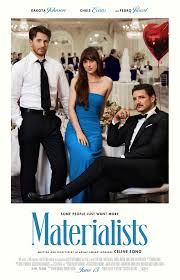
MATERIALISTS
US, 2025, 117 minutes, Colour.
Dakota Johnson, Chris Evans, Pedro Pascal.
Directed by Celine Song.
Here is a New York drama which is worth seeing – and, certainly, worth listening to.
Film has been written and directed by Korean-born, Celine Song. H er previous film, Past Lives, received Oscar nominations.
This is a film about a woman who works as a professional matchmaker, in a company which advertises, makes personal contacts, arranges meetings, especially dinners, according to the data they collect. In fact, Celine Song worked for six months in a matchmaking firm. She certainly draws on a lot of information as well as personal experiences.
One reason why the film is worth listening to is that the philosophy behind the matchmaking company, at least in the affluent areas of New York City, is, as the title indicates, materialist. The approach to setting up couples with hope for married unions is very much as what Christians often called “worldly”. And, in the case of Lucy, Dakota Johnson, whom we get to know very well during the film, she is very materialistic in her perspective. When she marries, she wants to marry into wealth, comfort, security, compatibility, not necessarily love as the Romantics would like.
In fact, she was in love with an actor, John, Chris Evans, often impoverished, now working in a catering firm, often servicing lavish materialist winnings. They are still friends, he in love with her, but she with her success ambitions held high. Then, at the wedding of a couple she organised, she encounters the brother of the groom, Harry, Pedro Pascal, and they are attracted to each other. Will this be the fulfilment of all her ambitions and her professional certainties? Maybe they would in another film, or in a television series, but there is much more to Materialists than this.
The three central characters are always interesting, Lucy often exasperating, a sympathy for John, questions about Harry and his motivations (and the rather startling discovery that amongst the criteria for matchmaking, an attraction for women is tall man, and that some men get their legs broken for height extension insertions!).
There is great power in several key speeches, well worth listening to and reflecting on: a long discussion between Harry and Lucy about their attitudes towards the criteria, to wealth, security, compatibility – but finally Lucy able to make a declaration honestly about her feelings, about whether marriages were for love or just deals and partnerships. There is also a very important discussion between Lucy and a client who was assaulted by the allotted partner, some of the shallowness of dating and its dangers, and her angry response. And, again, well worth listening to is a long discussion between John and Lucy, reflecting on their relationship over the years, love, emotions, his declaration of love rather than any deal, his image of growing old together, long-lasting commitment, personal interaction. And the fourth important discussion to listen to, Lucy’s final response.
The title, with its focus on material achievements and satisfactions, with their seeming priority over love, is certainly a challenge. Audiences identifying more immediately with Lucy, will be challenged. Audiences identifying with John be more hopeful, audiences identifying with Harry will have to give some serious thoughts to their attitudes. Materialist matchmaking is very much focused on success in this world, not appreciating the fact there are more profound values, especially love, the transcend the materialist ambitions.
- The emphasis of the title, a story about matchmakers, but the criteria for the matches, the boxes ticked, suitability is, financial issues and status, security, marriage and is business, and deal? The emphasis on the materialist criteria?
- New York City, the office of the matchmakers, the venues for ceremonies, wealthy mansions, sharing squalid apartments, the New York high life, restaurants, the small theatre and performance, out-of-town, the countryside, the country wedding celebration? Atmosphere? The tone of the musical score, the range of popular songs and their lyrics?
- The focus on Lucy, her age, little background of her family, the past and her relationship with John, her being interested in acting, his acting career, love for him, but her expectations for wealthy marriage and comfort? The encounter with Harry, the wedding, his attentions to her, her response, his digging all the right boxes, a “unicorn”? The possibilities for her future?
- The theme of the film and its critique of materialist ambitions and criteria for marriages? As dramatised in the collage of the variety of interviews, clients explaining themselves and their hopes, issues of age, appearance, sociability? Older men for younger women? The lonely women getting older? Sophie and her reactions to criticisms? The range of those working as matchmakers, violent running the office, celebrating their successes, Lucy and her nine successes? Her failure with Sophie and Mark?
- Audience response to the focus on materialist criteria and boxes ticked? The issue of love? Suitability? Values – and the quality of men affirming women as valuable? And the contrast?
- John, his age, or, acting career, some success, working as a caterer, the encounter with Lucy at the wedding, the discussions, the memories of the past, the flashback to Lucy getting out of the car, standing the street and blocking traffic with her confrontation? John and the play, success, the drinks afterwards, seeing Lucy with Harry, his reactions? Seeing him at his apartment, the slovenly behaviour of the partner in the apartment? His love for Lucy, continuing despite her behaviour?
- Lucy, the crisis with Sophie, the phone call to Mark, Sophie and the lawsuit, suing the company, Violet not blaming Lucy? Lucy trying to apologise, Sophie’s fears speech against her? It later, the phone call, Sophie wringing, John driving Lucy to the apartment, Lucy able to soothe Sophie, the embrace, passing the night, John waiting on the steps? And later Sophie’s contact that she had found somebody suitable?
- The strength of the dialogue, the manifestation of the three central characters, raising the issues of marriage, dating, deals, a vision of an ageing partnership?
- The power of several key speeches: the long discussion between Harry and Lucy about their attitudes towards the criteria, to wealth, security, compatibility – but finally Lucy able to say that she did not love him, nor he her, it was just to deal and partnership rather than love? The importance of the discussion with Sophie, and her raising the issues and the shallowness of dating, its dangers? The long discussion between John and Lucy, his declaration of love rather than deal, his image of growing old together, long-lasting commitment, personal interaction? And the final speech of Lucy’s acceptance?
- The happy ending, Lucy to resign but Violet offering her the post of leading the company? And the glimpse of all the people, couples, registry for marriage licenses, the cheerfulness, the atmosphere, and Lucy and John seen amongst them?
- The film and its title as a moral fable about the importance of marriage, commitment, it deeper values than wealth and security?
