Displaying items by tag: Dakota Johnson
Daddio
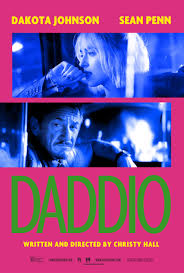
DADDIO
US, 2024, 100 minutes, Colour.
Dakota Johnson, Sean Penn.
Directed by Christy Hall.
There are many styles of presenting a two hander drama. And there are many films set within vehicles, especially cars, like the British Locke and several of the films by Iranian director, Abbas Kierostami. And the screenplays provide material which could easily be adapted for theatrical presentation.
Writer Christy Hall (also writer of the screenplay for It Ends With Us), directs her first film. And her two players are Dakota Johnson and Sean Penn.
The film is persuasively photographed by veteran cinematographer, Phaedon Papamichael, and the editing is skilful, moving from face-to-face, the use of the rear vision mirror, the driver turning his head, the to-ing and fro-ing of conversations, the camera resting during pauses for reflection.
Dakota Johnson is (strangely/provocatively) referred to as Girlie. In her 20s, arriving at Kennedy airport, and eventually getting a taxi to go home, she encounters Sean Penn as a driver with decades of experience. He notes she doesn’t immediately go for her phone for the trip, begins a conversation with her, she responding. He has been driving taxis so long that he has become something of character spotter, noting clues, interested, capacity for sympathy, and empathy.
The conversation takes place during the drive to Manhattan, halted by an accident, giving plenty of time for the conversation to develop. Girlie is polite, interest aroused, responding to conversation questions. Clark, the driver’s name though he would prefer Vinnie and at the end would opt for Mikey, is very direct, frank in dialogue and vocabulary, not so many filters.
What happens is gradual revelations, Girlie and her background in Oklahoma, present relationship, family issues, memories. Clark is also able to talk about himself, his marriages, his behaviour, his opinions on male status and treatment of women, women and their responses. Each of them begins to vie with telling episodes – but, just when we think they have done some self-revelation which has been worthwhile, Girlie tells a much more telling personal experience.
The cab acts as something of a therapy room, a confessional, and the audience realising that everybody needs to surface their issues, be able to articulate, appreciate an empathetic listener, enabling some kind of salvation/redemption through confession and an experience of some kind of healing.
- The impact of the drama set within a taxi, two characters, conversations, sympathy, clashes, empathy?
- The airport, the taxi line, the roads from the airport, traffic accident and block, the visuals of New York at night? The musical score underlying the conversation?
- The performances, the writing, the ordinary beginning, initial interactions, gradual revelation of character, truths, lies, stories, becoming deeper, and the final story and its impact?
- Calling the female character, Girlie? Dakota Johnson’s performance, delivery of lines, quiet times, the effect of the conversation on her? Her story, Oklahoma, harsh background, half sister, the impact of her father, and the separation, memories of his shaking her hand, leaving? The work and study, programming? The relationship, the phone communication, his being married, the comment on his wife, the three children, the texting and the children going to bed, the issue of whether he loved her not?
- Her response to clerk, the cab driver, years of experience, pleasant, listening, pleased that his passenger did not initially isolate herself with her phone, the gradual involvement, the rival stories and revelations, expressing her bucket list, the herbs, diving from the Greek cliff… ? Her final story to Clsrk? The sudden depth of experience, her expressing it, profound, the pregnancy, decisions, concealing, the blood, the miscarriage, the fetus leaving her, her not leaving the fetus? Her final text to the lover, her uncertainty?
- Clark, 20 years, Sean Penn’s performance, appearance, worldly -wise, chatting with passengers, reading people, commenting, few filters on his conversation? His eliciting responses from Girlie? His listening, silences, questions, challenges? Gradual revelation of his own story, frank, meeting his first wife, blonde, beautiful, not intelligent, but optimistic, his enjoying moments with her, her getting older, putting on weight, h is is further affairs, second wife, his attitudes towards women? His attitude towards men, summing up the lover, the use of the word love or not, reading his character, his analysis of men, their attitudes towards women, vying with each other in terms of position, masculine status?
- The impact of the final story on him, her arriving home, his telling her of his preference for the name, Vinnie, instead of Clark, but finally preferring Mikey?
- The cab as the equivalent of a therapy room, confessional, highlighting the need for people to communicate, to reflect in-depth, to surface responses, to express them, the possibilities for healing?
Materialists
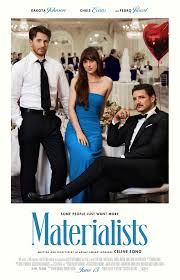
MATERIALISTS
US, 2025, 117 minutes, Colour.
Dakota Johnson, Chris Evans, Pedro Pascal.
Directed by Celine Song.
Here is a New York drama which is worth seeing – and, certainly, worth listening to.
Film has been written and directed by Korean-born, Celine Song. H er previous film, Past Lives, received Oscar nominations.
This is a film about a woman who works as a professional matchmaker, in a company which advertises, makes personal contacts, arranges meetings, especially dinners, according to the data they collect. In fact, Celine Song worked for six months in a matchmaking firm. She certainly draws on a lot of information as well as personal experiences.
One reason why the film is worth listening to is that the philosophy behind the matchmaking company, at least in the affluent areas of New York City, is, as the title indicates, materialist. The approach to setting up couples with hope for married unions is very much as what Christians often called “worldly”. And, in the case of Lucy, Dakota Johnson, whom we get to know very well during the film, she is very materialistic in her perspective. When she marries, she wants to marry into wealth, comfort, security, compatibility, not necessarily love as the Romantics would like.
In fact, she was in love with an actor, John, Chris Evans, often impoverished, now working in a catering firm, often servicing lavish materialist winnings. They are still friends, he in love with her, but she with her success ambitions held high. Then, at the wedding of a couple she organised, she encounters the brother of the groom, Harry, Pedro Pascal, and they are attracted to each other. Will this be the fulfilment of all her ambitions and her professional certainties? Maybe they would in another film, or in a television series, but there is much more to Materialists than this.
The three central characters are always interesting, Lucy often exasperating, a sympathy for John, questions about Harry and his motivations (and the rather startling discovery that amongst the criteria for matchmaking, an attraction for women is tall man, and that some men get their legs broken for height extension insertions!).
There is great power in several key speeches, well worth listening to and reflecting on: a long discussion between Harry and Lucy about their attitudes towards the criteria, to wealth, security, compatibility – but finally Lucy able to make a declaration honestly about her feelings, about whether marriages were for love or just deals and partnerships. There is also a very important discussion between Lucy and a client who was assaulted by the allotted partner, some of the shallowness of dating and its dangers, and her angry response. And, again, well worth listening to is a long discussion between John and Lucy, reflecting on their relationship over the years, love, emotions, his declaration of love rather than any deal, his image of growing old together, long-lasting commitment, personal interaction. And the fourth important discussion to listen to, Lucy’s final response.
The title, with its focus on material achievements and satisfactions, with their seeming priority over love, is certainly a challenge. Audiences identifying more immediately with Lucy, will be challenged. Audiences identifying with John be more hopeful, audiences identifying with Harry will have to give some serious thoughts to their attitudes. Materialist matchmaking is very much focused on success in this world, not appreciating the fact there are more profound values, especially love, the transcend the materialist ambitions.
- The emphasis of the title, a story about matchmakers, but the criteria for the matches, the boxes ticked, suitability is, financial issues and status, security, marriage and is business, and deal? The emphasis on the materialist criteria?
- New York City, the office of the matchmakers, the venues for ceremonies, wealthy mansions, sharing squalid apartments, the New York high life, restaurants, the small theatre and performance, out-of-town, the countryside, the country wedding celebration? Atmosphere? The tone of the musical score, the range of popular songs and their lyrics?
- The focus on Lucy, her age, little background of her family, the past and her relationship with John, her being interested in acting, his acting career, love for him, but her expectations for wealthy marriage and comfort? The encounter with Harry, the wedding, his attentions to her, her response, his digging all the right boxes, a “unicorn”? The possibilities for her future?
- The theme of the film and its critique of materialist ambitions and criteria for marriages? As dramatised in the collage of the variety of interviews, clients explaining themselves and their hopes, issues of age, appearance, sociability? Older men for younger women? The lonely women getting older? Sophie and her reactions to criticisms? The range of those working as matchmakers, violent running the office, celebrating their successes, Lucy and her nine successes? Her failure with Sophie and Mark?
- Audience response to the focus on materialist criteria and boxes ticked? The issue of love? Suitability? Values – and the quality of men affirming women as valuable? And the contrast?
- John, his age, or, acting career, some success, working as a caterer, the encounter with Lucy at the wedding, the discussions, the memories of the past, the flashback to Lucy getting out of the car, standing the street and blocking traffic with her confrontation? John and the play, success, the drinks afterwards, seeing Lucy with Harry, his reactions? Seeing him at his apartment, the slovenly behaviour of the partner in the apartment? His love for Lucy, continuing despite her behaviour?
- Lucy, the crisis with Sophie, the phone call to Mark, Sophie and the lawsuit, suing the company, Violet not blaming Lucy? Lucy trying to apologise, Sophie’s fears speech against her? It later, the phone call, Sophie wringing, John driving Lucy to the apartment, Lucy able to soothe Sophie, the embrace, passing the night, John waiting on the steps? And later Sophie’s contact that she had found somebody suitable?
- The strength of the dialogue, the manifestation of the three central characters, raising the issues of marriage, dating, deals, a vision of an ageing partnership?
- The power of several key speeches: the long discussion between Harry and Lucy about their attitudes towards the criteria, to wealth, security, compatibility – but finally Lucy able to say that she did not love him, nor he her, it was just to deal and partnership rather than love? The importance of the discussion with Sophie, and her raising the issues and the shallowness of dating, its dangers? The long discussion between John and Lucy, his declaration of love rather than deal, his image of growing old together, long-lasting commitment, personal interaction? And the final speech of Lucy’s acceptance?
- The happy ending, Lucy to resign but Violet offering her the post of leading the company? And the glimpse of all the people, couples, registry for marriage licenses, the cheerfulness, the atmosphere, and Lucy and John seen amongst them?
- The film and its title as a moral fable about the importance of marriage, commitment, it deeper values than wealth and security?
Am I OK?
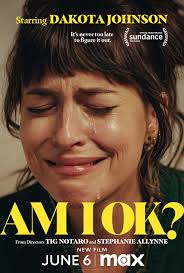
AM I OKAY?
US, 2022, 95 minutes, Colour.
Dakota Johnson, Sonoya Mizuno, Jermaine Fowler, Kiersey Clemens, Sean Hayes, Tim Notaro.
Directed by Stephanie Allynne, Tig Notaro.
This is a continued question by the central character, Lucy, played by Dakota Johnson. She is 32, working in mass Haj but schooled in painting, and questioning her sexual orientation and attractions.
This is a film for female audience, the male audience looking on from the outside, two male characters somewhat on the periphery of the action.
The writer and directors are wanting to explore Lesbian issues, the uncertainties of the central character reflecting on her past, of the formal relationship with a male friend, an attraction towards a co-worker in mass Haj, and quite a lot of discussion about female issues.
Is also a story of friendship, the of the central character, Jane, played by some lawyer mid to know, is a best friend from years ago, not appreciating the orientation of Lucy, always wanting to give her advice, a controlling character, eager to set her up with a man friend, quite explicit in sex language, in a relationship with Danny, Jermaine Fowler.
The cause of conflict is the situation in which Jane, originally from London, is asked by her boss (a cameo by Sean Hayes) to set up a bureau in London – and the effect on Lucy, sometimes emotionally distraught, thrown back on her own devices, and experiment with the worker at the mass arch, on to cope with the loss of her best friend.
The two friends attend yoga classes and Jane goes to a camp, with a cameo by Tim Notaro yoga and meditation oriented we Jane is urged to scream as loudly as possible – and she does.
There is a surprise ending with Lucy deciding to teach and to London, stay for a while – but neglects to think about where she will park the car while she is away! (And one wonders how she paid for the ticket to London books are quickly.)
While there are many mainstream films about manual gay friendships, this is a contribution to films about lesbian questions.
Madame Web
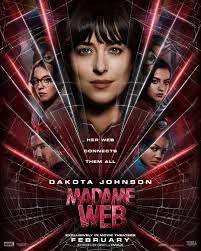
MADAME WEBB
US, 2024, 117 minutes, Colour.
Dakota Johnson, Sydney Sweeney, Isabella Merced, Celeste O'Connor, Tahar Rahim, Emma Roberts, Adam Scott, Mike Epps.
Directed by S.J.Clarkson.
This tale is almost the exact opposite of the Marvel Universe adventures. It is the villain who has the powers – and the lead, Dakota Johnson as Cassie Webb, has no superpowers except for some anticipatory glimpses of the future. As she says, she can see the future, “kind of…”.
This film was produced by Sony which seems to have the rights to Marvel stories connected with spiders, all the Spiderman films, the Venom films as well as Morbius. And, at one stage, someone does a riff on the well-known statement, this time the great responsibility has power!
This time Marvel has given us something of a Girls Night Out show – not too much to appeal to macho Marvel fans.
This is the Tale of the Threatened Three, three initially annoying and self-preoccupied 16 or so-year-olds (which does continue for a bit), targeted by a power-hungry maniac. His played by Tahar Rahim, a long way away from his excellent roles in French films. It is he who is the Spiderman variation, costume, mask, climbing walls, walking upside down on roofs, leaps from vehicle to vehicle – but no web.
Cassie Webb is an efficient New York fire department paramedic, working alongside the very nice Adam Scott whose sister-in-law, Emma Roberts, is pregnant and will provide an urgent setting for the climax. But Cassie has some strange hallucinatory moments, déjà vu as reality catches up with her glimpses. An accidental falling into the river in a locked ambulance leads to mysterious underwater lights and experiences. She doesn’t know why.
But, we do. We have seen the prologue to the film, in Peru, 30 years earlier, her pregnant mother searching for an exotic spider with mysterious healing powers. She is betrayed by her partner, Ezechiel (Rahim) who makes off with the spider, but has visions of three teenagers who will threaten his life. He has amassed a city-wide super surveillance system and goes in pursuit.
At one stage, Cassie trains the girls in CPR. Seems a bit tame – but, of course, it will be a key to saving Cassie after Ezechiel goes up in a spectacular explosion in a large fireworks factory – and crushed by a huge Pepsi Cola sign – Sony and Pepsi have an extensive promotion contract and business partnership.
Pregnant mothers and daughters, baby showers, teenagers flirting, female heroics…, As Marvel Universe tales go, a bit moderate.
- The Marvel Universe, a different perspective, female perspective, different presentation of superpowers?
- The film’s failure at the box office, the decline of the Marvel films?
- The reworking of the plot from the comics, the focus on Cassie, age 30, not having superpowers, strong personality, working with the New York fire department, paramedic, Ben, collaboration, driving, tending the wounded, banter? Responsibilities? Establishing her character, strong, then the moments of clairvoyance, déjà vu as reality catches up? A different lead for the Marvel Universe?
- The prologue, Peru, 1973, constant, pregnant, working with Ezekiel, the search for the spider, her finding one, the betrayal by Ezekiel, his violence, his escape with the spider? The local people, the spider people and their appearance, the shaman, her giving birth, her death? The baby in the water and the mysterious light and atmosphere?
- Ezekiel, 30 years later, his power, the elaborate surveillance system and his assistant, his vision of the three teenagers who will destroy him? His quest to find them?
- Cassie, the female atmosphere, the baby shower, the guessing game, her reluctance? The introduction to Mary, Ben’s care of her, Mary later appearing, about to give birth, the ambulance, the crisis?
- The clairvoyance, seeing the future, a kind of…? Her bewilderment? Trapped in the ambulance, into the river, the water, the lights, the effect on her?
- Cassie, the subway, finding the three girls, the threats, Ezekiel as the Spiderman variation, the pursuit? His vengeance?
- Cassie, with the three girls, their age, self-preoccupation, irritating to Cassie and the audience? Taking the cab, the bewildered driver, out into the countryside, telling them to stay? Her going to research her mother’s notes?
- The three girls, the different personalities, their backgrounds, neglected by their parents, selfish? The influence of each on the other? The decision to go to the diner, the food, flirting with the boys, dancing? Cassie, the research, returning, crashing the car into the diner, taking the girls, hiding them? Their becoming more compliant?
- Cassie and the trip to Peru, the bus, the countryside, the encounter with the shaman, learning the truth about her mother, her potential illness, the mother looking for the spider, to help Cassie’s health? The promise of the shaman to continue to help her?
- Ezekiel, on the trains, leaping from vehicle to vehicle, on the roof…? No web!
- The hospital emergency, the ambulance, making all the light screen, the crashes, Mary and the birth of the baby?
- The buildup to the climax, Cassie taking the girls to the previous site of the explosion, the fireworks factory? Setting up Ezekiel? And the request for the helicopter for the rescue?
- The climax, the fights, the confrontations, the girls, Cassie, memories of her mother, the fights, the explosions, the Pepsi Cola sign, crashing Ezekiel?
- All reconciled? Cassie and her future? Seeming indications of the three girls and superpowers, and the link with Madame Web?
