Displaying items by tag: Topher Grace
Calling, The/ 2014
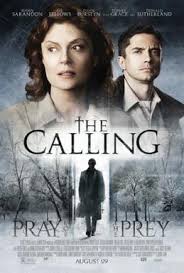
THE CALLING
Canada, 2014, 108 minutes, Colour.
Susan Sarandon, Gil Bellows, Ellen Burstyn, Topher Grace, Donald Sutherland, Christopher Heyerdahl, Ted Whitall.
Directed by Jason Stone.
The Calling is a little-known Canadian detective story. Made in Canada, especially in rather bleak, snowy country areas – with some trips to the city of Hamilton.
This is not a police thriller, not an action show. Rather, Fans will have to slow down, meet the detectives, learn their stories, discover the crimes, the forensic evidence, building theories, receiving clues, making connections, going into action to track the killer.
The star of the film is Susan Sarandon, Hazel, in charge of the police station in the country town, Gil Bellows her assistant. Then, Topher Grace comes the city, not immediately welcomed, but proving invaluable in terms of amassing clues and interpreting them. And they become more numerous.
The film states that it has a Catholic background, a visit to a church and, indeed. Donald Sutherland as a veteran priest, Father Price. However, the religious theory behind the killings is an invention of the screenwriter with very little reference to historical reality, and some of this expressed dates personalities, inaccurately (by Father Price) all kinds of conspiracies and secrecy in the early centuries of the church, range of beliefs in resurrection, believing human sacrifices to achieve resurrection. (And, at the end, when Father Price recites the Lord’s Prayer, he uses the Protestant version rather than the Catholic version.)
What is different is that the audience sees the killer rather early in the piece, initially suspecting him, seeing him in action with a little girl and his offering to heal her, then his contact with various victims, the detectives having photos of the victims, noting their mouths, their seemingly singing, and Father Price interpreting the words as a chant for liberation.
There are psychological problems, Hazel and her relationship with her mother, Ellen Burstyn, and Hazel.
The strong cast and the unusual case mean that is an interesting film thforose who enjoy detection.
- General sounding title, the ominous explanation? Religion, Catholic traditions, screenwriters inventions?
- The Canadian setting, the bleak snowy landscapes, the town, police precincts, homes, diners, the contrast with the Canadian cities? The musical score?
- The detective story, not a police thriller? Detection, the crimes, the clues, forensic evidence, theories, higher authorities, local jurisdictions, police, detectives, medical practitioners?
- Susan Sarandon as Hazel, her age, the back story, marriage, loss of her child, depression, suicide attempt, her back injuries, living with her mother, tension and love between them, waking up, drinking, eating, relationships in the town, Ray, working with her, collaboration, clashes? Andrew, his wife, clashes?
- The dead woman, throat slashed, her son and his arrival, the mystery, investigations, the back story? The post-mortem, theories?
- Wingate, his arrival, Hazel’s and Ray’s reactions, his leaving the city, his explanation about the death of his partner, the gay background? His enthusiasm, the investigation of a number of deaths, the phone calls, information, the photos, the study of the mouthes, the theory of the singing?
- The visit to Father Price, his explanations, the inaccuracy of historical and scriptural details, the screenplay’s invented theories about secrecy, about sacrifices, about victims, about resurrection? But Father Price’s beliefs, doubts, his age and experience, the discussions with Hazel? The impact on her, her religious background? The later revelation about Father Price, his illness, the theories, his helping the brothers, Gabriel’s suicide, his contact with Peter, his offering himself as a victim? His death?
- Catholic background, inaccuracies, the use of a non-Catholic Church, the Protestant recitation of the Lord’s Prayer, the invented theory about sacrifices and secrecy?
- Hazel, going to the city, the clash with Mason, not getting promotion, not getting extra help? The continuing investigations? Wingate, his contacts, the phone number, travelling to the countryside, following the suspect, the discovery of the artist, the formaldehyde body? The later revisit by the police, the body of the suicide brother, ready for resurrection? And the behaviour of the disciples?
- Wingate, coming to the house, the photos, Hazel examining them, her mother’s response, inviting him for the meal?
- The audience knowing the killer early, at the cafe, his tea, the waitress, her story, a little girl collapsing, his going to the house, initial fear, with the little girl, the tea, persuading her to drink, to sing? Hospital, seek, coming back to life, the reference to the Gospel of Mark, the raising of the little girl by Jesus?
- The issue of the mouthes, the song, the Latin, Father Price explaining the of theme of liberation?
- Wingate, going to the house, in phone contact with Hazel, Ray disapproving, risking her job? The killer, attacking Wingate, talking with Hazel on the phone?
- Hazel, at home, the arrival of the killer, the conversation with Hazel, her past, despairs, bound, urging her to drink, her will to live, his defeat, shooting himself?
- Detective work, the serial killer, religious beliefs, their motivations?
How to Make a Killing
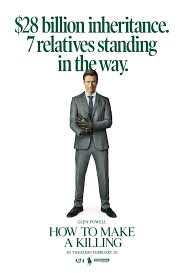
HOW TO MAKE A KILLING
US, 2026, 105 minutes, Colour.
Glen Powell, Margaret Qualey, Jessica Henwick, Bill Camp, Ed Harris, Topher Grace, Zach Wood, Andrew Lukis.
Directed by John Patton Ford.
Quite a slick 21st century American entertainment, the world of wealth, loss of wealth, ambitions, amoral, turning immoral, murder – murders.
And a generally glossy affluent setting, some moderate hardships in New Jersey, the affluent world of New York. And, leading the cast is popular Glen Powell, several starring roles each years since his break out in Maverick, along with Margaret Qualley, an even more frequent screen presence in recent years.
This is a murder drama, a touch of the serious, a touch of the satiric, not intending to be a film for thoughtful reflection on ethical and moral issues – though, there is quite an unexpected twists towards the end which certainly gets the central character thinking.
In the final credits, there is an acknowledgement that this film was inspired by the 1949 British film, Kind Hearts and Coronets, and the novel on which was based. This was a film, certainly, from another era, effective serious/satiric British filmmaking, and the famous tour-de-force performance by Alec Guinness playing all those to be murdered by the ambitious central character.
The origins of How to make a Killing may be of little interest to the 21st-century audience. However, those who remember and appreciated the original have the advantage of knowing what is going to happen. But, they will have the regrets that while there are victims here to be killed, they are played by a varied including Bill Camp, Topher Grace and, ultimately, Ed Harris.
So, the audience is invited to have sympathy for Glen Powell’s ability to bring grinning charm despite his ordinary upbringing even though he discovers he is heir to millions. He is Beckett Redfellow, his pregnant mother disowned by her wealthy father, having to go to work, and Beckett finishing up in a clothing store.
As a boy, he fell for the charms of the rather dominating Julia who grows up to be the dominating Margarette Qualey, false charms, ready to twist any man around her little finger. And she does.
The screenplay, remembering the original, has the whole story told in flashback, Beckett on death row, execution imminent, and the prison chaplain, a serious priest, asking the question and spending the whole film listening to Beckett’s interesting story and his murderous quest for his fortune – including quite the finale and the deathly confrontation with his grandfather.
The unexpected twist towards the end leads the story in a somewhat different direction.
An easy night out kind of entertainment.
- The 21st century American entertainment, ambiguous hero, romantic entanglements, ambition and greed, murders, the law?
- The credit with the note about Kind Hearts and Coronets, 1949, inspiring this film?
- Beckett Redfellow, his story, in death row, execution close, the arrival of the priest, prison chaplain, Beckett telling his story, the priest listening, his interventions, encouraging? The execution time, the prayer?
- The flashbacks to the past, Mary, wealthy family, her dominating father, the attraction, the date, her pregnancy, the birth sequence, the father collapsing and dying? Her father confronting her, denunciation, cutting her off? Bringing up her baby, encouraging him, her hard work, Beckett as an adult, his life, prospects?
- Explaining the issue of money, the family, the family tree, those between him and the fortune?
- His mundane life, accommodation, his job, the clothing store, Julia arriving, the flashbacks to the flirtation in the past, her being dominating, his response? In the store, memories, announcing her engagement? His having to give up his job because of the owner and replacement? Going to the warehouse, working there, the beginning of his plan? The encounter with his uncle, sympathetic, giving him the job, privileges?
- The first victim, playboy, extravagant, wild scenes, on the yacht, Beckett present, the plan, the rope, the anchor, his death?
- The final sequence – and the repetition for each of the victims?
- Noah, music and art, the gallery, the encounter with Beckett, the discussions, friendship, revelations, Noah and his death?
- The FBI, the couple, the interrogations?
- Stephen, money, swindles, religion, his following, his speeches, Beckett pretending to interview him, the boastful interview, the sword, the revelation, Stephen’s many enemies, the contrivance of his death?
- The aunt, the adoptions, her charity, her personality, her teeth, the whitening, her death?
- Julia, her continued appearances, dominating, charm and ruthlessness, her husband, his inefficiency, wealth, losing, her asking for the loan, the various visits to Beckett, seductive and tantalising, the ultimatum? The timing, blackmail, Beckett hurrying to the office, the encounter with Lyle, the confrontation, collapse, the FBI, the accusation, the evidence, the murder?
- Ruth, her relationship with Noah, about to break it, the attraction to Beckett, him to her, her life, working in the garment industry, the outings with Beckett, his falling in love with her, the time together, the proposal, the plan for the engagement, the party, and their fashionable apartment?
- Beckett, prospering, arrogant, wealth, lifestyle, the meetings of the wealthy board, his uncle, his uncle’s collapse and death?
- His grandfather, personality, in the shadows, emerging, inviting Beckett to dinner, his dilemma about his engagement party, his arrival, the vast mansion, the meal, the discussions, the grandfather and his rifle, eating attacking his grandson, Beckett and his defence, firing the arrows, the death of his grandfather? His hurrying back to the party? Ruth and her waiting, her decision to walk out on Beckett?
- The arrest, the irony of his being arrested for a murder he did not commit? Interrogation, the evidence, the trial, being found guilty? Julia, her testimony, talking of Beckett always loving her? Julia with the incriminating photos?
- His finishing his narration for the priest, going to execution, the stay, Julia and her letter assisting him, her visit to the prison, the breakup, his desperation? Her deal, his signing away all his wealth to her?
- The finale, the priest in the bar contemplating what he had heard, Beckett released, Ruth, meeting him, giving him the hair token of his mother which he often looked at, motivation, her driving away? Julia in the parking lot – and future, Beckett subservient to her?
Flight Risk
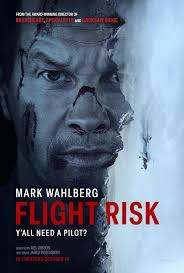
FLIGHT RISK
US, 2025, 91 minutes, Colour.
Michelle Dockery, Topher Grace, Mark Wahlberg, Maaz Ali, Paul Ben-Victor.
Directed by Mel Gibson.
Best to consider first the issue of Mel Gibson, his reputation, personal, as a filmmaker. Many audiences react against Mel Gibson because of his strong views, his anti-Semitic outbursts in the past. (Catholic audiences are probably dismayed by his extreme views about the church, tradition, the inheritance from his father’s Conservative stances but will still go to see and even enjoy his films!).
In fact, Mel Gibson is an Oscar-winning director with Braveheart. He also directed Apocalypto and Hacksaw Ridge which have strong reputations. And, of course, there is The Passion of the Christ.
This 90 minute action show is a long way from these films. Gibson said he wanted to make it for sheer entertainment and that is what it offers. It is reminiscent of a number of films but that is the nature of the popular action show.
While Mark Wahlberg has top billing, above the title, the main strength of the film is with Michelle Dockery, Madolyn, taking some time off from Downton Abbey. She is an officer who has allowed someone to die on her watch and has been suspended, given the opportunity for rehabilitation, going to Alaska to apprehend a key witness against a violent financial criminal. The witness is Winston, played by Topher Grace, a timid desk person but shrewd in his management of money, incessantly chatty, but with the possibility of some kind of redemption and witness protection.
The bulk of the film takes place in the air during a flight across Alaska to Anchorage. Mark Wahlberg plays the good old boy pilot, even having the top of his head shaved which makes him seem more eerie! And, it very quickly emerges that he is not what he seems and, in fact, is a hired killer.
Which means then that there are lots of complications during the flight, guns, knives, but, especially, effective tasering. The plane is rickety, the mountain peaks ominously looming, Madolyn having to fly the plane, on automatic, getting guidance from an official who is flirtatious while giving his advice. Then there is the question of a leak in the department, suspicion on Madolyn’s contact, on her boss, and the taunts of the hitman pilot.
And, there is always the excitement of the crash landing.
Most entertainment action films are made up of elements that we are familiar with but with some variations. Same here.
- Expectations of Mel Gibson film? Of an action film? Action in the plane?
- The Alaskan settings, the town, the mountains, the city, the tarmac…? The musical score?
- Situation, Winston, his background, accounting, doing deals for criminals, under threat? Hiding in Alaska? His personality, chatter, his mother, fearful? Wanted as a witness?
- Madolyn, her history, the person killed under her watch, suspended, invited back, determined, the confrontation with Winston, taking him in? The plane flight to New York? Her contact with Janine through phone? Some suspicions of her? Contact with Coleridge the boss? The discovery of the truth? The ruthlessness, Janine’s death?
- The plane, the pilot, Mark Wahlberg, jovial old boy, the bald head? The chatter, the blood? Madolyn realising the truth, pulling the gun, the struggle, Tasering him? The reality of his being a hit man, knowing all about her, taunting her? The fights, tying him up, the spectacles, cutting loose? His personality, taunting?
- The pilot loose, the fight, Winston and the knife, his being stabbed?
- Madolyn, using her wits, strength, talking with Winston, the threats to him, untying him? The personal story, his mother? Autopilot? Talking with Janine, talking with Coleridge? The discussions with Hasan, jovial, flirting, his helping her land?
- The dramatic issues, the fights, the mountains, fuel diminishing, the landing, the wind, the crashing, the pilot thrown out, run over by the vehicle?
- Landing, the hospital for Winston, her meeting Hasan? The threats by Coleridge, her recording them? Vindication?
Heretic
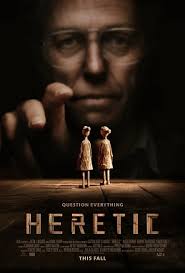
HERETIC
US, 2024, 111 minutes, Colour.
Hugh Grant, Sophie Thatcher, Chloe East, Topher Grace.
Directed by Scott Beck, Bryan Woods.
An arresting title. Heresy – but heresy from what faith?
It is not easy to categorise this thriller. On the one hand, there will be an audience who wants to see it as a horror film, an insane male character terrorising two young women, confining them in his house, continued threats, violence. And, this audience will be aware that there is a lot of religious discussion during the film but they will not find this very interesting, hearing it but not particularly taking note of it. The thriller tension is what is important.
On the other hand, there will be an audience who listens attentively to all the dialogue, the focus on churches, on religion itself, unbelief and its consequences – all presented in the context of a thriller of menace and ultimate violence.
And, this thriller is particularly different because of the presence of Hugh Grant. He has played some villains in recent films and television series but here he returns to the style that he used in so many of his romantic comedies. There are his sometimes stumbling manner, his ironic grimaces and self-deprecation, his immediate charm. But, as the narrative goes on, this becomes a very sinister charm.
One of the arresting aspects of the film is that it initially focuses on the Church of Latter Day Saints, the Mormons. (In fact, film information notes that the two actresses were brought up as Mormons, though no longer belonging to the church, and so know from the inside how they should play their roles.) They are young, earnest, chatting together initially about personal attitudes, one finding that watching a pornographic film confirms her belief in God, the of the more wary. And, they are ignored in the town as they offer leaflets, mocked by a group of girls wanting a self it with them.
But, their appointment is with Mr Reed who has told the church he is interested in Mormon beliefs. And so, Hugh Grant, Mr Reed, charming and welcoming, the girls cautious because they need to have another woman in the room with them, Mr Reed promising his wife in the kitchen, making blueberry pie, will join them. Of course, she does not. And, while he has trapped the girls, he continues with his conversation, asking them about their faith, talking about his religious investigations, studies and essays, all the time reassuring them even though they become more and more anxious, pretending to ring the church for rescue.
So, interest in the film will depend on how much audiences want to see as the menace continues, the consequences for the young women, trapped, wanting to escape, and, indeed, going down to the basement and discovering another weirdly sinister world. And the young women using their wits in desperate situations.
Those following the dialogue will be both enlightened and confused as it develops, Mr Reed using songs like The Air I Breathe and board games like Monopoly and the changes with further “iterations” as illustrations of how original experiences of faith lose their strength and power with further iterations. And he does come up with a solution, even as he horrifies the women and ourselves as we discover his secret and weird belief in raising women “prophets” from the dead. Control is his final answer, all the nature and core of all religion being control.
Audiences were not quite expecting this one!
1. Title, religious themes?
2. Orthodoxy and heterodoxy?
3. The Church of Latter Day Saints context, as a church, Joseph Smith and his testing religions, forming his own, his personal life, issue of polygamy, changing laws, evangelisation, sisters and brothers going out to visit, the Church authorities?
- The film as a psychological thriller, as a religious/religion-oriented thriller?
- The presence of Hugh Grant, his reputation, his acting style, his charm and idiosyncrasies, grimaces, eyebrows… Used to different advantage here?
- The plausibility of the plot, the church, the missionaries, their behaviour? Mr Reed and his house, his initial manner, the deception, the control, the discussions about the true religion, God, the trapping of the women in the house, the issue of raising from the dead, the revelation of the truth, Mr Reed and his believe in that true religion is control?
- The introduction to the two missionaries, the huge mountain, the seat, chat, the discussion about pornography, and the reinforcement faith? Sister Barnes and her reaction? Moving through the town, ignored by people, the girls with the photo and pulling sister Paxton’s skirt, climbing the steps, returning, the bikes, going to the Reed house, the appointment?
- Hugh Grant as Mr Reed, the welcome, the sympathy about Mormonism, the offering pie, the promise to meet his wife, her shyness, the drink, the candles? Taking their coats? The revelation about locking the bikes, the key in the wrong pocket? The beginning of the uneasiness?
- The thriller aspect, the women trapped, time passing, the pretence about phone calls, yet his saying that there was metal in the walls, no phone, the mechanism for locking the door? The possibly leaving at the back, the house built on the cliff, the two doors, belief in disbelief, his taunting them, the going down into the basement, the consequences in the basement, the apparition of the old woman, eating the pie, her death, the plan for her resuscitation? The desperation of the young women, the device of trying to get the matches?
- The theological aspect, audience interest in Mormonism, its history, Joseph Smith, his own behaviour, the comments about polygamy and the changing of the law, polygamy for promoting more children in the church? The further conversations about the different churches, about God, about belief, the testing of the girls? Mr Reed and his explanations about his study, the range of books on his library, his essays, his explorations, his playing of the music, The Air I Breathe, and his theory of iterations, from the original through the various developments, moving away from the original insight? The example of Monopoly on the boardgames in the developments?
- In the basement, Sister Paxton attacking Reed, his slashing Sister Barnes, her bleeding out, her coming again, bashing Mr Reed? Sister Paxton, the confrontation of ideas with Reed, her astuteness in noticing things, her escape, through the various doors, the discovery of the women in cages, his controlling them? Her shrewdness in noting what had happened, the conclusion of religion was Control? His agreement, the attack by Sister Barnes, her death? Sister Paxton and her working out that his control was to make them think that they were in control while he controlled them?
- The background of the elder, in the church, checking on the girls and their return to headquarters, his going to visit Mr Reed, his return with the pamphlet?
- The uncertain ending, the effect on Sister Paxton, Reed and his beliefs, control, his Satan -like theories?
