Displaying items by tag: Christopher Abbott
Testament of Ann Lee, The
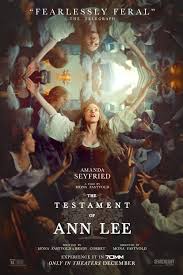
THE TESTAMENT OF ANN LEE
US, 2025, 137 minutes, Colour.
Amanda Seyfried, Lewis Pullman, Thomasin McKenzie, Matthew Beard, Christopher Abbott, Viola Prettejohn, David Cale, Stacy Martin, Scott Handy, Jeremy Wheeler, Tim Blake Nelson.
Directed by Mona Fastvold.
Who was Ann Lee – and a woman significant another to leave a testament? The answer to this question here is challenging, unsettling.
Norwegian writer-director Mona Fastvold, who writes and directs with her partner, Brady Corbett, especially the Oscar-winning The Brutalist, discovered that Ann Lee was significant in the 18th century establishment of the Shaker movement in New England, moving from the English city of Manchester. As the film shows in an initial startling Quaker episode where participants begin to shake, dangling arms loose, and young man and an old woman screaming incessantly, the Shakers were a development from the very quiet religious prayerful movement of the Quakers.
One of the striking features of this film is the recreation of the city of Manchester in the middle of the 18th century, the attention to detail, costumes and decor, the religious meeting places, homes, workplaces, the streets and markets, the intervention of the authorities. This film looks very impressive.
And, it sounds very impressive. The music direction has gone back to Shaker Spirituals of the period, disturbingly movement rhythms, forcefully sung, chanted, heavy pounding beats of the instruments, and all accompanied by an extraordinary choreography, men and women, period costume, rhythmic and erratic movement, shaking, stirring, stomping, the participants lost in some kind of spiritual ecstasy.
One might say this is a rather brutalist screen experience.
There is a voice-over narration of the story of Ann Lee, a devout little girl, always accompanied by her brother William, no playing with toys, rather a sense of prayer and the presence of God, continuing as she grew up, her Quaker involvement, her rebellion against formal Anglicanism and enthusiasm for popular movements like the Methodists. Personally, she experienced some lingering shock when witnessing her parents’ lovemaking, but marrying blacksmith, Abraham, having four children but their all dying young, and her spiritual sense and development moving her against all kinds of sexual experience. And requiring this her followers.
Ann Lee is played in an award-nominated performance by Amanda Seyfried, a powerful and intense performance, ensuring that Ann Lee comes across as intensely sincere, ecstatically prayerful, high standards for herself, her being acclaimed as Mother in the Shaker movement, and her belief that, while God came to earth as male in Jesus, God was to return to Earth for the second coming as female, in her.
There are also some arresting supporting performances led by Lewis Pullman as her brother William and continue disciple, and Christopher Abbott as her tormented husband, Abraham.
Ultimately, Mother has an inspiration that she should take her followers to America, just as the American Revolution was underway, an extraordinary storm scene which would make anyone wonder why men and women took the sea in those centuries, her trust and faith to find a land base, and the establishment of the various communities in this new world, becoming more numerous, significant prayer gatherings, a men’s door and a separate women’s door into the meeting room, then chant, stomping, gesticulating, until the time comes when Ann realises that she must leave this world.
Many audiences have found they are not on the wavelength of this particular religious history, its themes, its manifestations of faith, the peculiarities of this spirit manifested in bodily shaking. But, for those interested in what William James called the varieties of religious experience, this film is informative, interesting in its way, confronting and always challenging.
During the final credits there are continued statistical pieces of information, the maximum number in various communities at their peak in America, and the dwindling numbers to the present (remembering Ann Lee’s injunctions against spiritual sexual experience and her reliance on converts.)
- The history of the Quakers, the Shakers, the transition to the United States and establishing communities? The heritage?
- Audience knowledge of the Shakers, Ann Lee, of 18th century Manchester and the religious movements, the mission to America? The final statistics as to the number of continuing Shakers, the peak community numbers?
- The film is described as a musical drama, the emphasis on the drama of Ann Lee’s religious experience, the churches in Manchester, her marriage, children and their deaths, her emerging leadership? Described as Mother?
- The musical contribution: the traditional Shaker Spirituals, the movement, the lyrics, the dance, gestures, the pounding instruments? The titles on screen, the scriptural references to the woman? Choirs, the group and dancers, costumes, choreography? Their insertion into the narrative?
- 18th century England, the status of the Anglican church, the emergence of other movements, the indication of the Methodists? The Quaker meetings? The key visuals of the meeting, the man and his cries, gestures and contortions, the old woman and her very long crying out? Presence of God, presence of the Spirit, entering the psyche, entering the body, the mentality, the contortions, the shaking, a different kind of religious experience?
- The narrative, explaining Ann, her family, her situation, her brother William, her reaction to her parents copulating, Abraham, the marriage, the sexual encounters, the pregnancies, the four births, the difficulties, the babyirs dying? The effect on Ann, her rejection of physical sexuality, the bride of Christ in union with him? (And making converts but no marriages, and the lessening of the population of the Shakers?)
- Ann and William as children, his dependence, walking the city, the churches, their workplace, the relationship with the parents? Ann and her description of her life, prayer, conscious of God, not playing with toys, religion all through her life? And her growing up?
- Ann and her female qualities, the qualities of leadership, in Manchester, the role of William, her marriage to Abraham, his work, her praise of him, his sexuality needs, her refusals, the children and their deaths? Some alienation?
- Her going to the local communities, James Mawdsley and his wife, their leadership, welcoming and, the sessions, the religious fervour, prayer, dancing, shaking, gestures? The God language?
- The development of the group over the years, and growing older, William and his continued presence, separation from Abraham? The role of the Wardsleys? The response of the people of Manchester? Some converts? The role of Mary, her eyes, her friendship?
- The attitude of the churches, condemnation and rejection, the Shakers and their defiance, the local authorities?
- The sense of mission, the decision to go to America, the discussions, the appeal for finance to the member, his recommendation for a sponsor, the Wardsleys staying in England, Ann, William, Abraham and his going with them, the other members of the group?
- At sea, the vividness of the storm, the waves, the effect on the ship, on the passengers, and her defiance, providence, the calm, the criticisms of the crew of the denunciations, and confronting them?
- The small group, landing in America, the political situation, the background of the war of independence, through the city, finding the landlady, Ann and her visions and convictions, their being welcomed, the meals, the discussions? The young man and the girl, the sexuality issues, their leaving the dinner, together, found by their father, their having to leave?
- The small group, sailing north, the eccentric captain, going through the woods, the old man and his visions, shaking, pointing, the travelling, finding the land, settling in?
- The overview of the settlement developing, Ann and her leadership, the maps and her pouring over them, the buildings, the trees, logging, sawing, the houses and halls?
- The increasing congregation, people gathering? The assembly, the separate doors for men and women, the women’s dress, the prayer, the shaking, the dancing?
- The issue of the second coming, Jesus as male, the second coming for Jesus as female, God as male and female? Ann seen as Jesus in his second coming, Mother, The leader?
- The character of William, dependence on his sister, constantly with her, his role at the meetings, the prayer, always with the group, his ventures in America, his death?
- Mary, with Ann, Ann speaking of William coming, Mary explaining to her his death, Ann saying that he was coming to welcome her to happen, to her babies?
- And the continued impact of the Shaker songs, movement and choreography throughout the film?
- The overall experience, depending on the audience’s religious attitudes, scepticism, belief, different modes of prayer and spirituality, the impact of shaking, songs and dancing, gesticulating? Historically interesting? Relevance to the 21st-century?
Bring Them Down
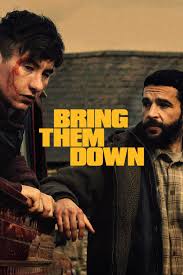
BRING THEM DOWN
Ireland/UK, 2024, 106 minutes, Colour.
Christopher Abbott, Barry Keoghan, Colm Meany, Nora-Jane Noone, Paul Ready, Aaron Heffernan, Susan Lynch.
Directed by Christopher Andrews.
Feuds often grim and violent. Family feuds fester. And, especially on the evidence of Bring Them Down, Irish feuds can be merciless – but also elements of forgiveness.
And, with feuds, there are always two points of view, at least. And this is what happens during this film, audiences needing to pay attention to see the transitions from one perspective of the savage events to another.
In fact, the opening scene is set 20 years earlier, Michael, a sheep farmer (an intense performance by American Christopher Abbott Irish accent and all) wildly driving his car, his girlfriend, Caroline, a passenger in the back, but his mother in the front, telling him that she is about to leave his father, more speed, a crash, Caroline’s face cut, his mother dead. A grim prologue for what will follow.
In the present day, Michael is still living with his old cantankerous father, Ray (a familiar role for actor Colm Meany). Michael is unmarried, looks after the sheep, Caroline having married his neighbour, Gary, and they have a son, Jack. But, times are difficult, finance hard. Gary is prepared to let his sheep go and develop some of his land building homes.
Jack is played by Barry Keoghen now coming into greater prominence with films like Banshees of Innisherin and Saltburn.
At the centre of the feud is the disappearance of the two rams owned by Michael. They are reported to be dead. Then they appear at the market. Jack is involved, clashes between Michael and Gary.
Which brings us to the title. Is it that each side of the feud wants to bring the other down? Certainly. But, with the huge centring on the rams, then on the sheep flock, Jack and his cousin brutally cutting the legs off of Michael’s shee, Michael bringing the sheep down from the hills and having to destroy them in their suffering.
This is where the screenplay challenges the audience, telling the story from Michael’s perspective and judgements, then recounting the same events from Jack’s point of view. And, Ray, influencing Michael to be more vengeful.
There has been a long hardness in the Irish experience over the centuries, Irish oppressed, religious persecutions, famines, migrations, tough attitudes for survival. And this is a buildup in a final confrontation between Michael and Jack. But, we realise that under the hardness, there is some humanity, some tenderness. And the film ends with both, some more hope rather than anger.
- The title, with reference to the sheep, sheep farmers?
- Locations and atmosphere, the mountains, hills, the sheep in the countryside, homes and interiors, sheds? The musical score and atmosphere?
- The prologue, the drive, Michael driving, not seen, Caroline in the back anxious, his mother, in the front, watching him, the plea to slow down, her leaving her husband, increasing the speed, the crash, Caroline and her face slashed, his mother dead?
- 20 years later, Michael, with the sheep, taciturn, looking after his father, the difficult relationship, his father not knowing his wife had left, cranky, needing care? Michael and the sheep? The relationship with Caroline, her marrying Gary, Jack as her son?
- The phone call, the rams dead, Michael going to the market, seeing the rams, the confrontation with Gary and Jack, the bystanders and support? The vehicles chase on the way back, Gary and Jack crashing, Michael giving Jack the lift?
- The story of bringing the sheep down? The two versions? Michael’s version, Jack’s version? Michael, searching for the sheep, the legs cut, his carrying the ramps? Upset, with his father? The vengeance, Gary and his buildings, going to the site, struggle with the builder, his ear shot, killing the builder, removing his head, his father’s request for a head, in the bag? His later realisation that he had the wrong head?
- Jack’s solution, with his cousin Aaron, the plan, the destroying of the sheep, the legs? Jack and his reaction, the confrontation with Aaron, not wanting to see him again? The blood, his mother, returning home, with his father?
- Michael, with his father, his father’s collapse, Caroline and helping? Her tending Michael’s ear?
- Jack, the realisation, running away, Michael pursuing him up the mountain, the Bluecoat decoy, gestating Michael, the fight, Michael stabbing Jack, carrying him down, giving to his mother, Caroline with the rifle?
- The end, Michael wounded, going back to the house – and audience speculation about the future?
mubi release, January 2026
Wolf Man
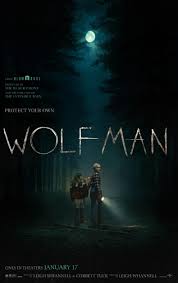
WOLF MAN
US, 2025, 103 minutes, Colour.
Christopher Abbott, Julia Garner, Sam Jaeger, Matilda Firth, Benedict Hardie, Zac Chandler.
Directed by Leigh Whannell.
A few years ago, Australian writer-director, Leigh Whannell, who has had a successful career with horror films, the Saw franchise, of the Insidious franchise, directed the remake of The Invisible Man, which was very successful with both critics and box office. He has now followed up with Wolf Man. But, it is not so much in the tradition of the previous Wolf Man horror films but rather a new development, a 21st-century perspective with reference to Native American traditions.
There is quite a contrast between the impact of The Invisible Man and Wolf Man, the visibility and invisibility. A filmmaker can work more subtle variations on horror and terror when the terrorising character is invisible, able to appear or disappear, those terrified not knowing where the invisible man is, present or absent, suddenly menacing. With the Wolf Man, everything is visible. This is very much the case here.
The setting is Oregon, forested mountains and valleys, a recluse taking his young son out hunting, trying to prepare him for the sense of menace and the tradition of a strange creature, somehow or other infected, wolflike manifestations, and, according to the Native American traditions named here, “the face of the Wolf”.
The action, in fact, takes place 30 years later. The young boy, Blake (Christopher Abbott) is npw a writer in New York, married with a young daughter, Ginger (McK enna Roberts) full-time parent, his nervy wife Charlotte (Julia Garner) a journalist. When news comes about the will of his dead father, he suggests they all go to Oregon which will bond them as a family.
As we guess, big mistake!
Most of the film takes place overnight, the family arriving with a huge van for removals lost in the forest, encountering a friend from the past, but suddenly confronted by the mysterious presence. The truck crashes, Blake is scratched and bleeding, Charlotte and Ginger terrified.
So, we see the gradual transformation of Blake into a monstrous version of himself, his daughter terrified, Charlotte able to assert some kind of authority to help.
This is a film of horror with the transformation, gradual and ugly, into the Wolf Man. It is also a film of terror for Charlotte and Ginger. And for audiences who appreciate and respond to this kind of horror and who have an enjoyment of menace and terror, this is what Wolf Man sets out to offer.
- The popularity of Wolf Man stories? Classic films? 21st-century interpretation?
- The beauty of the Oracle mountains and forests, the father and son, their home, the equipment and communication, hunting, the rifles? The stern father, the boy and his attention, fears, going to ship the deer, his father’s reaction, and up on the lookout, his father’s explanations? At home, the effect of the father on the boy? The personality of the Father, war, communications? Then the story of his disappearance?
- 30 years later, New York City, Blake, writer, looking out his daughter, Charlotte, at work, her moods, difficulties at home, phone calls? Blake and his daughter, protecting her, her reading his mind, the meals?
- The news of his father’s will, the suggestion to go to Oregon, the fan, travelling through the forest, the desd end gate, Derek on the lookout, the fears, his friendliness, back story, guiding them to the house? The apparition of the road, swerving, the crash, Derek falling out, being taken away by the creature? The creature, the struggle, Blake being scratched, mother and daughter on the roof of the van, walking through the woods, finding the house, getting the lights going, the threats, locking the door?
- Blake and his transformation, the arm, the blood, Charlotte ending the wound, his later tearing it off, chewing on his arm, the impact on Charlotte, the impact on Ginger? Her age, dependence on her father, not so close to her mother, her mother having to protect her, her being bewildered by the transformation of her father?
- Blake and the further degeneration, his face, the touch of the Wolf, facial hair, the blood, his trying to protect them, Charlotte and her getting the engine going, trying to escape in the car, Blake leading of the creature?
- The revelation that the creature was Blake’s father, the confrontation between the two, the fight, the destruction of the creature? Blake and his death?
- A grim ending, the action taking place overnight, the pessimism of this variation of the Wolf Man story?
Kraven the Hunter
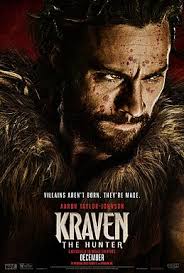
KRAVEN THE HUNTER
US, 2024, 127 minutes, Colour.
Aaron Taylor-Johnson, Russell Crowe, Arianna DeBose, Fred Hechinger, Alessandro Nivola, Christopher Abbott, Levi Miller, Billy Barratt.
Directed by J.C.Chandor.
Kraven the Hunter was created by veteran Marvel Comics expert, Stan Lee. As the title suggests, he is a Hunter, literally of animals as well as of human beings, a foe of Spiderman.
The Spiderman series was made in collaboration with Marvel Studios by Sony. The Sony Marvel action films have been far less successful than the others, beers, Venom, Madame Webb and, now Kraven. In fact, Sony executives have commented that the press “crucified” Madame Webb as well as Kraven making them financial flops, both in 2024.
And, this is a pity with Kraven because it is actually an action show more than a superpowers show, even though Kraven himself has received the capacity for extraordinary climbs and leaps.
Perhaps the central character is not too sympathetic – although Morbius and Venom are not the most attractive superpower heroes.
The film opens strikingly, a convoy of prisoners in the Russian snow and isolation, a harsh Gulag, and Kraven, a sturdy presence and performance by Aaron Taylor-Johnson, suddenly appearing, killing several gangsters in the prison, escaping in a plane. And then this screenplay goes back to an origins story, 16 years earlier.
There are two young Russian boys in the New York elite school, visited by their father, a big Russian drug dealer played with quite some heft and heaviness by Russell Crowe. He makes demands on his sons, especially the older, Sergei (played here by Australian Levi Miller). On safari in Ghana, the young man is mauled by a lion, allegedly legendary, eventually killed by his father keeping it is a trophy. But, Sergei is saved by a mysterious African young woman, Calypso, with tarot cards and a special potion.
Sergei then becomes Kraven, isolating himself, living in Russia, a Hunter, able to be hired to pursue criminals. But, every year, he comes to New York to visit his brother, now a musician and lounge singer, in New York and some contact with his father.
Then various complications ensue, the abduction of the younger brother, the emergence of an arch-criminal, rivalling the father, Rhino (Alessandro Nivola who also has had some strange injections and, unless tempered, his skin becomes like that of a rhinoceros). He also hires a killer, The Foreigner (Christopher Abbott) who can mesmerise his opponents through gazing at them and overpowering them.
What follows is action adventure, the kind that Liam Neeson and other actors used to get involved in, scenes in Turkey, Russia, a rescue for the younger brother, double Cross, Calypso (Ariana DeBose) to the rescue… And a final confrontation with the father. And the importance for Kraven to establish his own moral code.
Which means then that the scenario is ready for an action adventure with Kraven and a confrontation with Spiderman.
- Kraven and his place in marvel comics, as a hunter in himself, and the conflicts with Spiderman? This film is an origin story for Kraven?
- The Marvel tradition, the hero, origin, superpowers, confrontations with the villains, personal relationships, testing, exercise of power responsibility, the temptation of the dark side?
- The range of settings, link Russian countryside, Eastern Europe and the forests, Kraven space, the privileged school in the United States, the sequences in London, homes, the club, the monastery in Turkey? The musical score?
- The introduction to Kraven, the prisoners, the bus, his challenge, in the prison, sharing the cell, three days, the fights and his abilities, confrontation with the authorities, the gang Lord, the deaths, the abilities of his escape, the flight?
- 16 years earlier? The back story of Kraven and his brother, the elegant school in New York, their careers of the school, their future? The visit of their father, the demanding man? The story of their mother, Russia, the property, the decline, death? The father, domineering, his business deals, drugs?
- The father and his expectations of his sons, Ghana, the hunt, testing his sons, the legendary lion, stalking, the attack, Sergei and the vicious mauling, the rescue? Healing? But the father killing the lion, having it a trophy in his home?
- Calypso, a young girl, her grandmother, the tarot cards, the potions, the quest for her? Her seeing Sergei, attending him, his recovery?
- Sergei, his retreating to Russia, alone, his home, his discovering his powers, superpowers, his skill as a hunter, his career, employed, hunting down criminals? The return to the Russian prison and his killing the criminals and his escape by plane?
- The exercise of his powers, climbing, leaving…?
- Kraven the Hunter, vigilante, returning to New York, his relationship with his brother, his brother in the club, pianist, singing, the visits from their father?
- Dimitri, different, singing, his being abducted, the plan for the rescue?
- The issue of the ransom, the father refusing to pay, Sergei going to see Calypso, her work as a lawyer, her contacts, getting information, willing to help Sergei?
- The character of Rhino, seeing him as young and diffident on the hunt in Ghana? The experience, his being transformed, his skin like the rhinoceros? His power? His henchmen, his plans? The rivalry with Sergei’s father? The contact with The Foreigner?
- The Foreigner in action, strong, his of hypnosis, the eyes? Swift movement, his attack? The money, wanting to lure Kraven, the information, Calypso given the false information? Dimitri imprisoned?
- The action to Turkey, the taking of Kraven, the dominance of The Foreigner, the buildup to the confrontation?
- Kraven, Calypso, the escape, the confrontation with his father, his father and the betrayal, the bear and the attack?
- Rhino, the confrontation, his being destroyed?
- The next encounter with Dimitri, his change of attitude, becoming more like his father, setting up a confrontation with his brother?
- Kraven, getting the vest, the fur, from his father, ready for the future – and the conflict with Spiderman?
Sanctuary/ 2022

SANCTUARY
US, 2022, 95 minutes, Colour.
Margaret Crowley, Christopher Abbott.
Directed by Zach Ziglom.
This is a psychodrama. It could also serve as a dramatic illustration of a psychosexual situation. It is a two-hander and practically all of the action takes place in a hotel room – some moments outside the room in the corridor and an opening elevator. The invitation for the audience is to observe, possibly identify with one or other of the characters, reflect on the interactions, the interdependency, the future of the characters.
The film opens with the young business executive, Hal played by Christopher Abbott, with a business-looking blonde young woman, Rebecca, entering and going through the details of a legal contract with him. But, Hal begins to object to the questions – and it emerges that he wrote the whole scenario and dialogue himself. The two are in a role-play, created by Hal, performed, ever more independently, by Rebecca.
What we are shown is a dominatrix situation, Rebecca employed by Hal who feels he has been belittled, underestimated by his successful father (seen in a photograph with his son). The issue is Hal’s inadequacy as a person, and the connection of this inadequacy with his sexuality. Interestingly, in terms of understanding himself, it is Hal who writes the various scenarios, seeming to have some insight into himself but then very dependent on Rebecca’s responses. She humiliates him, his having to clean the floor, self-deprecation, sexual experiences.
As the film progresses, Rebecca seems to assert more independence from Hal and the scenarios, walking out, tantalising him that there was video of all their activities and his consequent smashing of the room to find the camera. Rebecca attempts to leave, Hal bringing her back. And Rebecca assert herself once more, discussing the contract, wanting Hal to invest his salary in her, and the suggestion arising that instead of Hal, Rebecca could be the CEO with Hal remaining at home in support.
Since this is a psychodrama, all options are open however practical, pragmatic or non-pragmatic they might be in reality. And the final question, the final image, what is the real relationship between Hal and Rebecca.
Which means that this psychosexual exploration may have limited interest and appeal, especially because of the claustrophobic confinement.
- A psychodrama? Psychosexual issues? Domination? The screenplay film as a case study?
- Audience response to this kind of psychodrama, observing, identifying, questioning, reflecting?
- The claustrophobic effect of the drama, in the one hotel suite, main room, bathroom? Going out to the corridor, the open elevator? The musical score?
- The introduction to Hal, his age, appearance, the photo with his father, his father the entrepreneur? The arrival of Rebecca, her appearance, blonde wig, stern, her papers, contracts? Initial audience response to each of them? Changing throughout the film?
- The reality of the situation, Rebecca and the lines, going through the scenario, Hal and his reactions, the fact that he had written the scenarios? The previous relationship, the contract, her role as a dominatrix, his role as the client, his having some kind of control through writing the scenes?
- The drama of the interactions, Rebecca and her control, the lines, criticism from Hal, her improvising, the discussions? The humiliation, stripping, cleaning the floor? The sexual encounter and her tantalising him, controlling him? The video, his searching for a, smashing the room, electrocution, the sexual effect? Sanctuary as the safe word"
- Hal, his relationship with his father, his father’s treatment of him, humiliating him, his mother, preparing to go to the function with her?
- Rebecca, the interactions, the control, her leaving, Hal coming to the elevated to get her back, twice?
- The development of the scenario, Hal and his suggestions, Rebecca in control? The issue of her payment, the money, the discussion of his salary, giving it to her, the possibility of selling his shares in buying back the company, Rebecca and her place in the company, becoming the CEO, his becoming the equivalent of the wife at home?
- The revelation of Rebecca’s strengths, of Hal’s weaknesses, the finale and the relationship between them, the kissing, the future?
