Displaying items by tag: Mamoudou Athie
Drama, The
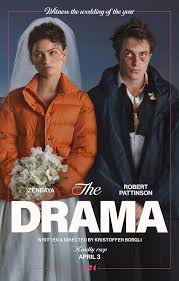
THE DRAMA
US, 2026, 105 minutes, Colour.
Zendaya, Robert Pattinson, Alana Haim, Mamoudou Athie, Hayley Gates, Jordyn Curet.
Directed by Kristoffer Borgli.
Sometimes people play, especially younger people, possibly after a couple of drinks, “what is the worst thing you have ever done?”. And that is the key to the drama in The Drama.
Charlie, Robert Pattinson, sees an attractive young woman reading a book in a cafe. She is Emma, Zendaya, and when he makes his approach, pretending to know the book, she does not respond – he is speaking into her deaf ear. Not the most propitious introduction. (Actually, there will be some very unpropitious developments as the film proceeds.) Nevertheless, they fall in love and are planning the wedding.
Charlie and Emma have friends, a married couple, Mike and Rachel (Mamadou Athie and Alana Haim). He is to be best man. She is to be the maid of honour. One night, drinking, good friends, the ‘worst thing’ game is proposed. They lovingly tell a story, with some reluctance. Emma, unwillingly first, tells the story of school bullying and the other three are aghast.
What follows, suspicions, puzzles, questioning, have some comic elements but, of course, deadly serious consequences. Rachel is vehemently condemned naturally. Mike tries to be supportive. But, it is Charlie who experiences the worst, suspicions, allaying suspicions, trying to communicate, going to his work and an extreme faux pas which has dire consequences during the wedding.
There is a strange and confusing flashbacks to members school days and her relationship with her parents. Violence, gun culture…
The wedding seems to be going well, but one of the most disastrous celebrations of marriage on screen.
Can anything be salvaged in the relationship? Charlie is shamed. Emma is confused, let down and embarrassed.
There is an ending which rather stretches credibility – leaving the audience wondering what will happen next? And, emotionally, wondering whether they have taken sides either with Emma or with Charlie.
- The title? The story as a drama, a touch of the tragic, the touch of the comic, satiric?
- The American setting, Americans in their 30s and 40s? Lifestyle, relationships, friends, marriage and weddings, taken for granted ordinariness?
- The twist in the plot, the two couples, their friendships, casual telling stories, the game of the worst thing ever done, revelations, consequences, suspicions, damage?
- The framework of the story, Charlie, British and American, seeing Emma, attracted, her reading, the music, discovering that she has i hearing in only one ear? Photographing the couple, returning, the discussion about the book, his inadequate answers? Together, the later meetings, the effect of the initial encounter on each of them?
- Charlie, with Mike, writing his wedding speech, the flashbacks, filling the details of the relationship, its development?
- Emma, 30s, her life so far, reading, friends, Rachel, Mike? The developing relationship with Charlie? Audiences liking her, liking Charlie?
- The meal, drinking, talking, the preparations for the wedding, the detail, Rachel as made of honour, Mike as best man, the discussion about the venue, the catering, clothes…?
- The telling of the worst stories, Charlie awkward, Rachel and locking the boy overnight, and her telling her story, gun culture, the flashbacks to her treatment at school, into the water, abused? Imagining the school massacre?
- The reaction of everyone? The audience reaction? Believing her not? Rachel, the indignant response, suspicions, denunciation, breaking contact? Mike, shocked, lower key, supportive of Charlie?
- Charlie, his response to the story, upset, suspicious, believing or not, communicating with Emma? Her attitude, telling the story, drinking, the aftermath?
- The consequences for Charlie and Emma, her story, trying to explain, memories of school, the rival, shooting practice, the group, gun control, her leadership and collection group?
- Charlie, imaginings, dreams, suspicions, that there was worse? Discussions with Mike? And to the office, the secretary, asking her about her relationship, if her boyfriend could commit a gun massacre, his weeping, making a sexual advance, her response, his change? And the later consequences of this episode?
- The preparations for the wedding, going to the venue, Emma’s and her behaviour, the dance practice the wedding, difficult, seeing the DJ allegedly taking drugs, building up to the confrontation, and estates? The food the decisions?
- Charlie and his love for Emma, suspicions, the damage to his psyche, the consequences of the episode in the office?
- The wedding, Emma’s parents coming, Charlie’s, awkwardness? The ceremony?
- The aftermath, the drama, Emma and her parents military background guns? Rachel, her presence, drunk, the violent speech? Emma’s father and his speech, the interruption? The growing awkwardness? Charlie going out, Emma going out, overhearing the secretary, the speech and everything coming out, the secretary boyfriend and punching Charlie? Confusion, and walking out, the kiss and bewilderment?
- The aftermath, Charlie beaten up, at home, going out to the diner, the hamburger, and arriving, going through the ritual as if they were meeting the first time?
- The issues of knowing one’s partner before marriage, secrets, revelations, understanding, forgiveness? Or revelations, too late, destructive for the marriage? And the future for Charlie and Emma?
Kinds of Kindness
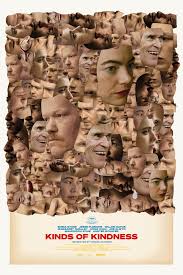
KINDS OF KINDNESS
US, 2024, 164 minutes, Colour.
Emma Stone, Jesse Plemons, William Dafoe, Margaret Qualley, Hong Chau, Joe Alwyn, Mamoudou Athie.
Directed by Yorgos Lanthimos.
Writer-directors, Yorgos Lanthimos, would probably agree that his perspective on life, especially in his earliest films, was “warped”. And, with Poor Things and Kinds of Kindness, that his sense of humour was also “warped”. His kinds of kindness are not exactly kind. Something more like “destructive kindnesses”.
This is a film containing three films linked by themes and linked by the actors. It is a cinematic triptych. Each panel of a triptych to be seen by itself, but also with its links to the other panels, combining for an overall view. And this seems to be what the director wants here, three stories, and a linking theme. Overall, it is a theme of coercive power. And that coercive power means extreme manipulation of victims, tyrannical domination mixed with power complacency, physical and mental cruelty and violence. But, with his warped sense of humour, the director also offers wry satire.
The contribution of a core cast enhances the impact of the drama/humour. Emma Stone has proven herself with two Oscars, appearing in the director’s The Favourite and winning her second Oscar for Poor Things. She shines as the principal character in the third story, a story of a pseudo-messianic cult, she has a divinity in search of a religious figure who has the power to raise people to life. The power of the cult dominates her and her companion in the search.
Jesse Plemons (in 2023 Killers of the Flower Moon, Civil War) won the Best Actor award at the 2024 Cannes film Festival. He shines in the first of the stories, a primly rather straightlaced yes-man to a controller who can only be described as wicked (Willem Dafoe who also appears in the three stories). In a moment of moral questioning, his morale collapses, made to feel even more dependent than before, commanded to kill someone. By contrast in the second film, he plays a police officer is anthropologist wife disappears, reappears, his moral and mental collapse as he determines that she is a double. And this part of the triptych also introduces the theme of cannibalism.
Each story shows the versatility of the characters and the talent of the rest of the cast, Dafoe, Margaret Qualley with four roles including twins, Hong Chau, Joe Alwyn and Mamoudou Athie.
So, after watching the three stories, the three panels of the triptych, the audience is left quite disturbed, moments of black humour, moments of horror, moments of disgust, some grim perspectives on the shallowness, the malice, the cruelty of human nature.
- The work of the director, perspectives, offbeat? Greek background? International career and outreach?
- The title, the tone, the issues? Irony, satire, absurdity? Black and bleak perspective?
- The film as a triptych, the one film, the three parts interconnecting: coercive power, manipulation and submission, aberrant behaviour, sex and violence, violent deaths?
- The work of the cast, in each story, different, appearance, accent, behaviour…?
- The first story: the focus on Robert, exact, controlled, look and clothes, diet, relationship with his wife,+? The encounters with Raymond, his personality, appearance, speaking, controlling, with Vivian as his companion, the meetings with Robert, the international business, the order to kill the victim, Robert’s failures, change of heart, anguish, changing eating habits, going to Raymond, rebuked and rejected by Raymond, the past encounters, sexual? The gifts of the sporting trophies, the gift of the racquet, Robert and his wife, valuing the trophies? The disappearance of the is one? The buyers and the possibilities of selling the trophies, the bargaining? Robert and his encounter with Rita, organising the date, her being in hospital, his discoveries at seeing Raymond, her being controlled, failing with the killing? His change of heart, going back to Raymond, and the vicious running over the victim? And his contentment in the threesome?
- The second story: Daniel, policeman, good service, friendship with Neil, the discussions, the meal, Neil and Martha, memories of Liz, the issue of the video, their watching, the shock of the group sex? Daniel, Liz surviving, the other members of the expedition dead? Hospital? His erratic behaviour, police work, the shooting of the passenger, licking the blood, being suspended? Neil trying to help? At home, the interactions with Liz, her behaviour, different? With her father, narrating the dream, dogs living as humans? Going to please Daniel, his withdrawing, not eating, asking her to cut off her finger, her cooking it, his giving it to the dog? Her frustration, his demanding the liver, her cutting it out? The alternate Liz, arriving, his embracing her??
- Third story: the background of the cult, the members, garb, the enclosure, the rituals? The leadership of Omi and his wife? Manner, style? Emily and Andrew, members of the cult? Emily and her control, going to the morgue, choosing the girl as able to raise the dead, the attendant, the corpse, her attempt a raise the dead, her desperation, rejected? Emily and Andrew, their travelling together, a speedy and reckless driving, the mission, searching for the special person who can raise the dead? Emily, her visits to her daughter, leaving the presence? The encounters with her husband, her daughter? The invitation to the meal, the drugs and headroom, his rape, her being rejected by the cult? Her growing desperation, the instructions by Omi and his wife? Her dream, drowning, the rescue? Rebecca, coming to the diner, the explanations? Emily, her decisions, pretending to have the dog, wounding it, Ruth as the vet, kindly? The next encounter, bugging Ruth, Rebecca satisfied, killing herself, going to the morgue, the dead body, Ruth – and the raising to life? Andrew and Emily reinstated?
- The mid-credits final sequence, the irony of the dead man raised to life, after being killed by Robert, raised by Ruth, and eating the sandwich and spilling the ketchup? Final ironies?
