Displaying items by tag: Yorgos Lanthimos
Bugonia
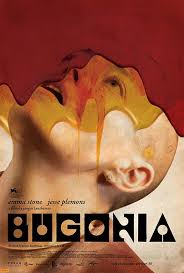
BUGONIA
US/Greece, 2025, 118 minutes, Colour.
Emma Stone, Jesse Plemons, Aidan Deblis, Stavros Halkias, Alicia Silverstone.
Directed by Yorgos Lanthimos.
The film doesn’t exactly explain the meaning of the title, though it gives some visual hints in its focus on bees. Bugonia refers to an ancient Greek and Roman belief that bees could spontaneously generate freshly life from the carcass of a young bull or cow.
The screenwriter, Will Tracy (touches of the bizarre with The Menu, The Regime) offers his comment: I think also, we just liked the ambiguity of the title as well. It kinda sounds like an insect, kinda sounds like a flower, kinda sounds alien, but also sounds like a place, maybe, that could be on Earth. It might also sound like an illness that someone might have. So, I think the non-specificity of it was also kind of attractive.
And it does start with a close-up of flowers, bees, and two cousins working the hives. And where it goes from there is quite unpredictable!
We are introduced to Teddy, conspiracy theorist par excellence, a striking performance from Jesse Plemons, straggly-looking and dressed, demanding the collaboration of his cousin (Aidan Deblis), setting up in his farmhouse basement quite an extraordinary IT communications centre – all in the aid of kidnapping and interrogating the CEO of a pharmaceutical company (Michelle), convinced that she is an alien, wanting her to admit it, torturing her for the confession, motivated by the illness of his mother and the use of experimental drugs to heal her.
Teddy also works during the day in the very ordinary role of packaging pharmaceuticals to be sent out to customers. He also has an old friend who is now in the police force, unfortunately trying to ingratiate himself in Teddy’s favour at quite the wrong time.
And, of course, there is Emma Stone who has had striking roles and an Oscar-winning performance working in Lanthimos’ films. She is an assured businesswoman, trying shrewdly to influence Teddy, but more skilful in her dealings with him, admitting, finally, as he wants, that she is an alien, subservient to her Emperor, to make contact with him in three days when there will be a lunar eclipse. Definitely the world of conspiracy theorists.
So, the main drama is in the interactions between Teddy and Michelle, his desperate rush to his mother’s bedside hoping for a cure, the sudden suspicion for the audience that Michelle is so convincing she could be an alien.
The film is based on a Korean film, How to Save the Planet, incorporating its critique of what humans are doing to the world, step by step towards its destruction, and opening up quite an extraordinary explanation of evolution as well as a different perspective on an apocalyptic future, and whether the world might end with a bang or, as T.S.Elliot suggested, with the equivalent of a whimper.
As with his other films, the director offers us strange combinations of the real and the absurd, and one extraordinary shock where the audience might find that, literally, the jaw drops (as it did for this reviewer).
There is a appointment irony with the use of the final song, Where have all the flowers gone…? And the haunting refrain into the credits, When will they ever learn, and the music then stops.
- The explanations for the title? Flowers, bees, a town, a planet…?
- The adaptation of a Korean film and its message about saving the planet? With some melodramatic, absurdist, takes on the theme?
- The work of the director, ironies, his working with the stars in other films? This achievement? The visual style, the pounding score, the use of songs?
- The opening, flowers, pollen and nectar, Teddy and Don going to work with the bees? The later discussion about bees, apiaries, construction and destruction? New life from rotting flesh?
- The portrait of Teddy, Jesse Plemons’ performance, age, look, clothes, cycling to work, at the headquarters, the parcels, the conversations? The revelation about the story of his mother, the experiments, in hospital, the failure of the experiment, his visit to his mother, thinking that he was healing her, her death? The impact, his desperately not wanting Michelle to name his mother? His angers?
- Teddy and his relationship with Don, Don and the actor on the spectrum, the performance, believing Teddy, trying to raise questions, put down, the capture of Michelle, on guard, with the rifle? The discussions with Michelle, her playing on his psychology, his wanting to escape – and the suddenness of his shooting himself?
- Teddy, conspiracy theories, his science, construction of his centre, his belief in aliens, that Michelle was an alien, out to destroy the humans? Working for her, his mother and the hospital, abducting her?
- Michelle, and Emma Stone’s performance, CEO, at home, exercise, medication and the contrast with Teddy and his tablets? Her lifestyle, manner, with her staff? Abducted?
- In the cellar, her head shaved because have provided for communications, the lotion, bound, over the period, the discussions, the interrogation, getting her to admit that she was an alien, different attempts, recorded, played back, and finally deciding to play along with Teddy, the explanations, the Emperor, the whole background of evolution over the millennia, human evolution, failures, the possibility of saving humanity, the Emperor beginning to think humanity was not worth saving?
- The screenplay, the audience not thinking that Michelle was an alien, but in her discussions, the screenplay even making the audience wonder whether she really was an alien?
- Casey, police, babysitting Teddy, wanting friendship, coming to the house, coming in, suspicions, the discussions about the abduction, going out to the fields, Teddy killing him?
- The buildup to the climax, Teddy and his desperation, cycling to the hospital and back, filling his mother with the antifreeze? His power over Michelle, her leading him on, the promise that he would meet the Emperor, going to headquarters, her injuries and limping, the wig, greeting people, his having the rifle, accompanying her?
- Her explanation of the closet, the entry to the portal? His believing her, wanting to go? The explosives? Her shrewdness, his going into the closet, her looking in, the explosion?
- The fact that Michelle was an alien, going to the Emperor, the alien creatures, their appearances, clothing, the final judgement against humanity?
- The collage of all the deaths, human life suddenly stopping wherever they were, the pathos of the world ending so quietly? And the animals surviving? Where have all the flowers gone? When will they ever learn?
Kinds of Kindness
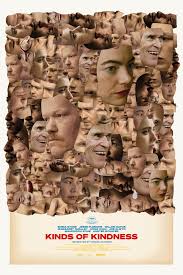
KINDS OF KINDNESS
US, 2024, 164 minutes, Colour.
Emma Stone, Jesse Plemons, William Dafoe, Margaret Qualley, Hong Chau, Joe Alwyn, Mamoudou Athie.
Directed by Yorgos Lanthimos.
Writer-directors, Yorgos Lanthimos, would probably agree that his perspective on life, especially in his earliest films, was “warped”. And, with Poor Things and Kinds of Kindness, that his sense of humour was also “warped”. His kinds of kindness are not exactly kind. Something more like “destructive kindnesses”.
This is a film containing three films linked by themes and linked by the actors. It is a cinematic triptych. Each panel of a triptych to be seen by itself, but also with its links to the other panels, combining for an overall view. And this seems to be what the director wants here, three stories, and a linking theme. Overall, it is a theme of coercive power. And that coercive power means extreme manipulation of victims, tyrannical domination mixed with power complacency, physical and mental cruelty and violence. But, with his warped sense of humour, the director also offers wry satire.
The contribution of a core cast enhances the impact of the drama/humour. Emma Stone has proven herself with two Oscars, appearing in the director’s The Favourite and winning her second Oscar for Poor Things. She shines as the principal character in the third story, a story of a pseudo-messianic cult, she has a divinity in search of a religious figure who has the power to raise people to life. The power of the cult dominates her and her companion in the search.
Jesse Plemons (in 2023 Killers of the Flower Moon, Civil War) won the Best Actor award at the 2024 Cannes film Festival. He shines in the first of the stories, a primly rather straightlaced yes-man to a controller who can only be described as wicked (Willem Dafoe who also appears in the three stories). In a moment of moral questioning, his morale collapses, made to feel even more dependent than before, commanded to kill someone. By contrast in the second film, he plays a police officer is anthropologist wife disappears, reappears, his moral and mental collapse as he determines that she is a double. And this part of the triptych also introduces the theme of cannibalism.
Each story shows the versatility of the characters and the talent of the rest of the cast, Dafoe, Margaret Qualley with four roles including twins, Hong Chau, Joe Alwyn and Mamoudou Athie.
So, after watching the three stories, the three panels of the triptych, the audience is left quite disturbed, moments of black humour, moments of horror, moments of disgust, some grim perspectives on the shallowness, the malice, the cruelty of human nature.
- The work of the director, perspectives, offbeat? Greek background? International career and outreach?
- The title, the tone, the issues? Irony, satire, absurdity? Black and bleak perspective?
- The film as a triptych, the one film, the three parts interconnecting: coercive power, manipulation and submission, aberrant behaviour, sex and violence, violent deaths?
- The work of the cast, in each story, different, appearance, accent, behaviour…?
- The first story: the focus on Robert, exact, controlled, look and clothes, diet, relationship with his wife,+? The encounters with Raymond, his personality, appearance, speaking, controlling, with Vivian as his companion, the meetings with Robert, the international business, the order to kill the victim, Robert’s failures, change of heart, anguish, changing eating habits, going to Raymond, rebuked and rejected by Raymond, the past encounters, sexual? The gifts of the sporting trophies, the gift of the racquet, Robert and his wife, valuing the trophies? The disappearance of the is one? The buyers and the possibilities of selling the trophies, the bargaining? Robert and his encounter with Rita, organising the date, her being in hospital, his discoveries at seeing Raymond, her being controlled, failing with the killing? His change of heart, going back to Raymond, and the vicious running over the victim? And his contentment in the threesome?
- The second story: Daniel, policeman, good service, friendship with Neil, the discussions, the meal, Neil and Martha, memories of Liz, the issue of the video, their watching, the shock of the group sex? Daniel, Liz surviving, the other members of the expedition dead? Hospital? His erratic behaviour, police work, the shooting of the passenger, licking the blood, being suspended? Neil trying to help? At home, the interactions with Liz, her behaviour, different? With her father, narrating the dream, dogs living as humans? Going to please Daniel, his withdrawing, not eating, asking her to cut off her finger, her cooking it, his giving it to the dog? Her frustration, his demanding the liver, her cutting it out? The alternate Liz, arriving, his embracing her??
- Third story: the background of the cult, the members, garb, the enclosure, the rituals? The leadership of Omi and his wife? Manner, style? Emily and Andrew, members of the cult? Emily and her control, going to the morgue, choosing the girl as able to raise the dead, the attendant, the corpse, her attempt a raise the dead, her desperation, rejected? Emily and Andrew, their travelling together, a speedy and reckless driving, the mission, searching for the special person who can raise the dead? Emily, her visits to her daughter, leaving the presence? The encounters with her husband, her daughter? The invitation to the meal, the drugs and headroom, his rape, her being rejected by the cult? Her growing desperation, the instructions by Omi and his wife? Her dream, drowning, the rescue? Rebecca, coming to the diner, the explanations? Emily, her decisions, pretending to have the dog, wounding it, Ruth as the vet, kindly? The next encounter, bugging Ruth, Rebecca satisfied, killing herself, going to the morgue, the dead body, Ruth – and the raising to life? Andrew and Emily reinstated?
- The mid-credits final sequence, the irony of the dead man raised to life, after being killed by Robert, raised by Ruth, and eating the sandwich and spilling the ketchup? Final ironies?
Poor Things
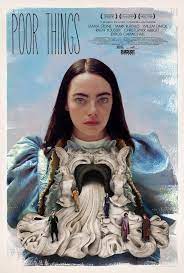
POOR THINGS
Ireland/US/UK, 2023, 140 minutes, Colour.
Emma Stone, Mark Ruffalo, Willem Dafoe, Ramy Youssef, Vicki Pepperdine, Hannah Schygulla, Jarrod Carmichael, Christopher Abbott, Kathryn Hunter, Margaret Qualley.
Directed by Yorgos Lanthimos.
It is safe to say that we have not seen the film like this before. We have watched the unusual films in the unusual career of writer-director, Yorgos Lanthimos, films like Dogtooth, Killing of a Sacred Deer, The Lobster, The Favourite. We have appreciated that he has a different kind of imagination, different stories and storytelling, and, with long experience of music videos, quite a talent for use of different lenses, angles, editing and pacing. Even so, we were not quite ready for Poor Things, but were alerted when it won the Golden Lion at Venice, 2023.
An attempt at a summary-content: an allegorical Odyssey of becoming human.
And the imagined setting, costumes, décor, manners, is 1895 (with a reference to The Importance of Being Earnest).
The initial image is somewhat overwhelming, a woman standing on a bridge, the camera looking up at her, and she falls to her death. But, the echoes of Mary Shelley and Frankenstein immediately come to mind, a strange scientist, Willem Dafoe at his best, with a deeply scarred reconstructed face, Dr Godwin Baxter, happy for people to refer to him as God. And, like Dr Frankenstein of the novel, he experiments to create life, the brain of the woman’s fetus inserted in her head. An different kind of Frankenstein-monster.
He calls his creation Bella. And she is played by Emma Stone, an extraordinary performance, with high demands made on her, dramatic, her having to move, in the adult body, from inarticulate infancy, to childhood and tantrums and uncontrolled behaviour, to learning vocabulary, to think, to move to an adolescent phase, discovering herself, her body, sensuality and sexuality, until she is well on the road to adult consciousness, absolutely devoted to God, her creator, but still wilful, not yet having a moral compass. The doctor has asked one of his students, Max (Ramy Youssef) to continually observe Below, take notes, have a record of her growth.
What will Bella’s place in life be? One obvious conclusion is that she should become engaged to Max who understands her so well. She is not averse to this. However, a foppish, self-centred lawyer Duncan Wedderburn, a surprising performance by Mark Ruffalo, comes to deal with contracts about Bella. He is attracted, seductive, she responding to the sensuality without understanding its consequences, without real emotion, deciding to go off on a trip to Lisbon, to Alexandria, a Mediterranean voyage, life in Paris. On the one hand, she enjoys it, a lot of sensuous “furious jumping”, he finding it hard to keep up with her, a gambler, and Bella, discovering the bodies of impoverished children, moved to tears and without any thought of consequences, taking all the money and giving it to charity (naïvely trusting worldly sailors).
On the voyage, the encounters a wise old woman, Martha (veteran Hannah Schygulla) and a cynical American, Harry (Jarrod Carmichael) who open her mind further, the world of philosophy, thought, books.
If this sounds intriguing, there is still a great deal more, Bella’s strange experience in Paris in a hotel-bordello, her return to England when God becomes unwell, the continued attentions of Max, and her actual husband identifying her, controlling her, and her having to make decisions, but with all kind of moral criteria that she has acquired.
Poor Things sounds a simple title but this is an intriguingly complex film, not quite like anything we have seen before.
- The title, the character who could not even say the word “poor”?
- The film as an allegory of human nature, instinct, intelligence, affections, moral choices? The human Odyssey?
- The unique impact of the film, derived from the novel, interpreted by the dialogue and silences, the visual, black-and-white photography, bright colour, the range of lenses and angles, the period, costumes and decor, the aural music and sound background? Pace?
- The prologue, Victoria, the angle, standing on the bridge, the clothes, falling into the water? Godwin Baxter, her survival, Mrs Pim as his assistant, the surgery, the brain of the fetus, inserted into Victoria’s body? The overtones of the Frankenstein story? Dr Frankenstein, his name Godwin, nicknamed God?
- The “monster”, Bella, as the fetus in her mother, her brain taken out, a child in an adult body, initial articulation, infant behaviour, tantrums, smashing things, moods, food, impulsive, the awkward walk, the issue of discipline? Her brain becoming more mature, yet still a child’s, the issue of sensuality and sexuality?
- Godwin, his scarred face, reconstructed? His continued references to his father and cruelty? His scientific stances, strict, no emotions, Mrs Pim, the experiments? Yet the production of Bella, his becoming attached, no children of his own, a creator-father, God, his providence guiding Bella?
- The lectures, the atmosphere of the 1890s, the doctors, surgeons, the classes, demonstrations, the fops in the class and their arrogance? The reference to The Importance of Being Earnest, 1895? The period, atmosphere?
- Max, for student, devoted to Baxter, defending him against the fops, his being ridiculed? His being employed, taking the notes, diligent, proper in the Victorian way, challenged, Bella’s childish behaviour, his prudish response, spontaneous responses?
- Bella, her brain growing older, reading, opinions, venturesome, going to the roof? Sharing the views with Max? Her relationship with Max, his notes and continued observations?
- Duncan Wedderburn, the lawyer, the interview with Baxter, the legal issues, paternity and family, Duncan as foppish? Curiosity about Bella, the growing infatuation, his foppish behaviour, his pursuing her, his awkwardness and blunders?
- Bella, her brain more adult, the issue of betrothal, Max and his being willing, but his personal cautions? The contrast with the encounter with Duncan, the sensual, the appetites, the act of the furious jumping? Sharing the experiences, their affect?
- The decision to travel with Duncan, Max and his reactions, Baxter and his reactions, thinking it temporary? Going to Lisbon, the experiences, sexuality, the city and its visuals, futuristic? Duncan and his ups and downs, his attitudes towards Bella, behaviour?
- The music, Bella wanting to dance, going onto the floor, the crowds, who awkward motions, Duncan going to dance with her?
- Going to Alexandria, the various encounters, Bella and her wandering, curiosity, her drinking, the effect, Duncan and his behaviour, the ups and downs of the relationship?
- The decision to travel by boat, the effect, the antagonism, the encounter with Martha, her age, experience, encouragement, sharing the books, Bella reading Thoreau, Duncan throwing the book and the water, advanced understandings, Harry and his cynicism, the discussions of philosophy? The effect of these two, the serious discussions with Harry? The contrast with Duncan, his gambling, the irony of his winning so much money, Bella and her seeing the bodies of the babies, taking all the money, giving it away – and the greedy sailors taking the money? The consequences for Duncan, his rage, upset, treatment, put ashore?
- Bella, going to Paris, surviving by herself, using her wits, going to the hotel, meeting the Madame, the explanation of the financial situation of the brothel, her not having any shame, presuppositions, the explanation of the sex, the money, the encounters with the various men, brutal behaviour, her becoming part of the business, the discussions with the Madame, with the other prostitute, the friendship, the lesbian experience? Duncan, arrival, his horror at Bella’s sexual behaviour?
- Bella sending the cards, the writing and their sketching? God and his decline in health, Max with him, urging Bella’s return? The effect of coming back, Mrs Pim, more sophisticated Bella, her judgements? Duncan, and his wanting her?
- The second experiment, the young woman, repeating the experiences of Bella?
- Bella being recognised as Victoria during the travels, the appearance of her husband, his claims, going to his house, her experience of the relationship, his own behaviour, lifestyle, military, abusive, imprisoning her?
- The buildup to an ending, the punishment for the husband, the animal brain?
- Happy ending, Bella and her achievement, Godwin, Max and the marriage, happy ever after – or?
- And everything in the perspective of irony and black comedy?
