Displaying items by tag: Joe Alwyn
Hamnet
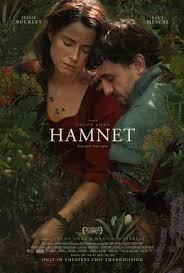
HAMNET
UK, 2025, 125 minutes, Colour.
Jessie Buckley, Paul Mescal, Emily Watson, Joe Alwyn, David Wilmot, Jacobi Jupe, Noah Jupe, Olivia Lynes.
Directed by Chloe Zhao.
Hamnet, or Hamlet, the name of Shakespeare’s son, the title of, perhaps, his most famous play.
In fact, we know very little about Shakespeare’s private life. He was from Stratford-on-Avon, he married Anne Hathaway, had an older daughter, Susanna, and twins, one of whom was Hamnet who died of the plague, very young.
What we have in this film, most arrestingly, a Shakespeare’s story from the imagination Northern Ireland’s novelist, Maggie O’Farrell, her 2020 novel. Oscar-winning director for Nomadland, Chloehao, worked with the novelist on the screenplay, presenting a more straightforward telling of the story, especially of Shakespeare’s wife, here called Agnes.
Agnes is a child of nature, a wild child, said to be connected with witches, knowing the seasons, cultivating fruits and able to make potions. And, she is played by Jessie Buckley, one of her many and varied excellent performances (and Jessie Buckley is also Irish, as is Paul Mescal who plays Shakespeare, quietly restrained). Will Shakespeare teaches at the local school, encounters Agnes, is caught up in the magic of her personality and they marry.
This is story has her staying in Stratford, giving birth to her children, sometimes with great stress, loving her husband but knowing that he has a creative talent, likes to write in his room, gives her asent that he should go to London and develop his work in the theatre. (It is only later in the film that Agnes and the audience eventually come to London.)
Agnes delights in her children, especially the twins, and the likeable and lively Hamnet (attractively played by Jacob Jupe. Hamnet is devoted to his father, practices swordfights, the children doing a rendition of the opening speech of Macbeth’s witches.
But, the plague, and Hamnet willing to take the place of his sick sister, the sadness of his death, Shakespeare’s absence, his being away eventually take its toll on Agnes’s emotions.
The major part of the film stays in Stratford, the green wildness of the forests, the glimpse of the Tudor streets and houses and church spire. But, when Agnes does go to London, sees the crowds coming into the Globe theatre, pushes her way to the stage, and the performance of Hamlet begins, this becomes most moving.
For this reviewer, this last part of the film is one of the most deeply memorable in cinema, Agnes watching as the play unfolds, the theme of death, absence, ghosts, the rejection of Ophelia and the emotions, the final confrontation with Laertes and… the rest is silence. Shakespeare himself, playing the ghost, watches Agnes’s response from the wings of the stage, one of the best dramatisations of what catharsis actually means, Agnes, slowly, surprised, coming to terms with all that has happened to her, some kind of purification of her emotions – and a strong reminder that the audience, involved i the n a play, responding to a tragedy, experiences their own dramatic catharsis.
Hamnet has won a number of awards, Best film, and many well-deserved awards for acting for Jessie Buckley.
- The focus on hand, explanation of the name, Shakespeare’s son, Shakespeare’s play?
- An imagination of Agnes and will Shakespeare and their children, family life, Shakespeare as a playwright, life and work in London? Not history?
- The Stratford settings, the opening with the forest, the trees, the grounds, the locks, holes, the sense of nature? The house, interiors, dimly lit? The town square and the church spire? The atmosphere of 16th-17th century Stratford? The contrast with London, the dark, the streets, the river, the globe theatre, exteriors and interiors? The atmospheric score and final song?
- The focus of Agnes, with the Eagle, swooping on the landing on her wrist, her background, her mother and which, of wild child, the sense of nature, this by her father, alienated from her stepmother? Living in the woods?
- Will, the scene in the classroom, the repetition, his encounter with Agnes, the attraction, for both, the story of Orpheus and you registry, the courting, the opinions of the family, his parents? Bartholomew? The sexual encounter, Agnes and Mary, the questions? The marriage ceremony?
- Jessie Buckley’s presence and performance as a this? Intense? In the forest, her communications, the background of witchery? Her pregnancy, giving birth in the woods, the difficulties, her daughter? Will’s response?
- Passing, will and his room, his writing, parchment, his imagination? Like Agnes? The new pregnancy? Will in London? The difficulty of birth, the size of the twin child, the dead child, Agnes’s response? Her power and its revival? Will’s arrival, his joy?
- Will, dissatisfied, wanting more in life, the decision to go to London? Is in support, his absences, the children, beginnings of alienation? His returns? The children growing up – and the sequence of their playing the role of the witches at the opening of Macbeth?
- Judith, the older daughter, her place in the household, Hamlet and his sister, the change of clothes, interchangeable? Hamlet and his lover’s father, the sword fighting sequence?
- Will, in London, his writings, the growing reputation, this is not the focus of the film?
- The Shadow play of the pestilence, Judas and his illness, Hamlet is generosity, willing to take her place, his illness, suffering, death, the pain for the family? Agnes and her grief? Mary and her support? Will and his return, Agnes upset, the blame? The discussions between the two, the new house, the biggest in Stratford, some compensation, and is in the upstairs room and her memories?
- The religious beliefs, the question background, the church visit? Yet Agnes and her nature believes? Special powers?
- Agnes and his stepmother, the poster for Hamlet? Her being upset? The continued support of Bartholomew?
- The decision to go to London with her brother, arriving, the bewilderment of the city, the globe theatre, the facade, the crowds coming in, the crowds inside,ne, those on the balconies?
- Will, his group in London, to be or not to be, the rivers edge? The glimpses of the rehearsal, the actor, Hamlet’s attitude towards year, will watching, making repetition, the intensity of his feelings of love and rejection?
- The play, and his bewildered, the crowds, the opening, the ghost, the beginning of suggestions for linking Hamlet, his illness, his death, afterlife, with the details of the play? The ghost and his speeches, afterlife, the condemnations, his brother and his wife, the fighting with Laertes, the speeches, everybody becoming more involved, the Queen’s death, the death of the king, and to the front of the stage, in Bloom blonde rather than in dark clothes, looking to the audience, the hands or reaching out, Agnes and the touch, the experience of the catharsis, from the plane, from her inner feelings, some kind of healing and understanding?
- Will, the part of the ghost, the speeches, the intensity of the meaning, his looking at Agnes?
- The glimpse of Hamlet at the end, the bond between will and Agnes, the impact of his son and death, the play and part is a meaning of catharsis of healing?
Brutalist, The
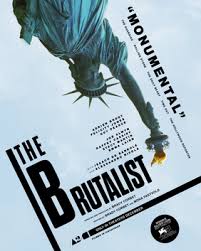
THE BRUTALIST
US, 2024, 215 minutes, Colour.
Adrien Brody, Felicity Jones, Guy Pearce, Joe Alwyn, Raffey Cassidy, Stacy Martin, Isaach de Bakole, Alessandro Nivola, Michael Epp, Emma Laird, Jonathan Hyde, Peter Polycarpou.
Directed by Brady Corbet.
The Brutalist is a vast film in scope and length. Beginning with an Overture, it becomes cinematic orchestral and in its two acts and epilogue cinematic operatic.
The screenplay is by former child actor, Brady Corbett, who directed Childhood of a Leader, Fox Looks, working with his partner, Mona. The scope of the storytelling is quite complex. It is multi-themed, beginning with Nazi persecution of the Jews, business close-up in the oppressive dark, concentration camp consequences. It then moves to re-settlement in the US and good use of the Statue of Liberty, Ellis Island, speeches and translations, then out into the vastness of America, a brother. In New York, then a train to Philadelphia.
Throughout the film there is a documentary evidence, radio news commentaries, about the significance of Pennsylvania in the history of the US.
The central character, Laszlo, is an architectural genius, and in prewar Germany, found unacceptable to national socialism, interned, along with his wife and niece. For most of the film, there is voice-over of letters from his wife, still in Europe.
This is the post-war USA, American business, migrants making good, shrewd businessman with no family backgrounds highly successful.
This is the story of Laszlo’s rise, not without its many pitfalls and falls. At first working with his cousin, Alessandra Mueller, participating in the commission from the son of a millionaire, Harry Van Buren is in (Joe all one) elevate his father, Harrison Van Buren’s personal library. Progress is made, Laszlo’s skill in design, his fine eye for detail, his modern furniture style, making a great impact until suddenly, Harrison bursts angrily onto the scene and dismisses everyone. Harrison is played by guy Pearce most convincingly.
But the central performances that of Adrien Brody (who won an Oscar for the pianist in 2002). He is sympathetic, sometimes upsetting, many outbursts, a growing sense of his own worth, his reaction to being challenged.
The film echoes the American confidence of the 1950s, progress and peace, buildings and achievement, the plans for building Harrison Van Buren’s community Centre in honour of his mother. There is the exhilaration of the design, very modern, the meeting of city officials, the inevitable as with material supply, budget overruns, interference from bureaucratic advisers, outbursts. And accidents, possibilities for being sued, compensation, he is in delay.
Unexpected is a sequence when Laszlo and Harrison go to Carrara to choose marble from the quarries there amazing visuals of the cliffs and quarries. But there is a key episode in Carrara that has something of a devastating effect on Laszlo and will offer a challenge to Harrison.
And, finally his wife, Felicity Jones, arise from Europe, wheelchair written, with the taciturn niece. And further complications with the Van Buren family, and with the niece and her fiance deciding to go to live in Jerusalem.
The film begins with an overture good end with an epilogue – and The Brutalist does, are vindication of Laszlo’s career and achievement, exhibition at Venice be a gnarly, and a tribute to Laszlo by his niece.
Often grim, sometimes overwhelming, moments of joy, and a perspective on American history in the post-World War II years.
- Title and tone? Contemporary art and architecture? Personalities in themselves and their communication?
- The scope of the film, orchestral and operatic, overture, acts and epilogue? The sound, the music, chords, heavy, light background? The visuals, the use of this division and its style? Editing and pace? The vastness of the impact?
- The structure, the effect of the overture, setting the tone, from the concentration camps, the crowds, the darkness, the suffering, the release, the focus on Laszlo, the communication with Erzsbert? The freedom, the voyage, the Statue of Liberty and the various angles? Freedom and future?
- The first part, from 1957 to the early 1950s? Migrants arriving, Ellis Island, the speeches and translations? Into the city – the glimpse of the women, the brothels, Laszlo and his friend? This impact after the years in the camps?
- To Philadelphia, the train, the meeting with Attila, the welcome, change of name, his store and furniture, marriage to Audrey, Catholic? Their work and reputation, Laszlo criticising the furniture? But his working, his modern designs, Harry Van Buren and, the visit, the commission, the library, the background story, the father and his devotion to his mother, her illness? The surprise?
- Gradual information about Laszlo, his studies in Germany, his skills, designs, Jewish background, Nazis and concentration camp? His skill in design, creative, demanding? The vision for the library, the visuals, the space, the cupboards opening, the shelves, the issue of the ceiling, its crashing? Harrison Van Buren arriving, the viciousness of his outburst, the dismissal? Laszlo and his reaction, the false accusation by Audrey, being ousted?
- Laszlo, shovelling coal, the previous encounter with Gordon and his son, Laszlo going to the queue for the bread, their working together? Laszlo and his personality, accepting his fate? The continued communication with Erzsbert?
- The arrival of Harrison Van Buren, his apology, researching Laszlo’s background, their discussions, the repayment, the possibilities for the future? The further conversations, Harry and his vision, as a tribute to his mother, the details of his background story, single mother, rejection by her parents, their later coming for money, his interviewing, withdrawing the $25,000, giving them 500? His mother’s death? His folio of photos of Laszlo’s work in Germany? The discussion about Laszlo’s past? The discussions about building the centre, the gathering of people and Mayor to present the project?
- The focus of the film on the building of the project, the long years, the plans, the materials, Laszlo and his explanations of the structure, shapes, worship, the role of the Cross, the sunlight? The happy progress, Gordon and his work? The encounter with Leslie, they working together, ups and downs?
- The financial difficulties, the time, Leslie and the consultant, Laszlo and his impatience, insulting, Harry and his mediating? The visit to Carrara, the marbles, Laszlo’s friend, the choice of the material, the celebration of the night, the drinking, the strange encounter, Harrison and his behaviour, talk, Laszlo his vulnerability, audience reaction to what they saw, what they thought they were seeing? The aftermath?
- The train derailment, the lawsuits, the financial difficulties, Laszlo offering his payment of the building to continue?
- Erzsbert, with their niece, the opening of the film and the interrogation of the niece, her growing up, mute, Erzsbert and her being confined to the wheelchair? Pain, the issue of drugs, Laszlo and his use of drugs for his broken nose and pain, dependence on Gordon?
- Erzsbert, in herself, the meals with Harrison and his family, journalist training, Harrison getting the job, some financial independence? The tentative relationship with Laszlo, the gradual change in Laszlo, the communication and love? Her pain, the drugs, her collapse, hospital?
- The niece, quiet, Harry Van Buren, his complaint, the incident with the niece, swimming, out into the woods, his return, behaviour? The effect on the niece? Her later fiance, the meal and discussion, going to Jerusalem?
- Erzsbert, her going into the meal, her denunciation of Harrison and the rape? Harry and his defence? Margaret and her care for Erzsbert? Harrison and his retreat into the building, the search throughout the building and tunnels, his death?
- The epilogue, Venice and its beauty, the biennial, the catalogue, the visuals of Laszlo’s architectural achievements, in the wheelchair, his age, the emotion of his niece’s speech, his response? His achievement?
- Part of American history, post-World War II, the migrants, the Jews, prejudice and racism, finance, exploitation, achievements? The focus on Pennsylvania and its achievement and history? The final impact for the audience and being immersed in this world and experiencing the characters, likes, dislikes, difficulties, challenges?
Kinds of Kindness
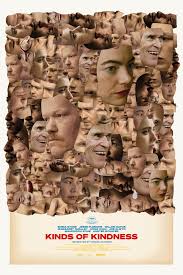
KINDS OF KINDNESS
US, 2024, 164 minutes, Colour.
Emma Stone, Jesse Plemons, William Dafoe, Margaret Qualley, Hong Chau, Joe Alwyn, Mamoudou Athie.
Directed by Yorgos Lanthimos.
Writer-directors, Yorgos Lanthimos, would probably agree that his perspective on life, especially in his earliest films, was “warped”. And, with Poor Things and Kinds of Kindness, that his sense of humour was also “warped”. His kinds of kindness are not exactly kind. Something more like “destructive kindnesses”.
This is a film containing three films linked by themes and linked by the actors. It is a cinematic triptych. Each panel of a triptych to be seen by itself, but also with its links to the other panels, combining for an overall view. And this seems to be what the director wants here, three stories, and a linking theme. Overall, it is a theme of coercive power. And that coercive power means extreme manipulation of victims, tyrannical domination mixed with power complacency, physical and mental cruelty and violence. But, with his warped sense of humour, the director also offers wry satire.
The contribution of a core cast enhances the impact of the drama/humour. Emma Stone has proven herself with two Oscars, appearing in the director’s The Favourite and winning her second Oscar for Poor Things. She shines as the principal character in the third story, a story of a pseudo-messianic cult, she has a divinity in search of a religious figure who has the power to raise people to life. The power of the cult dominates her and her companion in the search.
Jesse Plemons (in 2023 Killers of the Flower Moon, Civil War) won the Best Actor award at the 2024 Cannes film Festival. He shines in the first of the stories, a primly rather straightlaced yes-man to a controller who can only be described as wicked (Willem Dafoe who also appears in the three stories). In a moment of moral questioning, his morale collapses, made to feel even more dependent than before, commanded to kill someone. By contrast in the second film, he plays a police officer is anthropologist wife disappears, reappears, his moral and mental collapse as he determines that she is a double. And this part of the triptych also introduces the theme of cannibalism.
Each story shows the versatility of the characters and the talent of the rest of the cast, Dafoe, Margaret Qualley with four roles including twins, Hong Chau, Joe Alwyn and Mamoudou Athie.
So, after watching the three stories, the three panels of the triptych, the audience is left quite disturbed, moments of black humour, moments of horror, moments of disgust, some grim perspectives on the shallowness, the malice, the cruelty of human nature.
- The work of the director, perspectives, offbeat? Greek background? International career and outreach?
- The title, the tone, the issues? Irony, satire, absurdity? Black and bleak perspective?
- The film as a triptych, the one film, the three parts interconnecting: coercive power, manipulation and submission, aberrant behaviour, sex and violence, violent deaths?
- The work of the cast, in each story, different, appearance, accent, behaviour…?
- The first story: the focus on Robert, exact, controlled, look and clothes, diet, relationship with his wife,+? The encounters with Raymond, his personality, appearance, speaking, controlling, with Vivian as his companion, the meetings with Robert, the international business, the order to kill the victim, Robert’s failures, change of heart, anguish, changing eating habits, going to Raymond, rebuked and rejected by Raymond, the past encounters, sexual? The gifts of the sporting trophies, the gift of the racquet, Robert and his wife, valuing the trophies? The disappearance of the is one? The buyers and the possibilities of selling the trophies, the bargaining? Robert and his encounter with Rita, organising the date, her being in hospital, his discoveries at seeing Raymond, her being controlled, failing with the killing? His change of heart, going back to Raymond, and the vicious running over the victim? And his contentment in the threesome?
- The second story: Daniel, policeman, good service, friendship with Neil, the discussions, the meal, Neil and Martha, memories of Liz, the issue of the video, their watching, the shock of the group sex? Daniel, Liz surviving, the other members of the expedition dead? Hospital? His erratic behaviour, police work, the shooting of the passenger, licking the blood, being suspended? Neil trying to help? At home, the interactions with Liz, her behaviour, different? With her father, narrating the dream, dogs living as humans? Going to please Daniel, his withdrawing, not eating, asking her to cut off her finger, her cooking it, his giving it to the dog? Her frustration, his demanding the liver, her cutting it out? The alternate Liz, arriving, his embracing her??
- Third story: the background of the cult, the members, garb, the enclosure, the rituals? The leadership of Omi and his wife? Manner, style? Emily and Andrew, members of the cult? Emily and her control, going to the morgue, choosing the girl as able to raise the dead, the attendant, the corpse, her attempt a raise the dead, her desperation, rejected? Emily and Andrew, their travelling together, a speedy and reckless driving, the mission, searching for the special person who can raise the dead? Emily, her visits to her daughter, leaving the presence? The encounters with her husband, her daughter? The invitation to the meal, the drugs and headroom, his rape, her being rejected by the cult? Her growing desperation, the instructions by Omi and his wife? Her dream, drowning, the rescue? Rebecca, coming to the diner, the explanations? Emily, her decisions, pretending to have the dog, wounding it, Ruth as the vet, kindly? The next encounter, bugging Ruth, Rebecca satisfied, killing herself, going to the morgue, the dead body, Ruth – and the raising to life? Andrew and Emily reinstated?
- The mid-credits final sequence, the irony of the dead man raised to life, after being killed by Robert, raised by Ruth, and eating the sandwich and spilling the ketchup? Final ironies?
