Displaying items by tag: Richard Attenborough
Man Upstairs, The
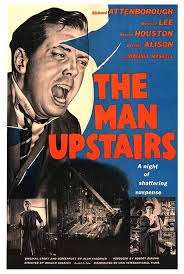
THE MAN UPSTAIRS
UK, 1958, 88 minutes, Black-and-white.
Richard Attenborough, Bernard Lee, Donald Houston, Dorothy Allison, Virginia Maskell, Kenneth Griffith, Patricia Jessel, Alfred Burke, Charles Houston, Maureen Connell, Walter Hudd.
Directed by Don Chaffey.
British 1950s psychological drama. There is an ensemble British cast led by Richard Attenborough, persuasive as a man who has been involved in an accident causing death which has taken its toll on him.
The action takes place over several hours in the early hours of the morning, the man upstairs waking, nightmares, upset, interacting with various members who live in the block of flats in London, attacking one, barricading himself in his room, the police arriving with strong, unsympathetic tactics (led by Bernard Lee), contrasting with the sympathetic wife and mother downstairs, Dorothy Alison, and different reactions from members of the household, especially the righteous Kenneth Griffith. Donald Huston plays a local counsellor who does get an opportunity to talk with the man upstairs but with little effect.
The action takes place within the block of flats, sometimes going outside to see the crowds, the police holding them back, the fire brigade arriving.
Some commentators have noted that this film came out just after the American 12 Angry Men, a drama in a room where members of the jury argue the different aspects of the case. Some bloggers have noted that they found the film tedious. Others, more sympathetic, will be interested in the character and experience of the man upstairs as well as the variety of responses to him.
- The title, the anonymity, the false name, the real name? Upstairs, the block of flats, the upstairs room, the stairs, the window, looking out to the street? Black and white photography?
- The British ensemble cast and its effectiveness?
- The situation, John Wilson/Peter Watson, waking, upset, in his room, there for three weeks, his bewildered reactions, the early hours of the morning? The encounter with the artist and his not helping? The encounter with Mr Pollen, hitting him and the reaction? The friendship with Mrs Barnes, helping her son with his homework? The continued trauma and bewilderment?
- The arrival of Helen, Mrs Barnes calling her, the story of the past, the accident, her brother’s death, the court case, the man’s outburst, his having a record?
- The gathering of those in the block, the harsh landlady, Dolly herself up, with Mr Pollen, the drinking, her harsh attitudes, cynical touches? The contrast with the elderly lady, frightened in her bed, brought downstairs? The artist, his work, his girlfriend present, trying to conceal her presence? Mr Pollen, fussy, civil defence, calling the police, backing the police? Mr Barnes arriving home after work? The range of people, the drama of their points of view, conflicts, final reactions, Mrs Barnes urging them all to go upstairs, Mr Pollen holding out, the going up the stairs?
- The arrival of the police, police attitudes, Thompson, his straightforward attitudes, harsh, unsympathetic to mental illness, doing his job? Intervening, the police going upstairs, the man pushing the policeman and his falling over the railing, to hospital? Thompson aggravated? The role of the other police, standing guard, guns, the arrival of the superintendent, the range of discussions, his decisions, Thompson disagreeing?
- Sanderson, his role in the borough, wanting to talk, Thompson’s lack of sympathy, the superintendent allowing him up, his attempts to talk, knocking, going in, the man’s reactions? Support with Mrs Barnes? The discussions with the superintendent?
- The fire brigade, the police, the teargas issue and its use?
- The light, into the room, the man upset, the suitcase on the window ledge, his pushing it over? The gun and the threats? With Sanderson and overcoming him?
- Mrs Barnes, urging, agreements and disagreements, the decision to go upstairs, her leadership, the meeting with the police? Her being allowed to go up, knocking, talking, the three minutes time limit, the man eventually coming out?
- The man, let downstairs, led away?
- The film of the 1950s, the role of the police, the role of mental illness, treatment, sympathy, harsh attitudes?
Father's Doing Fine
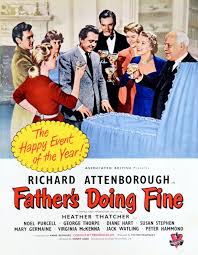
FATHER’S DOING FINE
UK, 1952, 83 minutes, Colour.
Heather Thatcher, Diane Hart, Virginia McKenna, Mary Germaine, Susan Stephen, Richard Attenborough, Peter Hammond, Jack Watling, Brian Worth, George Thorpe, Noel Purcell, Ambrosine Philtlpot's, Sidney James.
Directed by Henry Cass.
Very light entertainment, rather dated, interesting only as an example of the type of popular film from the UK in the early 1950s, a farce on screen, and performances by Heather Thatcher and Richard Attenborough.
The film is based on a play, Little Lambs Eat Ivy, by Noel Langley. It is a story of an upper-class British family woman on hard times, the busy mother led by Heather Thatcher in a sprightly, and often exasperated with her daughters, performance, the range of four daughters, the irritatingly adolescent and presumptuous would-be actress, Susan Stephen, the rather quiet Virginia McKenna before her more successful career, the very sensible Mary Germaine, and Diane Hart as the pregnant woman seen only in bed (and not looking particularly pregnant, especially when she gives birth to twins in one of the most rapid and quiet birth sequences).
The anxiety is in the character played by Richard Attenborough, her husband, not really doing fine at all, continually upset, finally finding a pal, drinking, and overwhelmed by the birth and the discovery of twins.
A range of British character actors play the various husbands and partners, George Thorpe is a sympathetic doctor, Noel Purcell is a roguish servant, Ambrosine Phillpotts as a harsh nurse and a cameo by Sid James as a taxi driver.
Observers comment that farce works much better on stage, audiences present to all the bumbling and falling, pratfalls and mistaken identities, embodied in the live performances. Unless particularly well crafted, farces look rather silly on screen.
Boys in Brown
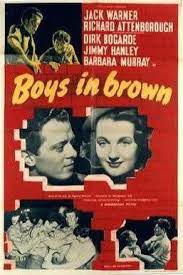
BOYS IN BROWN
UK, 1949, 85 minutes, Black-and-white.
Jack Warner, Richard Attenborough, Dirk Bogarde, Jimmy Hanley, Barbara Murray, Patrick Holt, Andrew Crawford, Thora Hird, Michael Medwin, Alfie Bass, Cyril Chamberlain.
Directed by Montgomery Tully.
Boys in Brown refers to the institution of the Borstal, not exactly a prison, but centres where boys and young men who have committed criminal offences are housed with the hope for rehabilitation and programs to assist this.
This is very much a film of the late 1940s, the post-war period, brief, in black and white, seasoned stars like Jack Warner (later with The Blue Lamp and his several hundred episodes of Dixon of Dock Green), Thora Hird, as well as up-and-coming actors like Richard Attenborough, Dirk Bogarde, Jimmy Hanley, Alfie Bass.
The focus here is on the character played by Richard Attenborough, a failed getaway attempt after a robbery, his going to the Borstal, trying to obey but entangled with some of those who are recalcitrant, wanting to escape. The most sinister is played by Dirk Bogarde, rather Machiavellian, something of a Iago and his sinister advice to Richard Attenborough and to bring him down.
There are emotional tangles, someone released (Jimmy Hanley) who visits the family, has a photo of the girlfriend (Barbara Murray) which Dirk Bogarde’s Iago uses to mislead Attenborough and to involve him in the escape. It comes to something of a melodramatic head with the escape and an attack on one of the staff.
This was an original play by actor in so many British films, Reginald Beckwith. Montgomery Tully was a director of this kind of film from the 40s to the 60s.
- Title? Criminal offences, the Borstal situation, prison/rehabilitation, the role of the authorities, the programs? Written in the 1940s?
- British film of the 1940s, the cast and their careers, Jack Warner and his status, black-and-white photography, issues? Social concern?
- The focus on Jackie, his background, easily led, his relationship with his mother, getaway driver, failure of the car, his being chased, arrested, the sentence, Borstal? Richard Attenborough and his performance on screen presence? His intention to serve at the time? The group, entering, the speeches, the Gov and his support? The mixed reaction of the group? Encounter with Alfie and his influence?
- Life of the Borstal, work, interactions, friendships, antipathy is? Theatre, rehearsals, Alfie and his performance? Labour?
- The group, planning the escape, Jackie not wanting to be part, their pressure on him, Alfie and his Machiavellian manipulation of Jackie?
- Jackie, the background, the friendship with Kitty, the photos, her visit? Jackie’s mother and his allowing her to come?
- Bill, serving his time, his background, intentions, leaving, the Borstal is part of the record, difficulty in getting a job, being targeted? Meeting Kitty, the attraction, the dance? Bill being caught up, the return, the photo with Kitty, Alfie and his manipulation, Jack and his motivations, forced to join the group?
- The plan, the escape, the confrontation with the member of staff, the violence, Jackie and his reaction, the man taken to hospital, the escape, everybody captured?
- The meeting with the governor and the authorities, his reaction, speeches, the recalcitrant Casey, Alfie being exposed, Jackie and his revolution to finish his sentence?
